

Plain kratom leaf has a natural ceiling: to take more mitragynine, you have to swallow more bitter powder, and nausea usually stops people before things get extreme. Kratom extracts remove that ceiling. By concentrating the leaf’s alkaloids, they deliver in a few drops, a small capsule or a 2 oz shot what would take a large pile of powder.
That convenience comes with real risks. This guide explains how extracts are made, what potency labels mean, how they compare with leaf and what to look for if you encounter them.
Key takeaways
- Extracts concentrate kratom alkaloids, mainly mitragynine, using water, alcohol or other solvents.
- Labels like “15x” or “50% MIT” describe concentration, but they’re often inconsistent or unverifiable.
- Extracts are associated with faster tolerance, stronger dependence and more severe withdrawal than leaf.
- Some “extracts” are spiked with 7-OH, which is far more potent at opioid receptors.
- Always check mg of mitragynine (and 7-OH) per serving on a batch-matched lab report.
How kratom extracts are made
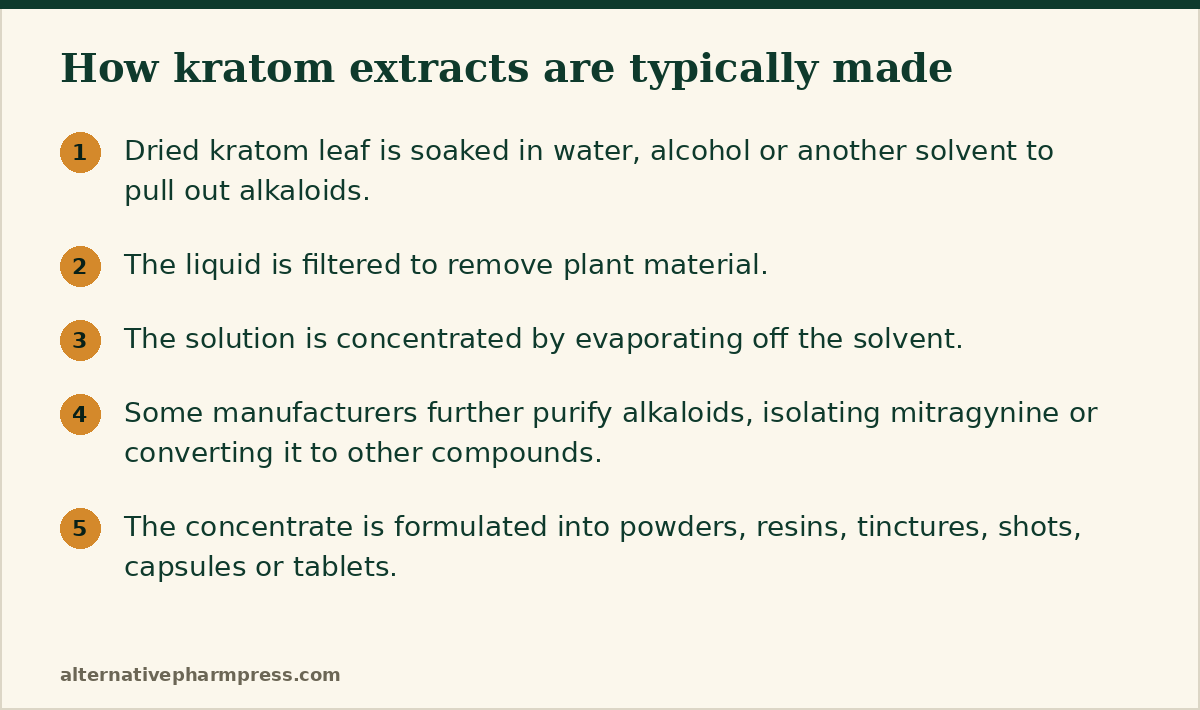
Extraction methods vary widely:
- Water extracts resemble a concentrated tea and are the closest to traditional preparation.
- Alcohol extracts pull more alkaloids and are common in tinctures.
- Full-spectrum extracts (FSE) aim to keep a broad range of alkaloids.
- Purified alkaloid extracts isolate mitragynine at high concentrations, sometimes 40–90%+.
- Semi-synthetic products convert mitragynine into 7-OH or related compounds — these are no longer simple “extracts.”
Understanding potency labels

The most useful number is milligrams of mitragynine per serving, backed by a lab report. For comparison:
- 1 g of typical leaf contains about 10–20 mg of mitragynine.
- A leaf “serving” of 3 g might contain 30–60 mg.
- An extract shot or capsule can contain 50–150 mg or more in a single serving.
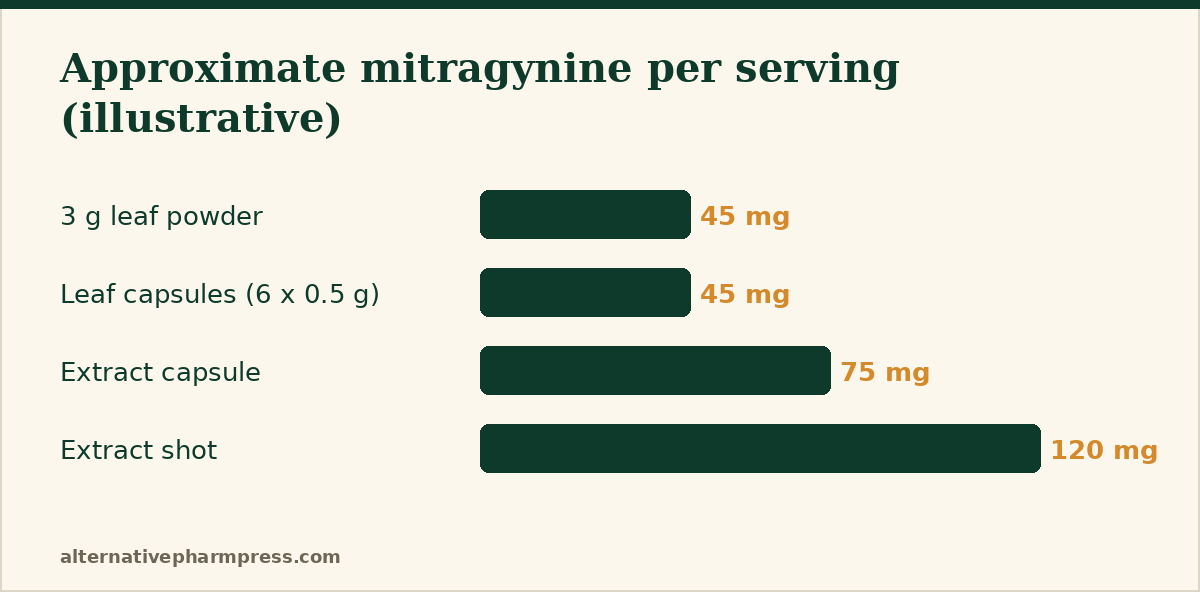
These are illustrative ranges; real products vary widely. Always rely on the product’s lab report.
Extract vs leaf: how risks compare
| Factor | Leaf powder or capsules | Extracts |
|---|---|---|
| Potency per gram | Lower | Much higher |
| Natural “brake” (nausea before overdose) | Stronger | Weaker |
| Tolerance and dependence | Develops with daily use | Develops faster |
| Withdrawal severity | Mild to moderate for many | Often more severe |
| Dosing errors | Easier to avoid with a scale | Easy to overshoot |
| 7-OH adulteration risk | Low with reputable vendors | Higher in “enhanced” products |
People who move from leaf to extracts frequently report needing more and more, and finding it harder to stop. Kratom withdrawal from extract use can resemble mild-to-moderate opioid withdrawal. Read kratom withdrawal, how kratom tolerance develops and Suboxone for kratom withdrawal.
The 7-OH problem
Some products sold as “kratom extract” contain 7-hydroxymitragynine (7-OH) at levels far above anything found in natural leaf. 7-OH is a potent opioid receptor agonist, and concentrated 7-OH products have been linked to rapid dependence and poison center calls. Regulators have moved to restrict or schedule 7-OH. If a product’s alkaloid panel shows elevated 7-OH — or doesn’t list it at all — be cautious. See what is 7-OH, 7-OH vs traditional kratom and mitragynine vs 7-hydroxymitragynine.
Safety considerations specific to extracts
- Drug interactions are more consequential at higher doses: avoid combining with opioids, benzodiazepines, alcohol, gabapentin and other sedatives. See kratom and alcohol.
- Liver injury reports often involve higher doses or concentrated products. See kratom liver injury.
- Overdose risk rises with concentrated products, particularly when combined with other depressants. See can you overdose on kratom?
- Seizures have been reported with high-dose kratom use in case reports.
If someone becomes very drowsy, confused or has slowed breathing after using a kratom extract, call 911. Naloxone (Narcan) may help if 7-OH or other opioids are involved.
How to read an extract label and COA
- Mitragynine per serving in mg, and the number of servings per container.
- 7-OH content — should be at trace levels if the product is meant to reflect natural leaf.
- Other alkaloids (paynantheine, speciogynine, speciociliatine) for full-spectrum claims.
- Residual solvents — ethanol, acetone or others used in extraction.
- Heavy metals and microbes.
- Batch number that matches, from an accredited third-party lab.
Our guides to reading a kratom lab report and kratom COA red flags walk through real examples.
Legal status of kratom extracts
Kratom Consumer Protection Acts in several states regulate extracts specifically — for example, by requiring labeling of alkaloid content, limiting 7-OH as a share of total alkaloids, banning synthetic alkaloids or restricting sales to adults 21+. Some states ban kratom entirely. Check kratom laws by state and the KCPA explainer.
Who should avoid extracts
- Anyone new to kratom
- People with a history of opioid or other substance use disorder
- People taking sedating medications or with liver disease
- Anyone pregnant or breastfeeding
- Anyone who has noticed escalating use of leaf kratom
If you’re already using extracts and want to cut back, talk to a clinician. Tapering under medical guidance, and sometimes medications used for opioid withdrawal, can make it much more manageable.
If you choose to use kratom at all
Plain, lab-tested leaf from a compliant vendor carries lower risk than extracts. See what kratom is used for, kratom powder guide and best kratom brands.
Why extracts change the experience
Users who switch from leaf to extracts often describe effects that feel more opioid-like: stronger euphoria, heavier sedation, more itching and constipation. Part of this is simply dose — extracts make it easy to take two or three times as much mitragynine as you would from leaf. Part may be the altered alkaloid balance: purified extracts concentrate mitragynine while dropping many of the minor alkaloids present in whole leaf, and some products contain more 7-OH. The result can feel quite different from traditional use, which is one reason many long-time leaf users avoid extracts entirely.
Extracts and tapering
Ironically, some people who are trying to quit kratom use extracts during tapers because they’re compact. That approach can backfire: extract doses are harder to reduce in small, precise steps, and potency varies between products. People who taper successfully usually switch to a single, consistent, lab-tested leaf product, weigh each dose and reduce gradually — ideally with medical support. If withdrawal is severe, buprenorphine-based treatment prescribed by a clinician can help.
Extract formats you may see
- Liquid shots — small bottles (often 1–2 oz) designed to be drunk at once. Often the strongest single-serving products on shelves. See kratom drinks explained.
- Tinctures — alcohol-based liquids dosed by dropper. Easy to measure in theory, but a small dropper of a concentrated tincture can be a large dose.
- Resins and pastes — sticky, dark concentrates sold by weight; very hard to dose accurately without a milligram scale.
- Extract powders — concentrated powders that look like leaf but are far stronger by weight. Mixing them up with leaf is a common cause of accidental overdosing.
- Capsules and tablets — extract or “enhanced” capsules, some combining leaf and extract. See kratom capsules guide.
- Gummies — increasingly common, sometimes containing 7-OH.
Questions to ask before buying any extract
- What’s the exact milligram amount of mitragynine per serving? If the seller can’t tell you, don’t buy.
- Is 7-OH present, and at what level? Ask for the full alkaloid panel.
- What solvent was used, and was the finished product tested for residual solvents?
- Is the product compliant with my state’s kratom law? Many states regulate extracts specifically.
- Who tested it? The lab should be independent and accredited, and the COA should match the batch.
Why “natural” extracts can still be dangerous
Even extracts made only from kratom leaf with water can be risky, because the issue is dose, not origin. Concentrating any plant’s active compounds changes its safety profile. Coffee is a useful comparison: a cup of coffee is safe for most people, but concentrated caffeine powder has caused fatal overdoses because a teaspoon contains the equivalent of dozens of cups. Kratom extracts follow the same logic.
FAQ
Are kratom extracts stronger than leaf?
Yes. Extracts concentrate alkaloids, delivering much more mitragynine per serving than leaf powder or capsules.
What does “50x kratom extract” mean?
It claims the leaf was concentrated 50 times, but there’s no standard definition. Milligrams of mitragynine per serving on a lab report are more meaningful.
Are kratom extracts more addictive?
They’re associated with faster tolerance, stronger dependence and more severe withdrawal than leaf, largely because of higher doses.
Do kratom extracts contain 7-OH?
Some do, especially “enhanced” products. Check the lab report for 7-hydroxymitragynine content.
Are kratom extracts legal?
Rules vary by state. Some states regulate extracts and 7-OH content specifically, and some ban kratom entirely.
Is full-spectrum kratom extract safer than isolated mitragynine?
Full-spectrum extracts keep more of the leaf’s minor alkaloids, which some people prefer, but both are concentrated products with higher dependence risk than leaf. Dose matters more than the label.
Can kratom extracts be dosed accurately?
Only if the label lists milligrams per serving and a matching lab report confirms it. Resins, pastes and loose extract powders are especially hard to measure accurately at home.