

A few years ago, kratom in the US mostly meant green powder in a bag. Today you can buy kratom drinks: fizzy seltzers in sleek cans, fruity “botanical” beverages, tiny concentrated shots by the register and freshly brewed kratom tea at kava bars. The category is one of the fastest-growing in the alternative wellness market.
But “kratom drink” covers products that differ enormously in strength. A can of lightly dosed seltzer and a 2 oz extract shot may both say kratom on the label while delivering wildly different amounts of alkaloids. This guide explains the main types of kratom drink, how to read their labels and how to stay safe.
Key takeaways
- Kratom drinks range from brewed leaf tea to canned beverages and concentrated extract shots.
- Strength depends on milligrams of mitragynine (and any 7-OH) per serving — not the volume of liquid.
- Shots are usually far stronger than teas or seltzers and are a common source of bad experiences.
- Check labels for alkaloid content per container, serving count and 7-OH.
- Don’t mix kratom drinks with alcohol, sedatives or other opioids.
Why kratom drinks are booming
There are a few reasons drinks have taken off:
- Taste. Kratom powder is famously bitter. Flavored drinks mask it.
- Convenience. No measuring, mixing or “toss and wash.”
- Social use. Kava bars and “sober bars” serve kratom as an alcohol alternative.
- Retail distribution. Cans and shots fit neatly into convenience store coolers and counters.
Traditional use in Southeast Asia often involved brewing fresh or dried leaves into tea, so drinking kratom isn’t new — but the modern, packaged versions are very different from a village brew.
The main types of kratom drinks
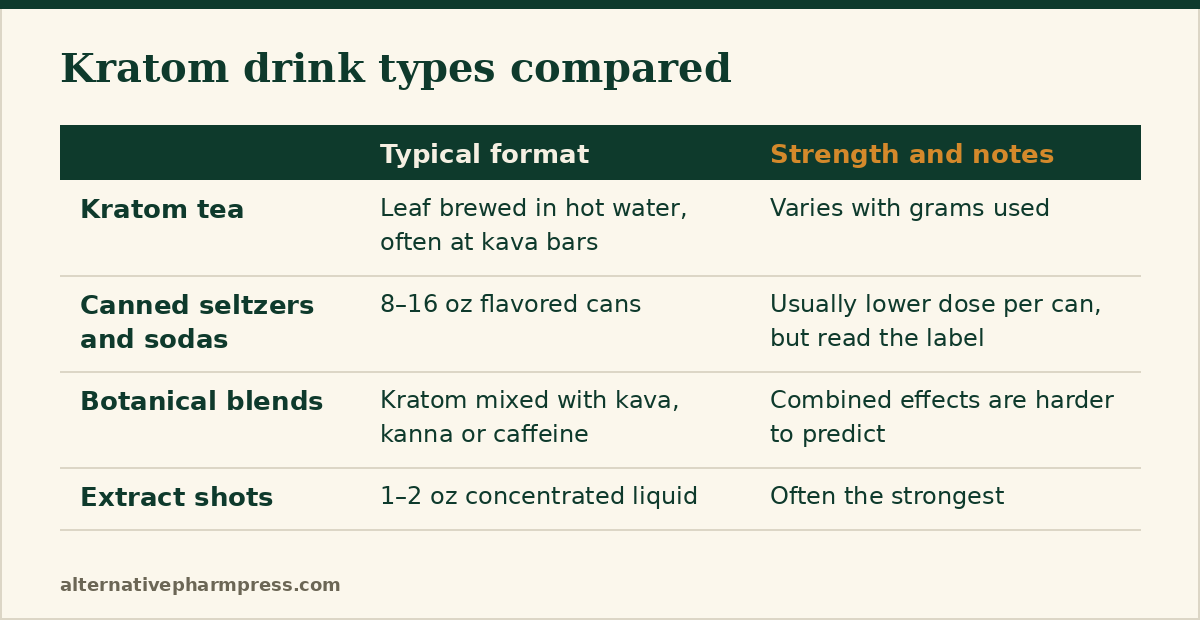
Kratom tea
Kratom tea is made by simmering leaf powder in hot water (sometimes with lemon juice, which some believe improves extraction), then straining. It’s the most traditional preparation. Strength depends entirely on how much leaf is used. Kava bars commonly serve kratom tea by the cup — ask how many grams of leaf go into each serving.
Canned kratom beverages and seltzers
These ready-to-drink products usually contain kratom leaf extract dissolved in carbonated or still water with flavorings. Many list milligrams of mitragynine per can. Some are relatively low-dose and pitched as a sessionable “social” drink; others are quite strong.
Kratom shots
Shots are small (often 1–2 oz) bottles of concentrated kratom extract. Because they pack a large dose into a small volume, they’re designed to be taken at once. Shots are frequently implicated in unpleasant experiences — nausea, vomiting, heavy sedation — especially among new users who treat them like an energy shot. Some shots also contain 7-OH, which is far more potent at opioid receptors. Read what 7-OH is before buying any concentrated product.
Botanical blends
Some drinks combine kratom with kava, kanna, caffeine or adaptogens. Combining multiple active botanicals makes effects harder to predict and can increase side effects. If you’re curious about these plants on their own, see what is kava and kratom vs kanna.
How strong is a kratom drink? Read the milligrams
The single most useful number on a kratom drink label is milligrams of mitragynine per serving (and per container). As a rough reference, a gram of typical kratom leaf powder contains around 10–20 mg of mitragynine, depending on the batch.
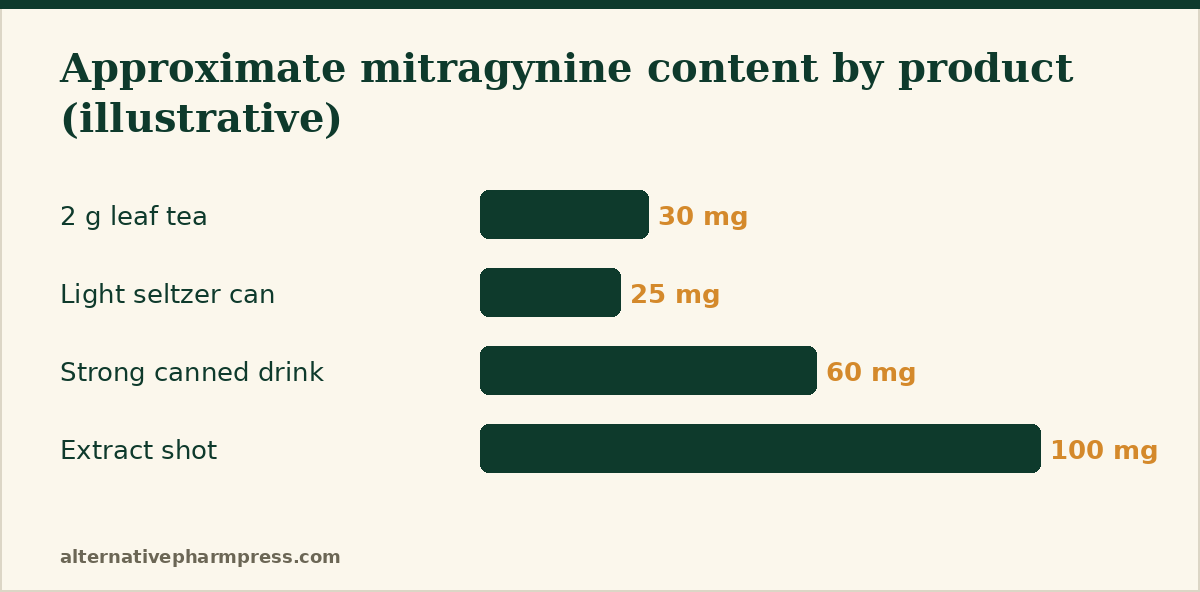
These figures are illustrative. Real products vary widely — always check the label and the lab report.
Label red flags
- No alkaloid content listed — you have no idea what dose you’re taking.
- “Proprietary blend” with no milligrams per ingredient.
- Multiple servings per bottle for a product clearly designed to be drunk at once.
- 7-OH listed or implied (“enhanced,” “plus,” “max,” “extra strength”).
- No batch number or QR code linking to a third-party certificate of analysis.
- Health claims such as treating pain, anxiety or opioid withdrawal — these are not legal claims for supplements and suggest a non-compliant seller.
Our guides to reading a kratom lab report and kratom COA red flags show what a trustworthy COA looks like.
What do kratom drinks feel like?
Effects follow the same dose-dependent pattern as other kratom products: lower doses tend to feel stimulating and sociable, while higher doses feel sedating and more opioid-like. Liquid forms may kick in slightly faster than capsules — often within 15–30 minutes — because there’s no capsule to dissolve. Our main guide to what kratom is used for covers the dose-effect relationship in detail.
Safety tips for kratom drinks
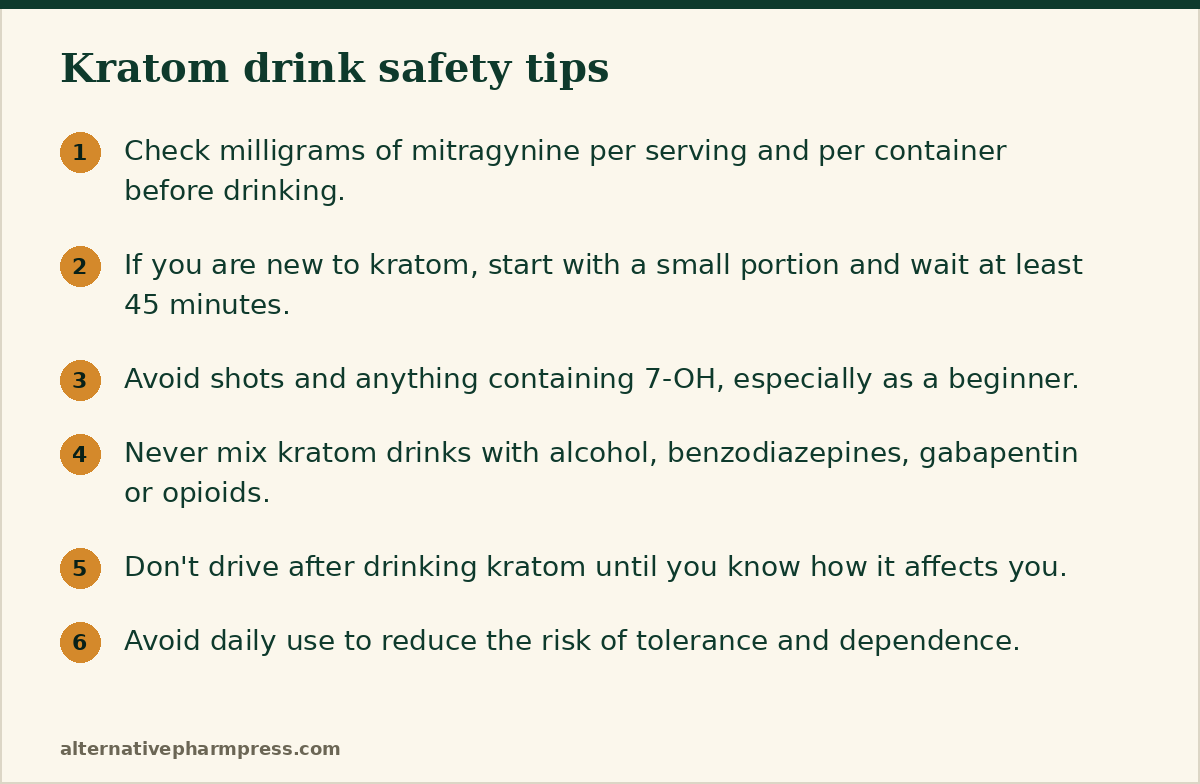
Additional points worth knowing:
- Hydration and nausea. Kratom can cause nausea and constipation, and drinking on an empty stomach makes nausea more likely.
- Caffeine combinations. Kratom energy drinks with added caffeine can raise heart rate and blood pressure.
- Alcohol. Combining kratom with alcohol increases sedation and the risk of serious harm. Read kratom and alcohol.
- Dependence. Regular daily kratom drinking can lead to tolerance and withdrawal. See how kratom tolerance develops and kratom withdrawal.
- Liver. Rare liver injury has been reported with kratom; see kratom and liver injury.
Who should avoid kratom drinks
Kratom drinks aren’t a good idea for everyone. Skip them if you:
- Are pregnant or breastfeeding. Babies exposed to kratom before birth have shown withdrawal symptoms after delivery.
- Take opioids, benzodiazepines, sleep aids, gabapentin or pregabalin. These combinations increase the risk of dangerous sedation.
- Have liver disease or a history of drug-induced liver problems.
- Have a history of substance use disorder. Kratom’s opioid-receptor activity can trigger cravings or a return to use.
- Have heart rhythm problems or high blood pressure, particularly with caffeinated kratom energy drinks.
- Are under 21. Most states that regulate kratom set a minimum age of 21, and adolescents are more vulnerable to dependence.
If you’re on any prescription medication, a pharmacist can check for interactions in a couple of minutes.
Shelf life and storage
Ready-to-drink kratom beverages usually carry a best-by date of several months. Once opened, treat them like juice: refrigerate and finish within a day or two. Alkaloids can degrade with heat and light, so avoid leaving cans in a hot car. Home-brewed tea is best consumed fresh. Store everything out of reach of children, who can be seriously harmed by even small amounts.
Are kratom drinks legal?
Kratom drinks follow kratom’s legal status, which varies by state and sometimes by city. Some states with Kratom Consumer Protection Acts restrict sales to adults (usually 21+), require labeling and limit 7-OH content. A few states ban kratom entirely, and 7-OH products face additional restrictions. Check our kratom laws by state index and the KCPA explainer before buying or traveling.
How to make kratom tea at home
If you prefer to control your dose, brewing tea from measured leaf powder is the most predictable option:
- Weigh your leaf powder with a digital scale rather than using spoons.
- Add it to about 1–2 cups of water and simmer gently (not a rolling boil) for 15–20 minutes.
- Strain through a fine mesh or coffee filter.
- Add honey, lemon or juice to cut the bitterness.
- Drink slowly and wait before considering more.
Brewed tea can be refrigerated for a day or two. Label it clearly so nobody drinks it by accident, and keep it away from children and pets.
Kratom drinks at kava bars: what to ask
Kava bars and “sober bars” often serve kratom alongside kava. If you’re ordering there, it’s reasonable to ask:
- How many grams of leaf (or milligrams of mitragynine) are in one cup? A good bar will know.
- Is it plain leaf or an extract? Extract-based drinks are stronger.
- Does anything on the menu contain 7-OH? Some bars have stopped serving it entirely; others haven’t.
- Is it mixed with kava or anything else? Combinations change the experience.
Pace yourself the same way you would with alcohol: one drink, wait, then decide. And don’t drive afterwards.
Kratom drinks vs other kratom formats
| Format | Dosing precision | Taste | Typical strength |
|---|---|---|---|
| Leaf powder | Good if weighed | Bitter | Moderate |
| Capsules | Moderate (capsule fill varies) | None | Moderate |
| Brewed tea | Good if leaf is weighed | Mild to bitter | Moderate |
| Canned drinks | Depends on label accuracy | Pleasant | Low to moderate |
| Extract shots | Depends on label accuracy | Often strong | High |
For a deeper look at capsules and powder, see kratom capsules vs powder, and for vetted vendors see best kratom brands.
FAQ
What is a kratom drink?
A kratom drink is any beverage containing kratom leaf or extract — from traditional brewed tea to canned seltzers and concentrated shots.
Are kratom shots stronger than kratom tea?
Usually, yes. Shots typically contain concentrated extract and deliver a large dose in a small volume. Always check the milligrams of mitragynine on the label.
How long does a kratom drink take to kick in?
Most people notice effects within 15–30 minutes, with effects lasting a few hours depending on dose.
Can you drink kratom with alcohol?
It’s not recommended. Combining kratom and alcohol increases sedation and the risk of serious harm.
Do kratom drinks contain 7-OH?
Some do. Check the label and lab report for 7-hydroxymitragynine, and avoid products that list it or hide alkaloid content.
What are kratom drinks?
Kratom drinks include traditional leaf teas and newer bottled "kratom shots" and seltzers. Shots can be far more concentrated than tea, and some contain added 7-OH, so check labels and lab reports.
Is kratom addictive?
It can be. Regular daily use can cause physical dependence, tolerance and withdrawal symptoms when stopping. Concentrated 7-OH products appear to carry a higher risk than plain leaf.