
Kratom (Mitragyna speciosa) is a tropical tree in the coffee family, native to Thailand, Malaysia, Indonesia and Papua New Guinea. For generations, farm workers in Southeast Asia chewed fresh leaves or brewed them as tea to push through long days in the heat. Today, millions of Americans buy kratom as powder, capsules, extracts and ready-to-drink shots — and the question we hear most often is simple: what is kratom used for?
The short answer is that people use kratom for energy, pain, mood and, increasingly, to manage opioid withdrawal. The longer answer is more complicated, because kratom’s effects change dramatically with dose, product type and the person taking it — and because the scientific evidence is still thin compared with how widely the plant is used.
Key takeaways
- Most people use kratom for pain relief, energy, mood or easing opioid withdrawal, according to large US surveys.
- Low doses tend to feel stimulating; higher doses tend to feel sedating and opioid-like.
- Kratom is not FDA-approved for any medical use, and research in humans is mostly surveys and case reports.
- Risks include dependence, withdrawal, liver injury and dangerous drug interactions — especially with concentrated extracts and 7-OH products.
What kratom is (and why it acts the way it does)
Kratom leaves contain more than 40 alkaloids. Two matter most:
- Mitragynine — the main alkaloid, typically 1–2% of dried leaf. It is a partial agonist at the mu-opioid receptor and also acts on adrenergic and serotonin receptors.
- 7-hydroxymitragynine (7-OH) — present only in trace amounts in natural leaf, but many times more potent at opioid receptors. Some modern products are spiked with concentrated 7-OH, which changes the risk profile completely. (Read our explainer on 7-OH vs traditional kratom.)
Because mitragynine hits several receptor systems at once, kratom does not behave like a single “drug class.” That is why the same plant can feel like strong coffee at one dose and like a mild painkiller at another. We cover the receptor science in depth in kratom and the opioid receptor.
The most common reasons people use kratom
Several large surveys of American kratom users — including work by researchers at Johns Hopkins and the University of Florida — paint a consistent picture of why people use it.
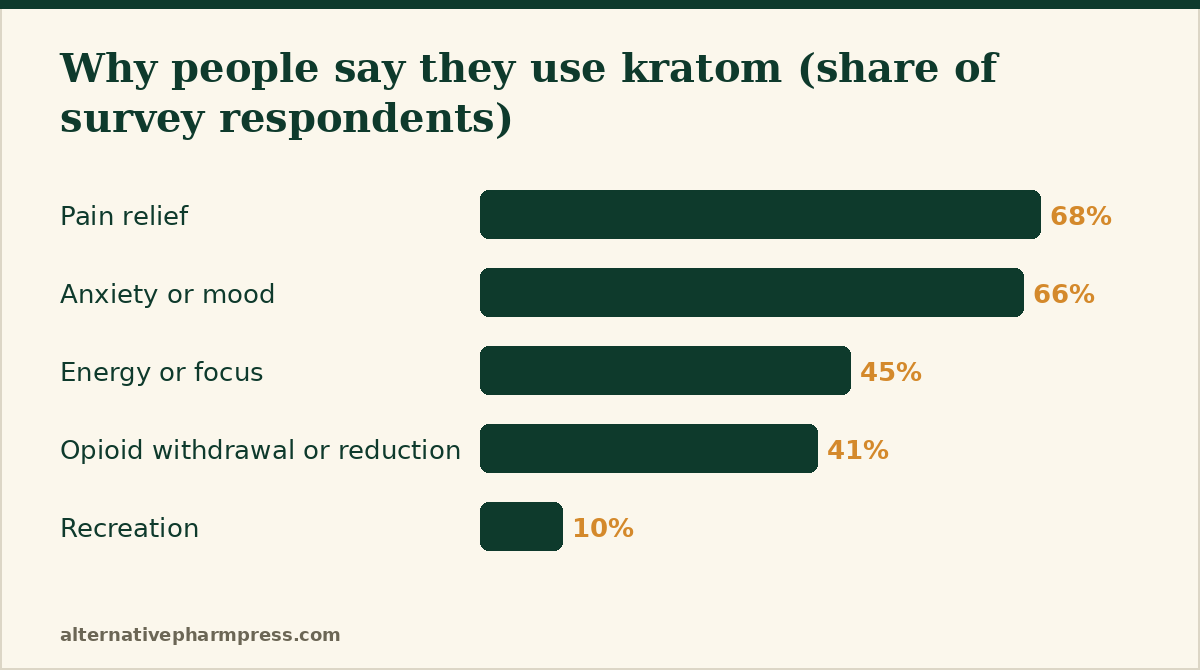
Figures above are rounded and approximate, drawn from published US user surveys; respondents could choose more than one reason.
1. Pain
Pain is the most frequently reported reason. People describe using kratom for back pain, arthritis, fibromyalgia and injury-related pain. Mitragynine’s partial opioid activity offers a plausible mechanism, and animal studies show pain-reducing effects. However, there are no completed large randomized controlled trials in humans proving kratom works for chronic pain, so it is not a substitute for a pain management plan built with a clinician.
2. Mood and anxiety
Many users report feeling calmer, more sociable or less anxious. This likely reflects a mix of opioid, adrenergic and serotonergic effects. The catch: daily use for mood can quietly build tolerance, and stopping can produce rebound anxiety and irritability — part of the kratom withdrawal picture.
3. Energy and focus
At low doses kratom acts more like a stimulant. This is the traditional use in Southeast Asia, where workers chewed a few fresh leaves to fight fatigue. Some people use it as a coffee replacement. It is worth knowing that kratom and caffeine stacked together can raise heart rate and blood pressure.
4. Easing opioid withdrawal
A significant share of users say they turned to kratom to cut down on or quit prescription opioids or heroin. Researchers take this seriously — it is one reason federal agencies have funded kratom studies — but it is also a reason for caution. Kratom itself can cause dependence, and swapping one dependence for another without medical support is risky. Proven treatments for opioid use disorder, such as buprenorphine and methadone, remain the standard of care. Our article on Suboxone for kratom withdrawal explains how clinicians approach it.
5. Recreation
A smaller group uses kratom recreationally for its mild euphoria. Higher doses are more likely to cause nausea, dizziness and sedation than a pleasant “high,” which tends to limit this use — though concentrated extracts and 7-OH products have changed that calculation.
How dose changes what kratom does
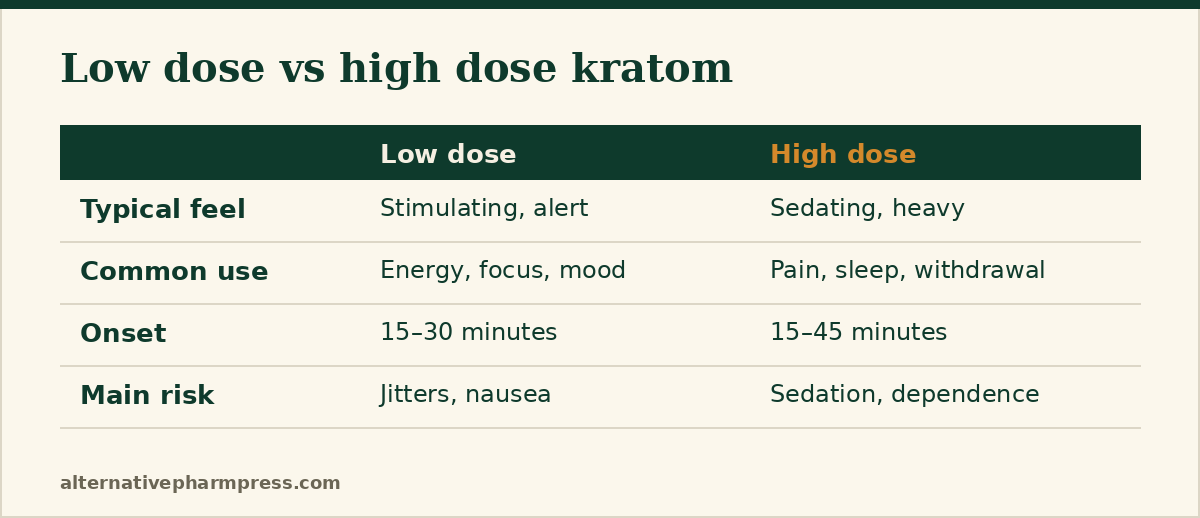
Dose is the single biggest factor in kratom’s effects. The table below summarises what users and researchers typically describe for plain leaf powder. Extracts, shots and 7-OH products are far stronger by weight and do not follow this table.
| Dose of leaf powder | Commonly reported effects | Main concerns |
|---|---|---|
| Low (about 1–3 g) | Alertness, sociability, mild energy | Jitteriness, stomach upset |
| Moderate (about 3–5 g) | Mixed: some energy, some pain relief and calm | Nausea, constipation, dizziness |
| High (5 g and up) | Sedation, stronger pain relief, opioid-like effects | Vomiting, heavy sedation, faster tolerance and dependence |
These ranges are descriptive, not recommendations. Body weight, tolerance, strain, product potency and other substances all shift the picture. Our kratom capsules vs powder guide explains why capsule counts are an unreliable way to estimate grams.
Strains and “colors”: do they change the use?
Vendors sell kratom as red, green and white “vein” strains and often market each for a specific purpose — white for energy, red for relaxation, green somewhere in between. There is some logic to it: harvest time and drying methods can shift the alkaloid balance. But lab testing shows that alkaloid content varies more between batches and vendors than between colors. Treat strain marketing as a loose guide, not a prescription. See red vs white kratom and green Malay vs green Maeng Da for side-by-side breakdowns.
What the research actually supports
Here is where honesty matters. Kratom research has grown fast, but most of it falls into three buckets:
- Surveys of users — useful for understanding why people use kratom, but they cannot prove it works or is safe.
- Animal and lab studies — they explain how mitragynine acts on receptors, but results don’t always translate to humans.
- Case reports — individual reports of harm (liver injury, seizures, deaths involving multiple substances) that flag risks but don’t tell us how common they are.
A handful of small human clinical studies have looked at pain tolerance and pharmacokinetics, and larger NIH-funded trials are under way. Until they report, the fair summary is: kratom has plausible effects with real-world popularity, but no proven medical use. The FDA has not approved kratom for any condition and has repeatedly warned consumers about it.
Risks you should know before using kratom
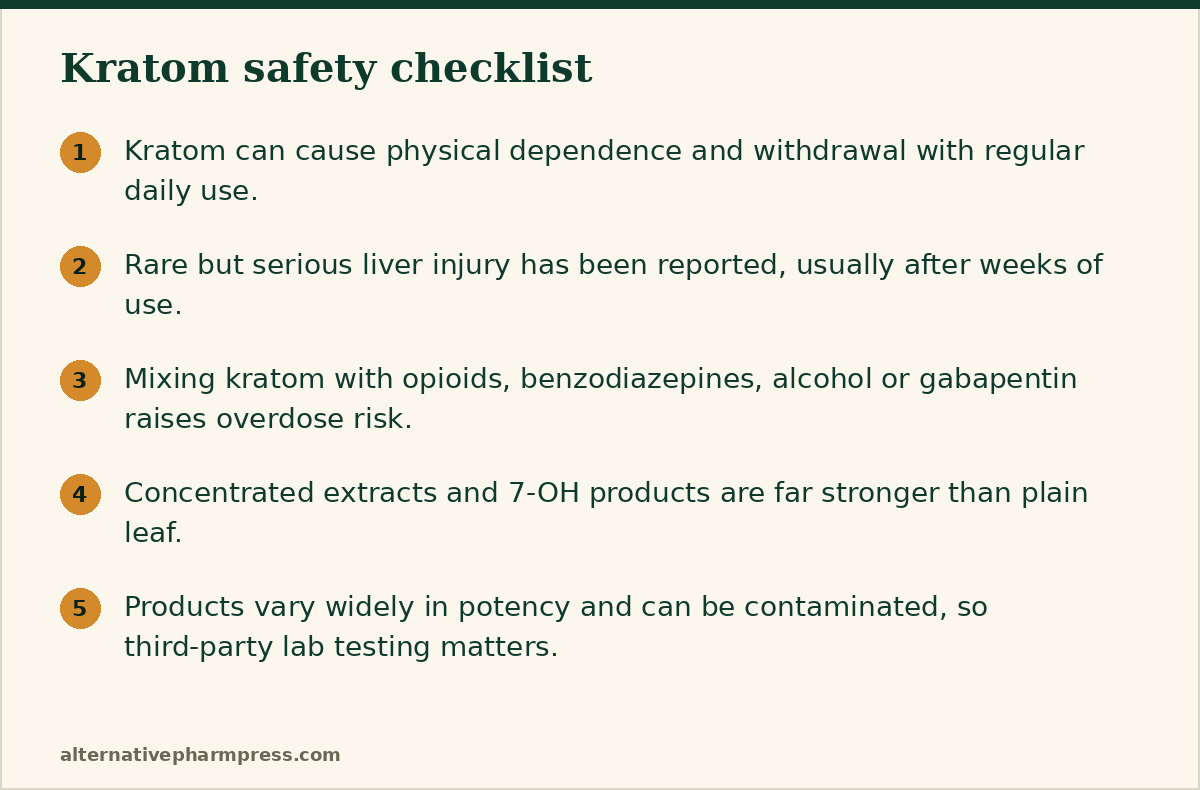
- Dependence and withdrawal. Daily users can develop tolerance and experience withdrawal — irritability, aches, sleep problems, cravings — when they stop. Our kratom withdrawal guide covers timelines.
- Liver injury. Uncommon, but documented. Read kratom and liver injury for the warning signs.
- Interactions. Combining kratom with other depressants is the main factor in serious poisonings. See kratom and alcohol.
- Overdose. Deaths involving kratom almost always involve other substances, but high doses of concentrated products are a real concern. See can you overdose on kratom?
- Drug tests. Standard panels don’t detect mitragynine, but specialised tests do. Details in does kratom show up on a drug test?
- Contamination. The FDA has recalled kratom products for salmonella and heavy metals. Learn the kratom COA red flags before you buy.
Pregnant or breastfeeding? Newborns exposed to kratom in the womb have shown withdrawal symptoms. Avoid kratom and talk to your doctor.
Is kratom legal?
Kratom is legal at the federal level in the US, but several states — including Alabama, Arkansas, Indiana, Rhode Island, Vermont and Wisconsin — ban it, and a growing number of cities and counties do too. Other states regulate it through a Kratom Consumer Protection Act, which sets age limits and labeling rules. Laws are changing quickly, especially around 7-OH products. Check our kratom laws by state index before you buy or travel.
How to choose a safer kratom product
If you decide to use kratom, a few habits reduce risk:
- Buy from vendors who publish batch-specific third-party lab reports covering alkaloids, heavy metals and microbes.
- Prefer plain leaf over concentrated extracts or products listing 7-OH.
- Start low, avoid daily use, and never combine with other depressants.
- Read our best kratom brands roundup, which only includes brands with verifiable lab testing, and our guide to signs a brand is third-party tested.
FAQ
What is kratom mainly used for?
Surveys show people mainly use kratom for pain relief, mood or anxiety, energy, and to reduce or manage opioid withdrawal. None of these uses are FDA-approved.
Is kratom a stimulant or a depressant?
Both, depending on dose. Low doses tend to feel stimulating, while higher doses feel sedating and opioid-like.
How long do kratom effects last?
Effects from plain leaf usually begin within 15–45 minutes and last roughly two to five hours, depending on dose and product.
Is kratom an opioid?
Kratom is not a classical opioid drug, but its main alkaloid, mitragynine, partially activates opioid receptors. That is why it can cause dependence and withdrawal.
Can kratom help with opioid withdrawal?
Many users report that it does, but kratom can cause its own dependence. Evidence-based treatments such as buprenorphine or methadone, supervised by a clinician, are safer and better studied.
Is kratom addictive?
It can be. Regular daily use can cause physical dependence, tolerance and withdrawal symptoms when stopping. Concentrated 7-OH products appear to carry a higher risk than plain leaf.