
Kava is a drink made from the root of Piper methysticum, a pepper plant native to the islands of the South Pacific. In Fiji, Vanuatu, Tonga, Samoa and Hawai’i it has been shared for centuries at ceremonies, village meetings and evenings with friends. It produces a calm, sociable, slightly numbing feeling — relaxation without the drunkenness of alcohol.
Over the past decade kava has gone mainstream in the US. There are now hundreds of kava bars, canned kava drinks in grocery fridges and kava capsules marketed for stress. So what is kava, what does it actually do, and is it safe? This guide covers the basics, the evidence and the risks.
Key takeaways
- Kava is a ground root traditionally mixed with water and strained; its active compounds are called kavalactones.
- Effects are relaxing and sociable, with clear-headedness at normal doses and numb lips and tongue on contact.
- The biggest safety question is liver injury, which appears linked mainly to poor-quality root, solvent extracts and heavy use.
- Kava is not the same as kratom — different plant, different chemistry, different risks.
Where kava comes from
Kava is a shrub grown mainly in Vanuatu, Fiji, Tonga, Samoa and Hawai’i. Farmers usually wait three to five years before harvesting, because older roots contain more active compounds. The roots and lower stems (“basal stems”) are washed, dried and ground. To prepare traditional kava, the powder is kneaded in water inside a cloth bag, then the muddy, earthy liquid is squeezed into a bowl and served in coconut shells.
Ceremony and community are central to kava culture. In Fiji, a kava session (“talanoa”) is where news is shared and disputes are settled. Many Pacific Islanders view kava as food, medicine and social glue all at once — context that matters when the drink is repackaged as a Western wellness product.
What’s in kava: kavalactones
Kava’s effects come from a group of compounds called kavalactones. Six of them make up most of the activity:
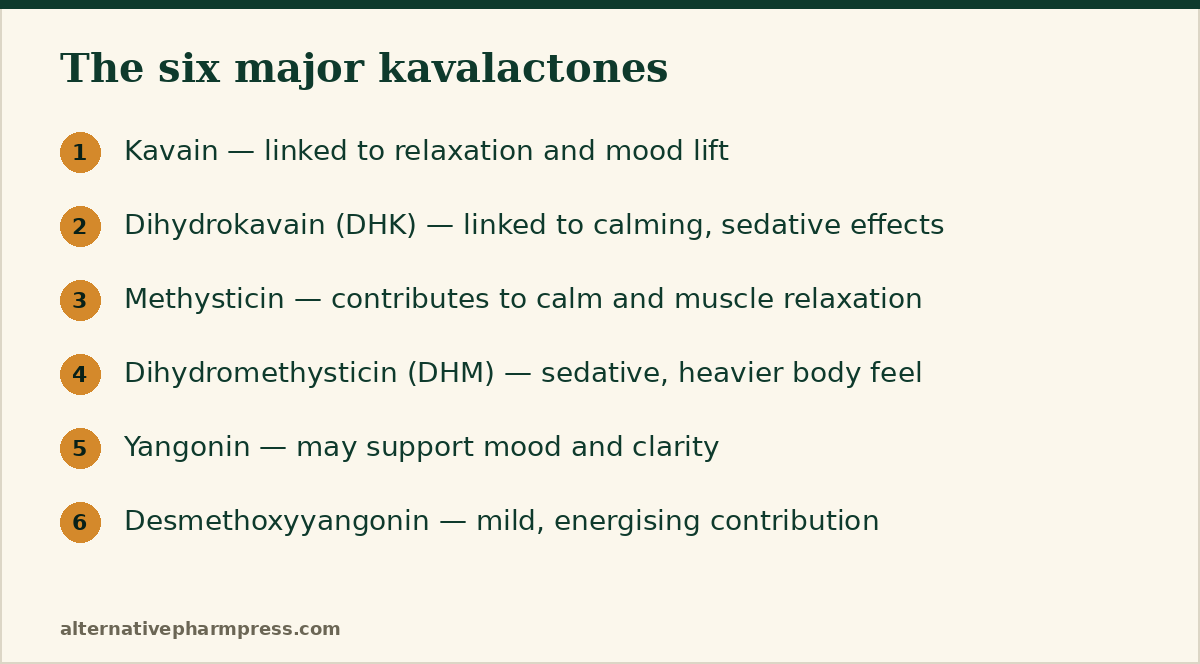
Different kava cultivars contain different ratios of these six, which is why some kava feels “heady” and uplifting while other kava feels “heavy” and sleepy. Vendors often publish a chemotype — a six-digit code ranking the kavalactones from most to least abundant — so experienced drinkers can choose the feel they want.
How kavalactones act in the body
Kavalactones appear to work through several mechanisms at once: they modulate GABA-A receptors (the same broad system targeted by anti-anxiety drugs, though in a different way), they influence sodium and calcium channels, and some may affect dopamine and noradrenaline. Unlike alcohol or benzodiazepines, kava at normal doses tends to leave thinking relatively clear.
What kava feels like
People describe kava as calming, gently euphoric and social. Common effects include:
- A sense of relaxation and reduced tension
- Muscle relaxation
- Talkativeness and ease in social settings
- A numb, tingly mouth and tongue (from direct contact with kavalactones)
- Heavier doses: drowsiness and a “kava legs” feeling of physical heaviness
Effects usually begin within 20–30 minutes and last two to four hours. Kava tastes bitter and earthy, and most people chase each shell with something sweet or sour.
Does kava work for anxiety?
Kava is one of the better-studied herbal options for anxiety. Several randomized controlled trials and meta-analyses — including a Cochrane review — found kava extract reduced anxiety scores more than placebo for short-term use. Later trials in generalized anxiety disorder were more mixed, with one large Australian trial finding no significant benefit over placebo.
The fair summary: kava may help some people with mild-to-moderate anxiety in the short term, but it is not a replacement for proven treatments, and it should not be combined with anti-anxiety or sleep medications without medical advice. For a broader view of the options, see our guide to the best supplements for anxiety.
Is kava safe? The liver question
In the early 2000s, reports of severe liver injury in Europe — some leading to transplants — triggered kava bans in Germany, the UK and other countries. That history still shapes kava’s reputation, so it is worth understanding what happened.
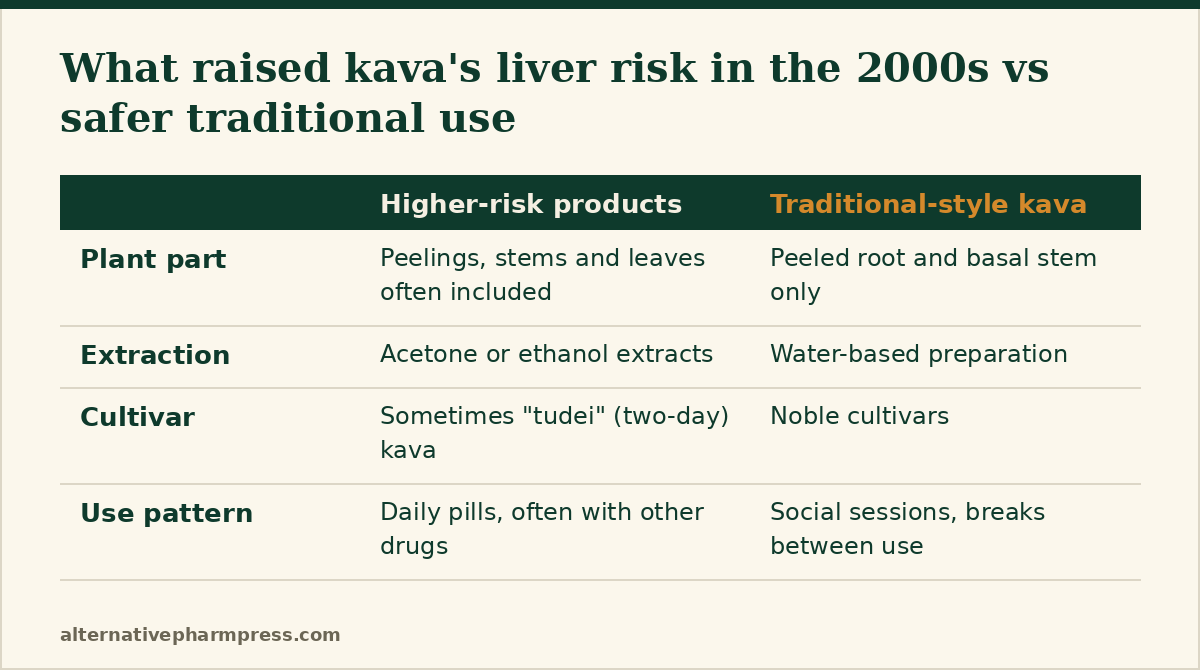
Investigations pointed to several likely factors: the use of solvent extracts instead of water preparations, inclusion of aerial parts and peelings that contain different compounds, poor-quality or “tudei” (two-day) cultivars, and combining kava with alcohol or liver-stressing medications. Germany later overturned its ban, and the World Health Organization concluded that traditional water-based preparations of noble kava appear to carry low risk — while still advising caution.
Practical safety points:
- Choose noble kava from vendors who state the cultivar and test for tudei kava.
- Prefer water-based traditional preparations over concentrated extracts.
- Avoid alcohol with kava and do not combine it with sedatives, benzodiazepines or medications known to affect the liver.
- Heavy long-term use can cause kava dermopathy, a dry, scaly skin rash that resolves after stopping.
- Don’t drive after drinking kava — several US states have charged drivers impaired by kava.
- Avoid kava if you are pregnant, breastfeeding or have liver disease.
The US National Center for Complementary and Integrative Health notes that kava has been associated with severe liver damage and advises talking to a healthcare provider before use.
Kava vs kratom: not the same thing
Kava and kratom are often sold side by side in kava bars, which causes plenty of confusion. They are completely different plants.
| Kava | Kratom | |
|---|---|---|
| Plant | Piper methysticum (pepper family) | Mitragyna speciosa (coffee family) |
| Region | South Pacific islands | Southeast Asia |
| Active compounds | Kavalactones | Mitragynine, 7-hydroxymitragynine |
| Main receptor action | GABA-A modulation, ion channels | Partial opioid agonist, adrenergic |
| Typical effects | Relaxation, sociability, numb mouth | Energy at low doses, sedation and pain relief at high doses |
| Dependence risk | Low physical dependence | Dependence and withdrawal documented |
| Main safety concern | Liver injury (rare), skin rash | Dependence, liver injury, drug interactions |
The most important difference is dependence: kratom acts on opioid receptors and can produce withdrawal, while kava is generally not considered physically addictive. For more detail, read what kratom is used for and our comparison of kava vs kanna.
Forms of kava you’ll see
- Traditional ground root — mixed with water and strained. The most authentic option.
- Micronized and instant kava — finely milled or dehydrated juice that dissolves without straining. Convenient, often stronger per spoon.
- Canned and bottled kava drinks — ready-to-drink beverages, sometimes blended with other botanicals. Check kavalactone content per can.
- Capsules and extracts — standardized kavalactone doses. Convenient but further from traditional use; quality varies.
- Kava bars — serve shells of traditional kava, and often kratom drinks too. Ask what you’re being served.
Buying tip: look for vendors that name the cultivar and island of origin, state “noble kava only”, and publish third-party tests for kavalactones, heavy metals and microbes. Our checklist on signs a brand is third-party tested applies here too.
How to prepare traditional kava at home
If you want to try kava the traditional way, the method is simple:
- Measure two to four tablespoons of medium-grind noble kava root into a strainer bag.
- Place the bag in a bowl with about one to two cups of room-temperature water. Hot water is not traditional and can make the drink harder to strain.
- Knead and squeeze the bag firmly for eight to ten minutes. The water will turn a cloudy, muddy brown.
- Squeeze out the last liquid, discard the spent root, and serve in small cups or shells.
- Start with one shell and wait 20–30 minutes before having another.
Drinking on an empty stomach makes the effects stronger and faster, but can also cause nausea. A light snack beforehand helps. Rinse your mouth with juice or eat fruit afterwards to cut the bitterness.
Who should avoid kava
Kava is not appropriate for everyone. Skip it if you:
- Have liver disease or raised liver enzymes, or drink alcohol heavily
- Take benzodiazepines, sleep medications, antidepressants, antipsychotics or medications processed heavily by the liver (such as acetaminophen in large amounts)
- Are pregnant or breastfeeding
- Have Parkinson’s disease — kava may interact with dopamine-related medications
- Are scheduled for surgery within two weeks, because of possible interactions with anaesthesia
If you notice yellowing skin or eyes, dark urine, unusual fatigue or abdominal pain while using kava, stop and see a doctor promptly.
Is kava legal?
In the US, kava is legal and sold as a food or dietary supplement. The FDA issued a consumer advisory about potential liver risk in 2002 but did not ban it. Kava has traditional food status in parts of the Pacific and is regulated with import limits in Australia. Rules differ in Europe, where some countries restrict extracts. Kava-impaired driving can be prosecuted under general impaired-driving laws.
FAQ
What is kava used for?
People mainly use kava to relax, ease stress and socialise without alcohol. It is also used in Pacific Island ceremonies and gatherings.
Does kava get you high?
Kava produces calm, mild euphoria and sociability rather than a strong high. Most people stay clear-headed at normal doses.
Is kava addictive?
Kava is not generally considered physically addictive, but heavy daily use can cause skin problems and possible liver strain, so breaks are recommended.
Can you drink kava every day?
Many Pacific Islanders drink kava regularly, but heavy daily use is associated with skin rash and higher liver risk. Moderate use with regular breaks is safer.
Is kava the same as kratom?
No. Kava comes from a Pacific pepper plant and works mainly through GABA-related pathways, while kratom comes from a Southeast Asian tree and acts on opioid receptors.