
BPC-157 is one of the most talked-about research peptides of the decade. Online, it is credited with healing torn tendons, calming inflamed guts, repairing ligaments and even protecting the brain. Athletes, biohackers and people with stubborn injuries are curious — and some are injecting it.
But the gap between the claims and the evidence is wide. This guide walks through the BPC-157 benefits that research actually supports, where the evidence comes from, what is still unknown and how regulators view the peptide in 2026.
Key takeaways
- BPC-157 is a 15-amino-acid synthetic peptide based on a fragment of a protein found in gastric juice.
- Most evidence comes from rodent studies, many from a single research group; human data is very limited.
- Animal studies suggest effects on tendon, ligament, muscle, gut and blood-vessel repair.
- BPC-157 is not FDA-approved, is banned in sport by WADA, and its long-term safety in humans is unknown.
What is BPC-157?
BPC stands for “Body Protection Compound.” BPC-157 is a synthetic chain of 15 amino acids derived from a sequence in a protein in human gastric juice. It was developed and studied mainly by researchers at the University of Zagreb in Croatia beginning in the 1990s.
Unlike many peptides, BPC-157 appears to be relatively stable in gastric acid, which is one reason it has been studied both orally and by injection in animals. You can read a quick definition in our BPC-157 glossary entry, and our explainer on what research peptides are covers the wider category.
How BPC-157 is thought to work
Researchers have proposed several mechanisms based on cell and animal studies:
- Angiogenesis — encouraging new blood vessel growth around injured tissue, which could improve oxygen and nutrient delivery.
- Growth factor signaling — interacting with pathways involving VEGF (vascular endothelial growth factor) and the growth hormone receptor on tendon cells.
- Nitric oxide system — modulating NO signaling, which affects blood flow and inflammation.
- Cell migration — helping fibroblasts (connective-tissue cells) move into and repair damaged areas.
These mechanisms are plausible, but most have been shown in isolated cells or rodents, not confirmed in people.
The BPC-157 benefits being studied
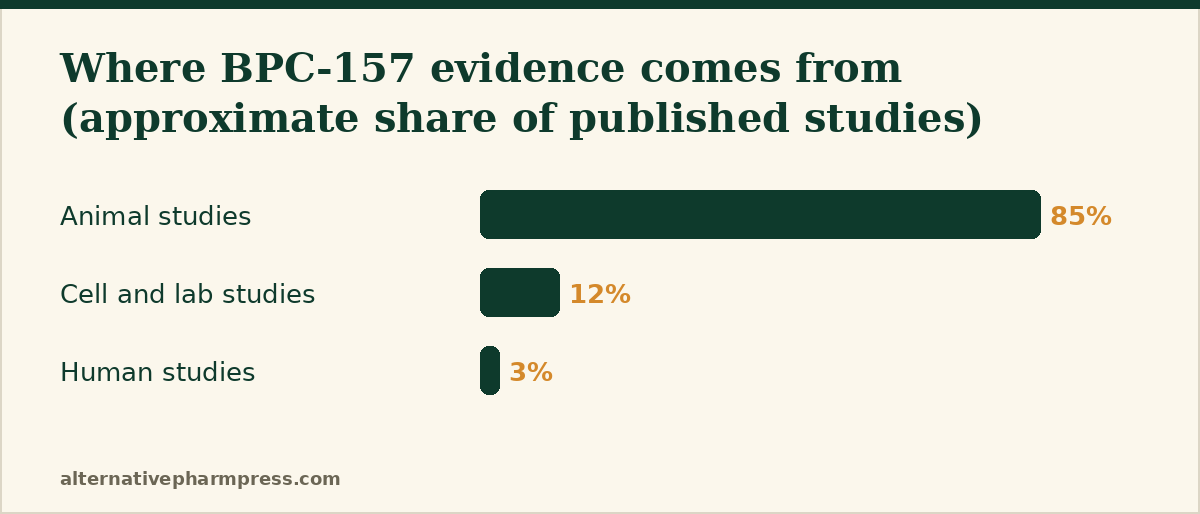
The chart above is an approximate illustration based on reviews of the BPC-157 literature: the overwhelming majority of published work is in animals.
1. Tendon and ligament healing
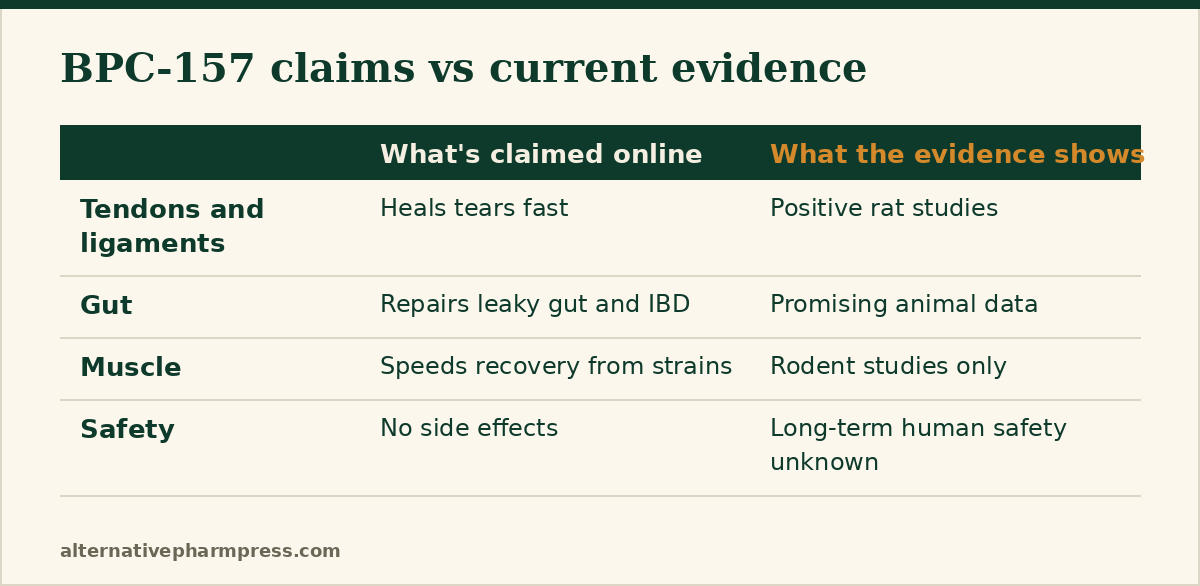
This is the most popular use. In rat studies, BPC-157 improved the strength and structure of cut or crushed Achilles tendons and medial collateral ligaments compared with untreated animals. Tendon cells exposed to BPC-157 in the lab showed increased survival and migration. No large human trial has tested BPC-157 for tendon injuries.
2. Muscle injury
Rodent studies report faster functional recovery after muscle crush and transection injuries, and some protection against muscle damage caused by corticosteroids.
3. Gut health
Given its gastric origin, BPC-157 has been studied in models of ulcers, inflammatory bowel disease, fistulas and intestinal injury. Animal results have been encouraging. A small early-phase clinical program in ulcerative colitis was reported in the past, but robust published results are lacking.
4. Wound and bone healing
Animal studies suggest improved skin wound closure, burn healing and bone repair in some fracture models.
5. Blood vessels and organ protection
Rodent studies describe protective effects on blood vessels, liver and brain in various injury models. These are early, exploratory findings.
What about humans?
Human evidence is thin. A few small pilot reports — for example, a small retrospective study of knee pain after intra-articular injection and a small pilot study of intravenous BPC-157 for safety — have been published, but they lack control groups and large sample sizes. That is nowhere near enough to confirm benefits or define safe doses.
Why the evidence is weaker than it looks
Search for BPC-157 and you’ll find dozens of studies. Three caveats matter:
- Concentration of authorship. A large share of the literature comes from one research group. Independent replication is limited.
- Animal-to-human gap. Many compounds that heal rat tendons never work — or prove unsafe — in people.
- Theoretical cancer concern. Because BPC-157 promotes angiogenesis, some researchers have raised the theoretical question of whether it could support the growth of existing tumors. This has not been demonstrated, but it hasn’t been ruled out either.
For a deeper look at the risks, read BPC-157 side effects and safety.
Regulatory status in 2026
- FDA: BPC-157 is not an approved drug. In 2023 the FDA placed it in the category of bulk drug substances that raise significant safety risks for compounding, which effectively stopped legitimate compounding pharmacies from preparing it. There has been ongoing advisory and policy debate since — see our explainer on the FDA advisory vote on BPC-157 and the 503A bulks list.
- Sport: BPC-157 is on the World Anti-Doping Agency prohibited list (as a non-approved substance). Tested athletes should avoid it.
- “Research use only”: Most BPC-157 sold online is labeled “for research use only, not for human consumption.” Our guide to what research-use-only means explains why that label matters legally and practically.
Quality is a major problem
Because BPC-157 isn’t regulated as a drug, purity and identity depend entirely on the seller. Independent testing of gray-market peptides has found underdosed vials, wrong compounds and bacterial endotoxin contamination. If you are evaluating a supplier for laboratory research, learn how to read a peptide COA and see our research peptide supplier criteria.
Not medical advice. BPC-157 is not approved for human use. If you have an injury that isn’t healing, a sports-medicine physician or physical therapist can offer treatments with proven safety and effectiveness.
How to read BPC-157 studies critically
If you dig into the literature yourself, a few questions will help you judge what any single study can tell you:
- What species? Rat and mouse results are a starting point, not proof. Look for “human,” “patients” or “participants” in the abstract.
- How many subjects? Small studies with a handful of animals or people can produce striking results by chance.
- Was there a control group? Without a comparison group, it is impossible to know whether healing would have happened anyway. Tendons, ligaments and muscles often heal on their own with time and rest.
- Who ran it? Independent replication by different labs is one of the strongest signals that a finding is real.
- What dose and route? Animal doses are usually given per kilogram of body weight and cannot simply be scaled up to humans.
- Was it peer-reviewed? Forum posts, vendor blogs and podcasts are not evidence, even when they cite studies.
Applying those questions to BPC-157 explains why researchers describe it as “promising but unproven.” The direction of the animal data is consistent, but the type of evidence regulators and doctors rely on — large, independent, controlled human trials — simply does not exist yet.
What a responsible approach looks like
Because BPC-157 is unapproved and its long-term safety is unknown, the most responsible path for someone with a slow-healing injury is to work with a clinician on treatments that have human evidence behind them: progressive loading programs for tendinopathy, physical therapy, platelet-rich plasma in selected cases, or surgical repair when needed.
For laboratories and researchers handling BPC-157, the priorities are verified identity and purity, proper storage (lyophilised powder kept cold and dry, reconstituted solution refrigerated and used promptly) and clear documentation. Our guide to research peptides covers these basics.
How BPC-157 compares with TB-500
BPC-157 is often stacked with TB-500, a synthetic fragment of thymosin beta-4. Both are promoted for healing, but they come from different proteins and act on different pathways. Neither has strong human evidence. We compare them side by side in BPC-157 vs TB-500, and cover GHK-Cu in GHK-Cu vs BPC-157.
FAQ
What are the main benefits of BPC-157?
In animal studies, BPC-157 has been linked to faster healing of tendons, ligaments, muscles, gut lining and skin wounds. These benefits have not been confirmed in controlled human trials.
Is BPC-157 safe for humans?
Its long-term safety in humans is unknown. Short-term pilot reports have not shown major problems, but the studies are too small to rule out risks.
Is BPC-157 FDA approved?
No. BPC-157 is not an FDA-approved drug and cannot legally be marketed for human use in the US.
Is BPC-157 banned in sports?
Yes. It is on the World Anti-Doping Agency prohibited list as a non-approved substance.
Does oral BPC-157 work?
BPC-157 appears unusually stable in stomach acid, and oral dosing has been studied in animals, but there is no solid human data comparing oral and injected forms.
How long does BPC-157 take to work in studies?
In rodent injury models, differences between treated and untreated animals were typically measured over days to a few weeks. Those timelines cannot be assumed to apply to people, and no human trial has established how long effects take or how long they last.
Can BPC-157 cause cancer?
There is no evidence that BPC-157 causes cancer. Some researchers have raised a theoretical concern because it encourages new blood-vessel growth, which tumors also rely on. The question simply hasn’t been studied in humans.
Is BPC-157 legal in 2026?
It isn’t FDA-approved. Since 30 October 2026, HHS has said it won’t act against qualifying prescription compounding by licensed pharmacies and physicians. Research-chemical sales for human use aren’t covered.
Is BPC-157 a steroid?
No. It’s a 15-amino-acid peptide, not a steroid hormone, though WADA still prohibits it in sport.