
THCA flower, THCA vapes, THCA diamonds — over the past few years, products labeled “THCA” have filled smoke shops and online stores across the US. They are often sold as legal hemp. That leads to an obvious question: does THCA get you high?
The honest answer is: raw THCA does not, but THCA that has been heated almost certainly will. Understanding why requires a quick look at cannabis chemistry — and it has big implications for how these products are used, how they show up on drug tests and how lawmakers treat them.
Key takeaways
- THCA (tetrahydrocannabinolic acid) is the non-intoxicating acid form of THC found in raw cannabis.
- Heat — smoking, vaping, baking — removes a carboxyl group and converts THCA into delta-9 THC, which is intoxicating.
- So smoked or vaped THCA flower gets you high much like marijuana.
- THCA products can cause a positive THC drug test once consumed with heat.
- Federal law is tightening: the hemp definition is shifting to count total THC, which includes THCA.
What is THCA?
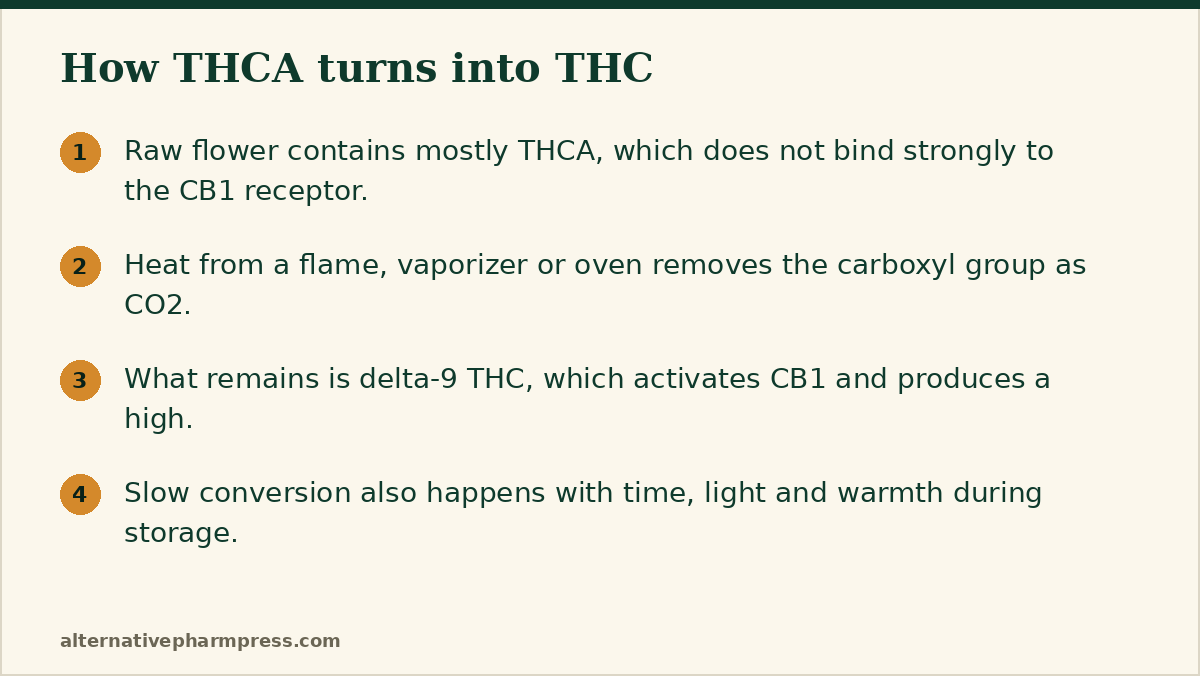
Cannabis plants don’t actually make much THC directly. Instead, they produce cannabinoid acids: THCA, CBDA, CBGA and others. These acids carry an extra carboxyl group (COOH) on their molecular structure. In a living or freshly harvested plant, most of what will become THC is still THCA.
THCA’s shape matters. With that extra carboxyl group attached, the molecule is larger and doesn’t fit well into the CB1 receptor in the brain — the receptor responsible for the cannabis “high.” That’s why eating raw cannabis leaves doesn’t produce intoxication in most people.
Decarboxylation: how THCA becomes THC
Decarboxylation (“decarbing”) is the chemical reaction that removes the carboxyl group as carbon dioxide. What’s left is delta-9 THC, which binds CB1 strongly and produces psychoactive effects.
Decarboxylation happens:
- Almost instantly when cannabis is smoked or vaporized at typical temperatures.
- Over 30–60 minutes when flower is baked in an oven at moderate temperatures for edibles.
- Slowly over months as flower ages, especially with heat and light exposure.
Not every molecule converts — some THCA is destroyed and conversion is rarely 100% efficient — but enough converts to produce strong effects.
So does THCA get you high? It depends on how you use it
| How THCA is consumed | Does it convert to THC? | Likely to get you high? |
|---|---|---|
| Raw flower in smoothies or juices | Very little | Generally no |
| Smoked flower or pre-rolls | Yes, rapidly | Yes |
| Vaporized flower or concentrates | Yes, rapidly | Yes |
| Dabbed THCA diamonds | Yes, rapidly | Yes, often strongly |
| Baked into edibles after decarbing | Yes | Yes |
| Tinctures or capsules labeled “raw THCA” | Little, unless heated | Generally no, but some products contain THC too |
In practice, almost everyone buying THCA flower or vapes is smoking or vaping it — so for them, THCA functions like regular marijuana. Users report effects that are indistinguishable from dispensary cannabis of similar potency.
Why THCA flower can be very potent
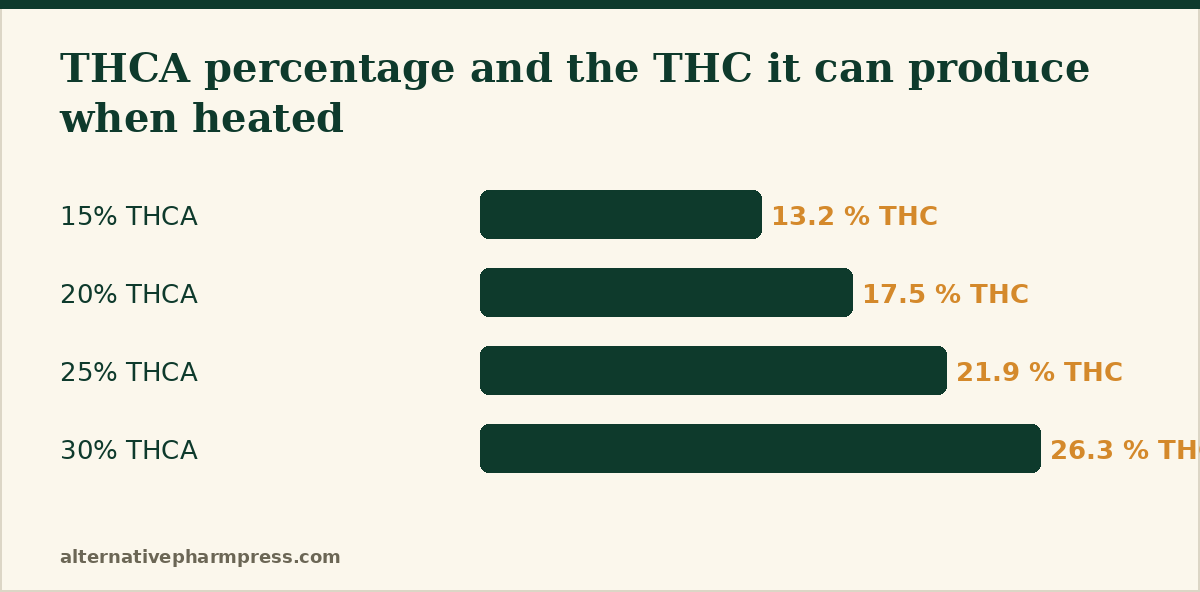
High-quality THCA flower often tests at 20–30% THCA. When multiplied by the conversion factor used in labs (0.877, because the carboxyl group adds weight), that equals roughly 17–26% potential THC — in the same range as strong dispensary flower. That’s why products marketed as “hemp” can be just as intoxicating as marijuana. Our guide to THCA vs delta-9 THC explains the math in detail.
Does raw THCA have any effects?
Raw THCA is not intoxicating, but researchers are interested in whether it has other effects. Early lab and animal studies have explored anti-inflammatory, anti-nausea and neuroprotective properties. These are preliminary findings — there are no good human trials — so be skeptical of products promising medical benefits. A related acid, CBDA, has a similar story; see our explainer on CBDA.
Will THCA make you fail a drug test?
Very likely, if you’ve heated and consumed it. Standard drug tests look for THC-COOH, a metabolite produced when your body breaks down delta-9 THC. Since smoking or vaping THCA delivers delta-9 THC, your body produces the same metabolite as it would from marijuana.
Even raw THCA products may cause problems: some THCA converts in the body or during storage, and many products contain measurable delta-9 THC as well. If you are subject to workplace, legal or sports testing, THCA products are a real risk. THC metabolites can be detectable in urine for days after a single use and for weeks in frequent users. For related details, see can CBD fail a drug test? and our comparison of delta-8 vs delta-9 THC.
Why THCA was sold as “legal hemp”
The 2018 Farm Bill legalized hemp, defined as cannabis containing no more than 0.3% delta-9 THC on a dry-weight basis. The definition focused on delta-9 THC specifically — not THCA. Many growers tested crops for delta-9 only, allowing high-THCA flower to qualify as hemp even though it becomes intoxicating when smoked.
That loophole has been closing:
- The USDA’s hemp production rules already required pre-harvest “total THC” testing (delta-9 THC plus 0.877 × THCA) for licensed growers.
- Several states — and new federal legislation passed in late 2025 — redefine hemp around total THC, which would make most THCA flower non-compliant. Implementation dates and details matter, so read our coverage of the federal hemp law changes, the 2026 hemp ban and whether THCA is legal after the change.
- State laws vary widely. Our THCA legal status by state guide is updated as rules change.
Bottom line on legality: “THCA is legal hemp” is no longer a safe assumption. Check your state’s current rules before buying, and never travel across state lines or internationally with THCA products.
Is THCA safe?
Once heated, THCA’s safety profile is essentially that of THC. Short-term effects include impaired coordination and judgment, increased heart rate, dry mouth, anxiety or paranoia at high doses and, rarely, cannabis-induced vomiting with heavy long-term use. Practical safety tips:
- Start low, especially with concentrates and diamonds, which can exceed 90% THCA.
- Don’t drive or operate machinery after use.
- Avoid if pregnant, breastfeeding or under 21, and talk to a clinician if you take medications or have heart or mental-health conditions.
- Buy tested products. Look for a recent certificate of analysis showing total THC, pesticides, heavy metals, mold and residual solvents. Our distillate vs live resin guide explains what’s in different concentrates.
THCA vs other hemp cannabinoids
THCA is only one of many hemp-derived cannabinoids on the market. Here’s how it differs from the most common alternatives:
- Delta-8 THC — a chemically converted isomer, usually made from CBD. Milder than delta-9 for most people. See THCA vs delta-8.
- CBD — non-intoxicating at any temperature. See THCA vs CBD.
- THCP — a rare, highly potent cannabinoid. See THCP vs delta-8.
- HHC — a hydrogenated THC analogue. See HHC vs delta-8.
How to use THCA responsibly if it’s legal where you live
If THCA is legal in your state and you choose to use it, a few practical habits make the experience safer and more predictable:
- Know your potency. Check the certificate of analysis for “total THC,” not just delta-9 THC. A flower listed as “0.2% delta-9” can still deliver over 20% THC once smoked.
- Take one or two small inhalations and wait 10–15 minutes. Smoked and vaped effects peak quickly, so there’s no need to keep going before you feel where you are.
- Be extra careful with concentrates. THCA diamonds, sauce and live resin can exceed 70–90% THCA. A tiny amount is a strong dose.
- For edibles, decarb properly and dose small. Homemade edibles are notoriously uneven. Start with 2.5–5 mg of THC and wait at least two hours before taking more.
- Store it cool, dark and airtight. Heat and light slowly convert THCA and degrade cannabinoids, changing potency over time.
- Keep it away from children and pets. Accidental edible ingestions by children have risen sharply as hemp products have spread.
THCA product types and what to expect
THCA is now sold in nearly every format you’d find in a dispensary. Here’s what each one means for potency and experience:
- THCA flower and pre-rolls — whole buds, typically 15–30% THCA. Effects arrive within minutes when smoked and last two to four hours.
- THCA vapes and carts — usually THCA distillate or live resin in a cartridge. The heating element decarboxylates THCA as you inhale. Hardware quality and additives matter; see our delta-8 vapes and carts guide for the hardware checks that apply here too.
- THCA diamonds, sauce and badder — crystalline or semi-liquid concentrates that can test above 90% THCA. These are among the strongest hemp products on the market.
- THCA tinctures and capsules — sometimes sold “raw” for non-intoxicating use, but check the label: many include decarboxylated THC.
- THCA edibles — must be decarboxylated during manufacturing to have intoxicating effects, so they’re usually labeled with delta-9 THC content instead.
FAQ
Does THCA get you high if you smoke it?
Yes. Smoking or vaping converts THCA into delta-9 THC almost instantly, so smoked THCA produces a high similar to marijuana.
Does raw THCA get you high?
Generally no. Raw THCA does not bind well to the CB1 receptor, so eating raw, unheated cannabis typically doesn’t cause intoxication.
Is THCA stronger than THC?
Not on its own. THCA is non-intoxicating, but THCA flower can produce as much THC as strong marijuana once heated.
Will THCA show up on a drug test?
Very likely if you smoke, vape or eat decarboxylated THCA, because your body produces the same metabolite tested for in standard THC drug screens.
Is THCA legal?
It depends on your state and on federal hemp rules, which are moving toward a “total THC” standard that includes THCA. Check current state law before buying.
Does THCA show up on a drug test?
Yes. When THCA is heated it becomes delta-9 THC, and even unheated products often contain some THC, so use can produce THC-COOH metabolites that standard tests detect.
Is THCA safe to smoke?
Smoking THCA flower exposes you to the same combustion by-products and THC effects as smoking cannabis. Untested hemp flower may also contain pesticides, mold or heavy metals, so look for full-panel lab reports.