
Bright red caps with white spots — Amanita muscaria, the fly agaric, is the most recognizable mushroom on Earth. It’s also become one of the most heavily marketed: amanita muscaria gummies now sit on smoke-shop and gas-station shelves, often with psychedelic artwork and promises of a “legal mushroom trip.”
These products are very different from psilocybin “magic mushrooms,” and they come with their own set of risks. This guide explains what’s in amanita gummies, what they do, why regulators are concerned and how to evaluate a label.
Key takeaways
- Amanita muscaria’s main active compounds are ibotenic acid and muscimol, which act on GABA and glutamate systems — not serotonin like psilocybin.
- Effects are typically sedative, dreamlike and dissociative, with nausea, confusion and muscle twitching common at higher doses.
- The FDA has said amanita muscaria and its constituents are not approved food ingredients, and some gummies have been recalled after serious illness.
- Many “mushroom gummies” contain undisclosed synthetic compounds — label honesty is a major issue.
- Children and pets are at particular risk from accidental ingestion.
What is Amanita muscaria?
Amanita muscaria is a mushroom found across temperate and boreal forests of the Northern Hemisphere, usually growing alongside birch and pine. It has a long cultural history — Siberian shamanic use is the best documented — and appears in folklore across Europe and Asia.
It is not a psilocybin mushroom. It belongs to the same genus as some of the deadliest mushrooms in the world (such as Amanita phalloides, the death cap), although A. muscaria itself contains different toxins and is far less likely to be fatal.
Muscimol and ibotenic acid: how amanita works
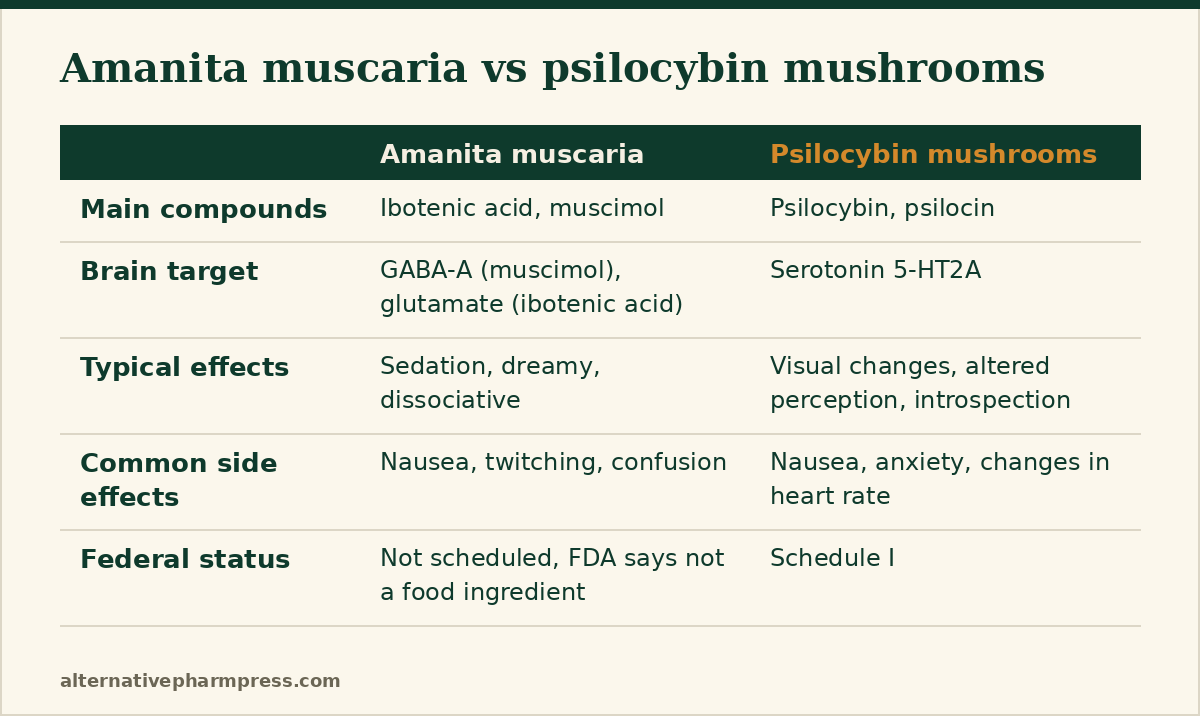
- Ibotenic acid is a glutamate-like compound that excites neurons. It is associated with nausea, agitation and some of amanita’s unpleasant effects.
- Muscimol is formed when ibotenic acid is decarboxylated — by drying, heating or in the body. Muscimol is a potent GABA-A receptor agonist, producing sedation, relaxation and dreamlike states.
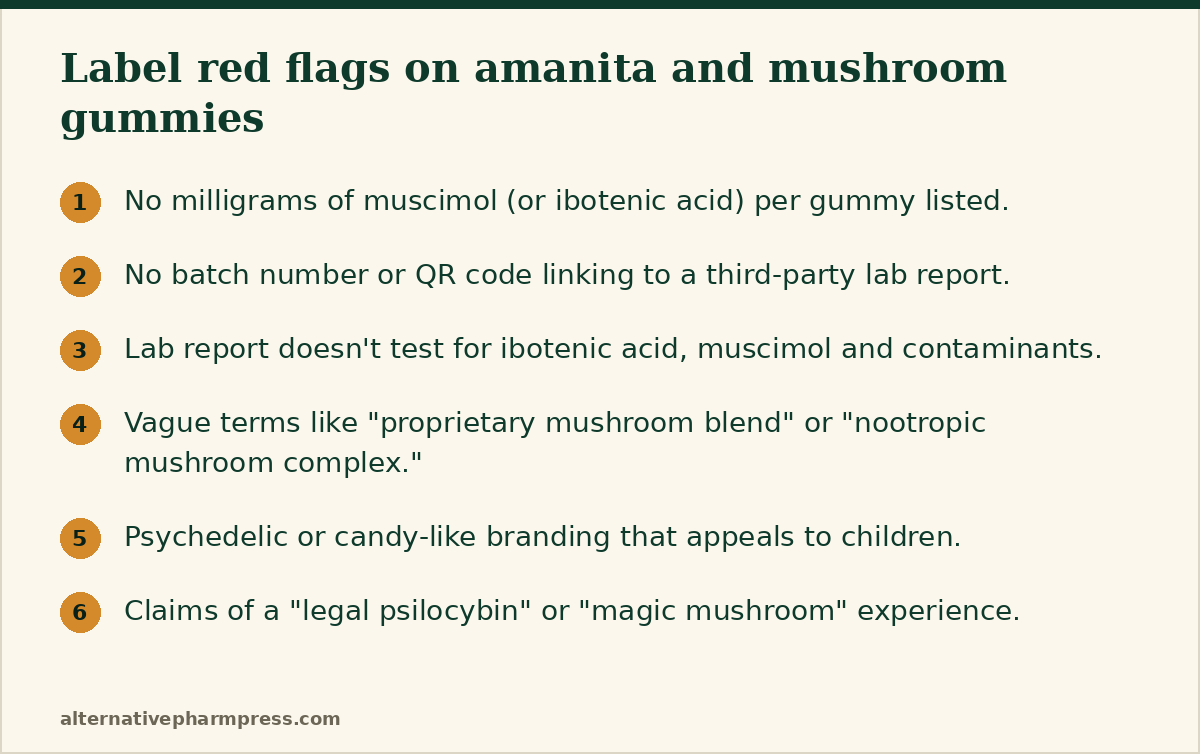
Many amanita products are processed to convert ibotenic acid into muscimol, and some labels advertise muscimol content in milligrams. That’s a step toward transparency — but only if the numbers are verified by an independent lab.
For a deeper comparison, read Amanita muscaria vs psilocybin and our report on amanita muscaria in 2026: the FDA’s position and muscimol research.
What do amanita muscaria gummies feel like?
Reports vary widely, partly because product potency varies so much. Commonly described effects include:
- Relaxation and sedation, sometimes deep sleep
- Dreamlike or “lucid” states and altered sense of time
- Mild euphoria or detachment
- Distorted perception of size or distance in some cases
- Nausea, salivation, sweating, dizziness
- Muscle twitches, confusion and loss of coordination at higher doses
Effects often begin within 30–90 minutes and can last several hours, with grogginess afterwards. Unlike psilocybin, amanita is not typically associated with vivid colorful visuals, and many people find the experience more sedating than “psychedelic.”
Safety concerns
Toxicity and poisoning
Amanita muscaria poisoning is rarely fatal in healthy adults, but it can cause serious symptoms: vomiting, agitation, confusion, delirium, seizures and coma. Poison control centers have reported rising numbers of exposures linked to amanita and “mushroom” products. Children are especially vulnerable to accidental ingestion of gummies that look like candy.
Undisclosed ingredients
Some of the biggest problems with mushroom gummies have had nothing to do with amanita itself. In 2024, a widely sold brand of “mushroom” chocolate bars and gummies was recalled after reports of seizures, loss of consciousness and hospitalizations; testing found compounds not listed on the label, including synthetic substances. Many products marketed as “amanita” or “magic mushroom” gummies don’t contain what they say.
Regulatory warnings
The FDA has stated that it does not consider Amanita muscaria or its constituents (muscimol and ibotenic acid) to be generally recognized as safe or approved as food additives, meaning they shouldn’t be added to foods like gummies. Some states have moved to restrict amanita products, and Louisiana banned amanita for human consumption years ago. Rules are evolving, so check local law before buying.
Interactions
Because muscimol acts on GABA-A receptors, combining amanita products with alcohol, benzodiazepines, sleep medications, gabapentin or other sedatives can intensify sedation and confusion. Avoid combinations.
If someone has eaten amanita or mushroom gummies and is confused, agitated, having seizures or is hard to wake, call 911 or Poison Control at 1-800-222-1222 right away. Bring the packaging if possible.
Amanita gummies vs functional mushroom gummies
Not every “mushroom gummy” is psychoactive. Functional mushroom gummies — lion’s mane, reishi, cordyceps, chaga, turkey tail — are non-intoxicating and marketed for focus, sleep or immunity. Confusingly, some brands sell both types in similar packaging. Read the ingredient list carefully. For non-psychoactive options, see do mushroom gummies work?, our functional mushroom research roundup and the best lion’s mane brands.
Is there any evidence of benefits?
Interest in muscimol research is growing, particularly for sleep and neurological conditions, and some early-stage clinical work has explored muscimol in controlled settings. But there are no well-designed human trials showing that amanita muscaria gummies safely improve sleep, anxiety or any other condition. Benefits claimed on packaging are not supported by strong evidence.
If you choose to use amanita products
We don’t recommend amanita gummies, given the unpredictable potency and safety concerns. If an adult chooses to use them anyway, risk-reduction steps include:
- Only buy products with a batch-specific COA from an accredited third-party lab that lists muscimol and ibotenic acid in mg per serving and screens for contaminants and synthetic adulterants.
- Start with a small fraction of a gummy and wait at least two hours.
- Never combine with alcohol, sedatives or other substances.
- Have a sober person present, don’t drive, and store products locked away from children and pets.
- Avoid entirely if pregnant, breastfeeding, or if you have seizure disorders, liver or kidney disease, or take psychiatric medications.
How amanita gummies are made
Most amanita gummies start with dried Amanita muscaria caps, which are harvested from the wild because the mushroom is difficult to cultivate. Manufacturers then either grind the dried mushroom into powder or make an extract — typically using water, sometimes with acid and heat to encourage the conversion of ibotenic acid into muscimol. The extract is blended into a gummy base with sugar, gelatin or pectin and flavorings.
Each step introduces variability. Wild-harvested mushrooms differ in potency; extraction methods differ in efficiency; and gummy manufacturing can distribute extract unevenly across a batch. Reputable manufacturers test the finished gummies, not just the raw material, and publish results by batch. Many don’t, which is why a label claiming “10 mg muscimol” may bear little relationship to what’s in the gummy you’re holding.
Some products marketed as amanita also contain added kava, kratom, botanicals or synthetic compounds to make effects more noticeable. Those additions are a major source of the serious reactions reported to poison centers.
Why dosing amanita is so unpredictable
Even when a label lists milligrams of muscimol, amanita remains harder to dose than most products. Several factors stack up:
- Natural variation. Muscimol and ibotenic acid levels vary between individual mushrooms, regions and seasons.
- Processing differences. Drying temperature, time and methods change how much ibotenic acid converts to muscimol. Poorly processed products may contain more ibotenic acid, which is linked to nausea and agitation.
- Individual sensitivity. Body weight, food in the stomach and personal sensitivity all affect the experience.
- Delayed onset. Because effects can take an hour or more, people sometimes take a second dose too soon, then experience both doses at once.
- Adulteration. If a product contains undisclosed substances, any dosing information on the label is meaningless.
That unpredictability is the main reason poison control experts urge caution with these products.
How amanita products are regulated in 2026
Amanita muscaria is not a federally controlled substance in the US, which is why gummies can appear on store shelves. But “not controlled” doesn’t mean approved. The FDA has said amanita and its constituents are not lawful food ingredients, which puts gummies and chocolates in a legal gray zone. Some states and cities have started to restrict sales, set age limits or ban amanita outright, and others are considering rules. Online retailers may also restrict shipping to certain states. Check your local rules before buying — and be skeptical of any product marketed as “federally legal” or “FDA compliant.”
FAQ
Are amanita muscaria gummies legal?
Amanita muscaria is not federally scheduled, but the FDA says its constituents are not approved food ingredients, and some states restrict it. Legality depends on where you live.
Do amanita gummies get you high?
They can produce sedation, dreamlike states and altered perception, which some people describe as a high. Effects differ from psilocybin.
Are amanita muscaria gummies the same as magic mushrooms?
No. Magic mushrooms contain psilocybin, which acts on serotonin receptors. Amanita contains muscimol and ibotenic acid, which act on GABA and glutamate systems.
Are amanita gummies safe?
They carry real risks, including nausea, confusion, seizures and accidental poisoning, and many products have inaccurate labels or undisclosed ingredients.
How long do amanita gummy effects last?
Effects often begin within one to two hours and can last several hours, sometimes followed by grogginess the next day.
Is amanita muscaria legal?
Amanita muscaria isn’t federally controlled, but FDA has said muscimol isn’t approved as a food ingredient, and Louisiana bans the mushroom for human consumption. Check state law before buying.
Is amanita muscaria psychedelic?
Not in the same way as psilocybin. Its active compounds, muscimol and ibotenic acid, act on GABA and glutamate systems and cause sedation, confusion and dream-like states rather than classic psychedelic effects.