
Disclosure: Some links on this page go to brands we cover. We may earn a commission if you buy through them, at no extra cost to you. This does not change our ratings. How we make money.
The best lion’s mane supplement is a fruiting body extract that states its beta-glucan content, measured by an enzymatic assay such as Megazyme’s rather than a vague “polysaccharide” figure, shows little starch and publishes contaminant testing. On those checks, Real Mushrooms leads our ranking, followed by Host Defense, FreshCap, Four Sigmatic and Om Mushrooms, each best for a different need.
Lion’s mane is the functional mushroom most people try first, usually because they have read that it might support focus. The gap between a good product and a poor one is wider than in almost any other supplement we cover, and it rarely shows up in the price. It shows up in what the jar is made from, how the brand measures it and whether an outside lab has checked it.
None of the brands below is in our directory, so every one is labelled an industry pick, not a verified partner. We did not lab-test any product. Each detail comes from the brand’s own website, checked in October 2026, or from the published research cited. People take lion’s mane for focus and general wellness, and we make no health claims.
Quick comparison: the best lion’s mane supplements
| Brand | Best for | Part used | Beta-glucan stated | What the brand says about testing |
|---|---|---|---|---|
| Real Mushrooms | Verified beta-glucans | Fruiting body only, hot-water extract | “Lab-verified” per batch; no % on the page we checked | Megazyme method for beta-glucan and starch; Purity-IQ identity check |
| Host Defense | A mycology-led brand | Mycelium on fermented rice | None on the capsule page | No product-level testing detail on the capsule page |
| FreshCap | Everyday powders | Fruiting body, dual extract, 14:1 | ≥31%, method not stated | Third-party testing of every lot |
| Four Sigmatic | Coffee and drink formats | Log-grown fruiting body extract in a blend | None; lion’s mane amount per serving not stated | Third-party tested for “purity, potency, and toxins” |
| Om Mushrooms | US-grown sourcing | Fruiting body and mycelium on organic oats, not extracted | None stated | In-house and third-party heavy metal testing |
How we ranked the best lion’s mane supplements
Lion’s mane products differ more in raw material and measurement than in branding, so we ranked on six checks that a buyer can verify before paying.
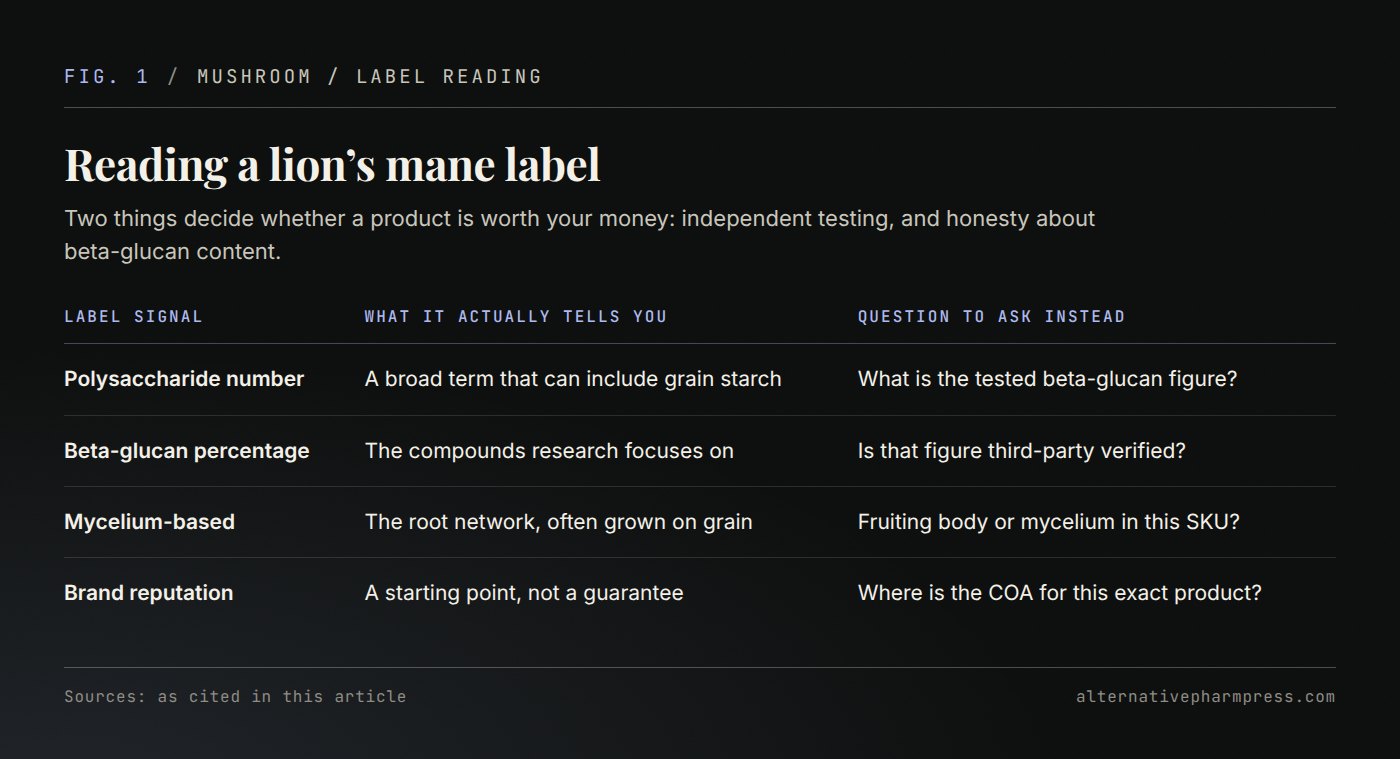
- Fruiting body or mycelium on grain. The fruiting body is the mushroom itself. Mycelium is the root-like network, and in many products it is grown on rice or oats and milled with the grain still in it. In a 2016 method-validation study, most commercial capsules tested were “mycelium propagated on grain,” and their main glucan was starch from the grain. Two mycelium blends held 1.3 and 3.2 g of beta-glucan per 100 g, against 66 to 73 g of alpha-glucan (starch).1
- Beta-glucan by an enzymatic assay. Beta-glucans are the fungal polysaccharides most research focuses on. Megazyme’s yeast and mushroom kit (K-YBGL) measures total glucan, then subtracts alpha-glucan, so starch cannot inflate the result.1,2 A “polysaccharides” percentage can include starch and tells you much less.
- Starch content. In the same study, alpha-glucan was below 4% in most pure mushroom species.1 A brand that reports low starch alongside beta-glucan is showing you the mushroom, not the grain.
- Extract ratio honesty. A label such as “14:1” or “10:1” describes how much raw mushroom went in, not how much active material came out. We gave credit when a ratio was paired with a measured beta-glucan figure.
- Certificates of analysis. A current, batch-matched certificate of analysis from an outside lab beats a general “third-party tested” badge. Our guide to the signs a brand is genuinely third-party tested explains what to look for.
- Heavy metals and identity. Mushrooms absorb what they grow in, so we looked for stated screening for lead, arsenic, cadmium and mercury, the four metals ConsumerLab checks in its lion’s mane reviews.3 Identity matters too: ConsumerLab could not approve four lion’s mane products labelled as “mushroom” that were made from mycelium.3
One more habit is worth building: judge the product you are holding, not the brand in general. A company can sell an excellent fruiting body extract and, on another shelf, a cheaper blend that leans on mycelium or fillers. We cover the wider pattern in our functional mushrooms research roundup.
Verified in our directory
No lion’s mane brand is currently verified in our brand directory, so this list contains industry picks only.
Industry picks (not in our directory)
1. Real Mushrooms, best for verified beta-glucans
Real Mushrooms is the brand we point to first when someone wants the transparency story done right. Its lion’s mane powder is “sourced from mushroom (fruiting bodies) only,” hot-water extracted, made from USDA certified organic mushrooms and described as “free of grains, starches, and fillers.” The company says it uses the Megazyme method to measure beta-glucans and starch on all its products,4 and that each lion’s mane batch is “lab-verified for beta-glucan content.” Identity is checked by Purity-IQ using nuclear magnetic resonance.
Two caveats. The product pages we checked did not print a beta-glucan percentage or offer a downloadable COA, so ask for the batch figure. And the brand says it was rated the top mushroom brand in a ConsumerLab survey; that is a reader survey, not a lab test of this product. It still ranks first because it measures the right things and says how.
2. Host Defense, best for a mycology-led brand
Host Defense was founded by mycologist Paul Stamets and grows its mushrooms on a certified organic farm in Washington State. Its lion’s mane capsules are “Powered by Mushroom Mycelium,” and the product page refers to “the fermented rice substrate.” That is a deliberate choice, not an oversight: the brand argues the mycelium and its substrate are the point.
By the criteria above, though, it is the hardest product here to verify. The capsule page lists no beta-glucan or starch figure, and given the McCleary findings on mycelium grown on grain,1 those are the numbers to ask for. If you trust the mycology-led approach, it is the recognisable name. Just go in knowing it is a mycelium product.
3. FreshCap, best for everyday powders
FreshCap sells an organic lion’s mane powder made from “100% pure fruiting bodies,” dual extracted, at 1 g per scoop. It is the only brand here whose page prints a beta-glucan figure: “standardized to contain ≥31% Beta Glucans,” or at least 310 mg per serving. The brand says it tests every lot through third-party labs.
It also illustrates the ratio problem. The page cites a “14:1 extract ratio, equivalent to 14,000 mg of raw mushrooms per serving.” That describes the input, not the effect, and the 31% beta-glucan figure is the more useful number. The assay method is not stated, and one page description calls the extract “triple-extracted,” so confirm both on the COA. For a reliable powder to stir into coffee, it is a sound pick.
4. Four Sigmatic, best for coffee and drink formats
Four Sigmatic built its name on mushroom coffee. Its Original Mushroom Coffee blends lion’s mane with chaga, cordyceps, reishi and turkey tail, and the brand says it extracts its lion’s mane “from log-grown fruiting bodies” with “no fillers, grains or carriers.” It is USDA certified organic, carries about 50 mg of caffeine per serving and says every product is third-party tested for “purity, potency, and toxins.”
The catch is dose. The page we checked gave no milligram figure for lion’s mane per serving, and ConsumerLab once found a lion’s mane and chaga “coffee” powder with much less beta-glucan than expected (it did not name the brand in its summary).3 For habit and flavour over measured potency, it fits; check the panel for the lion’s mane amount.
5. Om Mushrooms, best for US-grown sourcing
Om Mushrooms grows its mushrooms in California, on “organic, gluten-free and whole” oats. Its Focus lion’s mane powder lists “Organic Lion’s Mane, fruiting body and mycelium,” and the brand says plainly: “We don’t use hot water or alcohol extraction.” The whole culture is dried and milled. It says it tests for heavy metals in its own lab and again through a third party, and tests every lot for gluten at 10 ppm.
Domestic growing and stated metal testing make the supply chain easier to follow. But an unextracted fruiting body and mycelium powder grown on oats is exactly the format the McCleary study found can carry a lot of starch,1 and the page lists no beta-glucan or starch figure. Ask for both before you compare it with an extract.
What the evidence says about lion’s mane supplements
Ranking brands on testing does not make lion’s mane proven. The human evidence is small, mixed and mostly short.
- The most cited trial is small. In 2009, 30 Japanese adults aged 50 to 80 with mild cognitive impairment took about 3 g a day of tablets made from dry fruiting body powder, or placebo, for 16 weeks. Cognitive scores were higher than placebo at weeks 8, 12 and 16, then fell after intake stopped.5
- The largest trial so far is modest. A 2026 preprint randomised 150 adults aged 40 to 75 with self-reported cognitive concerns and analysed 109. Two grams a day of fruiting body and mycelial biomass grown on oats, for eight weeks, improved one of six computer tasks and self-rated sleep and mood. The product came from an ingredient supplier whose staff were authors.6
- Reviews call the evidence limited. A 2025 systematic review found 26 studies, only five of them randomised controlled trials, and described the cognitive evidence as small and heterogeneous.7
Our refreshed look at lion’s mane trials, the 2026 study and cognition claims walks through each trial, including those in healthy young adults that found little. On safety, the same review listed stomach discomfort, headache and allergic reactions, often unreported in trials;7 our guide to lion’s mane side effects in human trials covers the case reports. If you are weighing a sweet format, read do mushroom gummies work? first, because gummy doses usually sit well below trial amounts.
Two points follow for buyers. Trials used different materials, from whole fruiting body powder to mixed biomass, so no product can claim to match “the research” unless it names the part, the amount and the trial. And because the strongest signals come from older adults over two to four months, a two-week tub is not a fair test of anything.
How to choose a lion’s mane supplement
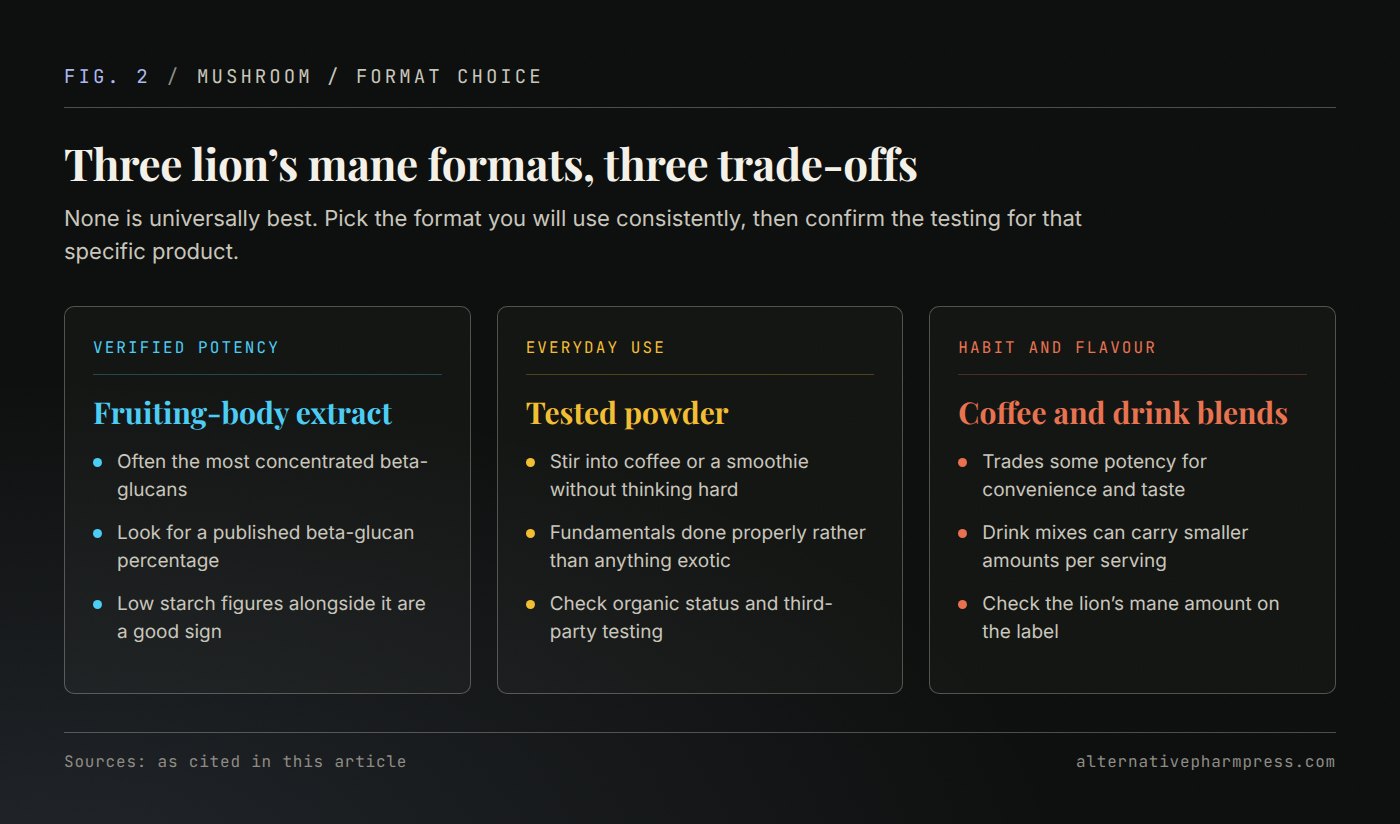
Start with format, because the best product is the one you will keep using. For the most verifiable potency, choose a fruiting body extract with a stated beta-glucan percentage, like Real Mushrooms or FreshCap. For a daily habit, a tested powder or a mushroom coffee may serve you better even at a lower or unstated concentration. Whichever you pick, find the current COA and confirm three things: a beta-glucan figure from an enzymatic method, low alpha-glucan or starch, and passing results for lead, arsenic, cadmium and mercury. Our COA reading guide walks through the same logic for another botanical, and the NIH Office of Dietary Supplements offers neutral background on supplement ingredients.
If you are comparing lion’s mane with other options, see bacopa vs lion’s mane, where bacopa has the larger memory trial base, or reishi vs lion’s mane. Our best nootropic brands of 2026 covers focus formulas that sometimes include lion’s mane, and the nootropics glossary explains the terms. You can also browse vetted sellers in the directory, read our reviews section or check the coupons page before you commit.
Are you a mushroom or nootropic brand?
If you make lion’s mane products and want to be considered for this list, we assess brands on lab transparency, not ad spend. You can register your brand in our directory or apply to be reviewed and listed. Send current, batch-matched COAs showing beta-glucan and alpha-glucan by an enzymatic method, heavy metals and microbials, and say plainly whether the product is fruiting body, mycelium or both. Directory placement is always disclosed and never disguised as editorial.
Frequently asked questions
What is the best lion’s mane supplement?
On testing transparency, Real Mushrooms is our top pick: fruiting body only, hot-water extracted and measured for beta-glucan and starch by the Megazyme method. FreshCap is the only brand here printing a beta-glucan figure, at least 31%. The best lion’s mane supplement for you is one whose batch COA shows beta-glucan, low starch and clean heavy metal results.
Is mycelium lion’s mane worse than fruiting body?
Not automatically, but it is harder to verify. Mycelium grown on grain is often milled with the grain, and in one validation study two mycelium blends held only 1.3 to 3.2 g of beta-glucan per 100 g against 66 to 73 g of starch. Some brands choose mycelium deliberately. Ask for beta-glucan and starch figures before comparing it with a fruiting body extract.
What beta-glucan percentage should I look for?
There is no official threshold. What matters more is how the number was measured. An enzymatic assay such as Megazyme’s subtracts starch from total glucan, so it cannot be inflated by grain. A “polysaccharides” percentage can include starch. Among the brands here, FreshCap states at least 31% beta-glucans; others say they test but did not print a figure on the pages we checked.
What does an extract ratio like 14:1 mean?
It means roughly 14 parts of raw mushroom went into each part of finished extract. It describes the starting material, not the amount of beta-glucan or any other compound in the product, and ratios are not standardised between brands. A measured beta-glucan percentage on a batch COA is a more useful comparison than a ratio on the front of the pack.
Does lion’s mane improve memory or focus?
The evidence is too thin to say so. A 2009 trial in 30 older adults with mild cognitive impairment found better scores over 16 weeks that faded after stopping, and a 2026 preprint in 109 adults found gains on one of six tasks. Trials in healthy young adults have mostly found little. Talk to a licensed healthcare provider before starting it, especially if you take medication.
How do I verify a lion’s mane brand’s testing claims?
Ask for the current certificate of analysis for your batch. It should name an outside lab and report beta-glucan and alpha-glucan by an enzymatic method, plus lead, arsenic, cadmium and mercury and microbial results. Identity testing is a bonus. A badge saying “third-party tested” without a report you can read is not verification, and a brand that will not share results is a reason to be cautious.
Is lion’s mane safe?
For most healthy adults it appears well tolerated in short studies, with stomach upset the most common complaint. People with mushroom allergies should avoid it, and anyone on diabetes or blood-thinning medicines should check with a pharmacist.
Sources
- McCleary BV, Draga A. Measurement of β-Glucan in Mushrooms and Mycelial Products. J AOAC Int. 2016;99(2):364-373. DOI: 10.5740/jaoacint.15-0289. PMID: 26957216. pubmed.ncbi.nlm.nih.gov
- Megazyme. β-Glucan Assay Kit (Yeast and Mushroom), K-YBGL. Accessed 24 October 2026. megazyme.com
- ConsumerLab.com. Best Lion’s Mane and Chaga Supplements (product review summary). 6 October 2022. consumerlab.com
- Real Mushrooms. Why measuring polysaccharides in mushroom products is a poor measure of quality. Accessed 24 October 2026. realmushrooms.com
- Mori K, Inatomi S, Ouchi K, Azumi Y, Tuchida T. Improving effects of the mushroom Yamabushitake (Hericium erinaceus) on mild cognitive impairment: a double-blind placebo-controlled clinical trial. Phytother Res. 2009;23(3):367-372. DOI: 10.1002/ptr.2634. PMID: 18844328. pubmed.ncbi.nlm.nih.gov
- Daoust J, Farrar S, Grant AD, Erfe MCB, Oliver PL, Luna V, et al. A randomized, double-blind, placebo-controlled study evaluating the impact of Hericium erinaceus (Lion’s Mane) on cognitive performance and subjective wellbeing. medRxiv (preprint). April 2026. DOI: 10.64898/2026.04.13.26350781. medrxiv.org
- Menon A, Jalal A, Arshad Z, Nawaz FA, Kashyap R. Benefits, side effects, and uses of Hericium erinaceus as a supplement: a systematic review. Front Nutr. 2025;12:1641246. DOI: 10.3389/fnut.2025.1641246. PMID: 40959699. pubmed.ncbi.nlm.nih.gov
Editorial note: A directory listing is not a paid editorial endorsement, and our editorial team operates independently of advertising. Some listings, reviews and coupons may be affiliate or paid placements, which do not influence our standards. Brand details were checked on each brand’s website in October 2026 and can change; we did not lab-test any product.
This article is for educational purposes only and is not medical or legal advice. Products discussed here are not intended to diagnose, treat, cure or prevent any disease. Laws vary by location and change often, so verify the rules that apply where you are. Always talk to a licensed healthcare provider before use, especially if you are under 21, pregnant or nursing, taking medication, or managing a health condition.