
Search for BPC-157 dosage and you’ll find confident charts: “250 mcg twice a day,” “500 mcg for injuries,” calculators that tell you exactly how many units to draw. What you won’t usually find is the most important fact: there is no established, evidence-based human dose of BPC-157. It is not an approved drug, and the controlled human trials that normally define dosing have not been done.
This article explains what doses researchers have actually used, why those numbers can’t simply be scaled to people, why we don’t publish reconstitution math, and what safety caveats matter. It is written for education, not as a dosing guide.
Key takeaways
- No human dose of BPC-157 is established by clinical trials; online dosing charts are extrapolations.
- Animal studies commonly used doses in the micrograms per kilogram range (often around 10 µg/kg) and occasionally nanograms per kilogram.
- Converting animal doses to humans requires body-surface-area scaling, and even then doesn’t guarantee safety or effect.
- Vial labels can be wrong: independent testing has found underfilled, overfilled and mislabeled gray-market vials.
- BPC-157 is not FDA-approved, is banned by WADA and is sold as “research use only.”
Why there’s no official BPC-157 dose
For approved medicines, dosing comes from a staged process: animal toxicology studies, then Phase 1 human trials to find safe dose ranges, then Phase 2 and 3 trials to find effective doses. BPC-157 has mainly been studied in rodents. A handful of small human pilot reports exist, but nothing approaching the dose-finding trials required for approval. You can read about the overall evidence in BPC-157 benefits: what the research shows.
So when you see a “standard dose,” it’s usually one of three things: an extrapolation from animal studies, a number repeated across forums and vendor sites, or a figure used by individual clinicians outside of trials. None of these is equivalent to a validated dose.
What doses were used in animal studies?
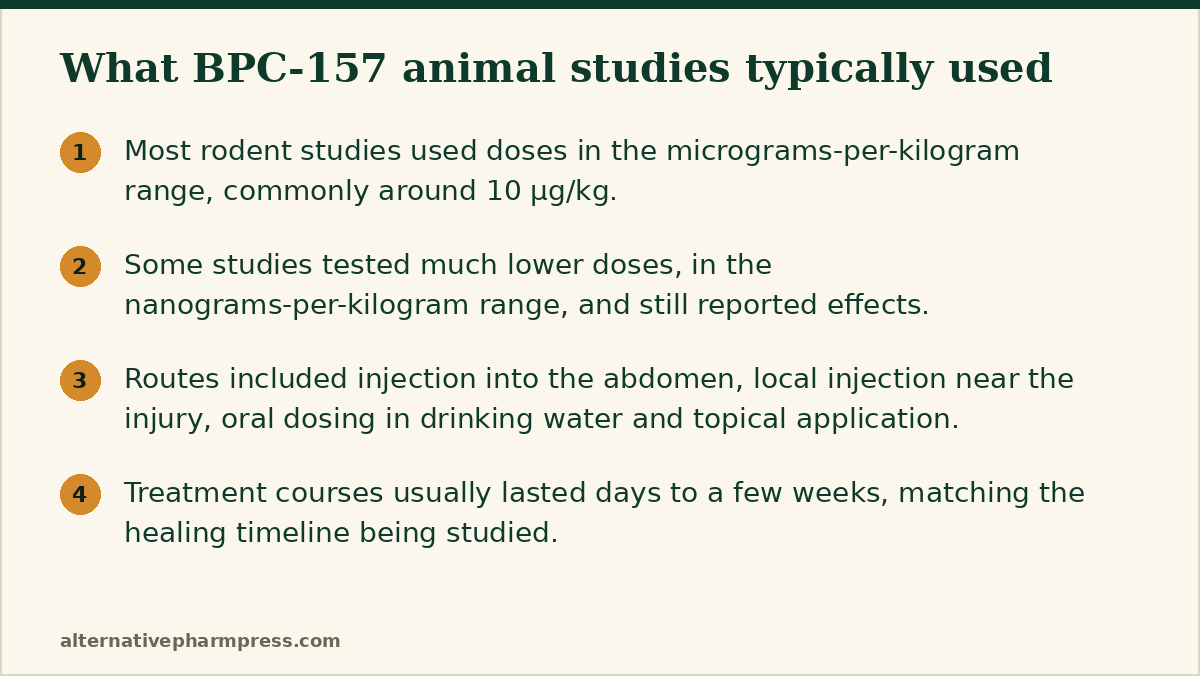
A recurring pattern in the published rodent work is a dose of about 10 micrograms per kilogram of body weight, sometimes compared against a much smaller dose (around 10 nanograms per kilogram). Many studies reported effects at both levels, which itself is unusual and is one reason scientists call for independent replication.
Routes varied: intraperitoneal injection (into the abdominal cavity, common in rodent research but not used in human medicine), local injection, oral administration in drinking water, and topical creams. Because routes differ so much, comparing doses across studies is tricky.
Why animal doses don’t convert neatly to humans
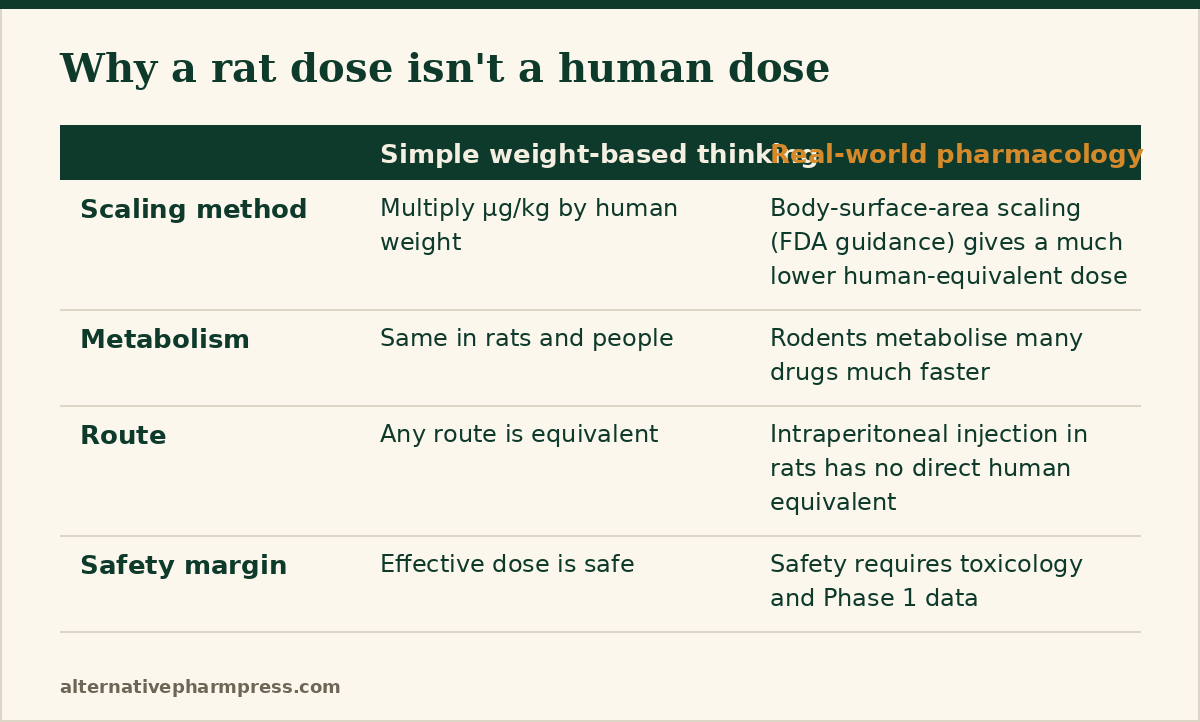
Drug developers convert animal doses to a human equivalent dose (HED) using body-surface-area scaling. Under the FDA’s standard approach, a rat dose in mg/kg is divided by roughly 6.2 to estimate the human mg/kg equivalent. Applied to 10 µg/kg in rats, that suggests something in the region of 1.6 µg/kg in humans — far lower than many online charts.
But HED is only a starting point for safety testing, not a recommended dose. It doesn’t account for differences in the route, in how the peptide is absorbed and broken down in people, or for long-term effects. That’s precisely why human trials exist.
Why we don’t publish reconstitution math
Many dosing pages include "reconstitution calculators" for mixing powdered BPC-157 vials. We’ve chosen not to. BPC-157 isn’t approved for human use, and step-by-step mixing and measuring instructions function as self-injection guidance for an unapproved drug.
The numbers also give false precision. A calculation is only as accurate as the vial, and independent testing of gray-market peptides has repeatedly found vials that were underfilled, overfilled, contaminated or contained a different compound. Sterility is another unknown: products sold as "research use only" aren’t made under the controls required for injectable medicines.
If you’re considering BPC-157 for an injury, the safer route in late 2026 is a clinician. Under the interim HHS policy published on 30 October 2026, a licensed physician can prescribe compounded BPC-157 for an identified patient from a state-licensed pharmacy that meets the policy’s conditions, which include quality testing. That doesn’t make it proven or approved, but it removes the guesswork about what’s in the vial.
Storage and handling basics
- Lyophilized powder: stable for longer when kept cold, dry and away from light.
- Sterility: non-sterile handling risks contamination. Gray-market vials have been found with bacterial endotoxins.
Oral vs injectable: does route change the dose?
BPC-157 is unusual among peptides because it appears relatively stable in gastric acid, and oral dosing worked in some animal models — particularly for gut-related conditions. Capsule products marketed online often contain 250–500 µg per capsule. Whether oral BPC-157 reaches meaningful levels in human tissues outside the gut is unknown. We’ll compare formats in more depth in a future guide.
Safety caveats that matter more than the number
Important: BPC-157 is not approved for human use. Using it outside of a regulated clinical trial means accepting unknown risks — including unknown long-term effects, product contamination and legal or sporting consequences. Speak with a licensed clinician about injury treatments with proven safety.
- Unknown long-term safety. No long-term human safety studies exist. See BPC-157 side effects and safety.
- Theoretical tumor concern. Because BPC-157 promotes blood-vessel growth, some researchers caution about use in people with active or past cancer.
- Regulatory status. The FDA has flagged BPC-157 as a bulk substance with significant safety concerns for compounding; read the FDA advisory vote on BPC-157 and the 503A bulks list update.
- Anti-doping. BPC-157 is prohibited by WADA. Tested athletes can face sanctions.
- “Research use only.” These labels mean the product is not intended for human consumption. See what research-use-only means.
BPC-157 “stacks” and combination dosing
Online protocols frequently pair BPC-157 with TB-500, GHK-Cu or growth-hormone secretagogues, sometimes in pre-mixed “wolverine” blends. Combining unapproved peptides multiplies the unknowns: neither the individual nor the combined doses have been validated in humans. Read BPC-157 vs TB-500 and our explainer on the Wolverine peptide stack for context.
Questions to ask before trusting any dosing chart
If you come across a BPC-157 dosing chart, ask:
- Where did this number come from? Is it cited to a specific study, and was that study in humans?
- What route and duration were studied? Injection near an injury in rats isn’t the same as oral capsules in people.
- Who benefits from the recommendation? Charts published by sellers have an obvious conflict of interest.
- What does it say about risks? A chart that lists only benefits and doses, with no caveats, is marketing.
- Is the source honest about evidence gaps? Credible sources acknowledge that human dosing hasn’t been established.
Common dosing myths, corrected
“Higher doses heal faster.” There’s no human evidence of a dose-response relationship for BPC-157. Interestingly, several rodent studies reported effects at both microgram and nanogram doses, which suggests more isn’t necessarily better.
“Inject it right at the injury for best results.” Local injection has been used in some animal models, but systemic routes also showed effects. In humans, injecting near tendons or joints carries its own risks — infection, nerve or tendon damage — especially with non-sterile products.
“It’s a natural peptide, so dosing doesn’t matter.” BPC-157 is synthetic. It’s based on a sequence from a stomach protein, but the molecule sold in vials is manufactured. Synthetic or natural, unverified products and unvalidated doses carry risk.
“Cycling prevents side effects.” Cycling schedules (for example, four weeks on, four weeks off) are common in forum protocols but have never been tested for BPC-157.
“A COA guarantees the dose.” A certificate of analysis only tells you about the batch that was tested, by the lab that tested it. If it isn’t batch-specific, from an accredited independent lab, with methods and results you can verify, it doesn’t guarantee much at all.
What reputable researchers are waiting for
Scientists interested in BPC-157 generally agree on what would settle the dosing question: properly registered Phase 1 trials measuring safety, blood levels and tolerability across a range of doses, followed by controlled trials in specific conditions such as tendon injury or inflammatory bowel disease. Until those exist, any dose — high or low — is a guess, and the most honest answer to “what’s the right BPC-157 dose?” is that nobody knows yet.
FAQ
What is the standard BPC-157 dosage?
There is no standard, evidence-based human dosage. Commonly cited online figures are extrapolated from animal studies and anecdotal reports, not clinical trials.
What dose of BPC-157 was used in studies?
Many rodent studies used around 10 micrograms per kilogram of body weight, with some testing much lower nanogram-per-kilogram doses.
Is oral BPC-157 dosed differently from injections?
Oral products often contain 250–500 µg per capsule, but there is no human data establishing equivalent oral and injected doses.
Is BPC-157 legal?
BPC-157 is not FDA-approved for human use and is generally sold as a research chemical. It is banned in tested sports by WADA.
Is BPC-157 FDA approved?
No. No BPC-157 product is FDA-approved. The October 2026 HHS policy only concerns enforcement against prescription compounding.
Does BPC-157 cause cancer?
There’s no human evidence that it does, but there’s no long-term human safety data either. Because BPC-157 promotes blood-vessel growth in animal studies, some researchers have raised theoretical concerns for people with a history of cancer.