
Before capsules, shots and seltzers, there was powder. Dried and ground kratom leaf is still the most common, flexible and affordable way kratom is sold. It’s also the format that gives you the most control — if you know what to look for.
This guide covers how kratom powder is made, what strain names and “vein colors” mean, why grind quality matters, how to measure and prepare it, and how to read a lab report before you buy.
Key takeaways
- Kratom powder is dried, ground leaf from Mitragyna speciosa, typically 1–2% mitragynine by weight.
- “Red, green, white” refers to vein color and processing, but batch variation often matters more.
- A digital scale is the only accurate way to measure; teaspoons vary widely.
- Common preparation methods include toss and wash, mixing into drinks and brewing tea.
- Look for batch-specific lab reports covering alkaloids, heavy metals and microbes.
How kratom leaf becomes powder
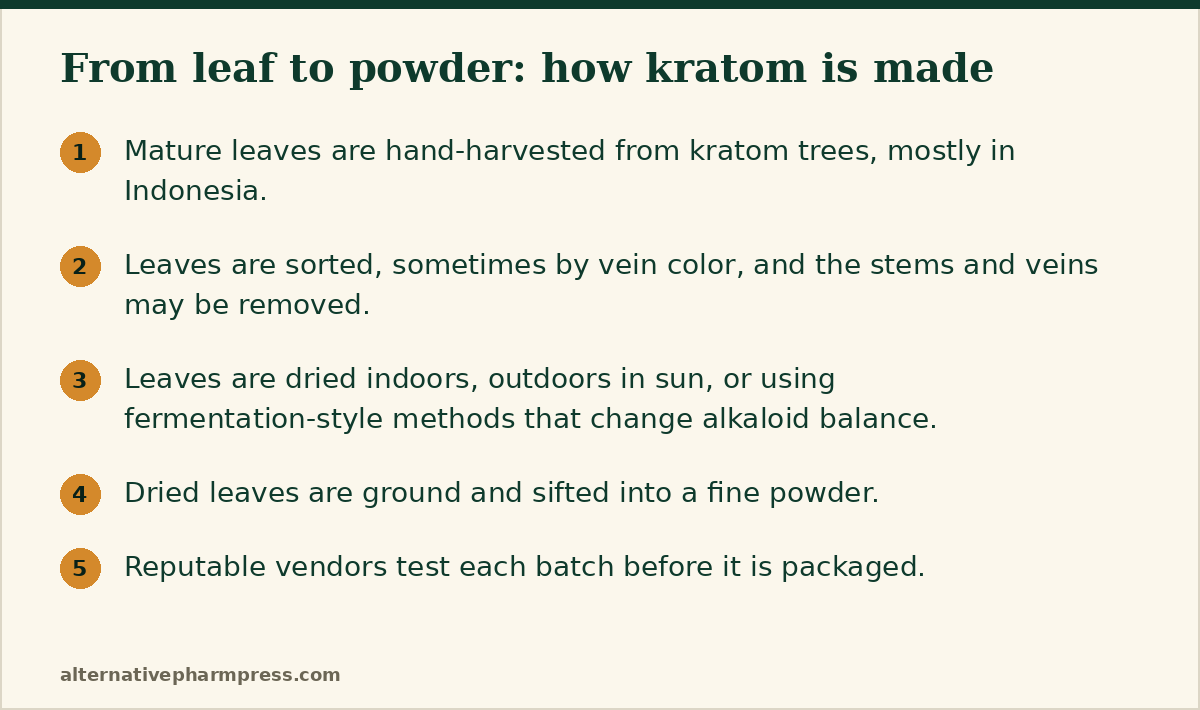
Most kratom sold in the US comes from Indonesia, especially Borneo and Sumatra. The drying method is one of the biggest influences on the final product: indoor drying, sun drying and “fermentation” (bagging leaves to sweat before drying) shift the ratio of alkaloids and color.
Strains, regions and vein colors
Kratom powders are typically labeled by vein color (red, green, white, sometimes yellow or “gold”) and region (Bali, Borneo, Malay, Maeng Da, Thai and so on).
| Vein color | Common marketing description | What’s behind it |
|---|---|---|
| White | Energizing, uplifting | Often earlier harvest and indoor drying |
| Green | Balanced | Mid-stage leaves, moderate drying |
| Red | Relaxing, soothing | Mature leaves, often sun-dried or fermented |
| Yellow / Gold | Smooth, mild | Usually extra drying or blending |
Region names are often marketing rather than strict geographic origin — “Maeng Da,” for example, generally refers to a selected high-potency strain, not a place. Lab testing shows that alkaloid content can vary more between batches and vendors than between colors. Use strain names as rough guides. See kratom strains explained, red vs white kratom, white vs green kratom, Maeng Da vs Bali and Borneo vs Bali.
Why grind quality matters
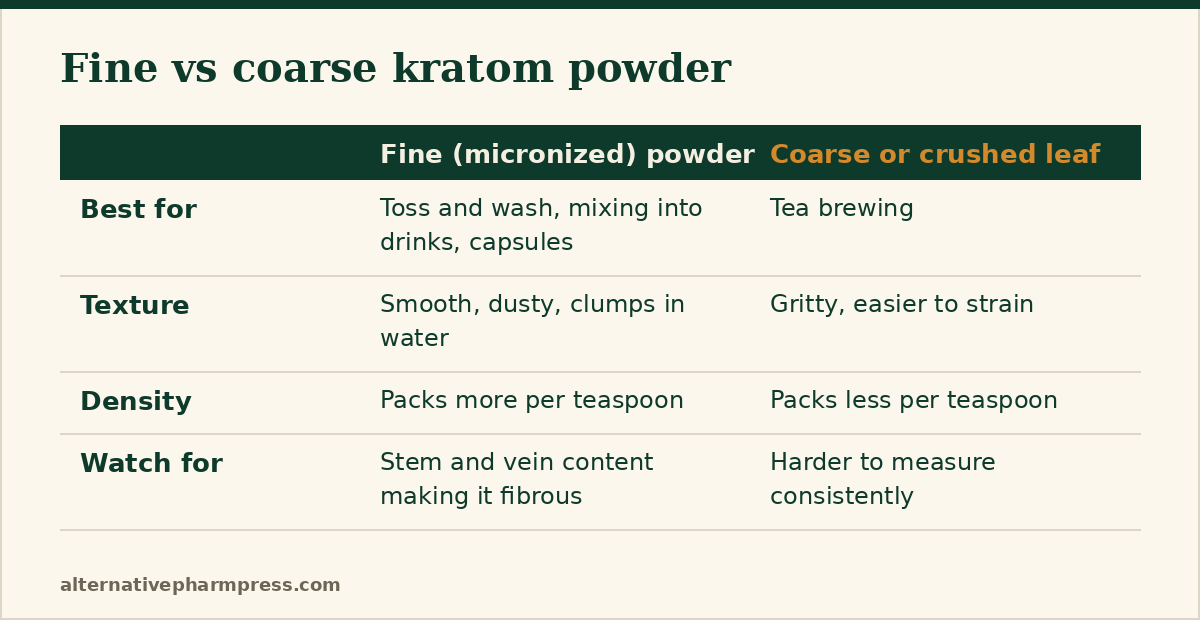
A good powder is fine, consistent and free of excessive stem or vein material, which adds fiber without alkaloids. Gritty or stringy powder suggests poor sifting.
How to measure kratom powder accurately
Teaspoons are unreliable because powder density varies. One level teaspoon can hold anywhere from roughly 2 to 3.5 grams depending on grind and packing. A digital milligram or 0.01 g scale costs very little and removes guesswork.
General harm-reduction ranges for plain leaf powder:
- Low (about 1–3 g): more stimulating effects
- Moderate (about 3–5 g): mixed effects
- High (5 g+): sedating, more opioid-like, higher risk of side effects and dependence
These aren’t recommendations. Our what kratom is used for guide explains dose-dependent effects, and kratom capsules vs powder compares formats.
How people prepare kratom powder
- Toss and wash: place powder on the tongue and wash down with water or juice. Fast, but the taste and texture are hard for many people.
- Mixed into a drink: stir into orange juice, yogurt, a protein shake or applesauce to mask bitterness.
- Brewed tea: simmer powder in water for 15–20 minutes and strain; see our guide to kratom drinks.
- Home-filled capsules: some people fill their own; see kratom capsules guide.
What a good lab report shows
A reliable certificate of analysis (COA) should include:
- Mitragynine (and ideally other alkaloids) as a percentage or mg per gram.
- 7-hydroxymitragynine at natural trace levels. Elevated 7-OH suggests adulteration; see what is 7-OH.
- Heavy metals: lead, arsenic, cadmium, mercury.
- Microbes: salmonella, E. coli, yeast and mold — the FDA has recalled kratom for salmonella.
- Batch number matching your package, from an accredited third-party lab.
Read how to read a kratom lab report and kratom COA red flags for a walkthrough.
Storage and shelf life
- Store powder in an airtight, opaque container in a cool, dark place.
- Avoid humidity — moisture invites mold and clumping.
- Alkaloids degrade slowly with heat and light; most powders are best used within 12–18 months.
- Keep it out of reach of children and pets, clearly labeled.
Safety reminders
- Dependence and withdrawal can develop with daily use. See kratom withdrawal and how kratom tolerance develops.
- Never mix with alcohol, benzodiazepines, gabapentin or opioids. See kratom and alcohol.
- Liver injury is rare but documented. See kratom liver injury.
- Legal status varies by state. Check kratom laws by state.
Buying kratom powder: practical tips
- Buy from vendors who publish batch COAs and list the harvest region honestly.
- Prefer vendors who comply with state Kratom Consumer Protection Acts (age limits, labeling, 7-OH caps).
- Start with small packages to judge quality before buying in bulk.
- Be wary of “ultra enhanced” or “extract-infused” powders unless you understand their potency.
See our best kratom powder buying guide and best kratom brands for vetted vendors.
Bulk buying: pros and cons
Kratom powder is often sold in sizes from 28 g up to 1 kg, with steep discounts for larger bags. Bulk buying can save money, but it has drawbacks:
- Freshness: a kilogram may take months to use, and potency can decline with time.
- Storage risk: large bags opened repeatedly are exposed to air and humidity.
- Consumption creep: having a lot on hand can make it easier to use more often than intended.
- Batch lock-in: if the batch isn’t to your liking, you’re stuck with it.
If you do buy in bulk, divide it into smaller airtight containers and only open one at a time.
Common myths about kratom powder
- “Red is always sedating, white is always energizing.” Strain color is a loose guide; dose and batch potency matter more.
- “Fresher harvests are always stronger.” Drying and processing methods influence alkaloid content as much as harvest timing.
- “Organic means safe.” Organic certification doesn’t guarantee freedom from heavy metals or microbes; testing does.
- “Rotating strains prevents tolerance.” Different strains contain the same main alkaloids; frequency of use is what drives tolerance.
- “More is better for pain.” Higher doses increase side effects and dependence risk without guaranteed benefit.
Kratom powder and the taste problem
Kratom is famously bitter, earthy and grassy. The taste is the main reason people switch to capsules or drinks. Some tips people use to make powder more palatable:
- Citrus juice: orange or grapefruit juice masks bitterness well. (Note that grapefruit can affect liver enzymes and may alter how kratom and medications are processed.)
- Thick mixers: yogurt, applesauce, smoothies or protein shakes suspend the powder and hide the texture.
- Chocolate milk or cocoa: the bitterness of cocoa blends with kratom’s.
- Ice-cold water: cold liquids blunt taste receptors.
- Chasers: a sip of juice or a bite of food right after helps.
Avoid mixing kratom into alcoholic drinks for safety reasons, and don’t add it to food that others in the household might eat by mistake.
Understanding kratom alkaloid percentages
Lab reports usually show mitragynine as a percentage of dry weight. Here’s how to turn that into something meaningful:
- 1.0% mitragynine = 10 mg mitragynine per gram of powder
- 1.5% mitragynine = 15 mg per gram
- 2.0% mitragynine = 20 mg per gram
So 3 g of a 1.5% powder contains about 45 mg of mitragynine, while 3 g of a 2% powder contains about 60 mg — a third more. That’s why switching vendors or batches can make the “same dose” feel different. Keeping track of the percentage on each batch’s COA helps you stay consistent.
Ethical and environmental sourcing
Kratom is an important cash crop for many farming communities in Indonesia. Responsible vendors work directly with farmers or established exporters, pay fair prices and support sustainable harvesting that doesn’t strip trees. Some vendors share information about their supply chain; others don’t. If sourcing matters to you, ask vendors where their leaf comes from and how farmers are paid.
FAQ
What is kratom powder?
Kratom powder is dried, ground leaf of the Mitragyna speciosa tree, typically containing about 1–2% mitragynine.
How much kratom powder is in a teaspoon?
It varies, commonly about 2–3.5 grams depending on grind and packing. A digital scale is far more accurate.
What’s the difference between red, green and white kratom?
They refer to vein color and processing. Marketing links them to different effects, but batch-to-batch variation often matters more.
How should kratom powder be stored?
In an airtight, opaque container in a cool, dark, dry place, away from children and pets.
How do I know if kratom powder is safe?
Look for a batch-matched third-party lab report covering alkaloids, heavy metals and microbes, and buy from vendors that follow state regulations.
Does kratom powder go bad?
It doesn’t spoil quickly, but alkaloids slowly degrade and moisture can lead to mold. Discard powder that smells musty, has visible mold or has clumped from humidity.
Is fine or coarse powder better?
Fine powder suits toss-and-wash, mixing and capsules, while coarser crushed leaf is easier to strain when brewing tea. Potency depends on the leaf, not the grind.