
Kava has a reputation as a gentle, social alternative to alcohol. As kava bars spread across the US, more people are drinking it regularly — some every night. That raises a reasonable question: is kava addictive?
The short answer is that kava is not generally considered physically addictive, and it doesn’t produce the withdrawal syndromes associated with alcohol, opioids or benzodiazepines. But “not addictive” isn’t the same as “no downsides.” Heavy, frequent kava use has documented effects on skin, liver markers, weight and daily functioning, and some people develop habits that are hard to break.
Key takeaways
- Kava isn’t associated with a classic physical withdrawal syndrome, and dependence is uncommon.
- Some people develop psychological habits around daily kava use, especially at kava bars.
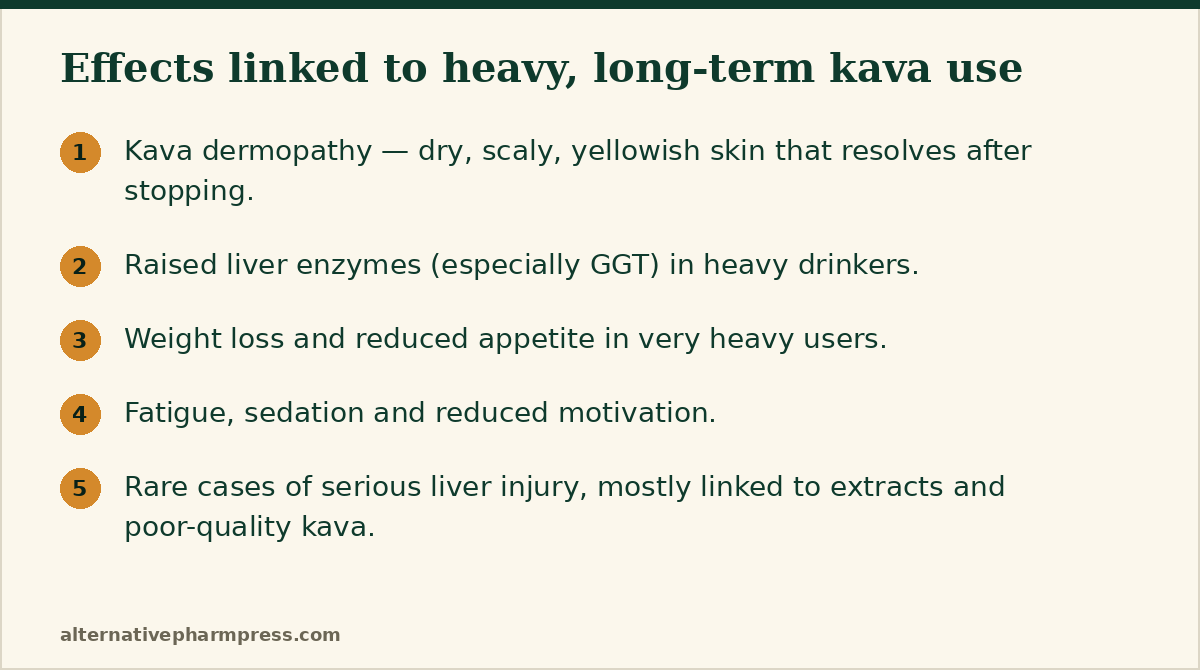
- Heavy use is linked to kava dermopathy (scaly skin), raised liver enzymes, weight loss and fatigue.
- Rare but serious liver injury has been reported, mostly with solvent extracts and poor-quality kava.
- Breaks, moderation, noble kava and avoiding alcohol reduce risk.
How kava works in the brain
Kava’s effects come from kavalactones, which act on several brain targets — most notably they modulate GABA-A receptors, the brain’s main calming system, though differently from benzodiazepines. They also influence sodium and calcium channels and may affect dopamine and noradrenaline. Crucially, kavalactones don’t act on opioid receptors, which is why kava lacks the dependence profile of opioids or kratom. Read our introduction to what kava is for the basics.
What research says about kava dependence
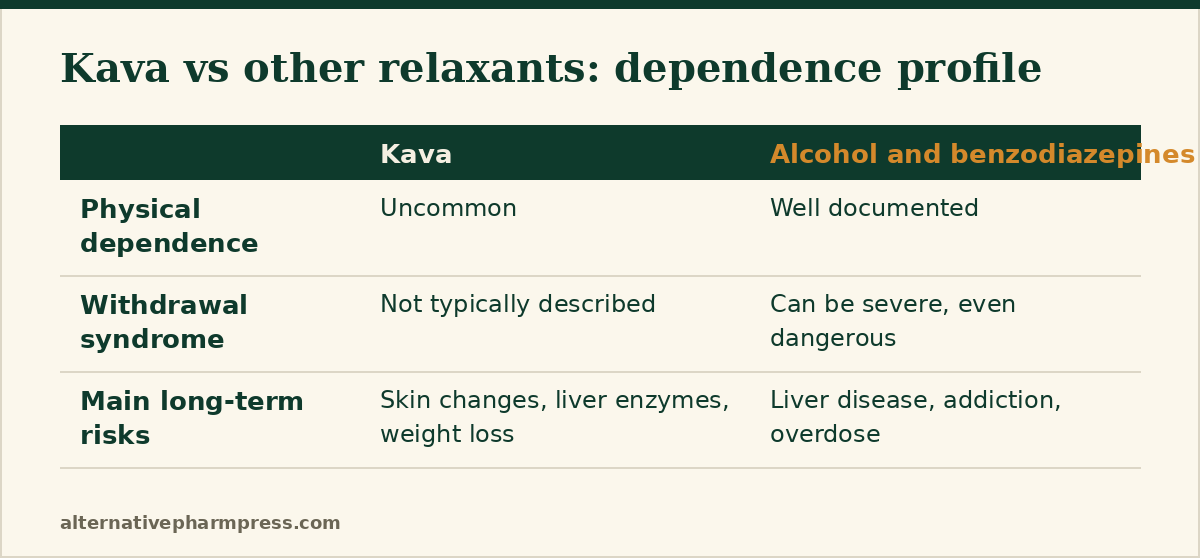
Clinical trials of kava extract for anxiety generally didn’t find withdrawal symptoms when participants stopped taking it. Researchers studying heavy traditional drinkers in the Pacific and Aboriginal communities in Australia described significant health effects from very heavy consumption, but not a classic withdrawal syndrome.
That said, a few points are worth noting:
- Psychological dependence is possible with any substance used to cope with stress or socialize. If you feel you “need” kava to relax every night, that’s worth paying attention to.
- Social habits can drive heavy use, especially when kava bars become a nightly routine.
- Mixing kava with kratom — common at kava bars — introduces a substance that does cause dependence. See kava vs kratom.
Tolerance and “reverse tolerance”
Many drinkers report the opposite of tolerance: that kava feels stronger after several sessions. This “reverse tolerance” isn’t well studied. Possible explanations include kavalactones accumulating in the body, or drinkers getting better at preparing kava. Others report that very heavy daily drinkers need more for the same effect. The bottom line: kava’s tolerance pattern isn’t like alcohol’s, and experiences vary.
Health effects of heavy kava use
Skin: kava dermopathy
Heavy drinkers can develop kava dermopathy, a dry, scaly, sometimes yellowish rash — often on the palms, soles, forearms and back. It’s reversible after reducing or stopping kava.
Liver
Two separate issues are often confused:
- Raised liver enzymes (especially gamma-glutamyl transferase, GGT) are common in heavy drinkers and usually reverse after stopping.
- Serious liver injury — including cases requiring transplantation — was reported in Europe in the early 2000s, mostly linked to acetone or ethanol extracts, products containing peelings or aerial parts, poor-quality cultivars and combinations with alcohol or other liver-stressing drugs.
The World Health Organization’s review concluded that traditional water-based preparations of noble kava appear to carry lower risk, but caution is still warranted. The US National Center for Complementary and Integrative Health also warns about the potential for liver damage.
Other effects
- Weight loss and nutritional problems in very heavy users
- Shortness of breath and changes in some blood tests (described in heavy-use populations)
- Impaired driving — kava can impair coordination and reaction time
Kava and alcohol: a risky combination
Combining kava with alcohol increases sedation and may increase liver strain. Some kava bars are explicitly alcohol-free for this reason. If you’re using kava to cut back on drinking, that can be a reasonable harm-reduction step — but don’t combine them.
Who should avoid kava
- People with liver disease or raised liver enzymes
- Heavy drinkers of alcohol
- Anyone taking benzodiazepines, sleep aids, antidepressants, antipsychotics or medications that affect the liver (including high-dose acetaminophen)
- People with Parkinson’s disease
- Pregnant or breastfeeding people
- Anyone who needs to drive or operate machinery after drinking
How to use kava more safely
- Choose noble kava from vendors who test for tudei (two-day) varieties and publish lab results.
- Prefer traditional water preparation over concentrated extracts.
- Take regular breaks — for example, several kava-free days each week.
- Keep track of how often and how much you drink.
- Don’t mix with alcohol, kratom or sedatives.
- Get blood tests if you’re a frequent drinker, especially if you have other liver risk factors.
- Watch for warning signs: yellowing skin or eyes, dark urine, abdominal pain or unusual fatigue mean stop and see a doctor.
Signs kava use may be becoming a problem
Even without physical addiction, it’s worth reflecting if you notice:
- Drinking kava every day and feeling unable to relax without it
- Spending more money or time at kava bars than you intended
- Using kava to avoid dealing with stress, anxiety or depression
- Skin changes, unintentional weight loss or persistent fatigue
- Combining kava with kratom or alcohol to get a stronger effect
If those apply, consider taking a break and talking with a healthcare provider about the underlying reasons — especially anxiety, which has effective treatments. Our article on supplements for anxiety explains where kava fits among other options.
Kava compared with other “relaxing” botanicals
People often consider several plants for relaxation:
- Kava — calming, sociable, short-acting; low dependence risk; liver and skin concerns with heavy use.
- Kratom — opioid-receptor activity at higher doses; clear dependence and withdrawal risk. See what kratom is used for.
- Kanna — serotonin-related mood effects; limited research. See kava vs kanna.
- Ashwagandha and rhodiola — adaptogens with more modest, gradual effects; see ashwagandha vs rhodiola.
- CBD — non-intoxicating; mixed evidence for anxiety. See CBD meaning.
What a “healthy” kava routine looks like
There’s no official safe limit for kava, but people who drink it with fewer problems tend to share some habits. They treat kava as an occasional social drink rather than a nightly necessity, often limiting sessions to a few times a week. They stick to traditionally prepared noble kava, drink moderate amounts over an evening rather than many strong shells quickly, and don’t mix kava with alcohol or kratom. They also stay hydrated, eat proper meals (heavy kava users sometimes neglect food) and arrange safe transport home.
If you’re a regular drinker, an annual blood test that includes liver function is a sensible precaution, particularly if you also drink alcohol, take regular medications or have a family history of liver disease. Mention your kava use to your doctor so they can interpret the results correctly — raised GGT is common in heavy kava drinkers and usually improves after cutting back.
Taking a break from kava: what to expect
Because kava isn’t associated with classic withdrawal, most people can stop without physical symptoms. Some notice they feel more restless or find it harder to unwind in the evenings for a week or two, especially if kava had become their main way of relaxing. Replacing the routine helps: an evening walk, a herbal tea, exercise, time with friends or a hobby. Skin changes from heavy use typically improve over several weeks after stopping, and liver enzymes generally return toward normal over a similar timeframe.
Why “noble” kava matters for safety
Kava cultivars are traditionally grouped into noble and non-noble (including “tudei,” meaning “two-day”) types. Noble varieties have been used for generations as everyday drinks, while tudei kava was traditionally avoided because it causes stronger, longer-lasting effects and more side effects such as nausea and next-day lethargy. Tudei kava has a different kavalactone profile, with higher levels of compounds like dihydromethysticin and flavokavains.
Vanuatu and other producing countries have export rules intended to keep tudei kava out of international markets, but enforcement isn’t perfect. Reputable vendors test each batch (often with a simple acetone test or HPLC) to confirm it’s noble. When you buy kava, look for “noble kava only” and a recent lab result.
FAQ
Is kava addictive?
Kava isn’t generally considered physically addictive and isn’t associated with a classic withdrawal syndrome, though some people develop psychological habits around regular use.
Can you get withdrawal from kava?
Classic withdrawal symptoms aren’t typically reported, even after heavy use. Some people may notice restlessness or difficulty relaxing when they stop.
Is it safe to drink kava every day?
Daily heavy use is linked to skin changes, raised liver enzymes and other effects. Moderate use with regular breaks is safer.
Does kava damage the liver?
Rare cases of serious liver injury have been reported, mostly with solvent extracts and poor-quality kava. Raised liver enzymes are common in heavy drinkers and usually reverse after stopping.
Is kava safer than alcohol?
Kava has a lower dependence risk than alcohol and doesn’t cause hangovers, but it isn’t risk-free and shouldn’t be combined with alcohol.