
Delta-8 THC is sold in gas stations and online shops as a legal hemp product, which leads many people to assume it won’t cause problems at work or on probation. That assumption is wrong. Delta-8 shows up on drug tests — and in most cases a lab can’t easily distinguish it from marijuana use.
This guide explains why, how long delta-8 can be detected by different tests, what affects detection time and what to do if you’re facing a test.
Key takeaways
- Delta-8 is metabolized into delta-8-THC-COOH, which cross-reacts with standard THC immunoassay screens.
- Many delta-8 products also contain delta-9 THC, adding to the risk.
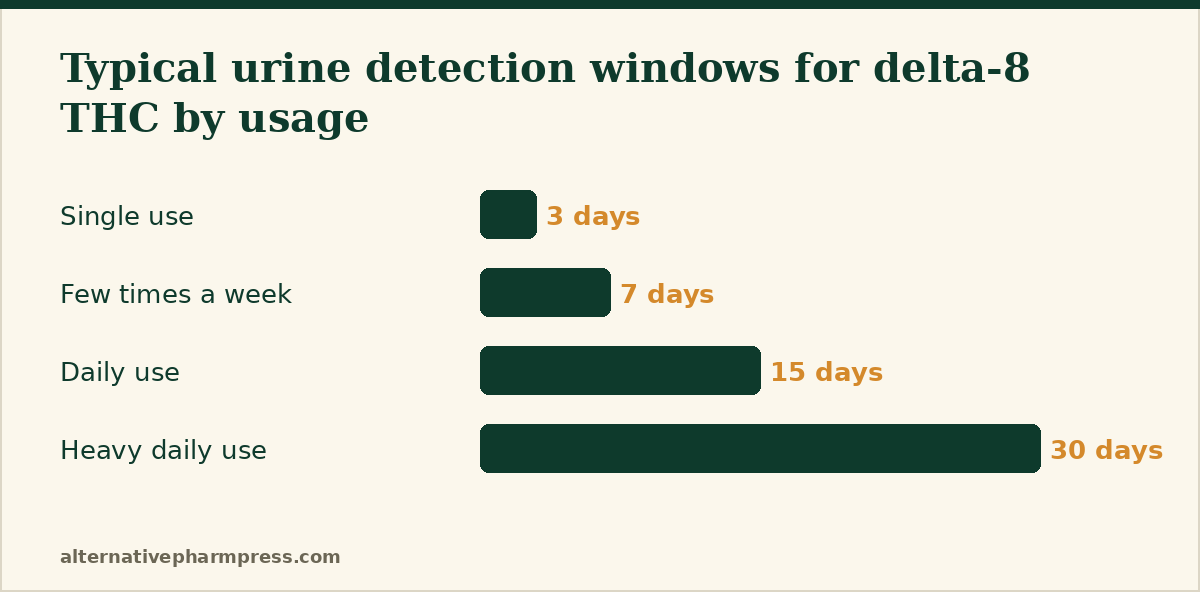
- Typical urine detection: 1–3 days after a single use, up to 30 days or more for heavy daily use.
- “Legal hemp” status doesn’t protect you from a positive result or workplace consequences.
- The only reliable way to pass is not using delta-8 before a test.
Why delta-8 triggers a positive drug test
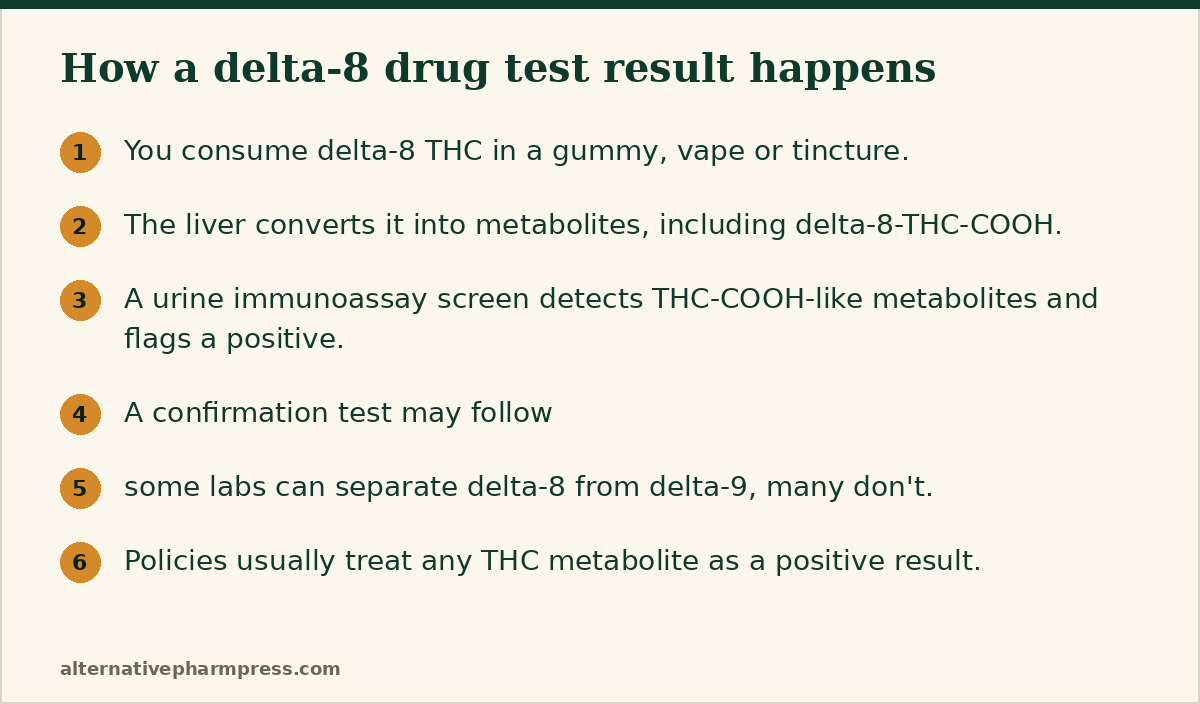
Most workplace and legal drug screens use an immunoassay — a quick test using antibodies that recognize THC metabolites, especially THC-COOH. Delta-8 and delta-9 THC are nearly identical molecules, and their metabolites look alike to these antibodies. When you consume delta-8, your body produces delta-8-THC-COOH, which the screening test detects as a THC positive.
If a screen is positive, labs often run a confirmation test (GC-MS or LC-MS). Some advanced labs can separate delta-8 metabolites from delta-9 metabolites, but many confirmation methods weren’t designed to distinguish them, and even when they can, an employer may still treat any THC as a violation. Plus, many delta-8 products contain measurable delta-9 THC.
Detection windows by test type
| Test type | Typical detection window | Notes |
|---|---|---|
| Urine (single use) | 1–3 days | Most common workplace test |
| Urine (moderate use, several times a week) | 5–10 days | Varies with body fat and dose |
| Urine (heavy daily use) | 30 days or more | Metabolites stored in fat tissue |
| Saliva | 1–3 days | Used for roadside and some workplace tests |
| Blood | Hours to 1–2 days | Mostly reflects recent use |
| Hair | Up to about 90 days | Less sensitive to single use |
These ranges come from research on delta-9 THC, which delta-8 is expected to follow closely. Individual results vary.
What affects how long delta-8 stays in your system
- Frequency of use — the biggest factor. Metabolites accumulate in fat tissue with regular use.
- Dose and potency — high-milligram gummies and vapes deliver more THC.
- Body fat percentage — THC metabolites are fat-soluble and stored in fat.
- Metabolism — age, genetics, activity level and liver function all play a role.
- Format — edibles produce more 11-hydroxy-THC and often involve larger doses than vaping.
- Test cutoff — a 20 ng/mL screen detects use for longer than a 50 ng/mL screen.
Our article on how long THCA stays in your system explains cutoffs and confirmation testing in more detail; the same principles apply to delta-8.
Common myths about delta-8 and drug tests
“It’s legal, so it won’t show up.” Legal status has nothing to do with detection. Drug tests look for metabolites, not legal categories.
“Delta-8 is a different molecule, so it won’t trigger the test.” The molecules are close enough that standard screens cross-react.
“I can explain it’s hemp.” Some employers accept explanations; many have zero-tolerance policies for any THC. Federal and safety-sensitive jobs typically don’t accept hemp explanations.
“Detox drinks will clear it.” Most detox products work by diluting urine. Labs check for dilution, and a “dilute” result can be treated as a failure or require a retest.
What about CBD and other hemp products?
| Product | Drug-test risk |
|---|---|
| Delta-8 THC | High |
| Delta-9 hemp gummies | High |
| THCA flower or vapes | High |
| HHC and THCP | Likely, and often blended with other THCs |
| Full-spectrum CBD | Possible with regular use |
| Broad-spectrum or isolate CBD | Low, unless contaminated |
See can CBD fail a drug test?, delta-8 vs delta-9 THC and delta-8 vs CBD.
If you have a drug test coming up
The only reliable approach: stop using delta-8 (and all THC products) as early as possible before any test you know about. If you’re subject to random testing, avoid THC products entirely.
Other considerations:
- Know your workplace policy. Some employers distinguish hemp products; many don’t.
- Check state law. A handful of states protect off-duty cannabis use for some workers, but rarely for safety-sensitive or federally regulated jobs, and protections may not cover hemp-derived THC.
- Medical review officers (MROs) review positive results. Be honest about legal products you’ve used, but understand it may not change the outcome.
- Don’t use synthetic urine or adulterants. Many states criminalize them, and labs routinely detect them.
Delta-8 and legal status
Delta-8’s legal status doesn’t change drug-test results, but it does affect whether you can buy it at all. Many states ban or restrict delta-8, and federal hemp law changes in 2026 restrict intoxicating hemp products further. See delta-8 legal status by state, delta-8 legal states 2026 and federal hemp law explained.
Home tests and delta-8
Home THC test strips use similar immunoassays and generally detect delta-8 metabolites too. They can give a rough idea of whether you’re still above a common cutoff, but they’re not definitive. A faint line, a different cutoff or diluted morning urine can all mislead you. Treat a negative home test as a hint, not a guarantee.
Can a lab tell delta-8 from delta-9?
Increasingly, yes — but it depends on the lab. Advanced confirmation methods using liquid chromatography with tandem mass spectrometry (LC-MS/MS) can separate delta-8-THC-COOH from delta-9-THC-COOH because the two compounds come off the column at slightly different times. Some forensic and toxicology labs have updated their methods to do this since delta-8 became widespread.
However, whether a lab separates them — and whether anyone cares — depends on the testing program:
- Workplace programs usually report a positive for “THC/cannabinoids” without distinguishing isomers.
- Federally regulated testing (for example, transportation workers) follows strict rules, and a THC metabolite positive is typically a violation regardless of source.
- Court and probation programs vary; some specifically prohibit any THC product.
- Sports testing prohibits all natural and synthetic cannabinoids except CBD under WADA rules.
So even when the lab can technically identify delta-8, it usually doesn’t help you pass.
Delta-8 metabolites and edibles vs vapes
Format affects more than how you feel. Edibles send THC through the liver first, producing more 11-hydroxy-THC and often involving larger total doses (a single gummy may contain 25–50 mg). Vapes deliver smaller amounts per puff but can be used repeatedly throughout the day. Both can lead to accumulation with frequent use. Heavy vape users who take dozens of puffs a day may test positive as long as heavy edible users.
Real-world scenarios
“I tried one delta-8 gummy at a party a week ago.” For an occasional user, a single moderate dose usually drops below standard urine cutoffs within a few days. A week later, most people would test negative on a standard 50 ng/mL screen — but higher doses, slower metabolism or a more sensitive cutoff could extend that.
“I vape delta-8 every evening and have a pre-employment test in 10 days.” Daily users often remain positive for two weeks or more. Ten days may not be enough. Stopping immediately gives you the best chance.
“I only use CBD, but my product might contain delta-8.” Some low-quality CBD products have been found to contain delta-8 or delta-9. Check the batch COA, and choose broad-spectrum or isolate products with full cannabinoid panels if you’re tested.
“I’m on probation, and delta-8 is legal in my state.” Probation terms often prohibit all THC regardless of legal status. Ask your probation officer before using any hemp-derived THC product.
FAQ
Does delta-8 show up on a drug test?
Yes. Standard THC drug screens detect delta-8 metabolites, and many delta-8 products also contain delta-9 THC.
How long does delta-8 stay in your urine?
Roughly one to three days after a single use, about a week or more for moderate use, and up to 30 days or more for heavy daily use.
Can a drug test tell the difference between delta-8 and delta-9?
Some advanced confirmation tests can, but many can’t, and employers often treat any THC metabolite as a positive result.
Will a delta-8 vape show up on a drug test?
Yes. Vaping delta-8 produces the same metabolites as edibles, though detection windows depend on how much and how often you vape.
Can I pass a drug test after using delta-8?
The only reliable way is to stop using it well before the test. Detox products and dilution are unreliable and often detected.
Does secondhand delta-8 vapor cause a positive test?
It’s very unlikely under normal conditions. Studies on secondhand cannabis smoke show positive results only in extreme, unventilated exposure, and vapor generally carries less.
How long after stopping delta-8 will I test negative?
It depends on how often you used it. Occasional users often test negative within a few days; daily users may need two to four weeks or longer.