
THCA products are often sold as “legal hemp,” which leads many people to assume they won’t affect a drug test. Unfortunately, that assumption causes a lot of failed tests. Once THCA is heated — smoked, vaped, dabbed or baked — it converts into delta-9 THC, and your body processes it exactly the same way it processes THC from marijuana.
So how long does THCA stay in your system? The answer depends on how you used it, how often, your body and the type of test. This guide breaks it down.
Key takeaways
- Heated THCA becomes delta-9 THC, which the body breaks down into THC-COOH — the metabolite drug tests look for.
- Urine: roughly 3 days after a single use, up to 30 days or more for heavy daily users.
- Blood: usually hours to a couple of days; longer in frequent users.
- Saliva: typically 1–3 days.
- Hair: up to about 90 days.
- Frequency of use and body fat are the biggest factors in how long metabolites linger.
Why THCA shows up on drug tests
Raw THCA is the non-intoxicating acid form of THC in cannabis. When heated, it loses a carboxyl group and becomes delta-9 THC (we explain the chemistry in does THCA get you high?). Delta-9 THC is then metabolized by the liver into:
- 11-hydroxy-THC — an active metabolite.
- THC-COOH (11-nor-9-carboxy-THC) — an inactive metabolite that is fat-soluble and stored in body fat, then slowly released.
Standard drug tests look for THC-COOH. They can’t tell whether it came from marijuana, THCA flower or a delta-9 hemp gummy. So legally purchased THCA can produce exactly the same positive result as dispensary cannabis.
Detection windows by test type
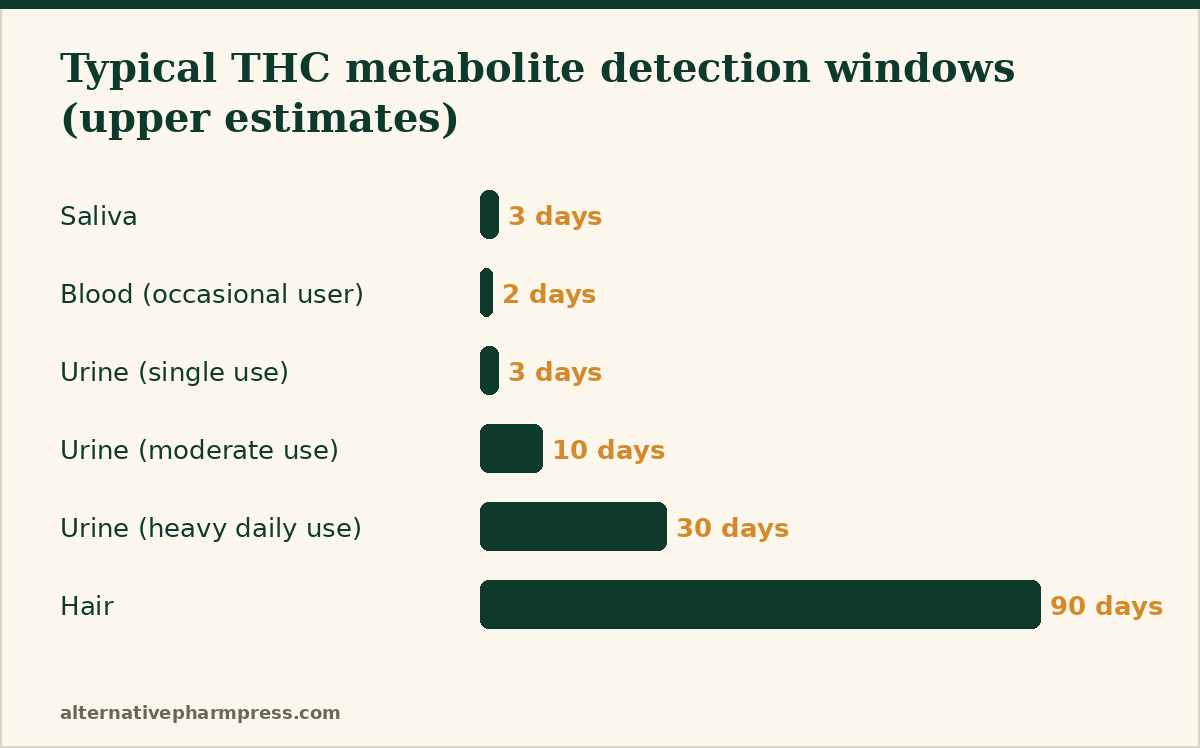
These are typical ranges; individual results vary and some heavy users test positive for longer.
Urine tests
Urine testing is the most common method for employment and probation screening. Typical immunoassay cutoffs are 50 ng/mL, with confirmation testing at 15 ng/mL.
| Usage pattern | Typical urine detection window |
|---|---|
| Single use | About 1–3 days |
| A few times a week | About 5–10 days |
| Daily use | About 10–20 days |
| Heavy daily use (several times a day) | 30 days or longer |
Blood tests
THC itself appears in blood within minutes of smoking and declines over hours. In occasional users it’s usually undetectable within a day or two, but metabolites can be found longer in frequent users. Blood tests are mostly used after accidents or in DUI investigations and generally reflect recent use.
Saliva tests
Oral fluid tests detect THC in the mouth and are increasingly used for roadside and workplace testing. Detection windows are typically 24–72 hours, sometimes longer in heavy users.
Hair tests
Hair tests can detect THC-COOH for around 90 days, because metabolites are incorporated into growing hair. They’re less sensitive to very light use, but regular users are likely to test positive.
What affects how long THCA stays in your system
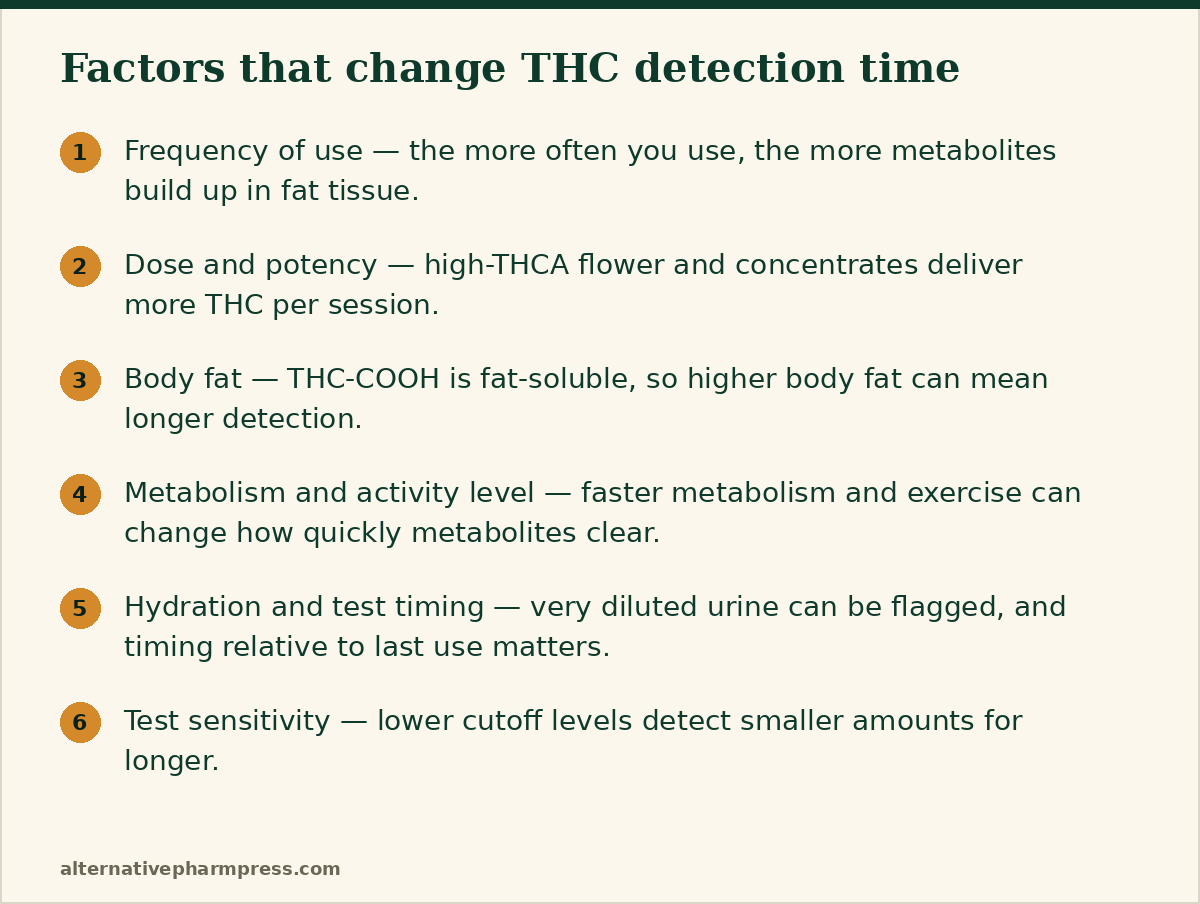
Frequency is the biggest factor
A single session might be undetectable in urine within a few days, while someone who smokes high-THCA flower daily can accumulate enough THC-COOH in fat tissue to test positive for a month or more after stopping.
Product potency
THCA flower often contains 20–30% THCA, which converts to roughly 17–26% THC when smoked. Concentrates like THCA diamonds exceed 90%. Higher doses mean more metabolites to clear.
Body composition and exercise
Because THC-COOH is stored in fat, people with higher body fat may test positive longer. Intense exercise or weight loss can release stored metabolites back into the blood — which is why some people see a positive result after a period of abstinence.
Does raw THCA show up on a drug test?
If you consume raw, unheated THCA (for example, raw cannabis in smoothies or “raw THCA” tinctures), less of it converts to THC. However:
- Some THCA converts during storage, processing and in the body.
- Many “raw” products also contain measurable delta-9 THC.
- Some tests may detect THCA-related compounds.
There have been cases where people consuming raw cannabis products tested positive. If you’re subject to testing, the safest choice is to avoid THCA products entirely.
Can you speed up clearing THCA?
There’s no proven way to rapidly flush THC metabolites. Common claims and what we know:
- Detox drinks and kits: mostly work by diluting urine and adding creatine or B vitamins to mask dilution. Labs test for dilution and adulteration, and a “dilute” or “adulterated” result can count as a failure.
- Drinking lots of water: dilutes urine temporarily but doesn’t remove stored metabolites, and over-hydration can be dangerous.
- Exercise: may help long-term but can temporarily raise metabolite levels if done right before a test.
- Time: the only reliable method.
Our advice: if you have an upcoming drug test for work, probation, sports or a medical program, don’t use THCA, delta-9 hemp or full-spectrum CBD products beforehand. Being “legal” doesn’t protect you from a positive result.
THCA vs other cannabinoids on drug tests
| Product | Likely to cause a positive THC test? |
|---|---|
| Smoked or vaped THCA flower | Very likely |
| Delta-9 hemp gummies | Very likely |
| Delta-8 THC products | Likely — metabolites cross-react with many tests |
| Full-spectrum CBD | Possible, with regular use |
| Broad-spectrum or isolate CBD | Unlikely, but not impossible with contaminated products |
Read more in can CBD fail a drug test?, delta-8 vs delta-9 THC and THCA vs delta-9 THC.
Legal context
THCA’s legal status is shifting as federal and state laws move toward counting “total THC.” But legal status doesn’t change drug-test results, and employers can typically enforce drug-free policies regardless of whether a product was legal to buy. Check our THCA legal guide by state and the latest on federal hemp law.
Understanding test cutoffs
Drug tests don’t simply detect “any THC.” They use cutoff levels — concentrations above which a result is called positive. Understanding them helps explain why two people with similar use can get different results:
- Initial screen (immunoassay): commonly set at 50 ng/mL of THC metabolites in urine for workplace testing, though some programs use 20 ng/mL, which detects use for longer.
- Confirmation test (GC-MS or LC-MS): a positive screen is usually confirmed with a more precise lab test, often with a 15 ng/mL cutoff for THC-COOH.
- Saliva cutoffs: oral fluid tests have their own, lower cutoffs because concentrations in saliva are much smaller.
A lower cutoff means a longer detection window. Some clinical and treatment programs use more sensitive testing than standard workplace panels, so the “typical” windows above may underestimate how long a positive result is possible in those settings.
Home drug tests: useful or misleading?
Home urine test strips are widely available and use the same immunoassay principle as many workplace screens. They can give you a rough idea of whether metabolites are still above a given cutoff, but there are important limits:
- Cutoffs differ. A home strip with a 50 ng/mL cutoff won’t tell you whether you’d pass a 20 ng/mL test.
- First-morning urine is more concentrated, so results can differ from a test taken later in the day.
- Reading errors are common, especially with faint lines.
- A negative home test isn’t a guarantee. Lab confirmation methods are more sensitive and specific.
If your job or legal situation depends on the result, treat a home test as a rough guide only.
Edibles vs smoking: does the method change detection time?
Eating decarboxylated THCA (for example, in homemade edibles) produces more 11-hydroxy-THC during the first pass through the liver, and effects last longer than smoking. Detection times in urine are broadly similar for similar total doses, but edibles often deliver larger doses than people realise, which can extend detection. Vaping and dabbing concentrates can deliver very high doses quickly, which also adds to metabolite load.
What to do if you’ve used THCA and have a test coming
If you’ve already used THCA and a test is coming up, your realistic options are limited:
- Stop using immediately. Every day without use gives metabolites time to clear.
- Don’t rely on detox products. Many are designed to dilute urine, which labs check for.
- Be honest where appropriate. In some medical or treatment settings, disclosure leads to better care than a surprise result.
- Know your rights. A few states protect off-duty cannabis use for some employees, but rules vary widely and rarely apply to safety-sensitive jobs or federal testing.
FAQ
How long does THCA stay in your urine?
After a single use, typically 1–3 days. Regular users may test positive for 10–30 days, and heavy daily users sometimes longer.
Will THCA flower make me fail a drug test?
Very likely. Smoking or vaping THCA produces delta-9 THC, and your body creates the same metabolite that standard drug tests detect.
How long does THCA stay in your blood?
THC is usually detectable in blood for hours to a couple of days in occasional users, and longer in frequent users.
Does raw THCA show up on a drug test?
It can. Some raw THCA converts to THC, and many raw products contain some delta-9 THC. If you’re tested, avoid THCA products.
Can I flush THCA out of my system quickly?
No method reliably speeds up clearance. Detox products mainly dilute urine, which labs can detect.
Does THCA show up on a drug test?
Yes. When THCA is heated it becomes delta-9 THC, and even unheated products often contain some THC, so use can produce THC-COOH metabolites that standard tests detect.