
Texas is home to thousands of hemp shops, and THCA flower became one of their best-selling products. For years, Texans could buy THCA pre-rolls and vapes legally even though recreational marijuana remained illegal. Then the political ground shifted — first at the state level in 2025, then federally.
So is THCA legal in Texas right now? The honest answer is that the rules have changed repeatedly and continue to change. This guide explains the history, the key decisions, how federal law now affects Texas and what you should verify before buying.
Key takeaways
- Texas legalized hemp in 2019 with a 0.3% delta-9 THC limit, which allowed a large market for THCA flower and other hemp-derived THC products.
- In 2025, the Legislature passed SB 3 to ban most consumable THC hemp products; the governor vetoed it and called for regulation instead.
- The governor then issued an executive order directing agencies to tighten rules, including age-21 limits.
- Federal legislation passed in late 2025 redefines hemp around total THC, which affects THCA flower nationwide.
- Because rules keep changing, check current Texas and federal rules before buying or traveling.
How THCA became legal in Texas
Texas’s 2019 hemp law (House Bill 1325) followed the federal 2018 Farm Bill, defining hemp as cannabis containing no more than 0.3% delta-9 THC on a dry-weight basis. The law focused on delta-9 THC. THCA — the acid form that converts to THC when heated — wasn’t treated the same way in retail testing, so high-THCA flower could be sold as hemp as long as its delta-9 content was under the limit.
When smoked or vaped, that flower behaves much like marijuana. We explain the chemistry in does THCA get you high? and the testing gap in THCA vs delta-9 THC.
The 2025 fight over THC in Texas
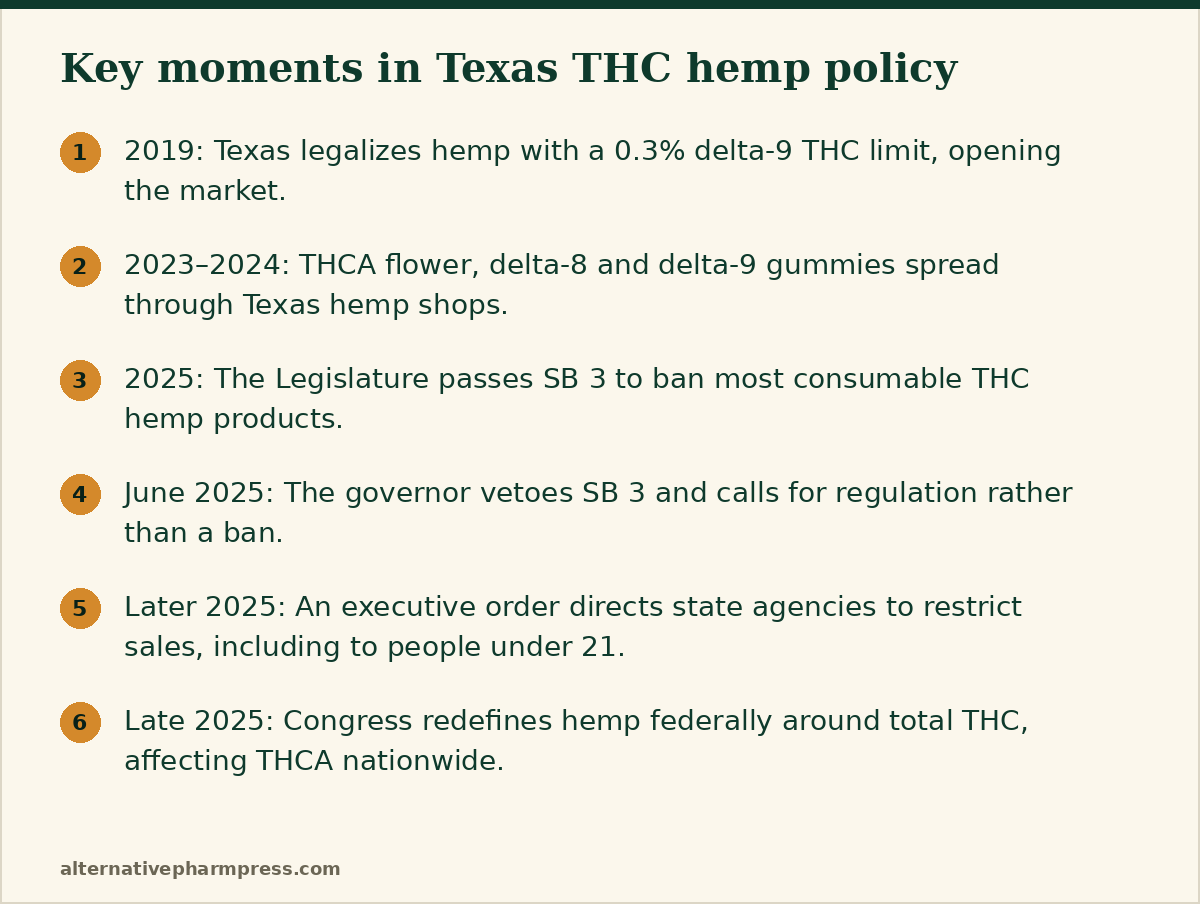
In 2025, the Texas Senate made banning THC hemp products a priority, and the Legislature passed Senate Bill 3, which would have banned most consumable products containing THC from hemp. Hemp businesses, veterans’ groups and others lobbied hard against it. In June 2025, Governor Greg Abbott vetoed SB 3, arguing that a ban would face legal challenges and that strict regulation — including age limits — was a better path. Special legislative sessions followed, with continued debate over how far restrictions should go.
The governor subsequently issued an executive order directing state agencies (including the Department of State Health Services and the Texas Alcoholic Beverage Commission) to tighten oversight of hemp-derived THC products, including prohibiting sales to people under 21 and stepping up testing and labeling enforcement.
Details of rulemaking and enforcement have continued to evolve, so treat any summary — including this one — as a starting point and confirm current rules with official sources.
How federal law changes the picture
Separately from Texas politics, Congress passed legislation in late 2025 that redefines hemp at the federal level. Key effects:
- Hemp is measured by total THC, which includes THCA (THCA × 0.877 + delta-9 THC), rather than delta-9 alone.
- Intoxicating hemp-derived products are sharply restricted, including limits on THC per container for consumer products.
- The change was designed to close the “THCA loophole” and the market for converted cannabinoids like delta-8.
Under a total-THC standard, typical high-THCA flower would no longer qualify as hemp, regardless of state law. Read our explainers on the federal hemp law, the hemp ban, what it means for products and whether THCA is legal after the federal change.
So, is THCA legal in Texas today?
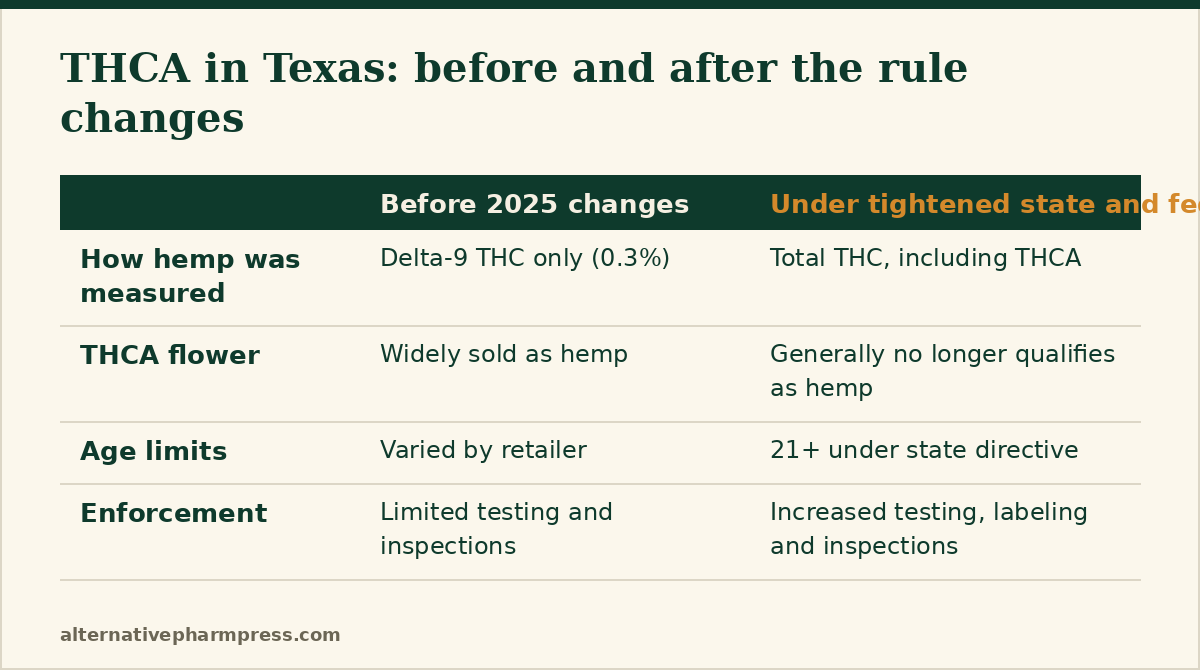
The practical answer for most consumers: THCA flower and high-THCA products face serious legal risk in Texas under the combination of state restrictions and the federal total-THC standard. Some products may still be on shelves during transition periods or due to legal challenges, but availability doesn’t mean legality.
Before buying, check:
- Current Texas DSHS and TABC guidance on consumable hemp products.
- Whether the product meets the federal total-THC definition on its certificate of analysis.
- Age requirements — you’ll generally need to be 21+.
- Local enforcement — some counties and cities have pursued their own actions against THC shops.
Our THCA legal status by state guide is updated as rules change.
Marijuana and medical cannabis in Texas
Recreational marijuana remains illegal in Texas. The state’s Compassionate Use Program allows registered patients with qualifying conditions to access low-THC cannabis through licensed dispensing organizations, and the program has been expanded over time. If you have a qualifying condition, that regulated pathway is more legally secure than hemp THC products.
Risks for Texans buying THCA
- Criminal exposure: products that don’t meet the hemp definition may be treated as marijuana. Penalties depend on amount and form; concentrates have historically been treated more harshly than flower in Texas.
- Drug tests: THCA produces positive THC results. See how long THCA stays in your system.
- Travel: carrying THCA across state lines or through airports is risky under federal law and other states’ laws.
- Product quality: enforcement sweeps have found mislabeled products; always check COAs.
This article is general information, not legal advice. Texas and federal hemp rules have changed several times and may change again. For decisions with legal consequences, consult a Texas attorney or official state guidance.
What about other hemp products in Texas?
The same state and federal changes affect delta-8, delta-9 hemp gummies, THCP, HHC and similar intoxicating products. Non-intoxicating CBD products generally remain available, though full-spectrum products with measurable THC may be affected by per-container THC limits. See delta-8 legal status by state, CBD and the federal hemp THC limit and THCP vs THCA.
What Texas hemp businesses are doing
Many Texas hemp retailers have adjusted inventory, shifting toward non-intoxicating CBD, functional mushrooms, kava and other botanicals. Some have challenged restrictions in court, and industry groups continue to lobby for a regulated adult-use hemp framework rather than prohibition. If you buy from a local shop, ask staff how they’re complying with the latest rules — reputable retailers will be able to show certificates of analysis and explain their age-verification process.
How to verify a product’s compliance
If you’re evaluating any hemp product in Texas, the certificate of analysis is your best tool:
- Look for total THC (or THCA and delta-9 listed separately so you can calculate it).
- Check that the sample date and batch match the product.
- Confirm the lab is accredited and independent.
- Note potency per serving and per package for edibles and beverages.
If a product only lists delta-9 THC and omits THCA, treat that as a red flag under current rules.
How Texas compares with neighboring states
Texans often travel to neighboring states, so it’s worth knowing the broad picture — while remembering that carrying cannabis products across state lines can break federal law and the laws of the states involved:
- New Mexico has legal adult-use marijuana through licensed dispensaries.
- Oklahoma has a large medical marijuana program.
- Louisiana has a medical program and regulates hemp-derived THC products separately.
- Arkansas has a medical marijuana program and has moved to restrict hemp-derived intoxicants.
Products bought legally in one state can be illegal to possess once you return to Texas. Don’t bring cannabis or THC products back across state lines.
Frequently misunderstood points
“If a shop sells it, it must be legal.” Shops sometimes sell products during legal transition periods, while lawsuits are pending, or simply in violation of the rules. Availability isn’t proof of legality.
“Hemp means federally legal everywhere.” The federal hemp definition has changed, and states can be stricter than federal law.
“Smokable hemp is the same as CBD.” Many smokable hemp products are high in THCA and produce THC when lit.
“Under 0.3% delta-9 means compliant.” Under a total-THC standard, THCA counts too.
FAQ
Is THCA legal in Texas?
THCA flower faces significant legal risk in Texas under tightened state rules and the new federal total-THC hemp definition. Check current state and federal guidance before buying.
Did Texas ban THC in 2025?
The Legislature passed SB 3 to ban most consumable THC hemp products, but the governor vetoed it and instead directed agencies to tighten regulation, including age-21 limits.
Can you buy THCA in Texas if you’re under 21?
State directives restrict sales of hemp-derived THC products to adults 21 and older.
Will federal law make THCA illegal in Texas?
The federal redefinition of hemp around total THC means most high-THCA flower no longer qualifies as hemp, regardless of state law.
Is marijuana legal in Texas?
No. Recreational marijuana remains illegal. Texas operates a limited medical program called the Compassionate Use Program.
Where can I check the latest Texas hemp rules?
The Texas Department of State Health Services publishes guidance for its Consumable Hemp Program, and the Texas Alcoholic Beverage Commission oversees some hemp retail rules. Check both, along with federal USDA hemp guidance.