
Most peptides are destroyed in the digestive tract, which is why drugs like insulin and semaglutide are usually injected. BPC-157 is often described as an exception: it appears unusually stable in gastric acid, and animal studies have tested it orally. That’s the basis for the booming market in BPC-157 capsules, which promise the benefits of the peptide without needles.
So do oral capsules work as well as injections? This article looks at the evidence, the theory behind oral delivery, the open questions and the quality problems that apply to both forms.
Key takeaways
- BPC-157 was derived from a gastric juice protein, and lab studies suggest it resists breakdown in stomach acid better than most peptides.
- Rodent studies tested oral (often in drinking water), injected and topical routes; several reported effects with oral dosing, especially for gut injuries.
- Whether oral BPC-157 reaches meaningful levels outside the gut in humans is unknown.
- There are no controlled human trials comparing oral capsules and injections.
- Both forms are unapproved, banned in sport and vulnerable to quality and labeling problems.
Why oral delivery is plausible for BPC-157
Peptides are chains of amino acids, and the stomach and small intestine are full of enzymes designed to break such chains apart. Most therapeutic peptides survive only minutes after swallowing, and only tiny fractions get absorbed intact.
BPC-157 is different in two ways:
- Origin: its sequence comes from a protein naturally present in gastric juice, an environment where stability would be useful.
- Lab stability: researchers have reported that BPC-157 remains stable in human gastric juice for extended periods in laboratory conditions.
That doesn’t mean it’s absorbed efficiently, but it does mean oral delivery isn’t automatically pointless — especially for problems located in the gut itself.
What animal studies tested
Rodent research from the main group studying BPC-157 often compared routes. Several studies reported that oral administration in drinking water produced effects in models of:
- Gastrointestinal injury — ulcers, inflammatory bowel disease models, fistulas and intestinal anastomosis healing
- Tendon and muscle injury — in some studies, oral dosing showed effects comparable to injection
- Organ protection — some models of liver and blood vessel injury
These findings fuel the claim that “oral works just as well.” But they come from rodents, often from a single research group, and rodent gut physiology and dosing differ substantially from people’s. Our overview of BPC-157 benefits covers the broader evidence base.
What we don’t know about oral BPC-157 in humans
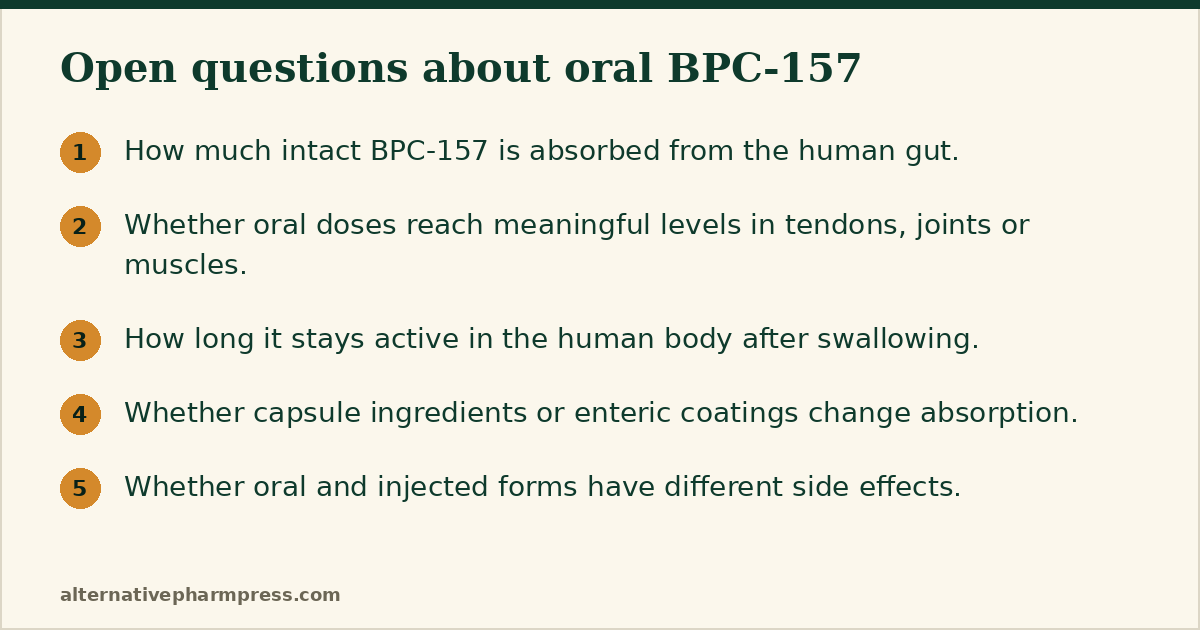
No published human pharmacokinetic studies clearly establish how much BPC-157 survives digestion and enters the bloodstream after oral dosing. That means claims that “500 mcg oral equals 250 mcg injected” are guesses. For a gut-focused problem, local action in the digestive tract might be enough; for a knee or shoulder, it’s unclear whether oral doses reach the tissue at all.
Oral vs injectable: a practical comparison
| Factor | Oral capsules | Injections |
|---|---|---|
| Evidence base | Rodent studies; especially gut models | Rodent studies; tendon, muscle, gut models |
| Human data | None controlled | Very limited pilot reports |
| Convenience | No needles, no reconstitution | Requires sterile handling |
| Infection risk | None from injection | Abscess and infection risk, especially with non-sterile products |
| Dosing precision | Depends on capsule accuracy | Depends on vial accuracy and measuring |
| Common product issues | Underdosing, fillers, degradation | Underdosing, contamination, endotoxins |
| Regulatory status | Unapproved | Unapproved |
Quality problems with BPC-157 capsules
Capsule products bring their own challenges:
- Stability during manufacturing and storage. Peptides can degrade with heat, moisture and time. Many capsule products don’t publish stability data.
- Dose accuracy. Tiny microgram amounts must be evenly distributed in filler powder. Independent tests of peptide products have found large discrepancies from label claims.
- “Arginate” or salt forms. Some products use BPC-157 arginate, marketed as more stable. Comparative human data doesn’t exist.
- Undisclosed ingredients. Some “gut health” capsules list BPC-157 alongside many other ingredients, making it hard to know what’s doing what.
Look for batch-specific certificates of analysis showing identity (mass spectrometry), purity (HPLC) and quantity per capsule. Our guide to how to read a peptide COA explains each test.
Safety considerations for both forms
- Unknown long-term safety — see BPC-157 side effects and safety.
- Theoretical tumor concern because of angiogenesis-related mechanisms.
- Interactions with medications are unstudied.
- Pregnancy and breastfeeding: no safety data; avoid.
- Athletes: prohibited by WADA in any form.
Oral capsules avoid injection-related risks like infection, but they don’t remove the core uncertainty of using an unapproved peptide.
Regulatory status
BPC-157 isn’t an approved drug in the US. The FDA flagged it among bulk substances with safety concerns for compounding, limiting legitimate pharmacy access, and products are sold as “research use only.” Some supplement-style capsules may violate FDA rules on new dietary ingredients. See the FDA advisory vote on BPC-157 and what research-use-only means.
Why gut health claims are the most plausible
If oral BPC-157 works anywhere, the gut is the most plausible target. The peptide would contact the stomach and intestinal lining directly, and the strongest oral data in animals involves gastrointestinal injury models. Even so, people with digestive conditions such as ulcers, inflammatory bowel disease or reflux should rely on proven treatments and medical care. Using an unregulated peptide could delay diagnosis of something serious.
Doses you’ll see marketed
Capsules commonly contain 250–500 micrograms per capsule, with labels suggesting one or two per day. These figures aren’t derived from human trials. For the background on why dosing is uncertain, read BPC-157 dosage in research.
How BPC-157 compares with other oral “healing” supplements
If you’re interested in oral options for joint or gut support, several supplements have more human research than BPC-157, though effects are generally modest:
- Collagen peptides — some trials suggest small benefits for joint pain and skin.
- Glutamine — studied for gut barrier support in specific clinical settings.
- Curcumin (with enhanced absorption) — some evidence for joint pain and inflammation.
- Omega-3 fatty acids — anti-inflammatory effects with broad cardiovascular evidence.
- Zinc carnosine — studied for stomach lining support.
None of these are miracle cures, but they’re regulated as supplements with longer safety track records. Talk to a clinician before starting anything for a diagnosed condition.
Reading capsule labels critically
When you examine a BPC-157 capsule product, check:
- Micrograms of BPC-157 per capsule — not just “proprietary blend.”
- The form — standard acetate, arginate salt or another variant.
- Capsule type — enteric-coated or delayed-release claims should be supported by data.
- Other ingredients — fillers, flow agents and any added botanicals.
- Storage instructions — refrigeration requirements suggest stability concerns.
- Batch-matched COA — identity, purity and quantity per capsule from an independent lab.
A product that can’t provide these details isn’t one you can evaluate.
The science of peptide absorption, simplified
To understand why oral peptides usually fail, it helps to know the obstacles they face:
- Stomach acid can unfold or break peptide bonds.
- Digestive enzymes such as pepsin, trypsin and chymotrypsin cut proteins into small fragments.
- The intestinal lining lets small nutrients through but blocks most large molecules.
- The liver processes much of what is absorbed before it reaches the rest of the body.
Pharmaceutical companies have spent decades developing tricks to get around these barriers. Oral semaglutide (Rybelsus), for example, uses an absorption enhancer called SNAC and still only a tiny percentage of each dose reaches the bloodstream — which is why the oral dose is much higher than the injected dose. BPC-157 capsules rarely use validated absorption technology, and their absorption hasn’t been measured in people.
What a good human study would look like
To settle the oral-versus-injection question, researchers would need to:
- Give healthy volunteers measured oral and injected doses and track blood levels over time (a pharmacokinetic study).
- Confirm that what’s detected is intact BPC-157 rather than fragments.
- Run randomized, placebo-controlled trials in a specific condition — for example, a tendon injury or ulcerative colitis — comparing routes.
- Follow participants long enough to detect side effects.
Until those studies exist, both oral and injected use rest on animal data and assumptions.
FAQ
Do oral BPC-157 capsules work?
Rodent studies reported effects with oral dosing, especially for gut injuries. Whether oral capsules work in humans, and for which conditions, hasn’t been established in controlled trials.
Is oral BPC-157 as effective as injections?
There are no human studies comparing them. Claims of equivalence come from animal research and anecdotes.
Why is BPC-157 stable in the stomach?
It’s derived from a gastric juice protein, and lab studies suggest it resists breakdown in stomach acid better than most peptides.
Are BPC-157 capsules legal?
BPC-157 isn’t FDA-approved and is generally sold as a research chemical. It’s prohibited in sport.
What’s the best form of BPC-157 for gut problems?
Animal data is most consistent for oral use in gut models, but there’s no proven human treatment. See a clinician for digestive issues.
Should BPC-157 capsules be refrigerated?
Many sellers recommend cool, dry storage, and some recommend refrigeration. Peptides can degrade with heat and moisture, so follow the label — and be wary of products with no storage guidance.