
Kratom tea is a hot-water extract of the leaves of Mitragyna speciosa. In Thailand and Malaysia, the leaves have traditionally been chewed fresh or boiled into a decoction, sometimes for hours. Lab tests show water pulls out only part of the leaf’s main alkaloid, mitragynine, so tea is usually weaker than the same weight of powder. It still carries real risks.
Much of what is written online about kratom tea is recipe content. This guide does not give one. It covers what researchers have found about traditional preparation, what boiling does to kratom’s alkaloids, what studies of long-term tea drinkers in Southeast Asia show, how commercial teas differ, and the safety, interaction and legal points that apply in October 2026.
At a glance
| Question | What the evidence shows |
|---|---|
| Traditional forms | Fresh leaves chewed; leaves boiled into a decoction1,2 |
| How much mitragynine reaches the tea | Far less than a solvent extract: 0.06 to 0.13% w/w by infusion vs 0.49 to 0.62% by methanol in one tea-bag study3 |
| Boiling vs steeping | Boiling extracted more active compounds in a Thai lab study4 |
| 7-OH in fresh-leaf decoction | Not detected in a preliminary Malaysian analysis5 |
| Average mitragynine per traditional drink | 79 mg in a survey of 293 Malaysian users6 |
| Dependence in regular tea drinkers | Common: over half had severe dependence in the same survey6 |
| US legal status | Leaf not federally scheduled; FDA says kratom is not lawful in food or supplements7 |
What is kratom tea?
Kratom is a tropical evergreen tree native to Southeast Asia, related to coffee. Its leaves contain dozens of indole alkaloids. The most abundant is mitragynine, joined by much smaller amounts of the more potent opioid agonist 7-hydroxymitragynine (7-OH).8 Our explainer on mitragynine vs 7-hydroxymitragynine covers how the two differ.
“Kratom tea” covers several things. In Southeast Asia it usually means a decoction of leaves boiled in water. In the US it more often means dried leaf powder steeped or simmered at home, commercial tea bags, or bottled drinks and extracts sold as tea. Those products are not chemically equivalent, a point Malaysian researchers stressed in an October 2026 commentary.5
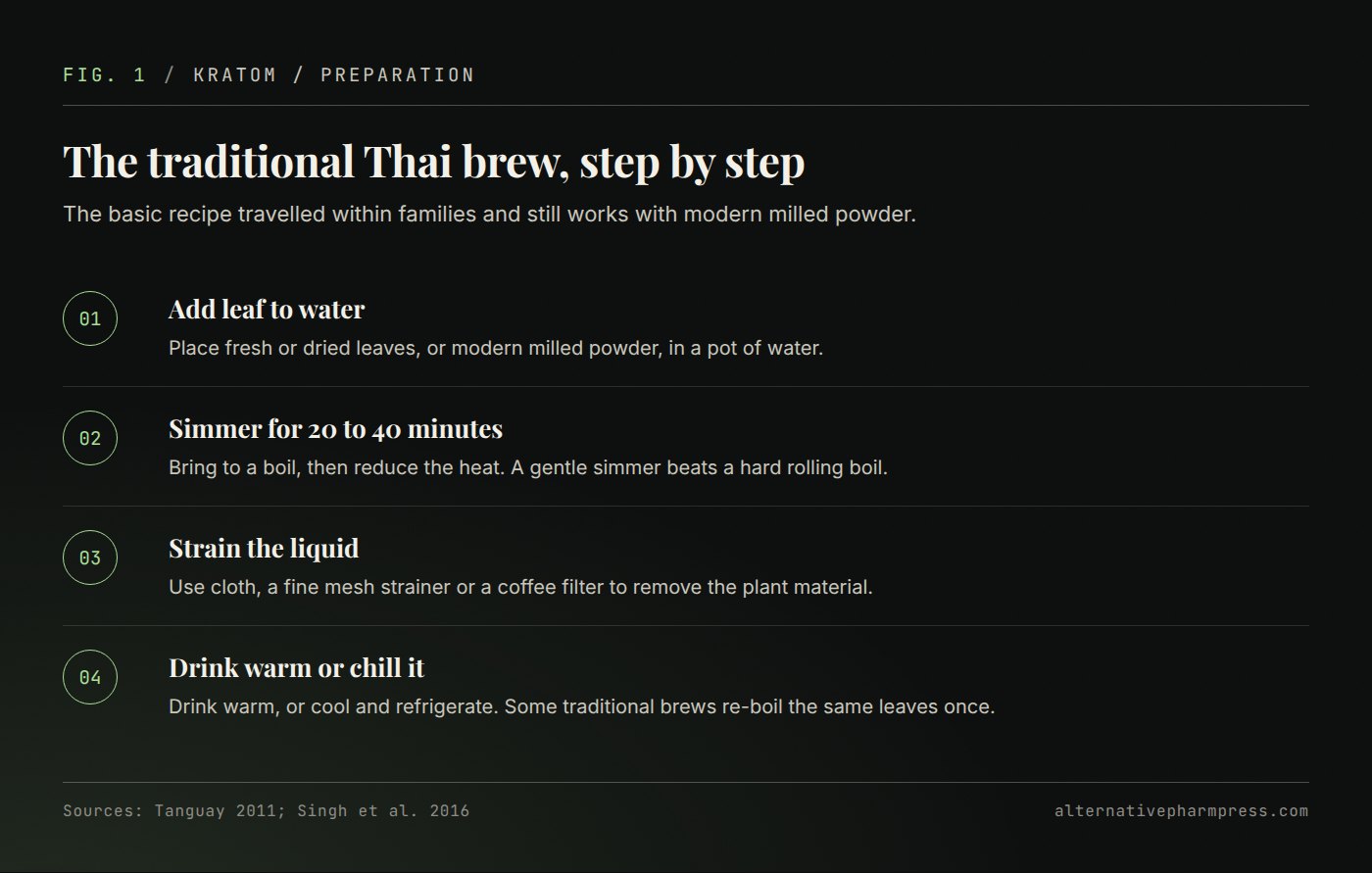
Traditional kratom tea preparation in Thailand and Malaysia
Kratom has long been used by rural people in Southeast Asia as a remedy for common ailments, to fight fatigue from manual work, as a social drink among men and in village religious functions.9 Two traditional routes dominate.
- Chewing fresh leaves. In southern Thailand, regular long-term chewing of fresh leaves is the traditional pattern examined in a community study of 1,118 men from 40 villages.2
- Boiled decoction. In Malaysia, kratom is mainly drunk as a decoction in which the leaves are boiled for several hours and the liquid is drunk several times through the day.1 Malaysian researchers note the traditional decoction is made from freshly harvested leaves, not dried ones.5
In the field, a “dose” is a glass of decoction, not a weighed amount of powder, so figures from Malaysia and Thailand do not translate neatly to Western products. For more on the leaf, see our guide to how kratom is processed.
The “4×100” cocktail and why it is a different risk
In urban areas, a newer pattern emerged: adulterated kratom cocktails drunk by younger people for euphoria.9 The best-known is “4×100”, popular in Thailand’s southernmost provinces. A Thai forensic report described it as boiled kratom leaves mixed with a cola soft drink, cough syrup and tranquillisers or mosquito coils.10
That report described a 21-year-old man whose blood and urine contained mitragynine alongside caffeine, diphenhydramine, alprazolam, nortriptyline, methadone, tramadol and methamphetamine. The authors concluded the death was probably caused by multidrug intoxication with additive central nervous system and respiratory depression.10 Thailand’s 2022 Kratom Act now prohibits consuming kratom mixed with narcotics, psychotropic substances or other designated substances, with fines of up to THB 50,000.11
What boiling does to kratom’s alkaloids
Only a few studies have measured what ends up in the cup, and they agree on one point: water extracts far less mitragynine than laboratory solvents.
- Tea bags. A University of Florida and Midwestern University team tested a commercial kratom tea bag. Brewing as a tea infusion gave 0.062 to 0.131% mitragynine by weight, compared with 0.485 to 0.616% when the same material was extracted with methanol.3 The tea-bag company supplied samples and recruited some survey participants, which the authors disclosed.
- Boiling vs steeping. A 2024 Thai study of three leaf varieties found brewing reduced mitragynine by about 80% compared with a methanol extract. Boiling extracted more active substances than steeping in hot water.4
- Fresh-leaf decoction. Malaysian researchers report that decoction from fresh leaves contains mitragynine and related alkaloids as water-soluble organic salts. Their preliminary analysis did not detect 7-OH in decoction made from freshly harvested, unprocessed leaves.5
Heat, acidity and alkaloid stability
Kratom alkaloids are sensitive to heat and pH. In a forensic stability study that held alkaloids at pH 2 to 10 and 4 to 80 °C for eight hours, all were acid labile. 7-OH was the least stable, with significant losses at 40 °C and above. Mitragynine showed no significant loss in water at up to 40 °C.12
That study was designed for handling lab samples, not to model tea, and it did not test hours of boiling. We found no published controlled study testing popular claims that adding lemon juice or other acids releases more alkaloids. No home preparation can tell you how much alkaloid is in a cup.
The starting leaf varies too
Mitragynine in naturally growing Thai kratom ranged from 7.5 to 26.6 mg per gram of dry leaf across regions, a more than three-fold spread.13 Add variable extraction on top, and two cups made the same way from different batches can differ substantially.
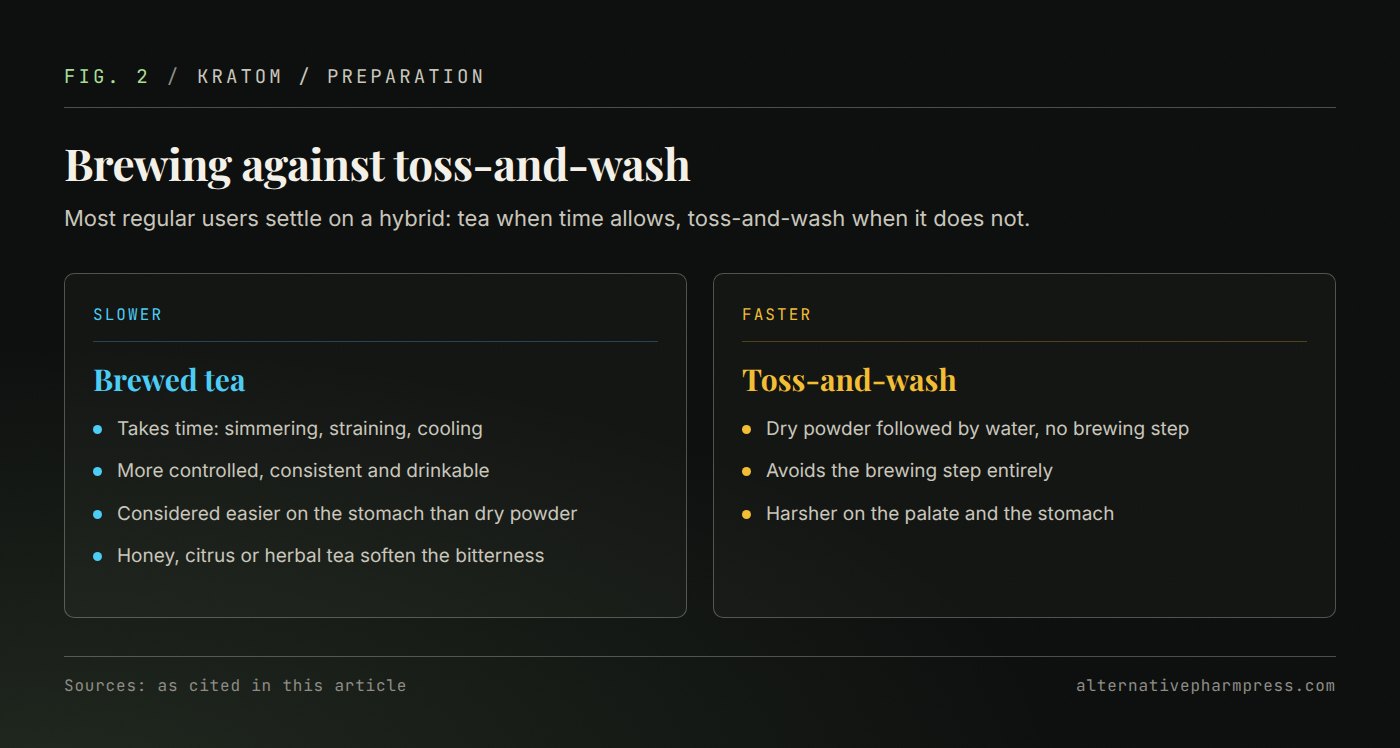
What research on traditional kratom tea drinkers shows
Most human data on kratom tea come from research groups in Malaysia and southern Thailand. The findings are mixed: few signs of physical harm in blood tests, but frequent dependence.
- Dependence and withdrawal. In a survey of 293 regular users in three northern Malaysian states, more than half had severe kratom dependence and 45% moderate dependence. The average mitragynine in a single kratom drink was 79 mg, suggesting about 276.5 mg a day. Drinking three or more glasses a day was linked with higher odds of severe dependence, withdrawal and craving.6
- Blood tests. A cross-sectional study of 58 regular users and 19 controls found no significant differences in haematology or clinical chemistry except HDL and LDL cholesterol. Use for over five years, or of 3½ glasses a day or more, did not appear to change the results.14
- Long-term health in Thailand. In the southern Thai surveys, common health complaints were no more frequent in users than non-users, but people with high dependence scores were more likely to report intense withdrawal, starting 1 to 12 hours after the last use. Medical records showed no deaths due to traditional use.2
- Pain tolerance. In a small randomised, placebo-controlled, double-blind study of 26 Malaysian men who drank kratom daily, a kratom decoction increased cold-water pain tolerance from 11.2 to 24.9 seconds after one hour, while a matched placebo drink did not.1
These studies have clear limits. Participants were almost all men, data were largely self-reported and cross-sectional, and blood-test studies were small. Lack of change in a blood panel does not rule out harm, and the dependence findings show traditional use is not risk-free. Our kratom research overview places these studies alongside Western data.
Human studies that used kratom tea
Kratom tea has also been the test product in clinical pharmacology studies:
- The first human pharmacokinetic study gave known amounts of kratom tea to 10 chronic Thai users. Mitragynine peaked in blood at about 0.83 hours, and its terminal half-life was about 23 hours.15
- A Thai metabolism study gave healthy volunteers freshly prepared tea containing 23.6 mg mitragynine. 7-OH appeared in blood, and pretreatment with the antifungal itraconazole cut its formation. The authors called it the first evidence of mitragynine being converted to 7-OH in humans, with the liver enzyme CYP3A4 involved.16
- A US interaction study found a single low dose of kratom tea (2 g) raised exposure to midazolam, a drug cleared by CYP3A, by about 39%, without affecting dextromethorphan.17
The last two findings matter for safety. Even a weak tea can change how the body handles certain medicines, and medicines that block CYP3A4 can change how kratom itself is processed.
Commercial kratom tea products
US shoppers meet kratom “tea” in several forms, and labels rarely make clear how they compare with a traditional decoction:
- Tea bags and loose leaf. In the tea-bag study above, consumers reported similar but often milder effects than users of other kratom products.3
- Extracts marketed as tea-like. A 2026 industry-funded observational study tested a leaf extract designed to mimic a traditional tea, at a 20 mg mitragynine-equivalent dose, and reported self-rated improvements in focus and energy.18 It had no control group, so placebo effects cannot be ruled out.
- Concentrated extracts. A 2026 trial of an extract containing 39.5% mitragynine concluded that concentrated extracts may give greater overall exposure than leaf powder or tea at comparable doses.19
- 7-OH products sold as “kratom”. Of 304 semi-synthetic 7-OH and mitragynine pseudoindoxyl products identified online, 92% of 7-OH-only products were advertised as kratom.20 They are not tea in any traditional sense. See 7-OH vs traditional kratom.
Contamination is another concern. The FDA has warned about kratom products contaminated with Salmonella or concerning levels of heavy metals.7 In eight products bought in Chicago-area shops, mitragynine ranged from 3.9 to 62.1 mg per gram, six carried microbes and seven had measurable nickel, lead and chromium.21 A batch certificate of analysis is the only independent check. Our guides to reading a kratom COA and COA red flags explain what to look for.
Kratom tea safety and side effects
Lower alkaloid content does not make tea safe. The FDA warns against using kratom because of the risk of serious adverse events including liver toxicity, seizures and substance use disorder, and it is aware of neonatal abstinence syndrome in babies exposed before birth.7
- Liver. The US Drug-Induced Liver Injury Network identified 11 cases attributed to kratom; all had jaundice and most were hospitalised, though all recovered.22 See kratom and liver injury.
- Heart. Austrian doctors reported cardiac arrest in a young, healthy man after drinking kratom tea, with markedly raised blood mitragynine, in what the authors described as isolated kratom intoxication.23 A single case cannot show how often this happens.
- Animal toxicity. Rats given kratom decoction daily for 28 days showed raised liver enzymes and changes in kidney, liver and brain tissue, with no deaths.24
- Dependence. As the Malaysian data show, frequent tea drinking can lead to dependence and withdrawal.6 Our article on kratom tolerance covers how it develops.
Reports to US poison centres rose from 258 in 2015 to 3,434 in 2025. Multiple-substance exposures were linked with more hospital admissions and accounted for 184 of 233 kratom-associated deaths.25
Interactions: alcohol, sedatives and medicines
Mixing is where much of the risk lies. In CDC data from 27 states, 152 people who died of overdoses tested positive for kratom; nearly all had multiple substances, most often fentanyl, with heroin, benzodiazepines, prescription opioids, cocaine and alcohol also listed as causes.26 Our guide to kratom and alcohol explains why that combination raises risk, and kratom and drug interactions covers medicines metabolised by CYP3A4 and CYP2D6.
Anyone taking prescription medicines, pregnant or breastfeeding, or with liver disease should talk to a doctor or pharmacist before using kratom in any form.
Is kratom tea legal?
United States. Kratom leaf is not a federally controlled substance. The FDA says kratom is not lawfully marketed as a drug, a dietary supplement or an additive in conventional food, and considers it an unsafe food additive.7 Several states ban it; see where kratom is legal.
On 14 October 2026 the DEA published a revised notice of intent to temporarily place 7-OH and mitragynine pseudoindoxyl in Schedule I above a threshold: more than 1 mg per gram (solids) or 1 mg per mL (liquids), or a mitragynine-to-7-OH (or 7-OH plus pseudoindoxyl) mass ratio below 100. The order cannot be published before 13 November 2026. Mitragynine and plain leaf are not scheduled by it, and the DEA notes that below-threshold products are not thereby deemed safe.27 As of 24 October 2026, 7-OH is not yet federally scheduled.
Thailand. Kratom was removed from the narcotics list on 24 August 2021.28 The Kratom Act, in force from 27 August 2022, bans sales to people under 18 and to pregnant or breastfeeding women, bans sales in places such as schools and parks, and prohibits consuming kratom mixed with narcotics or other designated substances.11
Malaysia. Mitragynine is listed under the Poisons Act 1952, and selling, processing and transporting kratom can be prosecuted, although the tree itself is not illegal.29
Frequently asked questions
Is kratom tea weaker than kratom powder?
Usually, per gram of leaf. In a tea-bag study, a water infusion extracted about 0.06 to 0.13% mitragynine by weight, compared with about 0.49 to 0.62% using methanol.3 A Thai study found brewing reduced mitragynine by about 80% versus a solvent extract.4 Leaf strength and preparation vary widely, so tea strength is unpredictable.
How is kratom tea traditionally prepared?
In Malaysia, kratom is mainly drunk as a decoction of leaves boiled for several hours, with the liquid drunk several times a day.1 Researchers note traditional decoction uses freshly harvested rather than dried leaves.5 In southern Thailand, chewing fresh leaves has been the main traditional route.2 Neither tradition uses weighed doses.
Does boiling kratom destroy 7-OH?
Heat can degrade it. In a stability study, 7-OH was the least stable kratom alkaloid, with significant losses over eight hours at 40 °C and above.12 A preliminary Malaysian analysis did not detect 7-OH in decoction made from fresh leaves.5 Neither study measured home-made tea from US powders, so the effect on any particular cup is unknown.
Is kratom tea safe?
Not risk-free. The FDA warns of liver toxicity, seizures and substance use disorder with kratom.7 Over half of 293 regular Malaysian tea drinkers had severe dependence.6 Blood tests in long-term users were largely normal in one small study,14 but serious events, including a cardiac arrest after kratom tea, have been reported.23
Can you drink kratom tea with alcohol or medicines?
Combining raises risk. Most kratom-associated deaths reported to US poison centres involved multiple substances.25 Even 2 g of kratom tea raised exposure to the CYP3A-cleared drug midazolam by about 39% in a clinical study.17 Avoid mixing kratom with alcohol, opioids, benzodiazepines or other sedatives, and ask a pharmacist about any prescription medicine.
Is kratom tea weaker than powder?
Tea extracts only part of the alkaloids into the water, and effects depend on the leaf and preparation, so strength varies. Bottled kratom shots can be much stronger than home-brewed tea.
Sources
- Vicknasingam B, Chooi WT, Rahim AA, Ramachandram D, Singh D, Ramanathan S, et al. Kratom and Pain Tolerance: A Randomized, Placebo-Controlled, Double-Blind Study. Yale J Biol Med. 2020;93(2):229-238. PMID: 32607084. pubmed.ncbi.nlm.nih.gov
- Saingam D, Singh D, Geater AF, Assanangkornchai S, Jitpiboon W, Latkin C. The Health Impact of Long-Term Kratom (Mitragyna Speciosa) Use in Southern Thailand. Subst Use Misuse. 2023;58(10):1212-1225. DOI: 10.1080/10826084.2023.2215301. PMID: 37270449. pubmed.ncbi.nlm.nih.gov
- Grundmann O, Hill K, Al Barzanji E, Hazrat NG, Kaur G, Negeve RE, et al. Correlations of kratom (Mitragyna speciosa Korth.) tea bag preparations and reported pharmacological effects. J Ethnopharmacol. 2023;317:116779. DOI: 10.1016/j.jep.2023.116779. PMID: 37364801. pubmed.ncbi.nlm.nih.gov
- Chairerk N, Chungsiriporn J, Pongyeela P. Analysis of mitragynine and antioxidant content in kratom leaves tea. J Appl Sci Emerg Technol. 2024;23(1):e252508. ph01.tci-thaijo.org
- Karunakaran T, Vicknasingam K, Chawarski MC. Kratom-labeled Products in the US Compared With Traditionally Consumed Natural Kratom in Southeast Asia. J Addict Med. 2026 (published online 20 October 2026). DOI: 10.1097/ADM.0000000000001785. PMID: 42822000. pubmed.ncbi.nlm.nih.gov
- Singh D, Müller CP, Vicknasingam BK. Kratom (Mitragyna speciosa) dependence, withdrawal symptoms and craving in regular users. Drug Alcohol Depend. 2014;139:132-137. DOI: 10.1016/j.drugalcdep.2014.03.017. PMID: 24698080. pubmed.ncbi.nlm.nih.gov
- US Food and Drug Administration. FDA and Kratom. Content current as of 2 December 2025. fda.gov
- Kruegel AC, Uprety R, Grinnell SG, Langreck C, Pekarskaya EA, Le Rouzic V, et al. 7-Hydroxymitragynine Is an Active Metabolite of Mitragynine and a Key Mediator of Its Analgesic Effects. ACS Cent Sci. 2019;5(6):992-1001. DOI: 10.1021/acscentsci.9b00141. PMID: 31263758. pubmed.ncbi.nlm.nih.gov
- Singh D, Narayanan S, Vicknasingam B, Corazza O, Santacroce R, Roman-Urrestarazu A. Changing trends in the use of kratom (Mitragyna speciosa) in Southeast Asia. Hum Psychopharmacol. 2017;32(3):e2582. DOI: 10.1002/hup.2582. PMID: 28544011. pubmed.ncbi.nlm.nih.gov
- Tungtananuwat W, Lawanprasert S. Fatal 4×100; Home-Made Kratom Juice Cocktail. J Health Res. 2010;24(1):43-47. he01.tci-thaijo.org
- Tilleke & Gibbins. Thailand’s New Legal Framework for Kratom. 15 September 2022. tilleke.com
- Basiliere S, Kerrigan S. Temperature and pH-Dependent Stability of Mitragyna Alkaloids. J Anal Toxicol. 2020;44(4):314-324. DOI: 10.1093/jat/bkz103. PMID: 31897484. pubmed.ncbi.nlm.nih.gov
- Leksungnoen N, Andriyas T, Ngernsaengsaruay C, Uthairatsamee S, Racharak P, Sonjaroon W, et al. Variations in mitragynine content in the naturally growing Kratom (Mitragyna speciosa) population of Thailand. Front Plant Sci. 2022;13:1028547. DOI: 10.3389/fpls.2022.1028547. PMID: 36388525. pubmed.ncbi.nlm.nih.gov
- Singh D, Müller CP, Murugaiyah V, Hamid SBS, Vicknasingam BK, Avery B, et al. Evaluating the hematological and clinical-chemistry parameters of kratom (Mitragyna speciosa) users in Malaysia. J Ethnopharmacol. 2018;214:197-206. DOI: 10.1016/j.jep.2017.12.017. PMID: 29248450. pubmed.ncbi.nlm.nih.gov
- Trakulsrichai S, Sathirakul K, Auparakkitanon S, Krongvorakul J, Sueajai J, Noumjad N, et al. Pharmacokinetics of mitragynine in man. Drug Des Devel Ther. 2015;9:2421-2429. DOI: 10.2147/DDDT.S79658. PMID: 25995615. pubmed.ncbi.nlm.nih.gov
- Mongar P, Jaisi A, Inkviya T, Wungsintaweekul J, Wiwattanawongsa K. Effects of Itraconazole on Pharmacokinetics of Mitragynine and 7-Hydroxymitragynine in Healthy Volunteers. ACS Pharmacol Transl Sci. 2024;7(3):823-833. DOI: 10.1021/acsptsci.3c00335. PMID: 38481700. pubmed.ncbi.nlm.nih.gov
- Tanna RS, Nguyen JT, Hadi DL, Layton ME, White JR, Cech NB, et al. Clinical Assessment of the Drug Interaction Potential of the Psychotropic Natural Product Kratom. Clin Pharmacol Ther. 2023;113(6):1315-1325. DOI: 10.1002/cpt.2891. PMID: 36924284. pubmed.ncbi.nlm.nih.gov
- Shields CM, Kirk R, Chan M, Lehfeldt P, Brown PN. Observational real-world analysis of dose-dependent effects of Mitragyna speciosa (Korth.) on focus and energy. Front Pharmacol. 2026;17:1838148. DOI: 10.3389/fphar.2026.1838148. PMID: 42676565. pubmed.ncbi.nlm.nih.gov
- Huestis MA, Brett MA, Bothmer J, Henningfield JE, Swift S. Mitragynine and 7-hydroxy-mitragyine plasma pharmacokinetics in humans after single and 15 multiple oral kratom extract doses. J Anal Toxicol. 2026;50(6):bkag042. DOI: 10.1093/jat/bkag042. PMID: 42266029. pubmed.ncbi.nlm.nih.gov
- Hill K, Boyer EW, Grundmann O, Smith KE. De facto opioids: Characterization of novel 7-hydroxymitragynine and mitragynine pseudoindoxyl product marketing. Drug Alcohol Depend. 2025;272:112701. DOI: 10.1016/j.drugalcdep.2025.112701. PMID: 40373645. pubmed.ncbi.nlm.nih.gov
- Prozialeck WC, Edwards JR, Lamar PC, Plotkin BJ, Sigar IM, Grundmann O, et al. Evaluation of the Mitragynine Content, Levels of Toxic Metals and the Presence of Microbes in Kratom Products Purchased in the Western Suburbs of Chicago. Int J Environ Res Public Health. 2020;17(15):5512. DOI: 10.3390/ijerph17155512. PMID: 32751712. pubmed.ncbi.nlm.nih.gov
- Ahmad J, Odin JA, Hayashi PH, Fontana RJ, Conjeevaram H, Avula B, et al. Liver injury associated with kratom, a popular opioid-like product: Experience from the U.S. drug induced liver injury network and a review of the literature. Drug Alcohol Depend. 2021;218:108426. DOI: 10.1016/j.drugalcdep.2020.108426. PMID: 33257199. pubmed.ncbi.nlm.nih.gov
- Dunz J, Janes M, Krösbacher A, Unterpertinger R, Putzer G. Sudden cardiac arrest in a young healthy man following kratom tea consumption: a case report and brief literature review. Wien Klin Wochenschr. 2026 (published online 23 September 2026). DOI: 10.1007/s00508-026-02826-5. PMID: 42778792. pubmed.ncbi.nlm.nih.gov
- Hassan Z, Singh D, Suhaimi FW, Chear NJ, Harun N, See CP, et al. Evaluation of toxicity profile of kratom (Mitragyna speciosa Korth) decoction in rats. Regul Toxicol Pharmacol. 2023;143:105466. DOI: 10.1016/j.yrtph.2023.105466. PMID: 37536550. pubmed.ncbi.nlm.nih.gov
- Towers EB, Thomas YT, Holstege CP, Farah R. Increases in Kratom-Related Reports to Poison Centers: National Poison Data System, United States, 2015-2025. MMWR Morb Mortal Wkly Rep. 2026;75(11):139-145. DOI: 10.15585/mmwr.mm7511a1. PMID: 41886310. pubmed.ncbi.nlm.nih.gov
- Olsen EO, O’Donnell J, Mattson CL, Schier JG, Wilson N. Notes from the Field: Unintentional Drug Overdose Deaths with Kratom Detected: 27 States, July 2016-December 2017. MMWR Morb Mortal Wkly Rep. 2019;68(14):326-327. DOI: 10.15585/mmwr.mm6814a2. PMID: 30973850. pubmed.ncbi.nlm.nih.gov
- Drug Enforcement Administration. Schedules of Controlled Substances: Temporary Placement of 7-Hydroxymitragynine and Mitragynine Pseudoindoxyl Above a Specified Threshold in Schedule I. 91 FR 65370, FR Doc. 2026-20943, Docket DEA-1570. 14 October 2026. federalregister.gov
- Tilleke & Gibbins. Thailand Decriminalizes Kratom in Amended Narcotics Act. 30 June 2021. tilleke.com
- Khalil@Halim S, Abdullah SAJ, Ahmad R. Enforcement status of the Poison Act 1952 against offences related to kratom (Mitragyna speciosa Korth) misuse in Malaysia. UUM J Legal Stud. 2020;11(1):75-93. e-journal.uum.edu.my
This article is for educational purposes only and is not medical or legal advice. Products discussed here are not intended to diagnose, treat, cure or prevent any disease. Laws vary by location and change often, so verify the rules that apply where you are. Always talk to a licensed healthcare provider before use, especially if you are under 21, pregnant or nursing, taking medication, or managing a health condition.