
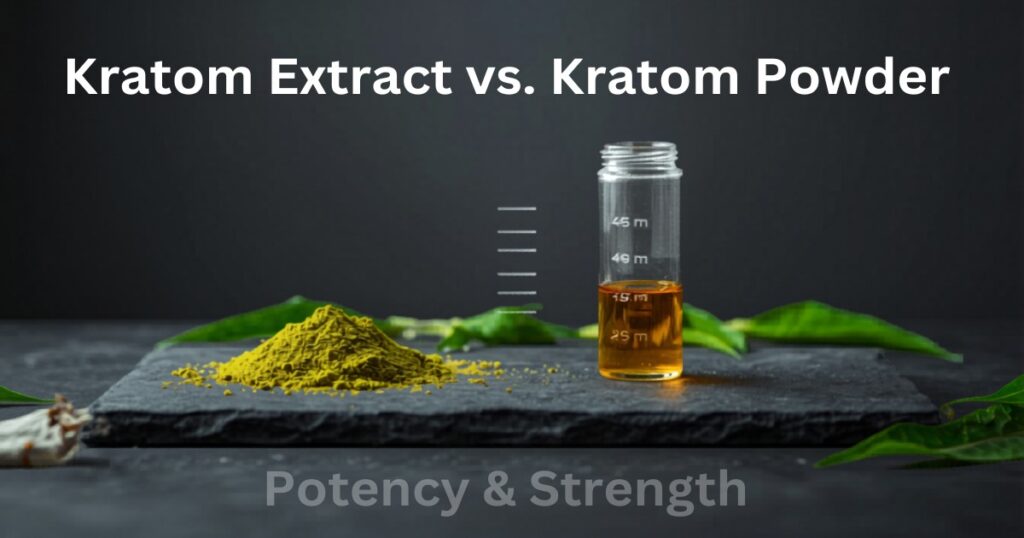
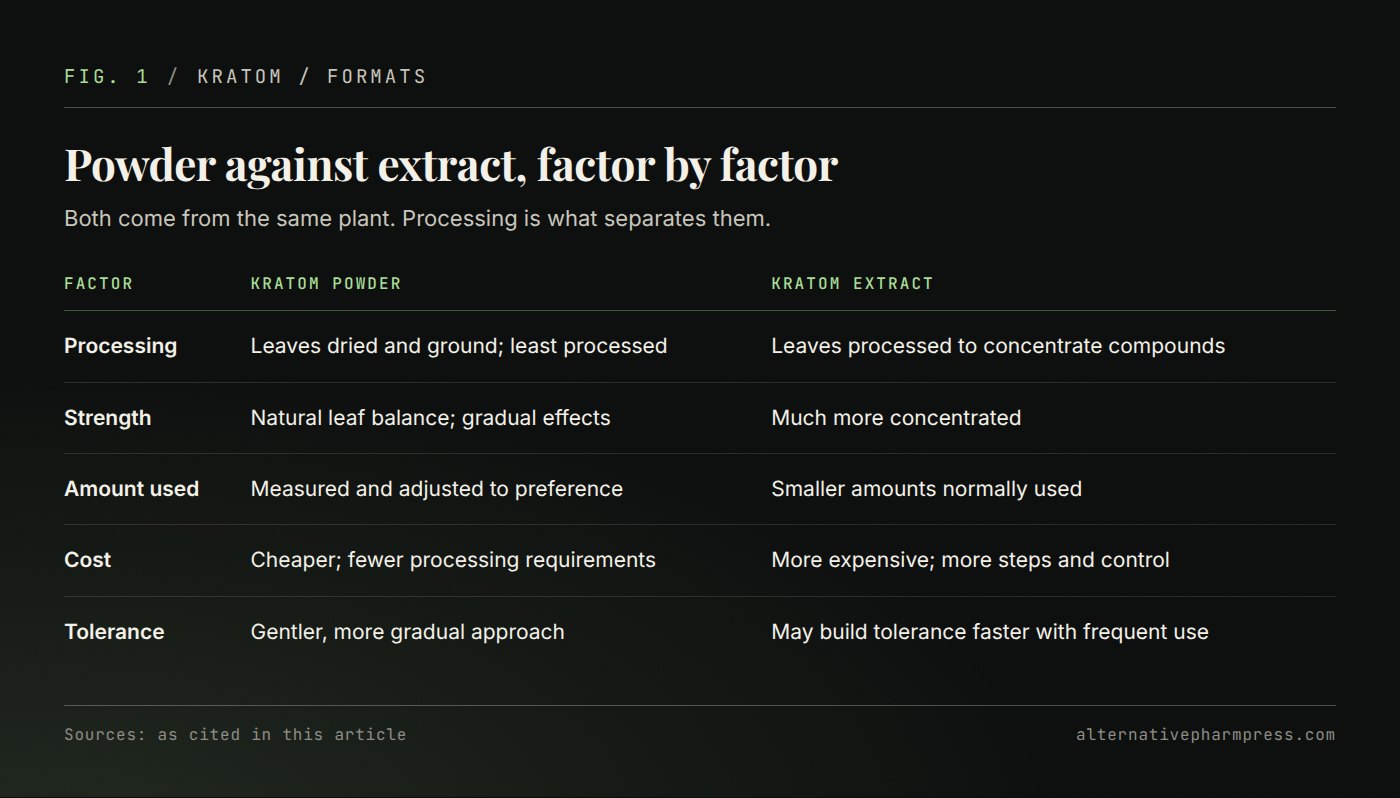
Kratom powder is dried, ground leaf, usually with about 1 to 2% mitragynine. A kratom extract concentrates the leaf’s alkaloids, from a few percent to about 40% or more, so a small serving delivers much more. That makes extracts stronger, easier to overdo, more likely to drive dependence and more likely to fall foul of the DEA’s proposed 7-OH thresholds.
The word “extract” also covers very different products. Some are concentrated leaf. Others, sold as “kratom extract,” contain mostly 7-hydroxymitragynine (7-OH) made in a lab. The label rarely tells you which.
Below we cover how extracts are made, how much stronger they are, what “enhanced” means, the risks, the DEA’s October 2026 ratio test, what to check on a lab report and where extracts are legal.
At a glance: kratom extract vs powder
| Property | Kratom powder | Kratom extract |
|---|---|---|
| What it is | Dried, milled leaf | Alkaloids pulled from leaf into a resin, powder, liquid or tablet |
| Mitragynine | About 0.3–4.9% in field samples; around 1% in tested retail powders1,2 | 39.5% in one studied extract; total alkaloids up to about 60% in concentrates3,8 |
| 7-OH | Trace; under 2% of total alkaloids4 | Rises with concentration; very high in fortified products5 |
| Typical serving | Grams of leaf | Milligrams of alkaloid, a shot or a gummy |
| Dependence risk | Present with regular use6 | Likely higher; limited data3 |
| DEA threshold test (pending) | Leaf normally well below both limits | Can exceed 1 mg/g 7-OH or fail the 100:1 ratio4 |
| State rules | Allowed in most states | Banned in some, such as Ohio11 |
What is the difference between kratom extract and powder?
Kratom powder is the leaf of Mitragyna speciosa, dried and milled. Nothing is removed or added, so a serving contains whatever alkaloid content the leaf had, which varies with season and region. One Thai survey of hundreds of trees found mitragynine from about 0.3% to 4.9% of leaf weight.1 Two commercial powders in a US analysis held 8.1 and 11.5 mg of mitragynine per gram, roughly 0.8% to 1.1%.2 Our guide to how kratom is processed covers drying and milling.
An extract starts with the same leaf, then separates the alkaloids from the plant fibre. What remains is a smaller amount of material carrying most of the alkaloids, sold as resin, fine powder, liquid shots, tinctures, gummies, capsules or tablets. Mitragynine is still the main alkaloid in a true leaf extract. Our explainer on mitragynine vs 7-hydroxymitragynine explains why the second, minor alkaloid matters so much.
How kratom extracts are made: the main types
Sellers rarely name the solvent or the process, so the categories below are a guide, not a list of what any one product contains.
- Water or tea-based extracts. Leaf is steeped or boiled and the liquid reduced to a resin or powder. Concentration is modest.
- Solvent “full spectrum” extracts. Ethanol or ethanol-water pulls out a broad mix of alkaloids. In a 2026 laboratory study, optimised ethanol-water extraction gave an extract with 4.66% mitragynine,7 a few times stronger than leaf.
- Alkaloid-rich extracts and concentrates. Further purification gives far higher figures. A 2026 human pharmacokinetic study used a commercial extract at 39.5% mitragynine,8 and a 2025 review notes concentrated extracts can reach about 60% alkaloids.3
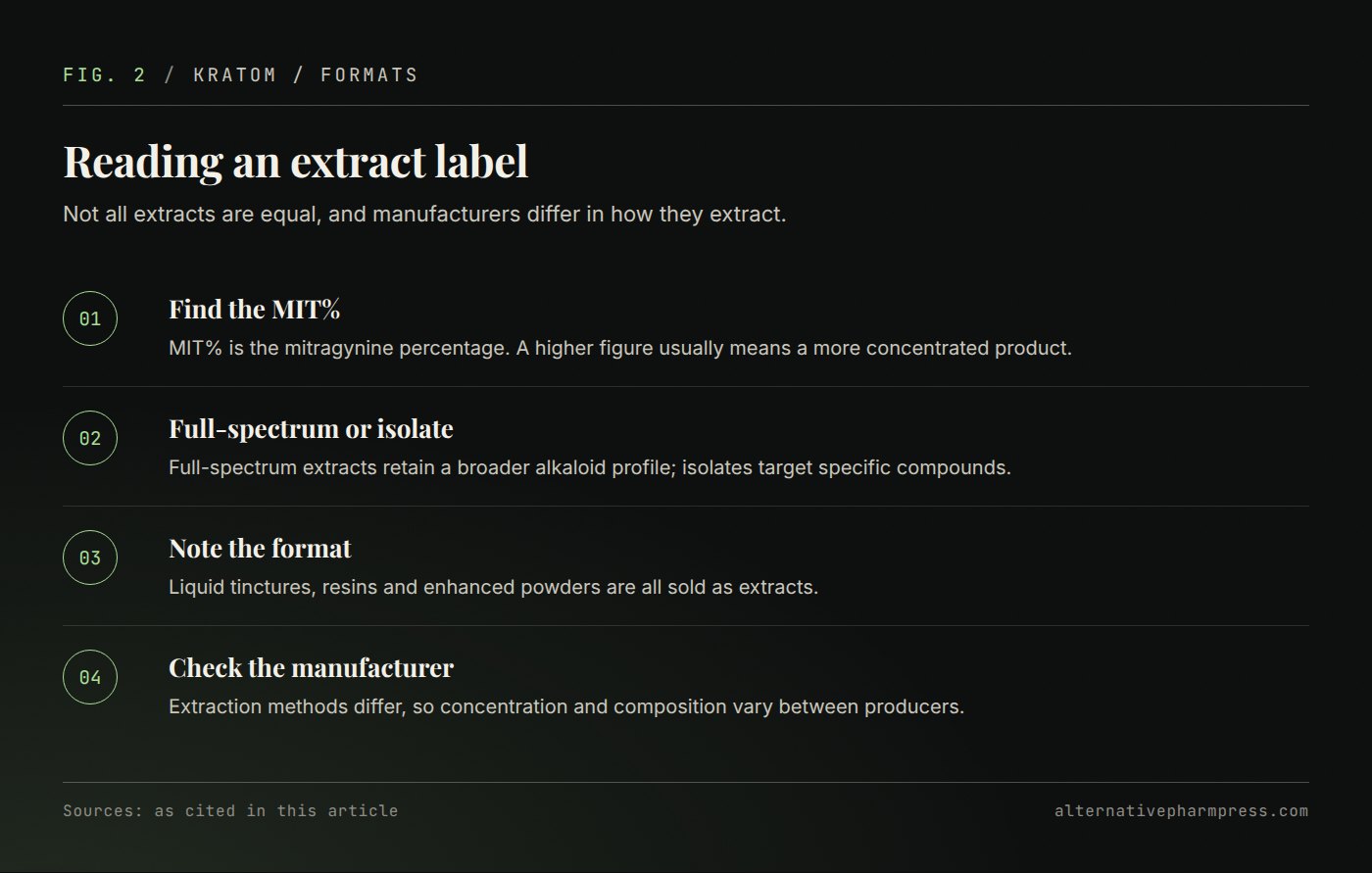
- “Enhanced” powders. Extract blended back into leaf powder. One vendor defines its Enhanced line as “high-quality extract powder + raw kratom leaf powder”; another sells a Maeng Da “enhanced to 3%+ MIT,” while its own testing page says mitragynine “typically sits at or below 2%” in quality dried leaf.
- 7-OH and pseudoindoxyl products. Not leaf extracts at all, though often labelled that way. They are covered below.
Alkaloid concentration: how much stronger is an extract?
The jump is in milligrams per serving, not just percentage. One vendor in our directory, Kingdom Kratom, lists 28 mg of mitragynine in a 2 g serving of its Green Maeng Da leaf powder, while its liquid extract shots “run from 45mg to 150mg mitragynine per bottle.” A 39.5% extract delivers 59 mg of mitragynine in about 150 mg of material, the top dose in the 2026 extract study.8
That study also found that concentrated extract “may yield greater overall mitragynine exposure” than leaf powder or tea at comparable doses, with higher 7-OH to mitragynine ratios in the blood after repeated dosing.8 Its authors’ earlier leaf study, of 500 mg to 4 g of encapsulated leaf (6.65 to 53.2 mg mitragynine), reported a mitragynine half-life of up to 43 hours after one dose and 68 hours with daily use.9 In practice, an extract shot can match several grams of powder, and a second shot is easy to take before the first has peaked. Our kratom dosage explainer covers why there is no official dose, and kratom capsules vs powder compares leaf formats.
Enhanced and 7-OH-fortified products: what labels hide
The biggest risk is not concentrated leaf but products labelled as kratom extract that are something else. In a 2026 analysis using an AOAC official method, every product tested was described on its label as containing “kratom extracts.” Mitragynine was only 2 to 6 mg per gram, below normal leaf, while 7-OH was 22 to 75 mg per gram. The chromatographic profiles did not match leaf, and the authors concluded the levels were “achievable only by synthetic means.”5 A 2016 study had already found commercial kratom products with 7-OH substantially above raw leaf, judged probable adulteration.10
The October 2026 HHS recommendation targets exactly this: products “intentionally enhanced or concentrated with 7-OH or MGPI,” as distinct from botanical kratom with trace levels.12 A 2026 potency assessment estimated mean opioid potency per serving, in morphine milligram equivalents, at 2.7 for powders and 31 for tablets, and found frequent FDA reports of dependence and withdrawal among users of 7-OH and pseudoindoxyl products, though use of other drugs could not be ruled out.13
Labels hide this in a few ways. “Full spectrum,” “extract,” “5X” or “enhanced” can describe anything from a modest blend to a semi-synthetic. Strength claims such as “5X” are rarely defined; one vendor we checked titles capsules “5X Strength” without explaining the measure. A milligram figure on the front may be total extract, not alkaloid. Our guide to 7-OH vs traditional kratom sets out the five differences buyers should know.
Dependence and other risks of kratom extracts
The FDA warns against kratom use because of serious adverse events, including liver toxicity, seizures and substance use disorder, and has cases of newborns with withdrawal signs after exposure in pregnancy.6 Those warnings apply to leaf too. Extracts add three things:
- A higher dose per serving, which speeds up tolerance.
- Greater opioid load. A 2025 review concluded that limited preclinical data indicate concentrated and isolated products “pose a greater risk of toxicity, drug interactions, and physiologic dependence,” and that clinical research is minimal.3
- Uncertainty about contents, since few extracts publish a full alkaloid profile.
We found no controlled trial comparing dependence on extracts with dependence on leaf, so the size of the difference is unknown. Read about 7-OH withdrawal, kratom and liver injury and drug interactions before using any concentrated product.
The DEA’s October 2026 ratio test: why extracts can fail it
On 14 October 2026 the DEA published a revised notice of intent to temporarily place 7-OH and mitragynine pseudoindoxyl in Schedule I above a threshold. A product is caught if either is true:4
- It contains more than 1 mg of 7-OH (or pseudoindoxyl) per gram of solid, or per millilitre of liquid.
- Its mitragynine content divided by its 7-OH content (or 7-OH plus pseudoindoxyl) is less than 100.
The order cannot be published before 13 November 2026 and takes effect on publication, with no comment period. Mitragynine and plain leaf are not scheduled by it, and the DEA says people “should not infer” that below-threshold levels are safe.4 Mitragynine pseudoindoxyl, MGM-15 and MGM-16 have been temporarily in Schedule I since 26 August 2026.14 As of 25 October 2026, 7-OH itself is not yet federally scheduled. Our explainer on where 7-OH scheduling stands follows the process.
Here is why extracts are exposed. In one commercial powder, mitragynine was 11.45 mg/g and 7-OH about 0.056 mg/g, a ratio near 200:1.2 That leaf passes both tests easily. But concentrate it about 18-fold, keeping the same ratio, and 7-OH reaches roughly 1 mg/g. A 39.5% mitragynine extract with that leaf ratio would hold about 2 mg/g of 7-OH, double the limit. These are our calculations, not measurements, because extraction does not move every alkaloid equally.
The ratio test catches fortified products. In the 2026 “kratom extract” samples, 7-OH outweighed mitragynine by roughly four to 37 times,5 so the ratio was below 1, not merely below 100. And because 7-OH is an oxidation product of mitragynine,5 poor processing or storage could in principle narrow the gap in a genuine extract. We found no published data quantifying that, so a lot-specific COA is the only way to know.
How to check a kratom extract’s lab report
An extract COA has to answer more questions than a powder COA. Look for:
- Mitragynine in mg/g and per serving, so you can compare it with leaf.
- A numeric 7-OH result in mg/g, or a stated limit of detection. Check it against 1 mg/g.
- The ratio. Divide mitragynine by 7-OH. Below 100 fails the DEA’s test; leaf is usually far above it.
- Mitragynine pseudoindoxyl, now a Schedule I substance.14
- A confirmatory method. A 2026 study of 38 products showed that relying on accurate mass alone can falsely identify 7-OH, and found 7-OH and pseudoindoxyl in several tablet and capsule products.15
- Finished-product testing, matched to your lot, not a raw leaf certificate.
- Heavy metals and microbes, including Salmonella and E. coli.
Our guide on how to read a kratom lab report walks through each panel, and the red flags on a kratom COA lists the warning signs.
Is kratom extract legal?
Federally, kratom leaf and mitragynine are not scheduled, but the FDA’s position is that kratom is not lawfully marketed as a dietary supplement, food additive or drug.6 Once the DEA order publishes, any extract above either threshold becomes a Schedule I substance.
States are moving faster against extracts than leaf. Ohio, for example, has banned “kratom extracts and tinctures” since 19 May 2026 and blended products since 4 August 2026, while natural leaf powder with trace 7-OH may still be sold.11 Other states ban kratom outright or cap 7-OH through consumer protection acts. Check our kratom legal status by state guide and the list of states that have banned kratom in 2026 before you buy.
Kratom extract or powder: which is the more cautious choice?
Neither is safe, and we make no recommendation to use either. But powder is easier to understand. Its alkaloid content sits in a natural range, it is measured in grams, and leaf normally clears both DEA thresholds. Extracts need more scrutiny on every point: the dose is concentrated, the label may not say what was concentrated, and the product may fail a federal test that leaf passes. If you already use powder, our kratom powder buying guide lists the lab checks that separate careful vendors from the rest.
Frequently asked questions
Is kratom extract stronger than powder?
Yes. Leaf powder usually contains about 1 to 2% mitragynine, while concentrated extracts can reach about 40% or more, and a 2025 review put the upper end near 60%. One extract shot can hold more mitragynine than several grams of leaf. A 2026 study found extract gave greater overall mitragynine exposure than leaf at comparable doses.
What is the difference between kratom extract vs powder?
Powder is dried, milled leaf with nothing removed. Extract separates the alkaloids from the plant fibre, leaving a smaller, stronger product sold as resin, powder, shots, tinctures, gummies or tablets. Some products labelled as kratom extract are not leaf extracts at all but contain lab-made 7-OH, so the lab report matters more than the name.
What does “enhanced” kratom mean?
There is no standard definition. It usually means extract blended into leaf powder to raise mitragynine, for example to 3% or more. HHS uses the term more broadly for products intentionally enhanced or concentrated with 7-OH or pseudoindoxyl. Strength claims such as “5X” are rarely explained, so check the COA for mitragynine and 7-OH in milligrams per gram.
Will kratom extracts be banned by the DEA?
Extracts above the threshold will be. The DEA’s October 2026 notice covers any product with more than 1 mg of 7-OH per gram or millilitre, or a mitragynine-to-7-OH ratio below 100. A highly concentrated extract can exceed 1 mg/g even with a leaf-like ratio. The order cannot publish before 13 November 2026.
Is kratom extract more addictive than powder?
Probably, though direct comparisons are lacking. The FDA lists substance use disorder among kratom’s risks, and a 2025 review concluded concentrated and isolated products likely carry a greater risk of physiologic dependence, based on limited preclinical data. Higher doses per serving also speed tolerance. No controlled trial has compared dependence on extracts and leaf.
How can I tell if a kratom extract contains added 7-OH?
Ask for a lot-matched COA showing mitragynine and 7-OH in milligrams per gram from a confirmatory LC-MS method. If mitragynine divided by 7-OH is below 100, or 7-OH exceeds 1 mg per gram, it fails the DEA test. Fortified products tested in 2026 had more 7-OH than mitragynine, which leaf never does.
Are kratom extracts more dangerous than powder?
Generally yes. Extracts concentrate alkaloids, making it easier to take far more than leaf would provide, and some are enhanced with 7-OH. That raises dependence and overdose risk.
Sources
- Sengnon N, Vonghirundecha P, Chaichan W, Juengwatanatrakul T, Onthong J, Kitprasong P, et al. Seasonal and Geographic Variation in Alkaloid Content of Kratom (Mitragyna speciosa (Korth.) Havil.) from Thailand. Plants (Basel). 2023;12(4):949. DOI: 10.3390/plants12040949. PMID: 36840297. pubmed.ncbi.nlm.nih.gov
- Todd DA, Kellogg JJ, Wallace ED, Khin M, Flores-Bocanegra L, Tanna RS, et al. Chemical composition and biological effects of kratom (Mitragyna speciosa): In vitro studies with implications for efficacy and drug interactions. Sci Rep. 2020;10(1):19158. DOI: 10.1038/s41598-020-76119-w. PMID: 33154449. pubmed.ncbi.nlm.nih.gov
- Vadiei N, Evoy KE, Grundmann O. The Impact of Diverse Kratom Products on Use Patterns, Dependence, and Toxicity. Curr Psychiatry Rep. 2025;27(10):584-592. DOI: 10.1007/s11920-025-01631-7. PMID: 40762659. pubmed.ncbi.nlm.nih.gov
- Drug Enforcement Administration. Schedules of Controlled Substances: Temporary Placement of 7-Hydroxymitragynine and Mitragynine Pseudoindoxyl Above a Specified Threshold in Schedule I (notice of intent). Federal Register. 14 October 2026;91 FR 65370. Document 2026-20943. federalregister.gov
- Brown PN, Chan M, Zhang X, Brendler T. Elevated 7-Hydroxymitragynine Levels Found in Products Misbranded as Kratom. J AOAC Int. 2026;109(1):124-130. DOI: 10.1093/jaoacint/qsaf094. PMID: 41065466. pubmed.ncbi.nlm.nih.gov
- US Food and Drug Administration. FDA and Kratom. Content current as of 2 December 2025. fda.gov
- Rusmadi NN, Karunakaran T, Ramli F, Ismail IS, Santhanam R, et al. Optimization of a Green Extraction Technique for Kratom (Ketum) Leaf Extract via Accelerated Solvent Extraction: Phytochemical Profiles, Cytotoxicity, and Antinociceptive Activity. ACS Pharmacol Transl Sci. 2026;9(1):126-140. DOI: 10.1021/acsptsci.5c00647. PMID: 41536288. pubmed.ncbi.nlm.nih.gov
- Huestis MA, Brett MA, Bothmer J, Henningfield JE, Swift S. Mitragynine and 7-hydroxy-mitragyine plasma pharmacokinetics in humans after single and 15 multiple oral kratom extract doses. J Anal Toxicol. 2026;50(6):bkag042. DOI: 10.1093/jat/bkag042. PMID: 42266029. pubmed.ncbi.nlm.nih.gov
- Huestis MA, Brett MA, Bothmer J, Atallah R. Human Mitragynine and 7-Hydroxymitragynine Pharmacokinetics after Single and Multiple Daily Doses of Oral Encapsulated Dried Kratom Leaf Powder. Molecules. 2024;29(5):984. DOI: 10.3390/molecules29050984. PMID: 38474495. pubmed.ncbi.nlm.nih.gov
- Lydecker AG, Sharma A, McCurdy CR, Avery BA, Babu KM, Boyer EW. Suspected Adulteration of Commercial Kratom Products with 7-Hydroxymitragynine. J Med Toxicol. 2016;12(4):341-349. DOI: 10.1007/s13181-016-0588-y. PMID: 27752985. pubmed.ncbi.nlm.nih.gov
- State of Ohio Board of Pharmacy. Notice on kratom and 7-OH products (OAC 4729:9-1-01.1). Revised 5 October 2026. pharmacy.ohio.gov
- US Department of Health and Human Services. HHS Recommends Science-Based Thresholds to Target Dangerous Enhanced Kratom Products. 9 October 2026. hhs.gov
- Heywood J, Farnham H, Jackson E, Steimel K, Brown S, Riordan A. Beyond kratom: Concentrated 7-hydroxymitragynine and mitragynine pseudoindoxyl products, an MME potency assessment. Regul Toxicol Pharmacol. 2026;173:106272. DOI: 10.1016/j.yrtph.2026.106272. PMID: 42838255. pubmed.ncbi.nlm.nih.gov
- Vicente LLP. DEA Places Three Kratom-Related Substances in Schedule I as 7-OH Scheduling Remains Pending. September 2026. vicentellp.com
- Sheehan D, Li Y, Meckler E, Upton R, Zhang M. Avoiding False Identification of 7-Hydroxymitragynine in Kratom Products Using a Multicriteria LC-MS Confirmation. J Am Soc Mass Spectrom. 2026;37(5):1303-1312. DOI: 10.1021/jasms.6c00088. PMID: 41989479. pubmed.ncbi.nlm.nih.gov
This article is for educational purposes only and is not medical or legal advice. Products discussed here are not intended to diagnose, treat, cure or prevent any disease. Laws vary by location and change often, so verify the rules that apply where you are. Always talk to a licensed healthcare provider before use, especially if you are under 21, pregnant or nursing, taking medication, or managing a health condition.