
There is no official kratom dosage. Kratom is not an approved drug in the US, and the FDA says it cannot be lawfully sold as a supplement, so no agency sets a dose. Surveys show the most common reported amount is 1 to 3 grams of leaf powder, but leaf strength varies several-fold and extracts and 7-OH products are far stronger.
That makes “kratom dosage” a harm-reduction question rather than a prescribing one. This guide does not tell you how much to take. It sets out what surveys and controlled studies actually report, why a gram of one product is not a gram of another, how to read milligrams of mitragynine on a lab report, and which factors raise the risk of any given amount.
At a glance
| Question | What the research shows |
|---|---|
| Official or approved dose | None; there are no FDA-approved kratom drugs1 |
| Most common amount reported by US consumers | 1 to 3 g of leaf per use (49% of 2,798 respondents)2 |
| Where side effects clustered in a large survey | 5 g or more per dose, or 22 or more doses a week3 |
| Largest controlled dosing study | 500 to 4,000 mg leaf powder (6.65 to 53.2 mg mitragynine)4 |
| Traditional Malaysian drink | About 79 mg mitragynine per glass on average5 |
| Mitragynine per gram of leaf | 7.5 to 26.6 mg in wild Thai trees6; 3.9 to 62.1 mg in eight retail products7 |
| 7-OH products | 1 mg to 700 mg per serving, per the DEA8 |
Why there is no official kratom dosage
A drug dose is normally set by trials that test effectiveness and safety at different amounts. Kratom has never been through that process. The FDA says there are no FDA-approved kratom drug products, that kratom is not appropriate for use as a dietary supplement and that it is an unsafe food additive.1
The controlled human studies that do exist measure blood levels, metabolism or interactions, not which amount works for a condition. Most knowledge about real-world amounts comes from surveys, which describe what people do, not what is safe. Our kratom guide for beginners covers the basics of the plant and its products.
What surveys say about kratom dosage in the US
Three large surveys give the clearest picture, with caveats about who answers.
- Grundmann 2017. An October 2016 online survey of 8,049 current users, recruited partly through the American Kratom Association, found dose-dependent effects. Negative effects, mainly nausea and constipation, presented mostly at high doses of 5 g or more and at 22 or more doses a week.3
- Garcia-Romeu 2020. In a 2017 Johns Hopkins survey of 2,798 users, kratom was mainly taken orally in doses of 1 to 3 g (49%), and daily use (59%) was most common. About a third reported adverse effects, mostly mild, and 2% met criteria for a moderate or severe kratom use disorder.2
- Rogers 2024. Among 395 US consumers, withdrawal and kratom use disorder symptoms rose with both dose amount and dose frequency, and the link was stronger for frequency.9
A 2024 study added objective chemistry. 357 consumers logged use for 15 days and 348 sent samples of their products for testing. Effects were stronger in people who used more per occasion, and extract effects started higher but faded faster than loose powder. Alkaloid content was surprisingly consistent across the products tested, and people used very consistent amounts from day to day.10
All of these surveys are self-selected and rely on people estimating grams, often with scoops rather than scales. They describe experienced, mostly white, middle-aged users, not first-time users.
Traditional use: doses measured in glasses
In Malaysia, kratom is mainly drunk as a boiled leaf decoction, so researchers measure use in glasses. In 293 regular users, a single drink averaged 79 mg of mitragynine, suggesting about 276.5 mg a day; people drinking three or more glasses a day had higher odds of severe dependence.5 A separate study of 58 users put the mitragynine content linked with heavy use, 3½ glasses or more a day, at 76.3 to 114.8 mg.11 Southern Thai users traditionally chew fresh leaves, and those with high dependence scores were more likely to report intense withdrawal.12
These figures do not transfer neatly to US products. Malaysian researchers point out that traditional decoction is made from freshly harvested leaves, contains alkaloids as water-soluble salts, and showed no detectable 7-OH in their preliminary analysis. They argue US dried-leaf and concentrated products differ in chemistry and may differ in safety.13 Our article on kratom tea and traditional preparation explains the chemistry.
Doses used in controlled kratom studies
The Huestis 2024 trial is the largest randomised, double-blind, placebo-controlled dose-escalation study of kratom leaf. Healthy adults took capsules of 500, 1,000, 2,000 or 4,000 mg of dried leaf powder, containing 6.65 to 53.2 mg of mitragynine, once and then daily for 15 days, with 12 people on active product per dose level.4
- The leaf was about 1.33% mitragynine, and 7-OH was below 0.01% of the powder.4
- Blood levels rose roughly in proportion to dose and peaked about 1 to 1.7 hours after a dose.4
- Mitragynine’s mean half-life reached 43.4 hours after one dose and 67.9 hours after repeated doses, and steady state took 8 to 9 days.4
Two points matter here. The study was paid for by the maker of the leaf product, and it measured blood levels, not benefit. And a long half-life means daily use builds up in the body over a week or more, so the same daily amount can feel stronger later.
A 2026 follow-up gave a concentrated extract (39.5% mitragynine) at 9.9, 29.6 and 59.2 mg mitragynine and concluded that extracts may give greater overall exposure than leaf powder or tea at comparable doses.14 A Thai study gave volunteers fresh kratom tea containing 23.6 mg mitragynine to study how the body forms 7-OH.15
Timing, redosing and build-up
How fast a dose acts and fades also shapes risk. In the 2024 leaf trial, mitragynine peaked about 1 to 1.7 hours after a dose and 7-OH about 1.2 to 2 hours after.4 In the real-world tracking study, felt effects of loose powder declined over three hours, while extracts started stronger and dropped off faster.10
Taking more before an earlier dose has peaked, or redosing quickly as an extract wears off, raises the total taken in a session. Over days, the long half-life means levels keep rising until steady state.4 And frequent dosing, more than amount, is what tracked with dependence in US data.9
Dose-dependent effects researchers report
The CDC summarises mitragynine as producing stimulant effects at low doses and some opioid-like effects at higher doses.16 The surveys are broadly consistent with that: more side effects with larger and more frequent doses,3 and stronger felt effects with larger amounts per use.10
The evidence for any specific cut-off is weak. A 2026 observational study reported improved self-rated focus and energy at a 20 mg mitragynine-equivalent extract dose, but it had no control group and was industry-linked.17 No controlled trial has defined a low, medium or high dose by effect, and the grams quoted on vendor sites are not drawn from such trials. Our overview of kratom and opioid receptor research explains the pharmacology behind the shift.
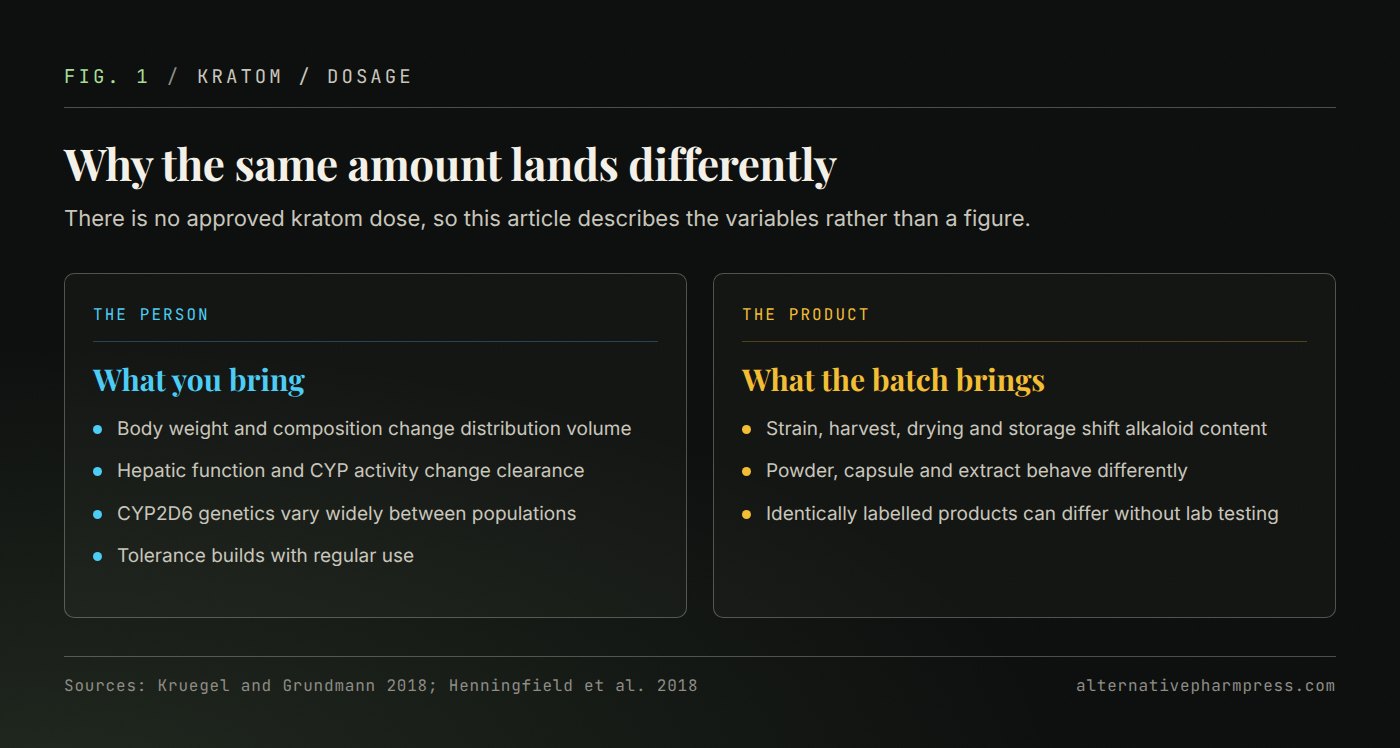
Why a gram of kratom is not a fixed dose
Most dosing talk is in grams of leaf, but what matters pharmacologically is milligrams of alkaloid, and that varies:
- Wild Thai trees: 7.5 to 26.6 mg mitragynine per gram of dry leaf, depending on region and conditions.6
- Eight Chicago-area retail products: 3.9 to 62.1 mg per gram.7
- US commercial products in a 2022 analysis: 13.9 to 270 mg per gram.18
So “3 grams” could mean under 25 mg of mitragynine or many times that, depending on the product. Vein colours and strain names do not fix this; see kratom strains explained.
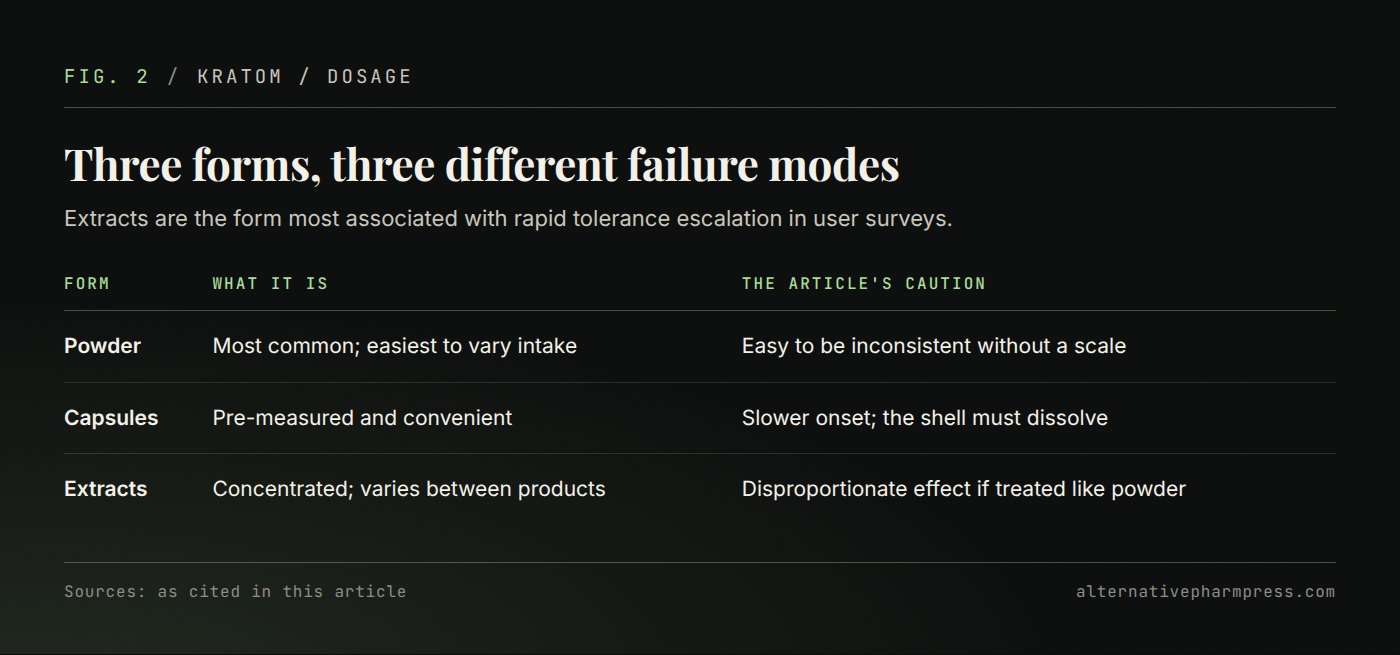
Extracts break any leaf-based reference
Extracts concentrate alkaloids. The 2026 extract trial used material at 39.5% mitragynine, about 30 times the concentration of the leaf in the 2024 trial.4,14 A gram-based habit carried over from powder to an extract can mean a much larger alkaloid dose. Our comparison of kratom extract vs powder goes into detail.
7-OH products are a different drug class
7-OH is about ten times more potent than mitragynine at the human mu-opioid receptor in lab tests.19 Semi-synthetic 7-OH tablets, shots and gummies are often sold as “kratom”: in one review of 304 such products, 92% of 7-OH-only products were advertised that way.20 The DEA says 7-OH products range from 1 mg to 700 mg per serving.8 Lab testing has found frequent mismatches between labelled and actual alkaloids.21
No leaf-based dose figure applies to these products. Some 7-OH products are made for under-the-tongue or nasal use, routes that bypass first-pass metabolism in the liver and speed onset. A case report describes a man who noticed tolerance within days of starting a 7-OH film and developed severe substance use disorder within weeks.22 See 7-OH vs traditional kratom and 7-OH withdrawal.
Reading mg of mitragynine per serving on a COA
A certificate of analysis (COA) is the only way to turn grams into alkaloid content. Look for:
- Mitragynine as a percentage or mg/g. Multiply by the serving weight. For leaf like that in the Huestis trial (about 1.33%), 1 g contains about 13.3 mg of mitragynine.4
- A 7-OH result, not just “pass”. Under the DEA’s 14 October 2026 notice, products would be controlled if 7-OH and mitragynine pseudoindoxyl, alone or combined, exceed 1 mg per gram (solids) or 1 mg per mL (liquids), or if the mitragynine-to-7-OH ratio is below 100.8 A COA showing both figures lets you check that ratio.
- Batch match and accredited lab. The batch number on the COA should match the pack.
- Contaminants. Heavy metals and microbes, both found in retail kratom.7
Our guides on how to read a kratom COA and COA red flags walk through examples.
Risk factors that change what any dose does
- Frequency. Dependence and withdrawal track dosing frequency more closely than amount.9
- Medicines. 2 g of kratom tea raised exposure to midazolam, a CYP3A-cleared drug, by about 39%.23 In reverse, the CYP3A4 inhibitor itraconazole raised peak mitragynine about 1.5-fold and cut 7-OH formation.15 See kratom and drug interactions.
- Alcohol and sedatives. In CDC data on 152 overdose deaths with kratom detected, almost all involved multiple substances, most often fentanyl.16 See kratom and alcohol.
- Liver. Kratom can cause severe liver injury with jaundice.24
- Pregnancy. The FDA is aware of neonatal abstinence syndrome cases.1
Reports to US poison centres rose from 258 in 2015 to 3,434 in 2025, and multiple-substance exposures accounted for most kratom-associated deaths.25
Dependence, tolerance and withdrawal
Regular use at any dose can lead to dependence. In the Malaysian survey more than half of regular users had severe dependence, with withdrawal symptoms such as muscle pain, sleep problems, runny nose and diarrhoea.5 In US surveys, use disorder was less common, at 2%,2 but symptoms rose with frequency.9 Rising amounts over time are a sign of tolerance; our article on kratom tolerance explains how it develops.
If kratom use is becoming hard to control, the free, confidential SAMHSA National Helpline is available 24 hours a day on 1-800-662-4357.26 Clinicians have treated 7-OH use disorder with buprenorphine,22 so anyone using 7-OH products heavily should seek medical advice rather than struggle alone.
Frequently asked questions
Is there an official kratom dosage?
No. Kratom is not an FDA-approved drug, and the FDA says it is not lawful as a dietary supplement or food ingredient, so no agency has set a dose.1 Published figures come from surveys and pharmacokinetic studies, which describe what people use or how the body handles it, not a safe or effective amount.
How much kratom do people usually take?
In a Johns Hopkins survey of 2,798 users, the most common reported amount was 1 to 3 g of leaf per use (49%).2 A larger survey found side effects clustered at 5 g or more per dose or 22 or more doses a week.3 Because leaf strength varies widely, grams are a poor guide to alkaloid dose.
What doses were used in the Huestis kratom study?
The 2024 Huestis trial gave 500, 1,000, 2,000 or 4,000 mg of encapsulated dried leaf, equal to 6.65 to 53.2 mg of mitragynine, as single and then 15 daily doses.4 It was a pharmacokinetic study funded by the product’s maker. It measured blood levels and half-life, not whether any dose was effective.
Does kratom dosage apply to 7-OH products?
No. 7-OH is about ten times more potent than mitragynine at the mu-opioid receptor in lab tests,19 and the DEA reports 7-OH products from 1 mg to 700 mg per serving.8 Leaf-based gram figures say nothing about these semi-synthetic products, which carry opioid-like dependence risks.
Is taking kratom every day risky?
It raises the risk of dependence. In a study of 395 US consumers, withdrawal and use disorder symptoms tracked dosing frequency more closely than amount.9 Mitragynine’s half-life of up to about 68 hours after repeated doses also means it accumulates with daily use.4 Talk to a clinician if you use daily.
How much kratom is too much in a day?
There’s no established safe daily amount. Risks rise with larger and more frequent use, and with extracts or 7-OH products. If you find yourself needing more to feel the same, talk to a clinician about cutting down.
Sources
- US Food and Drug Administration. FDA and Kratom. Content current as of 2 December 2025. fda.gov
- Garcia-Romeu A, Cox DJ, Smith KE, Dunn KE, Griffiths RR. Kratom (Mitragyna speciosa): User demographics, use patterns, and implications for the opioid epidemic. Drug Alcohol Depend. 2020;208:107849. DOI: 10.1016/j.drugalcdep.2020.107849. PMID: 32029298. pubmed.ncbi.nlm.nih.gov
- Grundmann O. Patterns of Kratom use and health impact in the US: Results from an online survey. Drug Alcohol Depend. 2017;176:63-70. DOI: 10.1016/j.drugalcdep.2017.03.007. PMID: 28521200. pubmed.ncbi.nlm.nih.gov
- Huestis MA, Brett MA, Bothmer J, Atallah R. Human Mitragynine and 7-Hydroxymitragynine Pharmacokinetics after Single and Multiple Daily Doses of Oral Encapsulated Dried Kratom Leaf Powder. Molecules. 2024;29(5):984. DOI: 10.3390/molecules29050984. PMID: 38474495. pubmed.ncbi.nlm.nih.gov
- Singh D, Müller CP, Vicknasingam BK. Kratom (Mitragyna speciosa) dependence, withdrawal symptoms and craving in regular users. Drug Alcohol Depend. 2014;139:132-137. DOI: 10.1016/j.drugalcdep.2014.03.017. PMID: 24698080. pubmed.ncbi.nlm.nih.gov
- Leksungnoen N, Andriyas T, Ngernsaengsaruay C, Uthairatsamee S, Racharak P, Sonjaroon W, et al. Variations in mitragynine content in the naturally growing Kratom (Mitragyna speciosa) population of Thailand. Front Plant Sci. 2022;13:1028547. DOI: 10.3389/fpls.2022.1028547. PMID: 36388525. pubmed.ncbi.nlm.nih.gov
- Prozialeck WC, Edwards JR, Lamar PC, Plotkin BJ, Sigar IM, Grundmann O, et al. Evaluation of the Mitragynine Content, Levels of Toxic Metals and the Presence of Microbes in Kratom Products Purchased in the Western Suburbs of Chicago. Int J Environ Res Public Health. 2020;17(15):5512. DOI: 10.3390/ijerph17155512. PMID: 32751712. pubmed.ncbi.nlm.nih.gov
- Drug Enforcement Administration. Schedules of Controlled Substances: Temporary Placement of 7-Hydroxymitragynine and Mitragynine Pseudoindoxyl Above a Specified Threshold in Schedule I. 91 FR 65370, FR Doc. 2026-20943, Docket DEA-1570. 14 October 2026. federalregister.gov
- Rogers JM, Weiss ST, Epstein DH, Grundmann O, Hill K, Smith KE. Kratom addiction per DSM-5 SUD criteria, and kratom physical dependence: Insights from dosing amount versus frequency. Drug Alcohol Depend. 2024;260:111329. DOI: 10.1016/j.drugalcdep.2024.111329. PMID: 38788532. pubmed.ncbi.nlm.nih.gov
- Smith KE, Panlilio LV, Sharma A, McCurdy CR, Feldman JD, Mukhopadhyay S, et al. Time course of kratom effects via ecological momentary assessment, by product type, dose amount, and assayed alkaloid content. Drug Alcohol Depend. 2024;264:112460. DOI: 10.1016/j.drugalcdep.2024.112460. PMID: 39405600. pubmed.ncbi.nlm.nih.gov
- Singh D, Müller CP, Murugaiyah V, Hamid SBS, Vicknasingam BK, Avery B, et al. Evaluating the hematological and clinical-chemistry parameters of kratom (Mitragyna speciosa) users in Malaysia. J Ethnopharmacol. 2018;214:197-206. DOI: 10.1016/j.jep.2017.12.017. PMID: 29248450. pubmed.ncbi.nlm.nih.gov
- Saingam D, Singh D, Geater AF, Assanangkornchai S, Jitpiboon W, Latkin C. The Health Impact of Long-Term Kratom (Mitragyna Speciosa) Use in Southern Thailand. Subst Use Misuse. 2023;58(10):1212-1225. DOI: 10.1080/10826084.2023.2215301. PMID: 37270449. pubmed.ncbi.nlm.nih.gov
- Karunakaran T, Vicknasingam K, Chawarski MC. Kratom-labeled Products in the US Compared With Traditionally Consumed Natural Kratom in Southeast Asia. J Addict Med. 2026 (published online 20 October 2026). DOI: 10.1097/ADM.0000000000001785. PMID: 42822000. pubmed.ncbi.nlm.nih.gov
- Huestis MA, Brett MA, Bothmer J, Henningfield JE, Swift S. Mitragynine and 7-hydroxy-mitragyine plasma pharmacokinetics in humans after single and 15 multiple oral kratom extract doses. J Anal Toxicol. 2026;50(6):bkag042. DOI: 10.1093/jat/bkag042. PMID: 42266029. pubmed.ncbi.nlm.nih.gov
- Mongar P, Jaisi A, Inkviya T, Wungsintaweekul J, Wiwattanawongsa K. Effects of Itraconazole on Pharmacokinetics of Mitragynine and 7-Hydroxymitragynine in Healthy Volunteers. ACS Pharmacol Transl Sci. 2024;7(3):823-833. DOI: 10.1021/acsptsci.3c00335. PMID: 38481700. pubmed.ncbi.nlm.nih.gov
- Olsen EO, O’Donnell J, Mattson CL, Schier JG, Wilson N. Notes from the Field: Unintentional Drug Overdose Deaths with Kratom Detected: 27 States, July 2016-December 2017. MMWR Morb Mortal Wkly Rep. 2019;68(14):326-327. DOI: 10.15585/mmwr.mm6814a2. PMID: 30973850. pubmed.ncbi.nlm.nih.gov
- Shields CM, Kirk R, Chan M, Lehfeldt P, Brown PN. Observational real-world analysis of dose-dependent effects of Mitragyna speciosa (Korth.) on focus and energy. Front Pharmacol. 2026;17:1838148. DOI: 10.3389/fphar.2026.1838148. PMID: 42676565. pubmed.ncbi.nlm.nih.gov
- Manwill PK, Flores-Bocanegra L, Khin M, Raja HA, Cech NB, Oberlies NH, et al. Kratom (Mitragyna speciosa) Validation: Quantitative Analysis of Indole and Oxindole Alkaloids Reveals Chemotypes of Plants and Products. Planta Med. 2022;88(9-10):838-857. DOI: 10.1055/a-1795-5876. PMID: 35468648. pubmed.ncbi.nlm.nih.gov
- Kruegel AC, Uprety R, Grinnell SG, Langreck C, Pekarskaya EA, Le Rouzic V, et al. 7-Hydroxymitragynine Is an Active Metabolite of Mitragynine and a Key Mediator of Its Analgesic Effects. ACS Cent Sci. 2019;5(6):992-1001. DOI: 10.1021/acscentsci.9b00141. PMID: 31263758. pubmed.ncbi.nlm.nih.gov
- Hill K, Boyer EW, Grundmann O, Smith KE. De facto opioids: Characterization of novel 7-hydroxymitragynine and mitragynine pseudoindoxyl product marketing. Drug Alcohol Depend. 2025;272:112701. DOI: 10.1016/j.drugalcdep.2025.112701. PMID: 40373645. pubmed.ncbi.nlm.nih.gov
- Gour A, Kanumuri SRR, Mukhopadhyay S, Pullman MK, León F, Cutler SJ, et al. Mislabeling and Status of Semisynthetic Kratom-Derived Products in the US Market. Drug Test Anal. 2026;18(10):1286-1295. DOI: 10.1002/dta.70122. PMID: 42448619. pubmed.ncbi.nlm.nih.gov
- Reif B, Adkins A, Boyer EW, Kanumuri SRR, Sharma A, Smith KE. Substance Use Disorder Following Consumption of a Novel Synthetic 7-Hydroxymitragynine Product. J Addict Med. 2025 (published online 5 November 2025). DOI: 10.1097/ADM.0000000000001603. PMID: 41189061. pubmed.ncbi.nlm.nih.gov
- Tanna RS, Nguyen JT, Hadi DL, Layton ME, White JR, Cech NB, et al. Clinical Assessment of the Drug Interaction Potential of the Psychotropic Natural Product Kratom. Clin Pharmacol Ther. 2023;113(6):1315-1325. DOI: 10.1002/cpt.2891. PMID: 36924284. pubmed.ncbi.nlm.nih.gov
- Ahmad J, Odin JA, Hayashi PH, Fontana RJ, Conjeevaram H, Avula B, et al. Liver injury associated with kratom, a popular opioid-like product: Experience from the U.S. drug induced liver injury network and a review of the literature. Drug Alcohol Depend. 2021;218:108426. DOI: 10.1016/j.drugalcdep.2020.108426. PMID: 33257199. pubmed.ncbi.nlm.nih.gov
- Towers EB, Thomas YT, Holstege CP, Farah R. Increases in Kratom-Related Reports to Poison Centers: National Poison Data System, United States, 2015-2025. MMWR Morb Mortal Wkly Rep. 2026;75(11):139-145. DOI: 10.15585/mmwr.mm7511a1. PMID: 41886310. pubmed.ncbi.nlm.nih.gov
- Substance Abuse and Mental Health Services Administration. SAMHSA’s National Helpline. samhsa.gov
This article is for educational purposes only and is not medical or legal advice. Products discussed here are not intended to diagnose, treat, cure or prevent any disease. Laws vary by location and change often, so verify the rules that apply where you are. Always talk to a licensed healthcare provider before use, especially if you are under 21, pregnant or nursing, taking medication, or managing a health condition.