
Is kratom legal? Federally, yes in a narrow sense: kratom leaf and its main alkaloid, mitragynine, are not controlled substances, although the FDA has approved no kratom product. As of 24 October 2026, 10 states ban kratom outright, and a DEA order on concentrated 7-OH can take effect from 13 November 2026.1,4
See it on a map: our interactive state legal map shows kratom, THCA and delta-8 status for every state, with links to each state guide.
Elsewhere the answer depends on the state and sometimes the county. Most states regulate sales through a Kratom Consumer Protection Act (KCPA) or have no kratom statute, and a growing group allows leaf while banning concentrated 7-hydroxymitragynine (7-OH).
This guide was rebuilt on 24 October 2026. Where we could not confirm a detail with a primary or reputable legal source, we say so.
Quick answer: states where kratom is banned
These 10 states ban kratom itself, including plain leaf, as of 24 October 2026. The list matches the 10 states the DEA named in its October 2026 notice as prohibiting 7-OH consumption, and we checked each against state sources.1
- Alabama (2016): mitragynine and 7-OH are Schedule I.6
- Arkansas (2015): Schedule I by regulation.6
- Connecticut (2026): kratom leaf, stem, extracts and 7-OH placed in Schedule I; stock had to be cleared by 25 March 2026.8
- Indiana (2012): both alkaloids listed as “synthetic drugs”, which are Schedule I.6
- Kansas (2026): mitragynine added to Schedule I from 1 July 2026.9
- Louisiana (2025): Act 41 banned possession, production and sale from 1 August 2025.12
- Massachusetts (2026, temporary): all kratom placed in state Schedule I from 28 August 2026 for up to a year.10
- Tennessee (2026): Matthew Davenport’s Law, in force from 1 July 2026.11
- Vermont (2016): both alkaloids on the Regulated Drug Rule.6
- Wisconsin (2014): both alkaloids in Schedule I.6
Three more need a footnote. Kentucky will ban all kratom sales from 1 July 2027. North Dakota allows natural kratom for adults in principle but no sales are lawful until licensing rules exist. Rhode Island was a ban state until 1 April 2026 and now licenses sales. Washington, DC bans 7-OH but has no rule on mitragynine.
If you are looking specifically for 7-OH tablets and shots, the map is different and stricter. See our state guide to where 7-OH is banned.
Kratom legality by state: all 50 states and DC
The table combines the Legislative Analysis and Public Policy Association (LAPPA) survey of state laws in force in January 2026, which was funded by the Office of National Drug Control Policy, with every 2026 change we could confirm.6 “No state law” means LAPPA found no kratom statute; general food law and local ordinances still apply. Years are the year the current rule was enacted or took effect.
| State | Status | Year | Note |
|---|---|---|---|
| Alabama | Banned | 2016 | Schedule I; attorney general issued a statewide cease-and-desist order in March 202613 |
| Alaska | Legal | None | No state law |
| Arizona | Legal with KCPA | 2019 | 18+; 7-OH capped at 2% of alkaloids; synthetics banned |
| Arkansas | Banned | 2015 | Schedule I; a 2025 bill to legalise and regulate died in the House14 |
| California | Sales barred as food; local bans | 2025 | Health department says kratom and 7-OH products are illegal to make or sell for consumption35 |
| Colorado | Legal with KCPA | 2022, 2025 | 21+; 2% 7-OH cap; no synthetics, vapes or candy-like forms |
| Connecticut | Banned | 2026 | Leaf, stem, extracts and 7-OH in Schedule I8 |
| Delaware | Legal, 21+ | 2026 | HB 332 signed 8 Sept 2026; testing and licensing report due January 202726,27 |
| District of Columbia | 7-OH restricted | 2016 | 7-OH in Schedule I by regulation; mitragynine not addressed |
| Florida | Legal with KCPA; 7-OH restricted; local ban | 2023, 2025–26 | 21+; 7-OH and related compounds in Schedule I by emergency rule; Sarasota County ban |
| Georgia | Legal with KCPA | 2019, 2025 | 21+; no more than 0.5 mg 7-OH per gram or 1 mg per serving |
| Hawaii | Legal | None | No state law |
| Idaho | Legal | None | No state law |
| Illinois | Legal, 18+; local bans | 2015 | Sales to under-18s banned; some localities ban kratom1 |
| Indiana | Banned | 2012 | Listed as synthetic drugs, which are Schedule I |
| Iowa | Legal | None | House passed a Schedule I bill in 2026; Senate did not act37 |
| Kansas | Banned | 2026 | Mitragynine in Schedule I from 1 July 20269 |
| Kentucky | Legal with KCPA; 7-OH restricted; ban due | 2024, 2026 | 21+; 2% cap; 7-OH above 400 ppm Schedule I; all sales banned from 1 July 20276,22,23 |
| Louisiana | Banned | 2025 | Up to five years in prison and $50,000 fines12 |
| Maine | Legal | None | No state law |
| Maryland | Legal with KCPA | 2024 | 21+; 2% 7-OH cap; synthetics banned |
| Massachusetts | Banned (temporary) | 2026 | Emergency Schedule I order from 28 Aug 2026, up to one year10 |
| Michigan | Legal | None | No state law |
| Minnesota | Legal, 21+ | 2018, 2026 | Age raised from 18 to 21 from 1 August 2026 (Laws 2026, ch. 63); sale to and possession by under-21s are offences |
| Mississippi | Legal with KCPA; local bans | 2025 | 21+; 7-OH no more than 1% of alkaloids or 0.5 mg per container; 30+ local restrictions or bans36 |
| Missouri | Legal; 7-OH enforcement; local rules | 2026 | No kratom statute; attorney general treats high-potency 7-OH as illegal; Kansas City ordinance30,31 |
| Montana | Legal | None | No state law |
| Nebraska | Legal with KCPA | 2025 | 21+; product registration with lab report showing 7-OH below 2% |
| Nevada | Legal with KCPA | 2019 | 18+; labelling and adulteration rules |
| New Hampshire | Legal; local bans | None | No state law; the DEA notes local bans1 |
| New Jersey | Legal | None | No state law |
| New Mexico | Legal | None | No state law |
| New York | Legal, 21+ | 2025 | Age 21 since Dec 2025; warning labels required from 19 Dec 2026 |
| North Carolina | Legal; local bans | None | No state law; a 2025 regulation bill stalled in the House; local bans noted by the DEA1,48 |
| North Dakota | Regulated; sales paused | 2026 | HB 1628 bans synthetic kratom; natural leaf 21+ with a licence once rules are adopted25 |
| Ohio | Leaf only; 7-OH and extracts banned | 2025–26 | Raw leaf and plain powder legal; extracts, synthetics and blends banned24 |
| Oklahoma | Legal with KCPA | 2021 | 18+; 7-OH capped at 1% of alkaloids |
| Oregon | Legal with KCPA | 2023 | 21+; processors must register |
| Pennsylvania | Legal; bill pending | None | HB 2657 passed the House 5 Oct 2026; in Senate committee28,29 |
| Rhode Island | Legal, licensed | 2026 | Ban replaced 1 April 2026; 21+; strict 7-OH limits16 |
| South Carolina | Legal with KCPA | 2025 | 21+; synthetics banned; a Schedule I bill stalled in the Senate in May 202638 |
| South Dakota | Legal with KCPA | 2021, 2025 | 21+; 2% 7-OH cap; synthetics banned |
| Tennessee | Banned | 2026 | Possession a Class A misdemeanour; sale a Class C felony11 |
| Texas | Legal with KCPA | 2023 | 18+; 2% 7-OH cap; product registration |
| Utah | Legal, pure leaf only | 2019, 2026 | Since 6 May 2026 only pure leaf, sold by registered tobacco specialty shops32 |
| Vermont | Banned | 2016 | Regulated Drug Rule; a 2025 regulation bill has not left committee15 |
| Virginia | Legal, 21+; 7-OH banned | 2023, 2026 | HB 360 bans 7-OH products and adds warning labels33 |
| Washington | Legal | None | No state law |
| West Virginia | Legal, permit system | 2023, 2026 | 21+; concentrated or synthetic products excluded from the legal definition since June 202634 |
| Wisconsin | Banned | 2014 | Schedule I |
| Wyoming | Legal with KCPA | 2026 | 21+ from 1 July 2026 (Senate File 56); 2% 7-OH cap; no synthesised alkaloids, vapes or candy-like forms |
Rows without a separate citation come from LAPPA.6 Its survey reflects January 2026, so treat any “no state law” row as a prompt to check your legislature’s website.
Is kratom legal in Florida?
Yes, for adults 21 and over, but concentrated 7-OH is not. Florida’s Kratom Consumer Protection Act, section 500.92 of the Florida Statutes, makes it a second-degree misdemeanour to sell or give any kratom product to someone under 21. The section does not mention local ordinances either way.17
Florida’s 7-OH emergency rules, 2025 to 2026
An attorney general’s emergency rule, effective 19 August 2025, made 7-OH above 400 parts per million (dry weight) a Schedule I substance; a labelling rule followed in December 2025.6
A June 2026 rule added related compounds, including mitragynine pseudoindoxyl, MGM-15 and MGM-16, with limits of 1 mg per gram or millilitre and a mitragynine-to-7-OH ratio of at least 100, the test the DEA later adopted. Penalties can reach 30 years in prison.18 Rule 2ER26-2 replaced it on 18 August 2026.19
None of this is permanent law yet: the 7-OH provision was stripped from SB 432 before the 2026 session ended.20 Plain leaf is not the target.
Sarasota County and Union County
Sarasota County banned kratom as a “designer drug” in 2014, and the Palm Beach Post described it in 2024 as the only Florida county with a ban.21 Some online trackers also list Union County. We could not find a Union County ordinance or a reliable report of one, so treat that claim as unconfirmed.
Is kratom legal in DC (District of Columbia)?
Partly. According to LAPPA, 7-OH has been a Schedule I controlled substance in the District since 25 March 2016, under 22-B DCMR § 1201. No DC statute or regulation addresses mitragynine.6
Plain leaf is not named, but it contains trace 7-OH and LAPPA reports no threshold for the DC listing. We found no test of whether that reaches leaf, so treat leaf as unconfirmed and 7-OH products as illegal.
Massachusetts: the August 2026 emergency order
The Department of Public Health’s emergency regulation, 105 CMR 726.000, placed kratom in Schedule I of the state Controlled Substances Act from 28 August 2026 for up to a year. It covers powders, tablets, capsules, gummies, strips and other forms. Local boards of health can remove all kratom products from shops.10
Wisconsin, Alabama, Arkansas, Indiana and Vermont
These are the long-standing bans; none has softened.
- Wisconsin added mitragynine and 7-OH to Schedule I under Wis. Stat. § 961.14 on 25 April 2014.6 We found no enacted change in 2025 or 2026.
- Alabama listed both alkaloids in Schedule I (Ala. Code § 20-2-23) on 10 May 2016.6 In March 2026 the attorney general ordered businesses statewide to stop selling them.13
- Arkansas scheduled both in November 2015. SB 534, a 2025 bill to replace the ban with a KCPA, died in the House.6,14
- Indiana defines both alkaloids as synthetic drugs (Ind. Code § 35-31.5-2-321), which are Schedule I.6
- Vermont lists both in its Regulated Drug Rule, in effect since 1 January 2016.6 S.121, a 2025 regulation bill, has not left committee.15
Rhode Island: from ban to licensed market
Rhode Island is the only state to reverse a ban. Since 1 April 2026, the Kratom Act (R.I. Gen. Laws ch. 21-28.12) has allowed licensed sales. Products are prohibited if they contain more than 0.5 mg of 7-OH per gram, more than 1 mg per serving, or 7-OH above 1% of total alkaloids. Synthetic alkaloids, vapes, injectables and candy-like products are also banned, and labels must state mitragynine and 7-OH content.16
States that changed kratom laws in 2026
Connecticut, Kansas and Tennessee: new bans
Connecticut’s consumer protection department placed kratom and 7-OH in Schedule I in early 2026; its business guidance, dated 4 March, told shops to destroy or return products by 25 March.8 Kansas added mitragynine to Schedule I in HB 2365 and SB 430, effective 1 July 2026.7,9 Tennessee’s HB 1649, signed on 16 April 2026, took effect on 1 July. Selling to a minor is a Class B felony.11
Kentucky: sales ban from July 2027
A 2026 amendment to KRS 217.2202 bars processors and retailers from selling any kratom, extract or kratom product from 1 July 2027 (moved from 1 January).22 Separately, a state regulation lists 7-OH as Schedule I.23 A kratom maker has challenged the ban in court; we found no ruling.47
North Dakota HB 1628
Signed on 4 September 2026, HB 1628 bans synthetic kratom, including 7-OH, MGM-15, MGM-16 and mitragynine pseudoindoxyl. Natural kratom is limited to adults 21 and over with licensed retailers, and sales stay prohibited until the attorney general’s rules are in place.25
Delaware HB 332
Signed on 8 September 2026, the law bars sales to anyone under 21 and orders state agencies to report on testing and possible retailer licensing.26,27
Pennsylvania HB 2657: status
The House passed HB 2657 unanimously on 5 October 2026. It would allow only natural leaf powder and capsules, ban synthetics, set an age limit of 21 and tax products at 12%. It went to the Senate Health and Human Services Committee on 13 October.28,29 It is not law.
Missouri
Missouri has no kratom statute. In September 2026 it adopted the federal Schedule I listing of MGM-15, and the attorney general says that makes high-potency 7-OH illegal under state law. In mid-October she widened a consumer protection investigation to nine more companies.30 Kansas City banned synthetic kratom products, including 7-OH, in February 2026, and limits natural kratom to licensed sellers and buyers 21 and over.31
Ohio, Utah, Virginia and West Virginia
Ohio allows natural leaf and plain powder but has banned extracts and synthetics (since 19 May 2026) and blended products (since 4 August 2026).24 Utah’s SB 45 limits sales to pure leaf from 6 May 2026.32 Virginia’s HB 360 bans 7-OH products and sets the age at 21.33 West Virginia’s SB 985 makes selling to under-21s a felony and excludes chemically concentrated products from the legal definition.34
Some bans failed. Iowa’s Senate did not take up a House-passed Schedule I bill, though the governor wants a total ban.37 South Carolina’s House-passed Schedule I bill stalled in the Senate.38 For a month-by-month record, see our kratom regulation roundup.
Federal law: FDA position and the DEA’s October 2026 7-OH notice
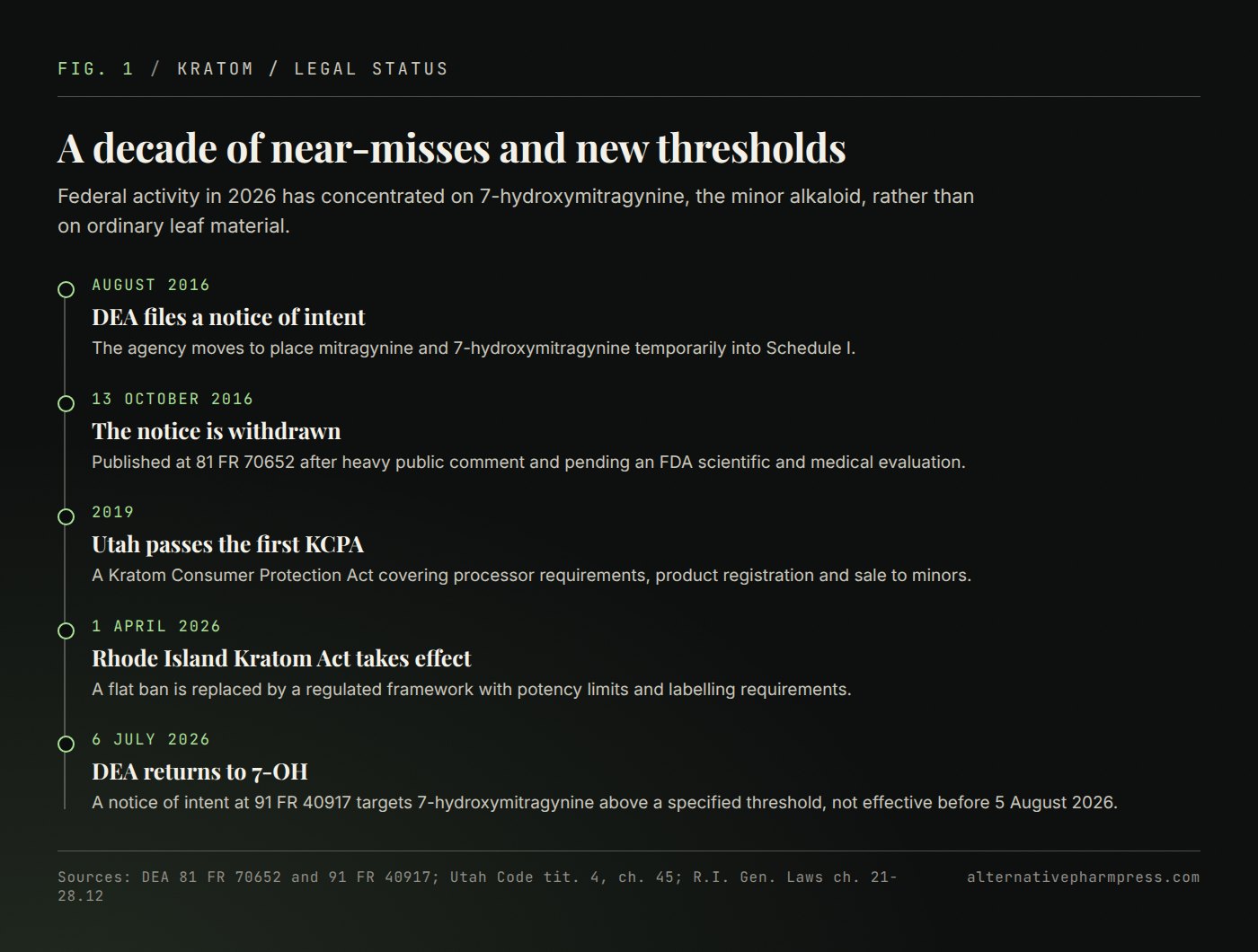
Kratom has been federally uncontrolled since October 2016, when the DEA withdrew a proposal to schedule mitragynine and 7-OH after heavy public comment.3
Unscheduled does not mean approved. The FDA says kratom is not lawfully marketed in the United States as a drug, dietary supplement or food additive, and treats kratom supplements as adulterated.4 Import Alert 54-15 lets officials detain kratom supplements and bulk ingredients at the border without examination.5
On 14 October 2026 the DEA published a revised notice of intent (FR Doc. 2026-20943, 91 FR 65370) to place 7-OH and mitragynine pseudoindoxyl temporarily in Schedule I above a threshold. A product is covered if either substance, or both combined, is present at more than 1 mg per gram (solids) or per millilitre (liquids), or if the mass of mitragynine divided by those substances is below 100. The order cannot be published before 13 November 2026, takes effect on publication and lasts two years, with a possible one-year extension.1
HHS, which recommended the threshold on 9 October, says the ratio is meant to catch products “intentionally enhanced or concentrated” without scheduling natural leaf.2 The DEA adds that below-threshold products should not be seen as safe, and that its action does not override stricter state laws.1 Our explainer on where 7-OH DEA scheduling stands works through the ratio test, and our guide to mitragynine vs 7-hydroxymitragynine explains why regulators treat the two alkaloids differently.
KCPA states: where kratom is regulated rather than banned
The DEA’s notice, citing the American Kratom Association, counts 19 states with a version of the KCPA model law: Arizona, Colorado, Florida, Georgia, Kentucky, Maryland, Mississippi, Nebraska, Nevada, New York, Oklahoma, Oregon, Rhode Island, South Carolina, South Dakota, Texas, Utah, Virginia and West Virginia.1 Kentucky’s will be overtaken by its 2027 sales ban, and Utah’s now allows only pure leaf.
Some set only an age limit; others require registration, lab testing and 7-OH caps, usually 2% of total alkaloids. A KCPA gives no protection against federal law: a product that passes a state cap can still exceed the DEA threshold. Our KCPA explainer sets out each state’s requirements, and our guide to reading a kratom lab report shows how to check 7-OH content.
Local kratom bans inside legal states
County and city rules are the most common source of surprises. The DEA notes local bans in Illinois, New Hampshire and North Carolina.1 Mississippi’s 2025 law kept existing local ordinances, and more than 30 counties and cities there already restricted or banned kratom.36 In California, San Diego, Newport Beach and Oceanside have banned sales.39 No national database of local codes exists.6
Why states keep changing the rules
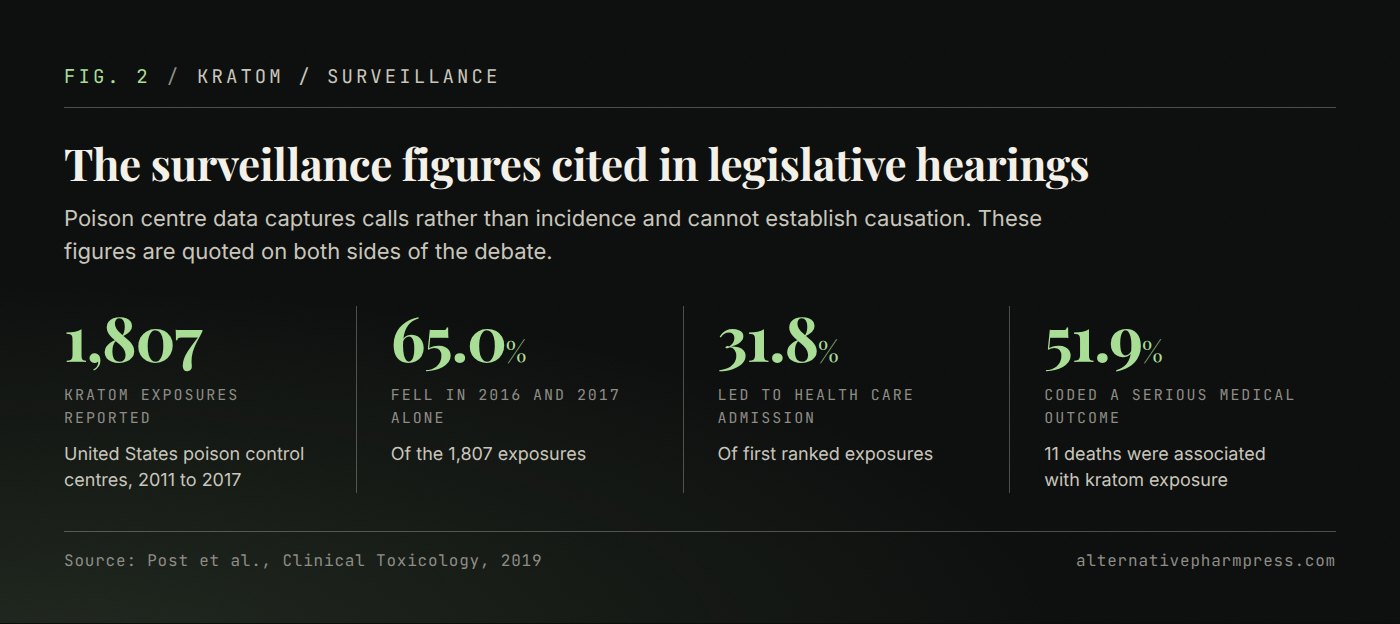
Safety data drives much of the activity. US poison centres logged 1,807 kratom exposures from 2011 to 2017, 65.0% of them in the last two years; 31.8% of first-ranked exposures led to hospital admission and 11 deaths were associated with kratom, two after kratom alone.42 Poison data counts calls, not incidence, and cannot show causation. The newer driver is concentrated 7-OH.
Kratom DUI laws: can you drive on kratom?
Being legal to buy does not make kratom legal to drive on. The Governors Highway Safety Association says every state has drug-impaired driving laws, though they vary a great deal. Only a minority set per se or zero-tolerance limits, and those cover specified drugs.40 We found no state naming mitragynine in a per se limit, but could not check every code (unconfirmed). In ban states, rules on controlled substances may also apply.
Kratom does turn up in arrests. In Orange County, California, 60 of 25,398 drug-impaired driving cases from 2017 to 2019 (0.24%) had detectable mitragynine. None involved mitragynine alone.41 Combining kratom with alcohol is a particular concern, which our article on kratom and alcohol covers. Whether a test picks it up depends on the panel used; see does kratom show up on a drug test.
Is kratom legal outside the US?
Kratom is not under international drug control: in 2021 the WHO’s Expert Committee on Drug Dependence found too little evidence to recommend a critical review and kept it under surveillance.46 National rules vary:
- Thailand: removed from the narcotics list in 2021; the Kratom Plant Act of 2022 bans sales to under-18s and pregnant or breastfeeding women and requires licences to import or export.43
- United Kingdom: the Psychoactive Substances Act 2016 makes it an offence to produce, supply, import or export psychoactive substances; simple possession outside prisons is not an offence.45
- Canada: Health Canada has not authorised the sale of any product containing kratom.44
- Mexico: unconfirmed. We could not find a Mexican government source, such as COFEPRIS or the General Health Law schedules, that addresses kratom. Seller claims that it is unregulated could not be verified.
Carrying kratom across any border can be an offence even where it is legal at home.
How to check the rules where you live
Start with the table, then check your legislature’s site and your county and city code for “kratom” and “mitragynine”. Then check the product: a 7-OH tablet can be illegal where leaf is legal, and from as early as 13 November 2026 products above the federal threshold will be Schedule I everywhere.1 If you rely on 7-OH products and supply is about to stop, our guide to 7-OH withdrawal explains what to expect and where to get help.
Frequently asked questions
Is kratom legal?
Federally, kratom leaf and mitragynine are not controlled substances, but the FDA has approved no kratom product. As of 24 October 2026, 10 states ban kratom outright: Alabama, Arkansas, Connecticut, Indiana, Kansas, Louisiana, Massachusetts (temporarily), Tennessee, Vermont and Wisconsin. Elsewhere it is legal for adults, often with age limits and 7-OH caps.1
Is kratom legal in Florida?
Yes, for adults 21 and over. Florida’s Kratom Consumer Protection Act bans sales to under-21s. Concentrated 7-OH and related compounds are Schedule I under emergency rules, most recently rule 2ER26-2 from 18 August 2026. Sarasota County bans kratom entirely, and reports of a Union County ban are unconfirmed.17,19
What states have banned kratom?
Ten, as of 24 October 2026: Alabama, Arkansas, Connecticut, Indiana, Kansas, Louisiana, Massachusetts, Tennessee, Vermont and Wisconsin. Massachusetts’ ban is a temporary order lasting up to a year. Kentucky will ban sales from 1 July 2027, North Dakota has paused sales until licensing rules exist, and Rhode Island lifted its ban in April 2026.1
Is kratom legal in DC?
Only partly. The District of Columbia has listed 7-OH in Schedule I by regulation since March 2016, but no DC law or rule names mitragynine. Plain leaf is therefore not expressly banned, though it contains trace 7-OH and the rule has not been tested on leaf. Treat 7-OH products as illegal and leaf as uncertain.6
Can you get a DUI for kratom?
Yes. Every state has drug-impaired driving laws, and most apply to any drug that impairs you, legal or not. Mitragynine has been detected in impaired-driving arrests, usually alongside alcohol or other drugs. Officers judge impairment through field sobriety tests and blood tests. If kratom affects your driving, the fact that you bought it legally is not a defence.40,41
Is kratom legal in Mexico in 2026?
We could not confirm it. We found no Mexican government source, from COFEPRIS or the General Health Law, that mentions kratom, and claims that it is unregulated come from sellers. Kratom is not under international control. Check with Mexican customs or a consulate before travelling, and do not carry it across the border.46
Is kratom legal in Texas?
Yes, for adults 18 and over under the Texas Kratom Consumer Protection Act, which requires product registration and caps 7-OH at 2% of alkaloids. Rules on 7-OH products have been tightening, so check current state guidance.
Sources
- Drug Enforcement Administration. Schedules of Controlled Substances: Temporary Placement of 7-Hydroxymitragynine and Mitragynine Pseudoindoxyl Above a Specified Threshold in Schedule I (FR Doc. 2026-20943, 91 FR 65370, Docket DEA-1570). 14 October 2026. federalregister.gov
- US Department of Health and Human Services. HHS Recommends Science-Based Thresholds to Target Dangerous Enhanced Kratom Products. 9 October 2026. hhs.gov
- Drug Enforcement Administration. Withdrawal of Notice of Intent To Temporarily Place Mitragynine and 7-Hydroxymitragynine Into Schedule I (81 FR 70652). 13 October 2016. federalregister.gov
- US Food and Drug Administration. FDA and Kratom. Updated 2 December 2025. fda.gov
- US Food and Drug Administration. Import Alert 54-15: Detention Without Physical Examination of Dietary Supplements and Bulk Dietary Ingredients That Are or Contain Mitragyna Speciosa or Kratom. Published 17 August 2026. accessdata.fda.gov
- Legislative Analysis and Public Policy Association. Kratom: Summary of State Laws (laws in effect as of January 2026). 5 February 2026. legislativeanalysis.org
- National Conference of State Legislatures. Lawmakers Weigh Guardrails, Bans on Kratom and 7-OH. 30 June 2026. ncsl.org
- Connecticut Department of Consumer Protection. Guidance for Businesses Regarding Controlled Substance Drug Schedule Updates. 4 March 2026. portal.ct.gov
- KCTV5. Kratom, 7-OH become illegal in Kansas July 1: Here’s what residents need to know. 26 June 2026. kctv5.com
- Massachusetts Department of Public Health. Legal advisory: kratom (105 CMR 726.000, temporary placement of kratom in Schedule 1). August 2026. mass.gov
- Metro Nashville Beer Permit Board. Metro Beer Permit Board Reminds Businesses of Tennessee Kratom Ban Effective July 1, 2026. 2026. nashville.gov
- Louisiana Department of Revenue. New penalties for Kratom in effect Aug. 1. 2025. revenue.la.gov
- FOX10 News. Alabama Attorney General issues statewide cease and desist order on products containing Kratom. 25 March 2026. fox10tv.com
- Plural Policy. Arkansas SB 534 (2025 Regular Session): Arkansas Kratom Consumer Protection Act, bill history. Accessed October 2026. open.pluralpolicy.com
- Vermont General Assembly. S.121, An act relating to the regulation of kratom products: bill status. Accessed October 2026. legislature.vermont.gov
- Rhode Island General Laws § 21-28.12-3. Kratom and kratom product limitations. Effective 1 April 2026. rilegislature.gov
- Florida Statutes § 500.92. Florida Kratom Consumer Protection Act. flsenate.gov
- The Capitolist. Florida moves to ban concentrated 7-OH products under emergency rule. 22 June 2026. thecapitolist.com
- Florida Department of Legal Affairs. Emergency Rule 2ER26-2: Addition of 7-Hydroxymitragynine (7-OH) and related substances to Schedule I. Effective 18 August 2026. flrules.org
- WUSF. Synthetic opioid 7-OH has fuzzy future in Florida. 22 March 2026. wusf.org
- The Palm Beach Post. Sarasota remains as the lone Florida county to have banned kratom. 16 January 2024. pressreader.com
- Kentucky Revised Statutes § 217.2202, Kratom processors and retailers: prohibitions (effective 1 July 2027; 2026 Ky. Acts ch. 161 and ch. 198). apps.legislature.ky.gov
- Kentucky Lantern. Omnibus bill would ban kratom sales, limit school levies and tax prediction markets. 1 April 2026. kentuckylantern.com
- Ohio Board of Pharmacy. Notice on kratom and 7-OH products under OAC 4729:9-1-01.1. Revised 5 October 2026. pharmacy.ohio.gov
- Office of the Governor of North Dakota. Armstrong signs bill banning synthetic kratom, restricting natural kratom to 21 and older. 4 September 2026. nd.gov
- Delaware Public Media. Delaware to get a state Title IX coordinator, implement new rules on kratom. 10 September 2026. delawarepublic.org
- BillTrack50. Delaware HB 332 (House Substitute 1): status, signed by the Governor 8 September 2026. Accessed October 2026. billtrack50.com
- Pennsylvania Capital-Star. Bill to regulate kratom sales and ban synthetic compounds passes Pa. House. 5 October 2026. penncapital-star.com
- FastDemocracy. Pennsylvania HB 2657 (2025–2026): actions. Accessed October 2026. fastdemocracy.com
- KCTV5. Missouri AG expands 7-OH kratom investigation to 9 more companies. 15 October 2026. kctv5.com
- KCUR. Kansas City bans synthetic kratom and other gas station drugs. 13 February 2026. kcur.org
- Utah Office of the Attorney General. New Kratom Law Now in Effect. 11 May 2026. ag.utah.gov
- Virginia Mercury. Kratom product sales to be regulated in Virginia. 27 May 2026. virginiamercury.com
- West Virginia Legislature. Enrolled Committee Substitute for Senate Bill 985 (2026 Regular Session). Passed 14 March 2026; effective 12 June 2026. wvlegislature.gov
- California Department of Public Health. News release NR26-016 on kratom and 7-OH products. 1 May 2026. cdph.ca.gov
- Mississippi Today. Kratom now 21-plus. 25 April 2025. mississippitoday.org
- KTIV. Why Iowa governor wants product banned that’s sold in some gas stations. 2 September 2026. ktiv.com
- Live 5 News. South Carolina kratom ban bill stalls in Senate. 11 May 2026. live5news.com
- Buchanan Ingersoll & Rooney. Kratom and 7-OH Update. 5 November 2025. bipc.com
- Governors Highway Safety Association. Drug-Impaired Driving: state laws. Updated 2025–2026. ghsa.org
- Kedzierski N, Mata D. Mitragynine in the Orange County DUID population. J Anal Toxicol. 2023;47(8):770-785. DOI: 10.1093/jat/bkad066. PMID: 37670456. pubmed.ncbi.nlm.nih.gov
- Post S, Spiller HA, Chounthirath T, Smith GA. Kratom exposures reported to United States poison control centers: 2011-2017. Clin Toxicol (Phila). 2019;57(10):847-854. DOI: 10.1080/15563650.2019.1569236. PMID: 30786220. pubmed.ncbi.nlm.nih.gov
- Tilleke & Gibbins. Thailand’s New Legal Framework for Kratom. 15 September 2022. tilleke.com
- Health Canada. Unauthorized “Sāj” kratom products seized from two Edmonton stores may pose serious health risks (public advisory). 4 May 2018. recalls-rappels.canada.ca
- UK Parliament. Psychoactive Substances Act 2016, explanatory notes: overview. legislation.gov.uk
- SupplySide Supplement Journal. WHO foregoes recommending ‘critical review’ of kratom. 7 December 2021. supplysidesj.com
- WBKO. Botanical manufacturer files lawsuit claiming Kentucky House Bill is unconstitutional. 3 June 2026. wbko.com
- North Carolina General Assembly. House Bill 468 (2025–2026 Session), Regulate Kratom Products: bill history. Accessed October 2026. ncleg.gov
This article is for educational purposes only and is not medical or legal advice. Products discussed here are not intended to diagnose, treat, cure or prevent any disease. Laws vary by location and change often, so verify the rules that apply where you are. Always talk to a licensed healthcare provider before use, especially if you are under 21, pregnant or nursing, taking medication, or managing a health condition.