

Disclosure: Some links on this page go to brands we cover. We may earn a commission if you buy through them, at no extra cost to you. This does not change our ratings. How we make money.
The best 7-OH brands of 2026, judged on lab transparency rather than strength, are 7Stax, 7OH.com and Elyxr from our verified directory, followed by nine widely sold industry picks: Kream, Press’d, OPiA, 7OHMZ, Hydroxie, Pure7, Real Botanicals, MIT45 and Paradise. We rank on proof: current, batch-matched third-party lab reports and clear milligram dosing per tablet.
We did not lab-test any product ourselves, and we do not score how strong a tablet feels. Every brand detail below either comes from the brand’s own website, checked in October 2026, or is framed as something you should check yourself. 7-OH tablets concentrate 7-hydroxymitragynine, a potent kratom alkaloid, so they carry far more risk than leaf. If you are new to the category, start with our explainer on 7-OH versus traditional kratom and our 7-OH tolerance overview.
Legal status: read this first
- A federal ban is close. On 14 October 2026 the DEA published a revised notice of intent to place 7-OH and mitragynine pseudoindoxyl in Schedule I above a threshold: more than 1 mg per gram (solids) or 1 mg per mL (liquids), or a mitragynine-to-7-OH ratio below 100. The order can be published on or after 13 November 2026, with no comment period.1
- Most 7-OH tablets would be covered. Products are sold at 1 mg to 700 mg of 7-OH per serving.1 Any tablet weighing under a gram that holds more than 1 mg of 7-OH is over the limit, and concentrated 7-OH tablets rarely contain 100 times more mitragynine than 7-OH. Once the order is published, those tablets become Schedule I. As of 24 October 2026, 7-OH is not yet federally scheduled.
- Many states already ban it. The DEA notice says ten states prohibit 7-OH consumption, including Alabama, Arkansas, Indiana and Wisconsin, and that the federal order does not preempt stricter state law.1 Check our 7-OH and kratom bans by state before buying anything.
- Dependence is a real risk. The DEA describes 7-OH as having opioidergic and addictive properties, with risks including tolerance, dependence and respiratory depression.1 If you use it daily, do not stop abruptly when supply disappears. Read our guide to 7-OH withdrawal and talk to a clinician.
What are 7-OH tablets?
7-OH tablets are pressed tablets sold on their content of 7-hydroxymitragynine, an alkaloid that occurs in kratom leaf only in small amounts. The DEA’s October notice says 7-OH makes up less than two percent of the total alkaloid content of the plant, and that commercial products, “including extracts and synthetic formulations”, contain a significantly higher concentration than botanical kratom.1 A 7-OH tablet is not powdered leaf in a different shape, and it is much stronger than the mitragynine that dominates leaf. Our comparison of mitragynine and 7-hydroxymitragynine explains how the two main alkaloids differ.
The FDA, which recommended scheduling in July 2025, called 7-OH “an opioid that can be more potent than morphine” and said it was not targeting natural kratom leaf products.2 It had already sent warning letters to companies selling 7-OH as tablets, gummies, drink mixes and shots.2
How much 7-OH is in a tablet?
It varies enormously. Citing a review of 250 products, the DEA notice says the 7-OH content of marketed products ranged from 1 mg to 700 mg in a single dose or serving.1 One directory brand below lists tablets from 20 mg to 150 mg each.
Why dosing varies so much
- Strength is not standardised. There is no official dose, and brands choose their own per-tablet figures.
- Tablets are often split. The DEA notes that many products feature serving sizes that require consumers to split tablets or doses,1 so the serving on the label may not be the whole tablet.
- Blends complicate the maths. Some tablets combine 7-OH with other alkaloids, including mitragynine pseudoindoxyl, which has been in Schedule I since 26 August 2026.3
- Tolerance shifts the goalposts. Regular users often need more for the same effect, which is how dependence builds. Our 7-OH gummies vs tablets guide covers format differences, and our explainer on how long 7-OH stays in your system covers drug testing.
How we ranked these brands
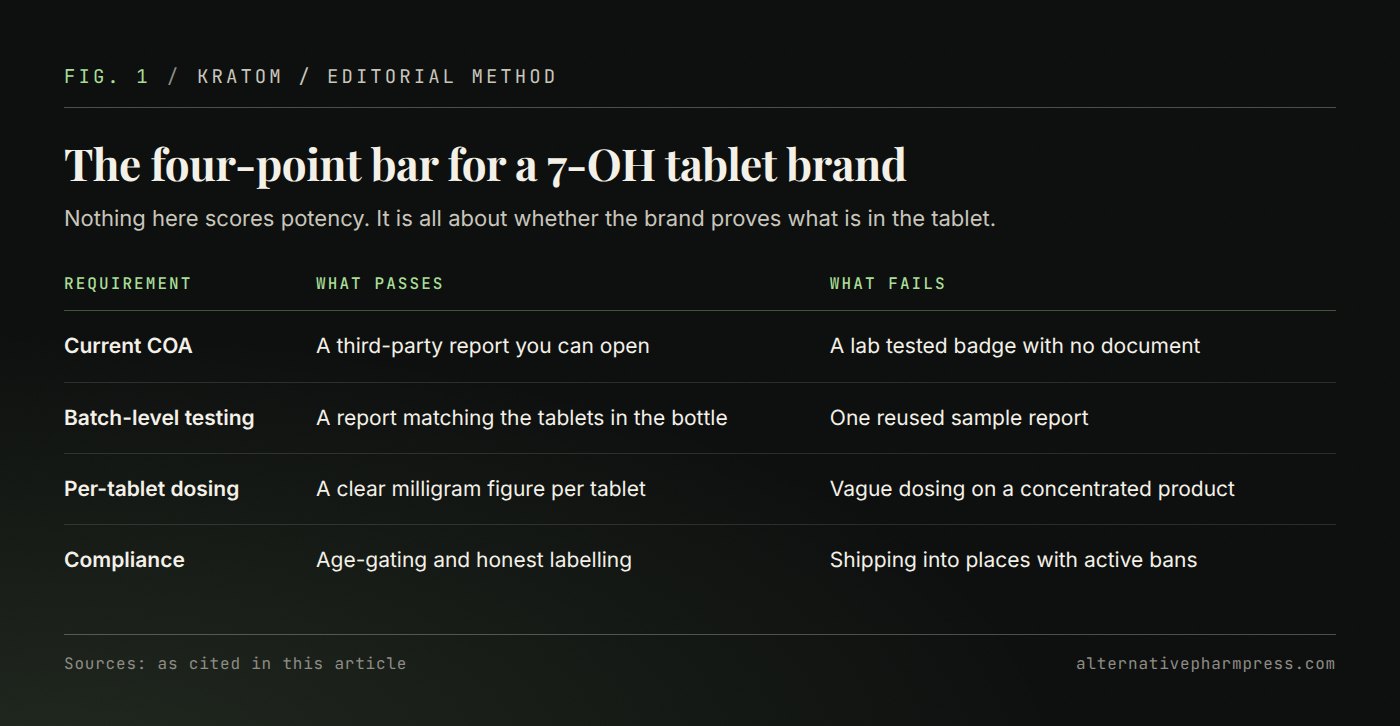
Every brand is judged against the same four-point bar, and none of it is about potency:
- A current third-party certificate of analysis (COA) that you can actually open, not a badge.
- Batch-level testing, so the report matches the tablets in the bottle rather than a one-time sample.
- Clear per-tablet dosing in milligrams, because a concentrated product with vague dosing is a problem.
- Compliance signals: honest labelling, age-gating and shipping rules that respect state and county bans.
Our guide on how to read a COA and our list of COA red flags explain how we check all of that. We split the list into brands verified in our own directory and industry picks we include for breadth. For industry picks we stick to general, verifiable facts and tell you to open the current COA yourself.
Quick comparison: the 12 best 7-OH brands
| Brand | Best for | Directory verified | Format |
|---|---|---|---|
| 7Stax | Clearly dosed tablets | Yes | Flavoured 7-OH tablets, lab reports page |
| 7OH.com | Comparing brands | Yes | Multi-brand marketplace |
| Elyxr | Broad lab-tested shelf | Yes | Retailer with lab report library |
| Kream | Blended formats | No, industry pick | Blended pressed tablets |
| Press’d | Dispensary-style retail | No, industry pick | Tablets via apothecary |
| OPiA | Frequently stocked | No, industry pick | Tablets |
| 7OHMZ | Established catalogue | No, industry pick | Tablets |
| Hydroxie | Single-focus brand | No, industry pick | High-purity tablets |
| Pure7 | Per-batch COA emphasis | No, industry pick | Tablets |
| Real Botanicals | Documented extraction | No, industry pick | Tablets |
| MIT45 | Well-known name | No, industry pick | Extract brand |
| Paradise | Marketplace availability | No, industry pick | Tablets |
Verified in our directory
1. 7Stax, best for clearly dosed tablets
7Stax is a directory-verified, single-purpose manufacturer that does one thing carefully: 7-OH tablets in clearly labelled strengths. When we checked its site in October 2026 it listed tablets at 20, 30, 50, 80, 100 and 150 mg each, in flavours such as mint, orange and wild berry, with a Lab Reports link in its main navigation and a list of states it will not ship to. Clear per-tablet dosing is exactly what a concentrated product needs, but note that every one of those strengths sits far above the proposed federal threshold. See our independent 7Stax review and the 7Stax directory profile, or visit 7stax.com.
2. 7OH.com, best marketplace to compare tablet brands
If you would rather compare several tablet brands side by side, 7OH.com is the directory-verified marketplace for it. It groups tablets into potency tiers and, when we checked, its brand menu included 7Stax, Kream, OPiA, Press’d, 7OHMZ and Hydroxie, along with a list of states and counties it does not ship to. Open the COA for the specific listing before you buy. Read our 7OH.com review and the directory profile, or visit 7oh.com.
3. Elyxr, best for a broad lab-tested shelf
Elyxr is a directory-listed Los Angeles retailer with a deep catalogue, a dedicated 7-OH section that stocks 7Stax tablets, and a Lab Reports library linked from its navigation. A searchable report library is the feature we care about most for a concentrated product. See our Elyxr review and the Elyxr directory profile, or visit elyxr.com.
Industry picks (not yet in our directory)
These nine are widely sold 7-OH tablet brands we include for breadth. We have not verified them in our directory, so treat each as a starting point and read the current batch COA before you buy.
4. Kream, best for blended tablet formats
Kream is one of the more visible tablet lines, known for products that blend 7-OH with other kratom alkaloids, and it shows up across major 7-OH marketplaces. Blends complicate what you are actually taking, so the COA matters even more: confirm the per-tablet content of every listed alkaloid for the exact product rather than assuming it across the range.
5. Press’d, best for dispensary-style distribution
Press’d is distributed through Kures Apothecary and other retailers, giving it a more dispensary-style footprint than direct-to-consumer labels. As with any retailer-distributed brand, check that the specific shop you buy from links a current, batch-matched lab report.
6. OPiA, best for a frequently stocked tablet line
OPiA is a tablet brand shoppers request often and marketplaces stock widely. Popularity is not proof of quality, so open the COA for the batch you are buying and confirm the per-tablet milligram figure before you trust the label.
7. 7OHMZ, best for an established catalog
7OHMZ is an established tablet brand carried across several marketplaces, including curated 7-OH storefronts. A recognisable catalogue makes it easy to find but no less important to verify: look for a current report with a batch number that matches the bottle.
8. Hydroxie, best for a single-focus brand
Hydroxie is built almost entirely around 7-OH and markets high-purity products. A narrow focus can be a plus, but high-purity claims need a current third-party COA behind them, not marketing language alone.
9. Pure7, best for per-batch COA emphasis
Pure7 positions itself around transparency, with third-party testing presented for each batch. That is the posture we want to see, so if the published reports are genuinely current and batch-matched when you check, it earns its place. Verify the report for your specific order.
10. Real Botanicals, best for documented extraction
Real Botanicals sells 7-hydroxymitragynine tablets and describes a proprietary extraction process alongside third-party testing. Documented process plus published testing is a reasonable combination, but the COA you can open for the current batch is what matters, not the process description.
11. MIT45, best for a well-known name
MIT45 is a widely recognised kratom-extract brand that independent testing trackers follow, and it sits in the broader 7-OH and concentrate conversation. Recognition is a starting point, not a guarantee, so apply the same four-point check you would to any brand here.
12. Paradise, best for marketplace availability
Paradise is carried across curated marketplaces and resellers, which makes it broadly available. With third-party shops, the quality of the listing depends on the seller, so buy from a storefront that publishes the current batch report rather than one that only shows a logo.
What to check before you buy any 7-OH tablet
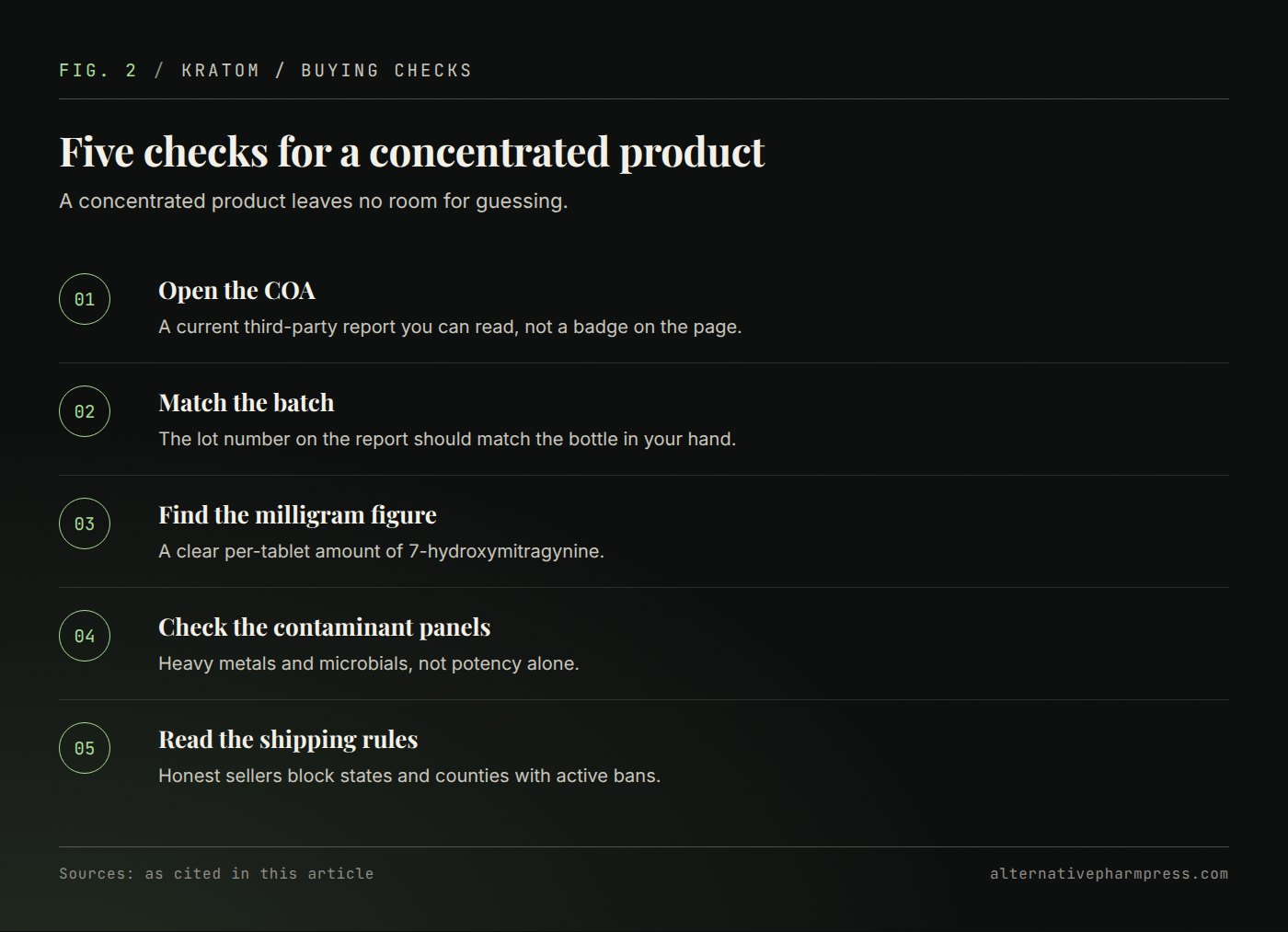
A concentrated product leaves no room for guessing. Confirm five things every time:
- A current third-party COA you can open, not a badge.
- A batch or lot number on the report that matches the bottle.
- A clear per-tablet milligram figure for 7-hydroxymitragynine, and for any other alkaloid in a blend. A label listing mitragynine pseudoindoxyl means a Schedule I substance.3
- Contaminant panels for heavy metals and microbials, not just potency.
- Shipping rules that block states and counties with active bans instead of pretending they do not exist.
Our COA red flags guide covers the dodges to watch for, and our checklist of signs a brand is actually third-party tested applies here too.
Which is the most potent 7-OH brand?
We do not rank brands on potency. The highest per-tablet strength we saw on a directory brand’s site was 150 mg, but a bigger number on a label is not a verified number, and it is not a better product. Higher-strength tablets speed up tolerance, raise dependence risk and are squarely inside the proposed federal ban. If a brand markets itself as the “strongest”, treat that as a reason to look harder at its COA, not a reason to buy.
How to read 7-OH brand reviews
Most 7-OH brand reviews online are written by retailers, affiliates or anonymous forum users, and very few check lab reports. A useful review tells you whether the COA was current, whether the batch number matched and whether the stated milligrams were confirmed by a named third-party lab. Our own reviews focus on documents, and directory placements are labelled as such.
A serious word on legality and safety
Our explainer on where DEA scheduling of 7-OH stands walks through the October notice and the ratio test, and our legal status by state tracker and explainer on the Kratom Consumer Protection Act cover state rules. The DEA stresses that neither it nor HHS has found these substances safe below the threshold.1 The FDA’s kratom page lays out the federal concerns. None of this is legal advice. If you use 7-OH, talk to a healthcare provider; SAMHSA’s free National Helpline (1-800-662-4357) can point you to local help.
Are you a 7-OH brand?
If you make or sell 7-OH tablets and want to be considered for this list, we review brands on lab transparency, not ad spend. You can apply to be reviewed and listed or register your brand in our directory. Send us current, batch-matched third-party COAs and we will take a look. Directory placement is clearly disclosed and never disguised as editorial.
Frequently asked questions
What is the best 7-OH brand in 2026?
On lab transparency, our top directory-verified pick is 7Stax for clearly dosed tablets, with 7OH.com best for comparing several brands at once and Elyxr for a broad shelf with a lab report library. The best 7-OH brand for any buyer is the one that publishes a current, batch-matched third-party COA for the exact product, and that ships legally to where they live.
What are 7-OH tablets?
7-OH tablets are pressed tablets sold on their 7-hydroxymitragynine content. In kratom leaf, 7-OH makes up less than two percent of total alkaloids, so tablets rely on extracts or synthetic formulations that concentrate it. The DEA says marketed products range from 1 mg to 700 mg of 7-OH per serving, which is why per-tablet dosing and lab reports matter so much.
What is the most potent 7-OH brand?
We do not rank 7-OH brands on potency, because higher strength means faster tolerance and greater dependence risk, not a better product. Label figures also need a current third-party COA to be trusted. The highest per-tablet strength we saw on a directory brand’s site was 150 mg. Any tablet sold on its 7-OH content is likely to fall inside the proposed federal ban.
Are 7-OH tablets legal in 2026?
As of 24 October 2026, 7-OH is not federally scheduled, but the DEA’s 14 October notice would place 7-OH above 1 mg per gram, or below a 100:1 mitragynine ratio, in Schedule I. That order can be published from 13 November 2026 and would cover most tablets. Many states, including Alabama, Arkansas, Indiana and Wisconsin, already prohibit 7-OH.
Are the best 7-OH products safer than regular kratom?
No. Even well-tested 7-OH products are far more concentrated than kratom leaf, and the DEA describes 7-OH as opioidergic and addictive, with risks including tolerance, dependence and respiratory depression. Lab testing confirms what is in a tablet, not that it is safe. Daily users should not stop abruptly and should talk to a clinician about tapering or treatment options.
Can I trust 7-OH brand reviews?
Treat most 7-OH brand reviews with caution. Many are written by retailers or affiliates, and few check whether the COA is current, whether the batch number matches the bottle or whether a named third-party lab confirmed the milligrams. A trustworthy review shows its evidence. Star ratings and comments about how quickly a tablet worked tell you nothing about what it contains.
Is 7-OH legal right now?
Federally, 7-OH was not yet scheduled as of 22 November 2026, but several states ban or restrict it, and the FDA has warned companies selling it. Check your state’s law and expect the federal position to change.
When will the 7-OH ban take effect?
The DEA’s October 2026 notice said a temporary order could be published on or after 13 November 2026. As of 22 November 2026 it had not been published. It takes effect on the day it appears in the Federal Register.
Sources
- Drug Enforcement Administration. Schedules of Controlled Substances: Temporary Placement of 7-Hydroxymitragynine and Mitragynine Pseudoindoxyl Above a Specified Threshold in Schedule I (notice of intent, FR Doc. 2026-20943, 91 FR 65370, Docket DEA-1570). 14 October 2026. federalregister.gov
- US Department of Health and Human Services. FDA Takes Steps to Restrict 7-OH Opioid Products Threatening American Consumers. 29 July 2025. hhs.gov
- Vicente LLP. DEA Places Three Kratom-Related Substances in Schedule I as 7-OH Scheduling Remains Pending. September 2026. vicentellp.com
Editorial note: A directory listing is not a paid editorial endorsement, and our editorial team operates independently of advertising. Some listings, reviews, and coupons may be affiliate or paid placements, which do not influence our standards.
This article is for educational purposes only and is not medical or legal advice. Products discussed here are not intended to diagnose, treat, cure or prevent any disease. Laws vary by location and change often, so verify the rules that apply where you are. Always talk to a licensed healthcare provider before use, especially if you are under 21, pregnant or nursing, taking medication, or managing a health condition.