
Kratom and kava are unrelated plants. Kratom is the leaf of Mitragyna speciosa, a Southeast Asian coffee-family tree whose alkaloids act on opioid receptors. Kava is a drink made from the root of Piper methysticum, a Pacific pepper plant whose kavalactones act as sedatives. Kratom carries a clear dependence risk; kava’s best-known risk is rare liver injury.1,2,3,4
The two are often lumped together because they share shelf space. Both are sold in US kava bars, smoke shops and online as alcohol alternatives, and a growing number of “kava” drinks now contain kratom, sometimes without saying so on the label.4,5
This comparison covers plant families, active compounds and mechanisms, what clinical trials show, safety and interactions, legal status in the US, UK, EU and Australia as of October 2026, and what to check at a kava bar. It gives no dosing advice and does not recommend either.
Kratom vs kava at a glance
| Property | Kratom | Kava |
|---|---|---|
| Plant | Mitragyna speciosa leaf; coffee family (Rubiaceae) | Piper methysticum root; pepper family (Piperaceae)3 |
| Native region | Southeast Asia6 | South Pacific3 |
| Active compounds | Indole alkaloids: mitragynine, trace 7-OH7,1 | Kavalactones (kavain and others)8 |
| Main target | Mu-opioid receptor (partial agonist)2 | GABA-A receptors (positive modulation)8 |
| Traditional form | Leaves chewed or brewed as tea9 | Water-based drink from the root |
| Best human evidence | Surveys; one small pain-tolerance trial10 | Several anxiety trials; mixed results11,12 |
| Dependence and withdrawal | Well documented13 | Not typically associated with physical dependence5 |
| Best-known serious risk | Dependence; rare liver injury14 | Rare liver injury3 |
| US federal status (24 Oct 2026) | Leaf not scheduled; DEA moving on concentrated 7-OH and MP | Not controlled; sold as supplement or beverage |
Two different plants: coffee family vs pepper family
Kratom is a tropical tree native to central and southern Thailand, northern Malaysia, Sumatra, Borneo, the Philippines and New Guinea.6 Its leaves have long been chewed fresh or brewed into tea, partly to fight fatigue during farm work.9 Today it is mostly sold as dried leaf powder, capsules, extracts and, increasingly, concentrated 7-OH products. Our plain-language guide, what is kratom, explains the product types.
Kava is a member of the pepper family native to the South Pacific. Pacific Islanders have long drunk it in ceremonies and as medicine, and it is now served in kava bars in the US.3 Traditional kava is a water-based drink from the root and rhizome; commercial products, including concentrated extracts and ready-to-drink beverages, can contain two to ten times the kavalactone concentrations of traditional preparations.4
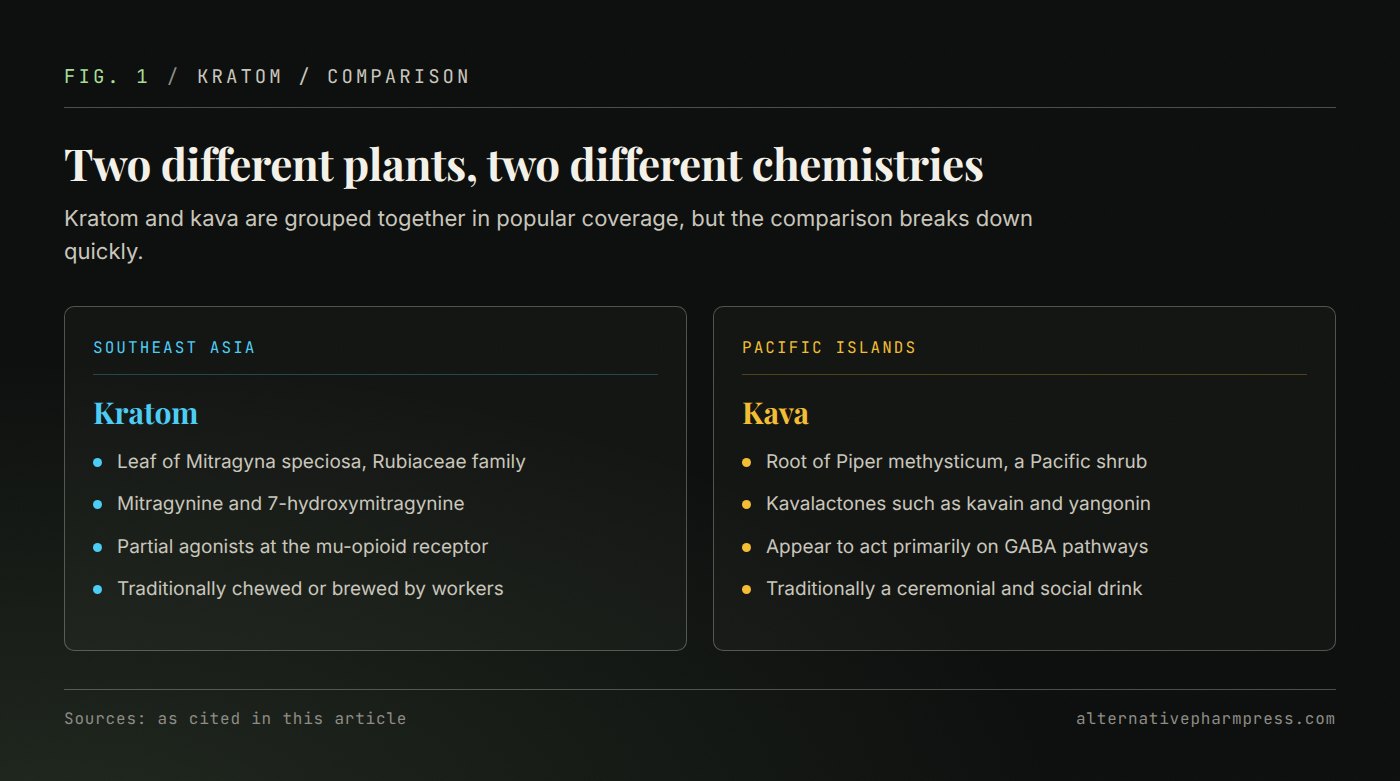
Active compounds and how they work
Kratom: indole alkaloids at opioid receptors
Kratom’s main alkaloid, mitragynine, is an indole alkaloid.7 Mitragynine and its more potent relative 7-hydroxymitragynine (7-OH) are partial agonists at the human mu-opioid receptor and block kappa- and delta-opioid receptors.2 The liver also turns some mitragynine into 7-OH, which in mice explained most of mitragynine’s opioid-receptor pain relief.15 Kratom alkaloids act on adrenergic and serotonin systems too.16 See kratom and the opioid receptor for the details.
Kava: kavalactones at GABA-A receptors
Kava’s active compounds are kavalactones, a family of related molecules. Their precise targets have been debated for years. A 2016 laboratory study found that kavain, the main anxiety-relevant kavalactone, enhanced every GABA-A receptor subtype tested, and did so through a site other than the one benzodiazepines use.8 The CDC describes kavalactones as having sedative and anxiety-reducing effects and kava as a central nervous system depressant.4
In short, kratom works mostly through the opioid system, kava mostly through the brain’s main calming (GABA) system. That one difference explains most of what follows on effects, dependence and interactions.
Effects: what users describe
Kratom effects appear to depend on amount: users describe stimulation and alertness at lower amounts and pain relief and sedation at higher amounts.9 In a study that tracked 357 US users in real time, people mostly used kratom for energy, productivity and pain.16
Kava is typically described as relaxing and sedating, reflecting the anxiety-reducing and sedative effects of kavalactones.4 Commonly reported side effects include stomach upset, headache and dizziness.3 Kava can also impair coordination; Australian food regulators list sedation, unsteadiness and impaired driving among its hazards.17
Both are also often compared with kanna (Sceletium tortuosum), a South African succulent that acts mainly on serotonin. Our comparisons of kava vs kanna and kratom vs kanna cover that third option.
| Kratom | Kava | |
|---|---|---|
| Plant | Mitragyna speciosa leaf (coffee family) | Piper methysticum root (pepper family) |
| Origin | Thailand, Malaysia, Indonesia, Myanmar, Papua New Guinea | Fiji, Vanuatu, Samoa, Tonga and other Pacific islands |
| Active compounds | Indole alkaloids (mitragynine, 7-hydroxymitragynine) | Kavalactones (kavain, methysticin, yangonin and others) |
| Main targets | Mu-opioid, adrenergic and serotonin receptors | GABA pathways |
| Reported effects | Stimulating at low doses, sedating at higher doses | Relaxing and sociable; numbs the mouth |
| Main risks | Dependence and withdrawal, drug interactions, rare liver injury | Rare liver injury, skin changes with heavy use, drug interactions |
| U.S. status | Banned in 9 states; 7-OH concentrates moving to Schedule I | Legal as a supplement and traditional drink |
What the research shows: kava anxiety trials vs kratom surveys
Kava
Kava has the stronger clinical record, though it is mixed.
- Cochrane review (2003). Eleven randomised, placebo-controlled trials with 645 participants were included. Pooling six that used the Hamilton Anxiety scale showed a significant reduction in anxiety with kava extract compared with placebo, and adverse events were mild, transient and infrequent.11 The review is more than 20 years old and called for long-term safety studies.
- Sarris 2013. In a six-week trial in generalised anxiety disorder (75 enrolled, 58 analysed), an aqueous kava extract reduced anxiety more than placebo, with a moderate effect size. Liver tests did not differ between groups.18
- Sarris 2020. A larger, longer trial in 171 people with generalised anxiety disorder found no benefit over placebo after 16 weeks. Liver test abnormalities were more frequent with kava, although no one met criteria for herb-induced liver injury.12
The US National Center for Complementary and Integrative Health concludes that kava may help anxiety but does not appear to help generalised anxiety disorder.3
Kratom
Kratom has no comparable trial base. The evidence is mostly surveys: in 8,049 US respondents, kratom was used mainly for pain, mood and withdrawal from prescription opioids.19 The one double-blind trial we found involved 26 male daily users in Malaysia, whose pain tolerance in an ice-water test rose after a kratom drink but not after placebo.10 Our kratom research overview covers the rest. Neither plant is approved to treat any condition in the US.
Safety compared: liver injury and dependence
Kava’s liver history, and the bans that followed
By late 2002, 11 people who had used kava products had needed liver transplants, two in the US and nine in Europe. The FDA issued a consumer advisory in March 2002, and Germany, Switzerland, Canada, Australia and France restricted sales.20 Australian food regulators note that liver toxicity has been reported with kava herbal extracts, and link it to possible causes such as non-noble varieties, extraction methods, drug interactions and mould toxins.17 The NIH adds the wrong plant parts, alcohol use and individual genetic differences to the list; no single cause has been confirmed.3
Some restrictions were later reversed. In Germany, the medicines regulator BfArM suspended kava drug approvals in 2002 and revoked them in 2007; a Cologne court annulled the revocation in 2014, and a higher administrative court upheld that ruling in 2015. BfArM then set strict conditions for a return, including prescription-only supply, a daily limit of 200 mg kavapyrones and weekly liver tests.21 The UK’s 2002 ban on kava in food remains in place.22
Australian and New Zealand food regulators now take a middle position: traditional kava beverages from noble varieties and peeled root are considered low risk, while heavy ongoing drinking has been linked to reversible changes in liver tests.17 Heavy long-term use can also cause kava dermopathy, a dry, scaly skin condition.3
Kratom’s dependence and liver risks
Dependence is kratom’s defining risk. In 293 regular users in Malaysia, more than half had severe dependence and 45% moderate dependence, with withdrawal symptoms including muscle pain, sleep problems, diarrhoea and restlessness.13 Kava, by contrast, is not typically associated with physical dependence.5
Kratom also has a liver signal. A 2020 review of case reports concluded kratom likely causes liver injury, usually cholestatic and appearing around three weeks after starting.14 Contamination is a further risk: a 2017 to 2018 Salmonella outbreak linked to kratom sickened 199 people in 41 states.23 See kratom and liver injury and how kratom tolerance develops.
Drug interactions: kratom vs kava
- Kratom. A single cup of kratom tea raised exposure to midazolam, a drug cleared by CYP3A, by about 39% in 12 healthy adults.24 Many opioids, benzodiazepines and other medicines use that pathway. See kratom and drug interactions.
- Kava. Kava should not be combined with alcohol, benzodiazepines or other sedatives.3 In 12 volunteers, 28 days of kava supplements reduced CYP2E1 activity by about 40%.25 A 2026 laboratory study found kava extracts inhibit CYP2B6, an enzyme that breaks down some medicines, including ketamine, and called for clinical testing.26
- Together. No study has tested kratom and kava combined. Pairing an opioid-acting plant with a sedative one raises obvious concerns about drowsiness and breathing, and our guide to kratom and alcohol covers a similar mix.
Kava bars and kratom-laced “kava” drinks
Kava bars, often promoted as alcohol-free social venues, have spread in the US; one estimate put their growth at about 30% between 2012 and 2017, with Hawaii and coastal cities the main hubs.4,27 At the same time, commercial kava products are increasingly combined with kratom, and are often sold online and in vape shops near college campuses.4
That mix is showing up in poison centre data. Kava exposure reports have risen steadily since 2011, reaching 203 in 2025, and reports involving kava combined with kratom made up 30% of them that year. Serious outcomes rose to 32% of reports, from 12% in 2000.4 In Alabama in late 2025, a cluster of people developed opioid-like withdrawal after using liquid products marketed as kava. Lab tests found kratom alkaloids in several products, one with mitragynine but no detectable kavalactones, and mitragynine pseudoindoxyl as the main kratom compound in three.5 Mitragynine pseudoindoxyl has been in Schedule I since 26 August 2026.28
If you go to a kava bar, ask what is in each drink, ask whether products have been tested for kratom alkaloids, and be wary of canned “kava” shots with vague ingredient lists. Kava alone does not show up on standard drug tests; kratom can be found by dedicated tests. See does kratom show up on a drug test.
Legal status of kratom and kava in 2026
| Jurisdiction | Kratom | Kava |
|---|---|---|
| United States | Leaf not federally scheduled; FDA says not lawful as supplement or food; DEA notice targets 7-OH and MP above a threshold1,29 | Not controlled; sold as a supplement; FDA indicated in Dec 2025 that single-ingredient kava in water is generally not a food additive27 |
| United Kingdom | Treated as a psychoactive substance: supply and import are offences, simple possession is not30,31 | Food containing kava banned since 2002; no review planned32,22 |
| European Union | No EU-wide rule; national approaches differ (Czech Republic regulated from Nov 2025)33 | No EU herbal monograph; Germany allows prescription kava medicines under strict conditions34,21 |
| Australia | Prohibited (Schedule 9)35 | Permitted as food within limits; commercial import pilot since Dec 202117,36,37 |
United States. On 14 October 2026 the DEA published a revised notice of intent to temporarily place 7-OH and mitragynine pseudoindoxyl in Schedule I when a product has more than 1 mg per gram (or per millilitre), or a mitragynine-to-7-OH ratio below 100. The order cannot be published before 13 November 2026. Plain kratom leaf and mitragynine are not scheduled by this action.29 State kratom rules vary, so check where kratom is legal in the US and our 7-OH scheduling explainer. For kava, the main local restriction is in New York City, which bars food service establishments from selling steeped kava, a policy a federal judge upheld.27
United Kingdom. The Kava-kava in Food (England) Regulations 2002 prohibit importing or selling food containing kava. In September 2025 the government said the Food Standards Agency had not seen evidence sufficient to amend the controls, and that a separate 2002 order on kava medicines also applies.22 The Psychoactive Substances Act 2016 makes producing, supplying and importing psychoactive substances offences, but not simple possession outside prisons.30
European Union. The European Medicines Agency’s herbal committee did not adopt an EU monograph for kava root, publishing a public statement instead in 2018.34 We found no single EU-wide position on kava or kratom as foods, so check national rules.
Australia. Kava is allowed as food only as raw or dried root or a water-based drink made from noble varieties, using peeled root, rhizome or basal stem, with warnings to use in moderation.17 A commercial importation pilot began on 1 December 2021, and its arrangements remained in place in mid-2026.36,37 Kratom, by contrast, is a prohibited Schedule 9 substance.35
Frequently asked questions
What is the difference between kratom and kava?
Kratom is the leaf of a Southeast Asian tree in the coffee family whose alkaloids, mainly mitragynine, act on opioid receptors.2 Kava is a drink made from the root of a Pacific pepper plant whose kavalactones enhance GABA-A receptors and act as sedatives.8 Kratom carries a well-documented dependence risk; kava’s main known risk is rare liver injury.13,3
Is kratom or kava safer?
Neither is risk-free, and the risks differ. Kratom can cause dependence and withdrawal, rare liver injury and drug interactions.13,14,24 Kava has been linked to rare but serious liver injury, mainly with extracts, and should not be mixed with alcohol or sedatives.3 Products combining the two, or “kava” drinks containing hidden kratom, add uncertainty.5
Can you mix kratom and kava?
No study has tested the combination, so its safety is unknown. It pairs an opioid-acting plant with a sedative one. US poison centre reports involving both rose to 30% of all kava reports in 2025, alongside a rise in serious outcomes.4 Anyone taking prescription medicines, or drinking alcohol, should speak to a pharmacist or doctor first.
Does kava help with anxiety?
Possibly for short-term anxiety, but not convincingly for generalised anxiety disorder. A 2003 Cochrane review of 11 trials found kava extract reduced anxiety scores compared with placebo.11 However, a 16-week trial in 171 people with generalised anxiety disorder found no benefit over placebo and more liver test abnormalities with kava.12
Why do kava bars sell kratom?
Both are marketed as alcohol-free alternatives and are sold through the same kinds of venues, shops and websites. CDC data show commercial kava products are increasingly combined with kratom.4 In a 2026 investigation, some liquids sold as kava contained kratom alkaloids, including mitragynine pseudoindoxyl, and were linked to opioid-like withdrawal.5 Ask what each drink contains and whether it has been tested.
Is kava legal in the UK?
Not as food. The Kava-kava in Food (England) Regulations 2002 prohibit importing or selling food containing kava, and in September 2025 the government said evidence had not been sufficient to change the controls.22 A separate 2002 order restricts kava medicines. Kratom is treated as a psychoactive substance in the UK, so supplying or importing it is an offence.30
Does kava show up on a drug test?
Standard drug panels don’t test for kavalactones. Kratom also isn’t on standard panels, though specialized tests exist.
Sources
- US Food and Drug Administration. FDA and Kratom. FDA Public Health Focus; content current as of 2 December 2025. fda.gov
- Kruegel AC, Gassaway MM, Kapoor A, Váradi A, Majumdar S, Filizola M, Javitch JA, Sames D. Synthetic and Receptor Signaling Explorations of the Mitragyna Alkaloids: Mitragynine as an Atypical Molecular Framework for Opioid Receptor Modulators. J Am Chem Soc. 2016;138(21):6754-6764. DOI: 10.1021/jacs.6b00360. PMID: 27192616. pubmed.ncbi.nlm.nih.gov
- National Center for Complementary and Integrative Health. Kava. Last updated April 2025. nccih.nih.gov
- Towers EB, Williams IL, Holstege CP, Farah R. Increase in Poison Center Reports Linked to Kratom-Containing Kava Products: National Poison Data System, United States, 2000-2025. MMWR Morb Mortal Wkly Rep. 2026;75(12):157-163. DOI: 10.15585/mmwr.mm7512a1. PMID: 41926333. pubmed.ncbi.nlm.nih.gov
- Marshall S, Leisch L, Scott KS, Rivera J, Whiddon J, Bradford D, et al. Unlabeled kratom alkaloids detected in products marketed as kava. Clin Toxicol (Phila). 2026;64(8):728-731. DOI: 10.1080/15563650.2026.2688238. PMID: 42374886. pubmed.ncbi.nlm.nih.gov
- Ransden KE, Ramachandria P, Laforest LC, Kanumuri SRR, Sharma A, McCurdy CR, Nadakuduti SS. Comparative analysis of monoterpene indole alkaloid composition and genotypic variation in Thai Mitragyna speciosa. Front Plant Sci. 2026;17:1821609. DOI: 10.3389/fpls.2026.1821609. PMID: 42158609. pubmed.ncbi.nlm.nih.gov
- Manwill PK, Flores-Bocanegra L, Khin M, Raja HA, Cech NB, Oberlies NH, Todd DA. Kratom (Mitragyna speciosa) Validation: Quantitative Analysis of Indole and Oxindole Alkaloids Reveals Chemotypes of Plants and Products. Planta Med. 2022;88(9-10):838-857. DOI: 10.1055/a-1795-5876. PMID: 35468648. pubmed.ncbi.nlm.nih.gov
- Chua HC, Christensen ET, Hoestgaard-Jensen K, Hartiadi LY, Ramzan I, Jensen AA, Absalom NL, Chebib M. Kavain, the Major Constituent of the Anxiolytic Kava Extract, Potentiates GABAA Receptors: Functional Characteristics and Molecular Mechanism. PLoS One. 2016;11(6):e0157700. DOI: 10.1371/journal.pone.0157700. PMID: 27332705. pubmed.ncbi.nlm.nih.gov
- Huisman G, Menke M, Grundmann O, Schreiber R, Mason N. Examining the Psychoactive Differences between Kratom Strains. Int J Environ Res Public Health. 2023;20(14):6425. DOI: 10.3390/ijerph20146425. PMID: 37510657. pubmed.ncbi.nlm.nih.gov
- Vicknasingam B, Chooi WT, Rahim AA, Ramachandram D, Singh D, Ramanathan S, et al. Kratom and Pain Tolerance: A Randomized, Placebo-Controlled, Double-Blind Study. Yale J Biol Med. 2020;93(2):229-238. PMID: 32607084. pubmed.ncbi.nlm.nih.gov
- Pittler MH, Ernst E. Kava extract for treating anxiety. Cochrane Database Syst Rev. 2003;(1):CD003383. DOI: 10.1002/14651858.CD003383. PMID: 12535473. pubmed.ncbi.nlm.nih.gov
- Sarris J, Byrne GJ, Bousman CA, Cribb L, Savage KM, Holmes O, et al. Kava for generalised anxiety disorder: A 16-week double-blind, randomised, placebo-controlled study. Aust N Z J Psychiatry. 2020;54(3):288-297. DOI: 10.1177/0004867419891246. PMID: 31813230. pubmed.ncbi.nlm.nih.gov
- Singh D, Müller CP, Vicknasingam BK. Kratom (Mitragyna speciosa) dependence, withdrawal symptoms and craving in regular users. Drug Alcohol Depend. 2014;139:132-137. DOI: 10.1016/j.drugalcdep.2014.03.017. PMID: 24698080. pubmed.ncbi.nlm.nih.gov
- Schimmel J, Dart RC. Kratom (Mitragyna Speciosa) Liver Injury: A Comprehensive Review. Drugs. 2020;80(3):263-283. DOI: 10.1007/s40265-019-01242-6. PMID: 31919755. pubmed.ncbi.nlm.nih.gov
- Kruegel AC, Uprety R, Grinnell SG, Langreck C, Pekarskaya EA, Le Rouzic V, et al. 7-Hydroxymitragynine Is an Active Metabolite of Mitragynine and a Key Mediator of Its Analgesic Effects. ACS Cent Sci. 2019;5(6):992-1001. DOI: 10.1021/acscentsci.9b00141. PMID: 31263758. pubmed.ncbi.nlm.nih.gov
- Smith KE, Panlilio LV, Feldman JD, Grundmann O, Dunn KE, McCurdy CR, Garcia-Romeu A, Epstein DH. Ecological Momentary Assessment of Self-Reported Kratom Use, Effects, and Motivations Among US Adults. JAMA Netw Open. 2024;7(1):e2353401. DOI: 10.1001/jamanetworkopen.2023.53401. PMID: 38277146. pubmed.ncbi.nlm.nih.gov
- Food Standards Australia New Zealand. Kava (Piper methysticum) advice. 15 January 2025. foodstandards.gov.au
- Sarris J, Stough C, Bousman CA, Wahid ZT, Murray G, Teschke R, et al. Kava in the treatment of generalized anxiety disorder: a double-blind, randomized, placebo-controlled study. J Clin Psychopharmacol. 2013;33(5):643-648. DOI: 10.1097/JCP.0b013e318291be67. PMID: 23635869. pubmed.ncbi.nlm.nih.gov
- Grundmann O. Patterns of Kratom use and health impact in the US: Results from an online survey. Drug Alcohol Depend. 2017;176:63-70. DOI: 10.1016/j.drugalcdep.2017.03.007. PMID: 28521200. pubmed.ncbi.nlm.nih.gov
- Centers for Disease Control and Prevention. Hepatic Toxicity Possibly Associated with Kava-Containing Products: United States, Germany, and Switzerland, 1999-2002. MMWR. 2002;51(47):1065-1067. cdc.gov
- Pradel J. BfArM erlaubt Kava-Kava nur unter strengen Auflagen. Apotheke Adhoc. 11 September 2015. apotheke-adhoc.de
- UK Parliament. Written question 75229: Kava-kava in Food (England) Regulations 2002. Answered by Ashley Dalton MP, 11 September 2025. westminsterbrief.co.uk
- Schwensohn C, Nsubuga J, Cronquist L, Jose G, Mastel L, McCullough L, et al. A Multiple-Serotype Outbreak of Salmonella Infections Linked to Kratom, United States, 2017-2018. Foodborne Pathog Dis. 2022;19(9):648-653. DOI: 10.1089/fpd.2022.0013. PMID: 35917511. pubmed.ncbi.nlm.nih.gov
- Tanna RS, Nguyen JT, Hadi DL, Layton ME, White JR, Cech NB, Oberlies NH, Rettie AE, Thummel KE, Paine MF. Clinical Assessment of the Drug Interaction Potential of the Psychotropic Natural Product Kratom. Clin Pharmacol Ther. 2023;113(6):1315-1325. DOI: 10.1002/cpt.2891. PMID: 36924284. pubmed.ncbi.nlm.nih.gov
- Gurley BJ, Gardner SF, Hubbard MA, Williams DK, Gentry WB, Khan IA, Shah A. In vivo effects of goldenseal, kava kava, black cohosh, and valerian on human cytochrome P450 1A2, 2D6, 2E1, and 3A4/5 phenotypes. Clin Pharmacol Ther. 2005;77(5):415-426. DOI: 10.1016/j.clpt.2005.01.009. PMID: 15900287. pubmed.ncbi.nlm.nih.gov
- Wang PF, Avula B, Katragunta K, Chittiboyina AG, Kharasch ED. Inhibition of cytochrome P450 2B6 activity by kava extracts. Drug Metab Dispos. 2026;54(10):100395. DOI: 10.1016/j.dmd.2026.100395. PMID: 42759205. pubmed.ncbi.nlm.nih.gov
- Majewska B, Kappel J, George A. Kava and Kanna: Regulation, Safety, and Market Trends for Novel Ingredients. Vicente LLP. 25 February 2026. vicentellp.com
- Vicente LLP. DEA places three kratom-related substances in Schedule I as 7-OH scheduling remains pending. 9 September 2026. vicentellp.com
- Drug Enforcement Administration. Schedules of Controlled Substances: Temporary Placement of 7-Hydroxymitragynine and Mitragynine Pseudoindoxyl Above a Specified Threshold in Schedule I (notice of intent). Federal Register. 14 October 2026;91 FR 65370. Document 2026-20943. Docket DEA-1570. federalregister.gov
- Psychoactive Substances Act 2016, explanatory notes: offences (sections 4 to 9). legislation.gov.uk
- Edinburgh Evening News. Father and son arrested in West Lothian in ‘organised crime’ drugs raid (kratom described as controlled under the Psychoactive Substances Act 2016). 14 May 2020. edinburghnews.scotsman.com
- The Kava-kava in Food (England) Regulations 2002 (SI 2002/3169). legislation.gov.uk
- Govarthnapany N, Lisak V, Dékány L, Vacek J, Mravčík V, Singh D, Hill K, Gabrhelík R. Semi-synthetic kratom derivatives in the Czech online market prior to regulatory reform: a baseline surveillance study. Am J Drug Alcohol Abuse. 2026:1-10. DOI: 10.1080/00952990.2026.2728044. PMID: 42837660. pubmed.ncbi.nlm.nih.gov
- European Medicines Agency. Piperis methystici rhizoma: herbal medicinal product (HMPC public statement; no EU monograph adopted). First published 13 April 2018. ema.europa.eu
- Australian Border Force. ABF seizes psychoactive plant in Sydney. 21 August 2024 (updated 22 September 2024). abf.gov.au
- Australian Minister for International Development and the Pacific. Commercial importation of kava (media release). 1 December 2021. ministers.dfat.gov.au
- Pacific Trade Invest Australia. Kava market update, Q2 2026. pacifictradeinvest.com
This article is for educational purposes only and is not medical or legal advice. Products discussed here are not intended to diagnose, treat, cure or prevent any disease. Laws vary by location and change often, so verify the rules that apply where you are. Always talk to a licensed healthcare provider before use, especially if you are under 21, pregnant or nursing, taking medication, or managing a health condition.