
Kratom’s bitter taste has always been its biggest barrier. Gummies solve that problem completely: a fruity, chewy candy with kratom inside. Unsurprisingly, kratom gummies have become one of the fastest-growing kratom formats.
That convenience brings new risks. Because a gummy can’t hold much leaf powder, most use concentrated extracts — and some use 7-OH. Gummies also look exactly like candy. This guide explains how to judge a kratom gummy’s potency, what to look for on a label and how to keep yourself and others safe.
Key takeaways
- Most kratom gummies contain extract, not leaf, because a gummy can only hold a small amount of powder.
- Potency is listed as mg of mitragynine (or total alkaloids) per gummy; values from 10 mg to 50 mg+ are common.
- Some gummies contain 7-OH, which is far more potent and dependence-forming.
- Gummies take longer to kick in than liquids; redosing too soon is a common mistake.
- They look like candy: store securely away from children and pets.
Why most kratom gummies use extract
A typical gummy weighs 3–5 grams in total, and most of that is sugar, gelatin or pectin and flavorings. Adding several grams of leaf powder would make it gritty, bitter and huge. So manufacturers use kratom extracts — concentrated alkaloids that fit into a small gummy while delivering a meaningful dose. Read kratom extract vs leaf to understand why that matters.
How strong are kratom gummies?
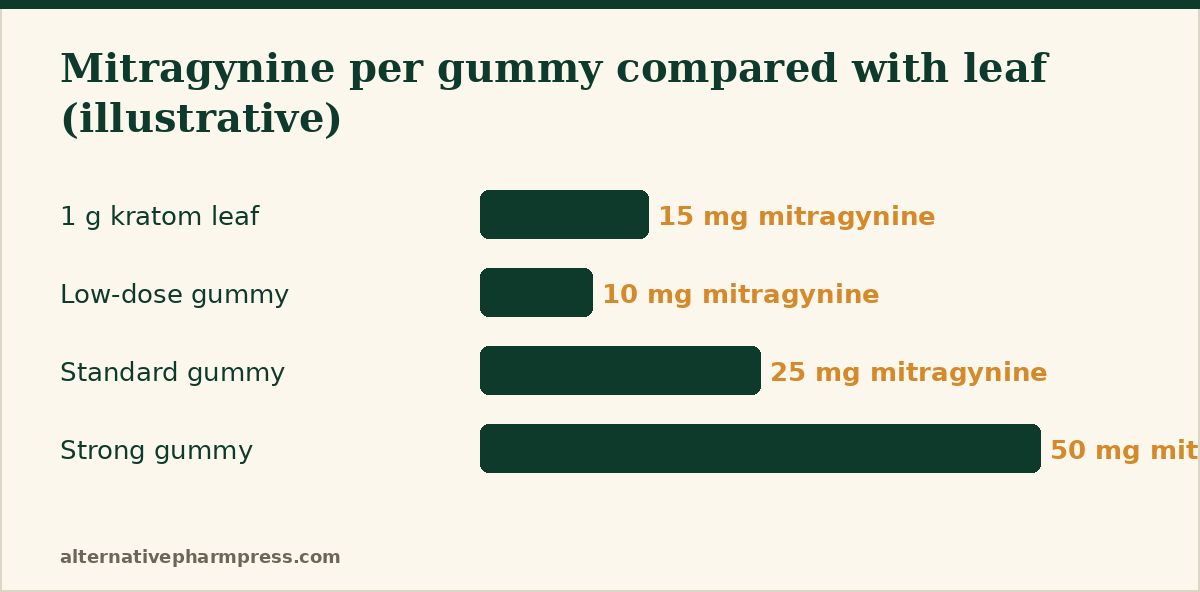
These are illustrative values; check the product’s label and lab report. As a rough guide, 1 g of kratom leaf contains about 10–20 mg of mitragynine. A “strong” 50 mg gummy can therefore equal roughly 3–5 g of leaf in a single chew.
Extract gummies vs 7-OH gummies
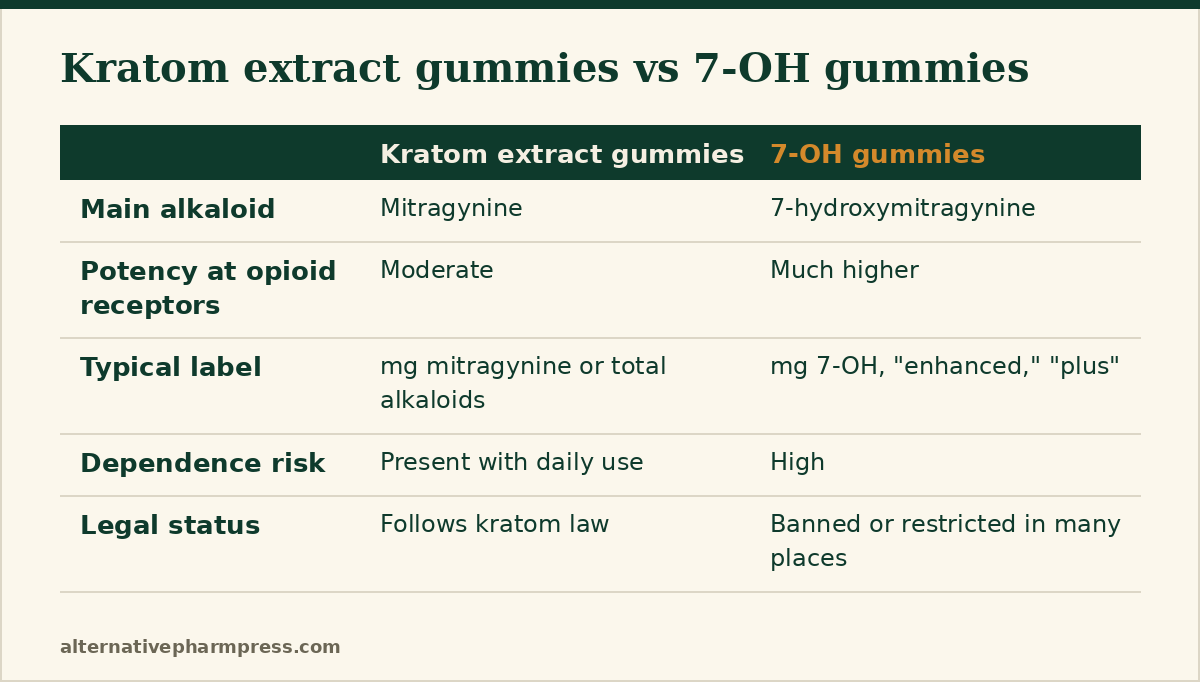
7-OH gummies are a different category. 7-hydroxymitragynine is a potent opioid receptor agonist, and concentrated products have been linked to rapid tolerance, dependence and poison center calls. If a gummy lists 7-OH, or uses words like “enhanced” without listing alkaloids, be very cautious. See what is 7-OH and 7-OH gummies vs tablets.
Onset and duration
Gummies are digested like food, so effects often begin in 30–60 minutes and may take longer on a full stomach. Effects usually last several hours. The slow onset tempts people to take another gummy too soon — then both doses hit at once, causing nausea, dizziness or heavy sedation. If you use them, wait at least an hour and a half before considering more.
What a trustworthy label shows
- mg of mitragynine per gummy and per package (or total alkaloids, with a breakdown).
- 7-OH content — ideally at natural trace levels or not present.
- Number of gummies per serving and per container.
- Batch number that matches a third-party certificate of analysis.
- Allergen information (gelatin, pectin, sugar, sweeteners).
- Warnings — age limits, pregnancy, keep out of reach of children.
- Child-resistant packaging, required in some states.
Our how to read a kratom lab report guide shows where to find these numbers.
Child safety: a serious concern
Gummies are indistinguishable from candy to a child. Accidental ingestion of kratom or 7-OH by children can cause dangerous sedation and breathing problems. Treat kratom gummies like prescription medication:
- Keep them in locked or high storage, in original child-resistant packaging.
- Never leave them in purses, cars or on counters.
- Don’t call them “candy” around children.
- If a child or pet eats one, call Poison Control (1-800-222-1222) or a vet immediately.
Shelf life and storage
- Gummies can melt or stick in heat; store below room temperature, away from sunlight.
- Humidity can make them sticky or moldy.
- Alkaloids slowly degrade; check the best-by date.
- Sugar-free gummies with sugar alcohols can cause digestive upset if several are eaten.
Safety considerations
- Dependence and withdrawal: extract-based products raise the risk compared with leaf. See kratom withdrawal and kratom tolerance.
- Interactions: don’t combine with alcohol, benzodiazepines, gabapentin or opioids. See kratom and alcohol.
- Liver: rare injury reported; see kratom liver injury.
- Pregnancy and breastfeeding: avoid.
New to kratom? Gummies aren’t the ideal starting point because they’re often extract-based. If you choose to try kratom, read what kratom is used for and the beginner’s guide first, and consider plain leaf from a tested vendor.
Legal status
Kratom gummies follow kratom laws, which vary by state. Some states with Kratom Consumer Protection Acts require age limits, labeling and caps on 7-OH; some ban kratom entirely; and 7-OH-containing gummies face extra restrictions. Check kratom laws by state and the KCPA explainer.
Gummies vs other kratom formats
| Format | Taste | Onset | Typical potency | Main concern |
|---|---|---|---|---|
| Gummies | Pleasant | 30–60+ min | Moderate to high (extract) | Candy-like, easy to overconsume |
| Capsules | None | 30–60 min | Moderate (leaf) or high (extract) | Fill weight variability |
| Powder | Bitter | 15–30 min | Moderate | Measuring accurately |
| Shots | Varies | 15–30 min | High | Very concentrated |
See kratom capsules guide, kratom powder guide and kratom drinks.
How gummies are made — and why consistency varies
Manufacturing a gummy involves mixing a gelling agent (gelatin or pectin), sugars and flavorings into a hot liquid, adding the active ingredient, then depositing the mixture into molds. If the extract isn’t evenly mixed, or if heat degrades some of the alkaloids, gummies from the same batch can vary in potency. Larger manufacturers use controlled processes and test finished gummies; small operations may not. That’s one reason a batch-matched lab report on the finished gummies — not just the raw extract — matters.
Sugar, sweeteners and dietary considerations
Most kratom gummies contain several grams of sugar per piece. Sugar-free versions often use sugar alcohols like maltitol or erythritol, which can cause bloating or diarrhea when several are eaten. Gelatin-based gummies aren’t vegetarian; pectin-based ones usually are. If you have diabetes, dietary restrictions or allergies, check the full ingredient list.
Signs you may be overusing kratom gummies
Because gummies are pleasant and easy to take, consumption can creep up. Warning signs include eating gummies daily, needing more for the same effect, feeling unwell (anxious, achy, restless) when you skip them, and spending more than you planned. If you notice these, consider cutting back gradually and talking to a clinician — tapering is easier with support.
Understanding “total alkaloids” on gummy labels
Some gummy labels list “total alkaloids” rather than mitragynine. Kratom contains dozens of alkaloids — mitragynine, paynantheine, speciogynine, speciociliatine, 7-OH and others — and “total alkaloids” adds them together. That number can be useful, but only if the lab report breaks it down. A gummy labeled “40 mg total alkaloids” could be mostly mitragynine (similar to leaf extract) or contain a meaningful share of 7-OH (much more potent). Always look for the individual numbers.
Watch out for these labeling tricks:
- “Per serving” when a serving is several gummies. A package may say “50 mg per serving” where a serving is two gummies.
- Package totals in large print. “500 mg” on the front may refer to the whole bag, not each gummy.
- Rounded or vague numbers like “up to 30 mg.”
- Mixing kratom with other actives such as kava, kanna or caffeine without listing doses.
Why taste can be a trap
Kratom’s bitterness acts as a natural brake: few people can stomach large amounts of leaf powder. Gummies remove that brake. Combined with extract potency and slow onset, it becomes easy to eat several gummies in an evening without realizing the total dose. Some practical safeguards:
- Decide on your limit before you start and take out only that many gummies.
- Put the rest of the package away out of sight.
- Track the time of each gummy on your phone.
- Avoid using gummies when drinking alcohol or when tired, when judgment is weaker.
FAQ
How strong are kratom gummies?
They commonly contain 10–50 mg or more of mitragynine per gummy, which can equal several grams of leaf. Always check the label and lab report.
Do kratom gummies contain 7-OH?
Some do. Check the alkaloid breakdown on the lab report and avoid products that list 7-OH or don’t disclose alkaloid content.
How long do kratom gummies take to work?
Typically 30–60 minutes or longer, depending on food and metabolism. Wait before taking more.
Are kratom gummies safer than powder?
Not necessarily. They taste better, but most use extracts, which carry higher dependence risk, and they pose accidental-ingestion risks for children.
How should kratom gummies be stored?
In a cool, dry place, in child-resistant packaging, locked away from children and pets.
Can you cut kratom gummies in half?
Yes. Cutting a gummy is an easy way to take a smaller amount, though potency may not be perfectly even within a single gummy.
Do kratom gummies show up on drug tests?
Standard panels don’t usually test for kratom, but specialized and expanded tests can detect mitragynine and 7-OH.