

Search for BPC-157 before and after and you’ll find dramatic stories: torn tendons healed in weeks, chronic gut problems resolved, years of joint pain gone. Videos, forum threads and photos make the peptide sound almost miraculous. These stories are compelling — and they’re one of the biggest reasons BPC-157 has spread so fast.
But anecdotes are a weak form of evidence, especially for injuries and conditions that often improve on their own. This guide explains why before-and-after stories can mislead, what the research actually shows and how to evaluate claims thoughtfully.
Key takeaways
- Many injuries improve naturally over weeks to months, so improvement after BPC-157 doesn’t prove it worked.
- Placebo effects, regression to the mean and confounding treatments commonly explain dramatic before-and-after stories.
- Survivorship bias: people with good results post; people with no effect or side effects often don’t.
- BPC-157 research is mostly animal studies; controlled human trials are very limited.
- Products are unapproved, “research use only” and vary in quality; BPC-157 is banned in sport.
Why before-and-after stories are persuasive
Personal stories feel real and relatable. A person describes their pain, shows their mobility before and after, and credits BPC-157. Our brains are wired to trust these narratives, especially when they match what we hope will happen to us. But persuasive isn’t the same as reliable.
Common reasons people improve without BPC-157 doing the work
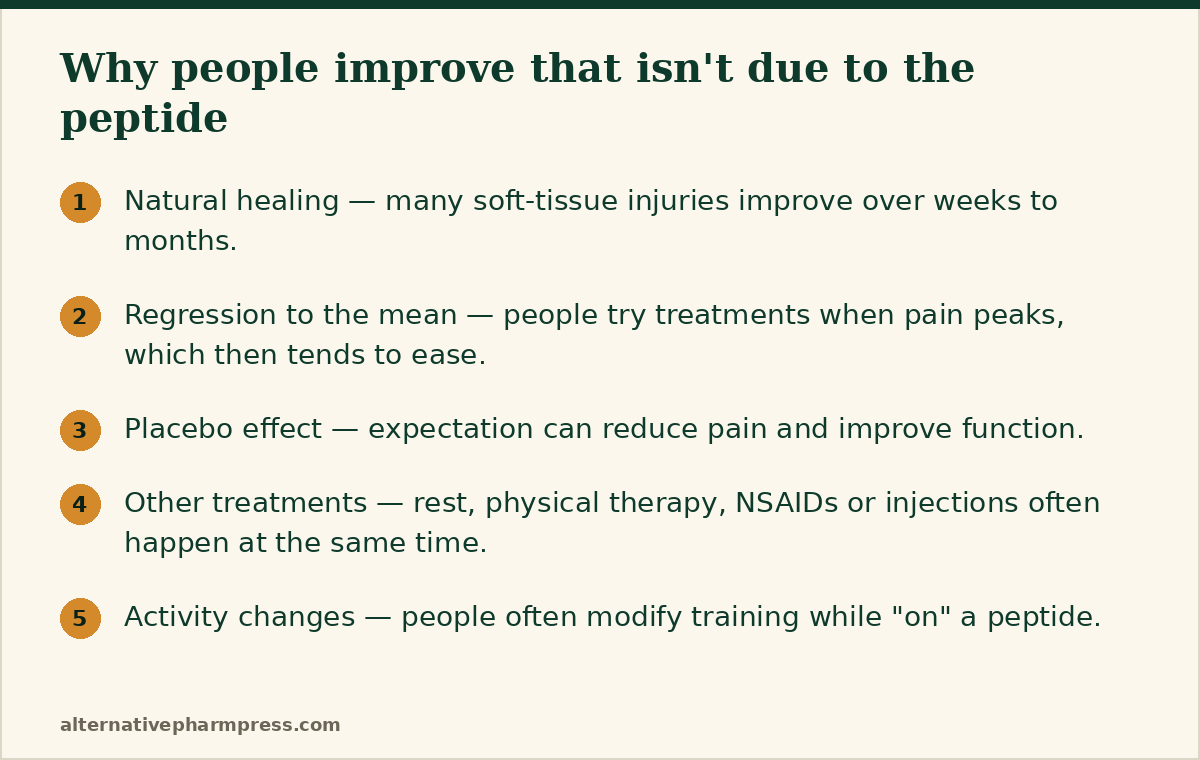
Natural healing
Many tendon, ligament and muscle injuries improve with time and rest. If someone starts BPC-157 two weeks after an injury and feels better four weeks later, the body’s natural healing likely contributed most — or all — of the improvement.
Regression to the mean
People usually seek new treatments when symptoms are at their worst. Symptoms that fluctuate tend to drift back toward average over time, which can look like a treatment effect.
Placebo effects
Placebo effects are strong for pain and subjective symptoms. Injecting a substance you believe will help, paying for it and following a protocol can all heighten expectations.
Confounding treatments
Before-and-after stories often involve rest, physical therapy, new stretching routines, anti-inflammatory medications, diet changes or other peptides. Attributing the result to one element is difficult. See BPC-157 and TB-500 stack and wolverine peptide stack.
Survivorship and reporting bias
People who experience dramatic improvements are much more likely to post online. Those who saw no change, stopped due to side effects or had infections from injections are less likely to share. Some content is also produced by sellers or affiliates with financial incentives. This creates a distorted picture where success stories dominate.
What the research shows
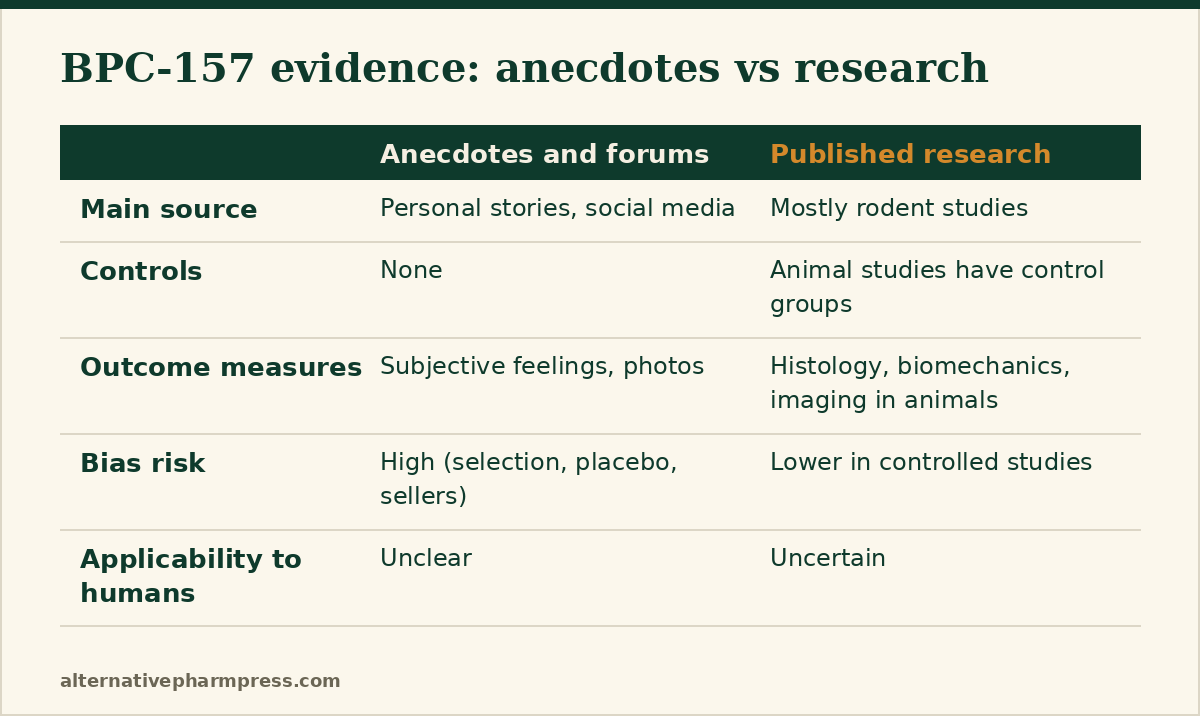
BPC-157 has shown promising results in rodent models of tendon, ligament, muscle, bone and gut injury. A few small human reports exist, but controlled clinical trials are scarce. That means we don’t yet know whether BPC-157 meaningfully helps people, what dose might work or what long-term risks are. Read BPC-157 benefits and BPC-157 side effects and safety.
How to evaluate a before-and-after claim
- What was the injury, and when did it happen? Recent injuries often heal naturally.
- What else changed? Rest, physical therapy, medications, diet or training.
- How was improvement measured? Pain scores, imaging or objective tests are more useful than “feels better.”
- Who’s telling the story? Is the person selling peptides or earning affiliate commissions?
- What happened long term? Did the improvement last or relapse?
- What about people it didn’t help? Look for balanced discussions, not just success stories.
Photos and imaging
Before-and-after photos of swelling, skin or body composition can be influenced by lighting, angles, timing and other factors. MRI or ultrasound images shared online lack context, and healing seen on imaging doesn’t always match how someone feels.
Quality concerns with BPC-157 products
Even if BPC-157 worked, gray-market products may not contain what’s labeled. Concerns include incorrect peptide content, impurities, contamination and endotoxins. See how to read a peptide COA, best research peptide suppliers and oral BPC-157 capsules vs injections.
Regulatory status
BPC-157 is not FDA-approved. The FDA has flagged it among bulk substances with potential safety concerns for compounding, and products are sold as “research use only.” WADA prohibits BPC-157 for tested athletes. Read the FDA advisory vote on BPC-157 and what research-use-only means.
Safer next steps for injuries
- Get a diagnosis from a sports medicine physician or orthopedist.
- Work with a physical therapist — progressive loading is one of the best-supported treatments for tendon injuries.
- Address sleep, nutrition and training load.
- Ask about evidence-based options, such as targeted exercises, bracing, injections or surgery where appropriate.
- Discuss peptides honestly with a clinician if you’re considering them.
Why controlled trials matter
In a randomized controlled trial, participants are randomly assigned to receive the treatment or a placebo, often without knowing which. Researchers measure outcomes using standard methods. This design separates the treatment’s true effect from natural healing, placebo and other influences. Without such trials, we can’t know whether BPC-157 truly helps.
A thought experiment
Imagine 100 people with tendon pain start BPC-157. After six weeks, 60 feel better. That sounds impressive — until you learn that, in similar groups receiving a placebo or nothing, 50–60 people also improve over six weeks. Without a comparison group, the 60 success stories would dominate social media, while the 40 who saw no change rarely post.
Dosing stories and “protocols”
Many before-and-after posts include specific dosing protocols, often in micrograms per day for several weeks. These protocols aren’t based on human dose-finding trials. They usually originate from animal studies scaled by body weight, or from seller recommendations. Following a stranger’s protocol adds uncertainty on top of product quality questions. See BPC-157 dosage for why dosing claims are uncertain.
Side effects people don’t post about
Online reports of BPC-157 problems exist but are less visible: injection-site pain, swelling or infection, nausea, dizziness, fatigue, headaches and changes in blood pressure. Because products are unregulated, some reactions may come from contaminants rather than the peptide itself. The absence of negative stories doesn’t mean the absence of risk.
How to talk to a clinician about BPC-157
If you’re considering BPC-157, be open with your healthcare provider. Share the product details and any lab reports, describe the injury and timeline and ask whether there are evidence-based treatments you haven’t tried. Clinicians may not recommend BPC-157, but they can help you weigh risks and avoid interactions.
Gut health stories
BPC-157 was originally studied as a “body protection compound” derived from a protein in gastric juice, and many before-and-after stories involve gut symptoms such as reflux, IBS, leaky gut claims or inflammatory bowel disease. Gut symptoms naturally fluctuate with diet, stress, sleep and infections, which makes self-assessment especially tricky. People often change their diet or start probiotics at the same time. Some gut conditions, like Crohn’s disease and ulcerative colitis, can be serious and require proper medical management. Relying on an unapproved peptide could delay effective treatment.
How to run a more honest self-experiment
If someone chooses to use BPC-157 despite the uncertainty, a more careful approach can at least reduce self-deception. Record a baseline of symptoms for several weeks before starting. Use objective measures where possible, such as range of motion, strength tests, a pain scale at the same time each day, or a symptom diary for gut issues. Change only one variable at a time. Note any side effects. Stop after a predetermined period and see whether symptoms change. This still can’t rule out placebo or natural healing, but it gives more useful information than a vague sense that things got better.
Stories from athletes and influencers
Athletes and fitness influencers often share peptide routines. Keep in mind that athletes typically have access to extensive physical therapy, medical care, nutrition support and recovery tools. Their recovery may also be faster due to fitness and age. Some influencers are paid by peptide sellers or use affiliate codes. That doesn’t automatically make their stories false, but it’s a reason to look for independent evidence.
FAQ
Do BPC-157 before-and-after results prove it works?
No. Anecdotes can’t separate the peptide’s effect from natural healing, placebo and other treatments.
Why do so many people report BPC-157 success?
Natural healing, placebo effects, other treatments and selective reporting all contribute to positive stories.
Is there human research on BPC-157?
Very little. Most studies are in animals, and controlled human trials are scarce.
Are BPC-157 before-and-after photos reliable?
Photos can be influenced by lighting, timing and other changes. They don’t provide strong evidence.
Is BPC-157 safe?
Its safety in humans is not well established. Gray-market products may be contaminated or mislabeled.
What should I do for a tendon or ligament injury?
See a sports medicine professional and consider physical therapy, which has strong evidence for many tendon problems.