
Search any peptide forum and one combination comes up more than any other: BPC-157 and TB-500. They’re sold separately and as pre-mixed “blends,” often marketed as the “Wolverine stack” for faster recovery from injuries. Searches for the pair outnumber searches for most peptides on their own.
This article explains why people combine them, what each peptide does in research, what we actually know (and don’t) about using them together, and the regulatory and safety issues that matter.
Key takeaways
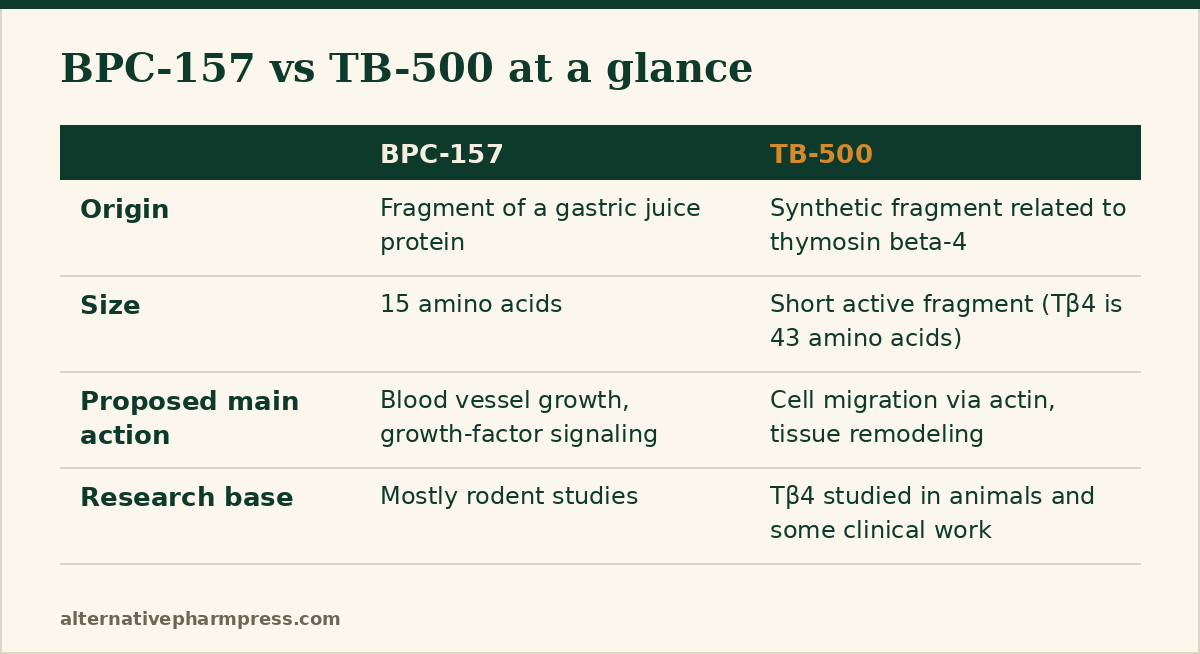
- BPC-157 is a 15-amino-acid synthetic peptide based on a gastric protein fragment; TB-500 is a synthetic fragment related to thymosin beta-4.
- The stacking rationale is that they act on different healing pathways — BPC-157 on blood vessel growth and growth-factor signaling, TB-500 on cell migration and actin.
- Both have mostly animal and lab evidence; there are no controlled human trials of the combination.
- Neither is FDA-approved; both are on the WADA prohibited list.
- Gray-market blends add quality and dosing uncertainty on top of unknown safety.
Meet the two peptides
BPC-157
BPC-157 (“Body Protection Compound”) is a synthetic peptide derived from a sequence in a protein found in human gastric juice. In rodent studies it has been linked to improved healing of tendons, ligaments, muscles and the gut lining. Proposed mechanisms include promoting angiogenesis (new blood vessel formation), interacting with VEGF and growth hormone receptor pathways, and modulating the nitric oxide system. Our in-depth guide to BPC-157 benefits covers the evidence.
TB-500
TB-500 is a synthetic peptide marketed as a fragment of thymosin beta-4 (Tβ4), a naturally occurring 43-amino-acid protein present in most human cells. Tβ4 binds actin — a structural protein essential for cell shape and movement — and is involved in cell migration, wound healing, blood vessel formation and inflammation regulation. Commercial “TB-500” usually refers to a short active region (often cited as the LKKTETQ sequence) or a modified version. Quick definitions are in our TB-500 glossary entry.
Why people stack them
The logic behind the stack is that the two peptides might complement each other:
- BPC-157 may help bring blood supply to injured tissue and support local repair signaling.
- TB-500 may help cells migrate into the injury and support tissue remodeling and flexibility.
- Users hope that together they speed recovery more than either alone.
It’s a plausible-sounding hypothesis. But it hasn’t been tested in a controlled human trial. “Synergy” claims for this stack come from mechanism-based reasoning and anecdotes, not data. See our head-to-head explainer, BPC-157 vs TB-500, for more on how they differ.
What the evidence actually shows
BPC-157 evidence
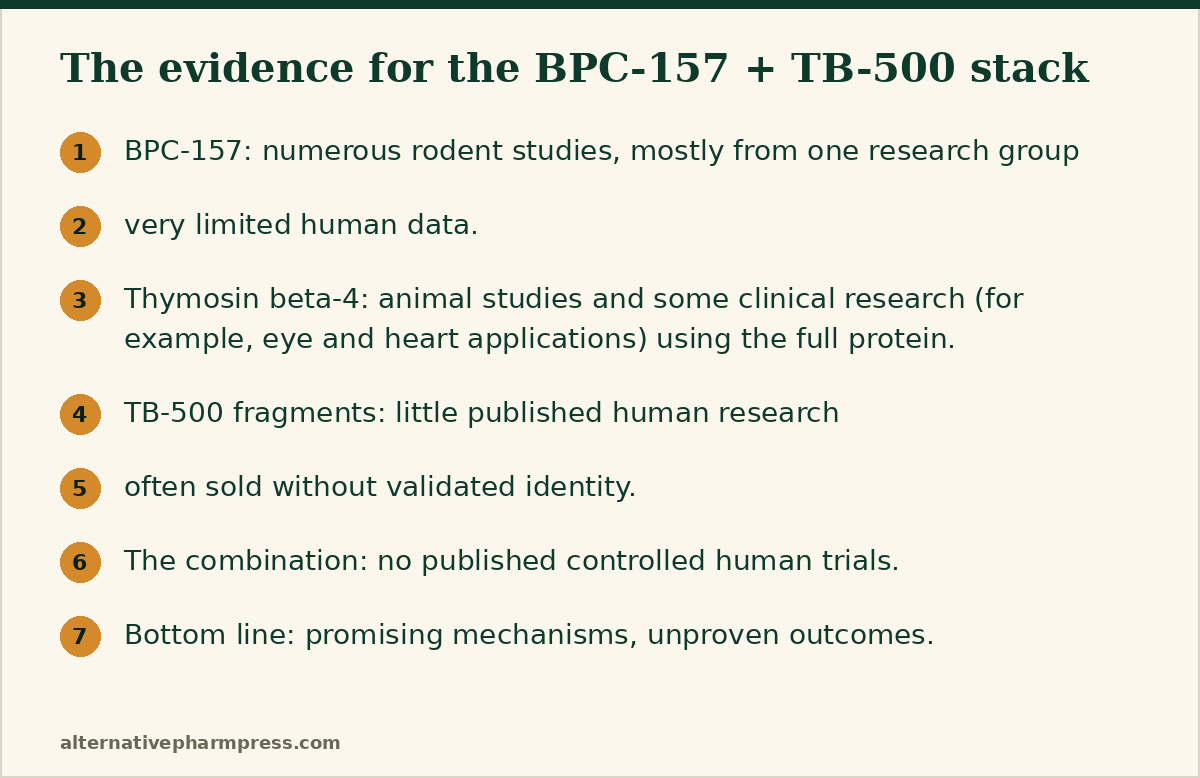
Rodent studies consistently report faster healing in tendon, ligament, muscle and gut injury models. The research is concentrated in one group, and human studies are limited to small pilot reports. Read BPC-157 side effects and safety for the safety picture.
Thymosin beta-4 evidence
The full Tβ4 protein has been studied more formally. Researchers have investigated it for corneal wound healing (eye drops), heart tissue repair after heart attack in animal models, and skin wound healing. Some early clinical trials were conducted, with mixed or inconclusive outcomes. Importantly, TB-500 is not the same as full-length Tβ4, and findings for one don’t automatically apply to the other.
The combination
There are no published, controlled human studies of BPC-157 and TB-500 together. Everything you’ll read about combined dosing, timelines and results comes from extrapolation or anecdote.
Safety unknowns
Using two unapproved peptides together compounds uncertainty:
- Unknown long-term effects for each, and for the combination.
- Theoretical tumor concern: both peptides are associated with angiogenesis and cell migration — processes that cancers also exploit. Researchers have raised this as a theoretical risk, especially for people with a history of cancer. It hasn’t been demonstrated, but it hasn’t been studied either.
- Injection risks: infection, abscesses and irritation, particularly with non-sterile products.
- Immune reactions: contaminants and impurities can provoke reactions.
- Drug testing: both are prohibited in sport. Athletes have been sanctioned for TB-500.
Quality problems with blends
Pre-mixed “BPC-157/TB-500” vials add another layer of uncertainty. You’re relying on the seller to have combined two peptides in the stated ratio, with both correctly synthesized and pure. Independent tests of gray-market peptides have found:
- Vials containing less (or more) than labeled
- Wrong peptides or degraded material
- Bacterial endotoxins and other contaminants
Learn how to evaluate testing in how to read a peptide COA, and why the “research use only” label matters in what research-use-only means.
Regulatory status in 2026
- FDA: neither peptide is approved as a drug. BPC-157 was placed among bulk substances flagged for safety concerns in compounding, and policy debate has continued; see the FDA advisory vote on BPC-157 and the 503A bulks list update.
- WADA: both are prohibited (BPC-157 as a non-approved substance; TB-500 under growth factors and modulators).
- Sales: both are sold online as “research chemicals,” not for human consumption.
Why dosing charts for the stack aren’t reliable
Online protocols list doses such as “BPC-157 250–500 mcg daily plus TB-500 2–5 mg weekly.” These numbers come from forums and vendors, not trials. We explain the problem with BPC-157 dosing in BPC-157 dosage in research, and the same issues apply to TB-500 — with even less published data to extrapolate from.
Related stacks
The BPC-157/TB-500 combination is sometimes expanded with GHK-Cu (a copper peptide studied for skin and wound healing) or growth-hormone secretagogues like ipamorelin. Each addition multiplies the unknowns. See the Wolverine peptide stack, GHK-Cu vs BPC-157, ipamorelin vs CJC-1295 and our overview of research peptides.
What does work for soft-tissue injuries?
The appeal of healing peptides comes from real frustration: tendon and ligament injuries can take months to recover and sometimes never feel quite right. But several approaches have stronger evidence than any peptide:
- Progressive loading programs for tendinopathy, such as eccentric or heavy slow resistance training, guided by a physical therapist.
- Relative rest and activity modification rather than complete immobilization in many cases.
- Physical therapy for strength, mobility and movement retraining.
- Shockwave therapy for some chronic tendon problems.
- Platelet-rich plasma (PRP) injections, which have mixed but growing evidence for certain conditions.
- Surgical repair for complete tears and some ligament injuries.
A sports-medicine physician can match the treatment to the specific injury, which matters more than any single product.
A closer look at thymosin beta-4 research
Because TB-500 is marketed on the back of thymosin beta-4 research, it’s worth understanding what that research involved. Thymosin beta-4 is one of the most abundant proteins inside cells, where it regulates actin — essentially controlling how cells move and change shape. When tissue is injured, Tβ4 is released and appears to help coordinate repair.
Researchers investigated Tβ4 for several clinical uses:
- Eye injuries and dry eye: Tβ4 eye drops were studied for corneal wound healing and severe dry eye, with some encouraging early results.
- Heart damage: animal studies suggested Tβ4 might protect heart muscle after a heart attack and support repair.
- Skin wounds: topical Tβ4 was studied for chronic wounds such as pressure ulcers and venous ulcers.
None of these programs led to a widely approved therapy, and all used the full protein or specific formulations under controlled conditions. That’s very different from injecting a short synthetic fragment bought online. Mechanistic overlap doesn’t mean equivalent effects.
The anti-doping angle
TB-500 deserves a special warning for competitive athletes. It has been detected in anti-doping tests across horse racing, cycling and other sports, and several athletes have received multi-year bans. BPC-157 is also prohibited. Because “research peptides” may be contaminated or mislabeled, athletes can also test positive for substances they didn’t intend to take. If you’re subject to drug testing in any sport, avoid both.
How to evaluate claims about the stack
When you read a glowing testimonial, ask:
- Was the injury diagnosed, and would it have healed on its own in the same timeframe?
- Were other treatments (rest, physical therapy, anti-inflammatories) used at the same time?
- Does the person sell peptides, coaching or affiliate products?
- Are any side effects or downsides mentioned?
Most recovery stories can’t separate the peptide’s effect from time, rest and other treatments — which is exactly why controlled trials exist.
FAQ
Why stack BPC-157 and TB-500?
People combine them because they’re thought to work through different healing pathways — BPC-157 on blood vessel growth and growth factors, TB-500 on cell migration. The combination hasn’t been tested in controlled human trials.
Is the BPC-157 and TB-500 stack safe?
Its safety is unknown. Neither peptide is approved, long-term human data is lacking and gray-market products have quality problems.
Is TB-500 the same as thymosin beta-4?
No. TB-500 is a synthetic fragment related to thymosin beta-4. Research on the full protein doesn’t automatically apply to TB-500.
Are BPC-157 and TB-500 legal?
They’re not FDA-approved and are sold as research chemicals. Both are prohibited in sport by WADA.
Do BPC-157 and TB-500 work faster together?
There’s no published human evidence showing the combination works better than either alone, or better than standard injury care.
Can a doctor prescribe a BPC-157 and TB-500 stack?
Each is covered individually by the interim HHS compounding policy. Whether a clinician prescribes both is a medical decision; there are no human trials of the combination.