

Lion’s mane (Hericium erinaceus) is a shaggy white mushroom that looks like a frozen waterfall or, as the name suggests, a lion’s mane. It’s eaten as a gourmet food, used in traditional Chinese medicine and now sold in capsules, powders, coffees and gummies as a “brain mushroom.”
So what is lion’s mane good for, according to evidence rather than marketing? This guide looks at each popular use and rates how strong the research really is.
Key takeaways
- Lion’s mane contains hericenones (in the fruiting body) and erinacines (in the mycelium) that stimulate nerve growth factor in lab studies.
- The best human evidence is for mild cognitive improvement in older adults, from a few small trials.
- Evidence for mood, focus in young adults, nerve repair, gut health and immunity is early or mostly from animals.
- It’s generally well tolerated, but allergic reactions and rare side effects occur.
- Supplement quality varies: check fruiting body vs mycelium, beta-glucan content and third-party testing.
What makes lion’s mane different
Most “functional mushrooms” are promoted for immunity. Lion’s mane stands out because two groups of its compounds have shown neurotrophic activity in lab research:
- Hericenones — found mainly in the fruiting body (the mushroom you can see and eat).
- Erinacines — found mainly in the mycelium (the root-like network), especially erinacine A.
In cell and animal studies, these compounds stimulate the production of nerve growth factor (NGF), a protein that supports the growth and maintenance of neurons. That’s the scientific foundation for lion’s mane’s “brain health” reputation. The big question is how much of this translates to people taking supplements.
Evidence by use case
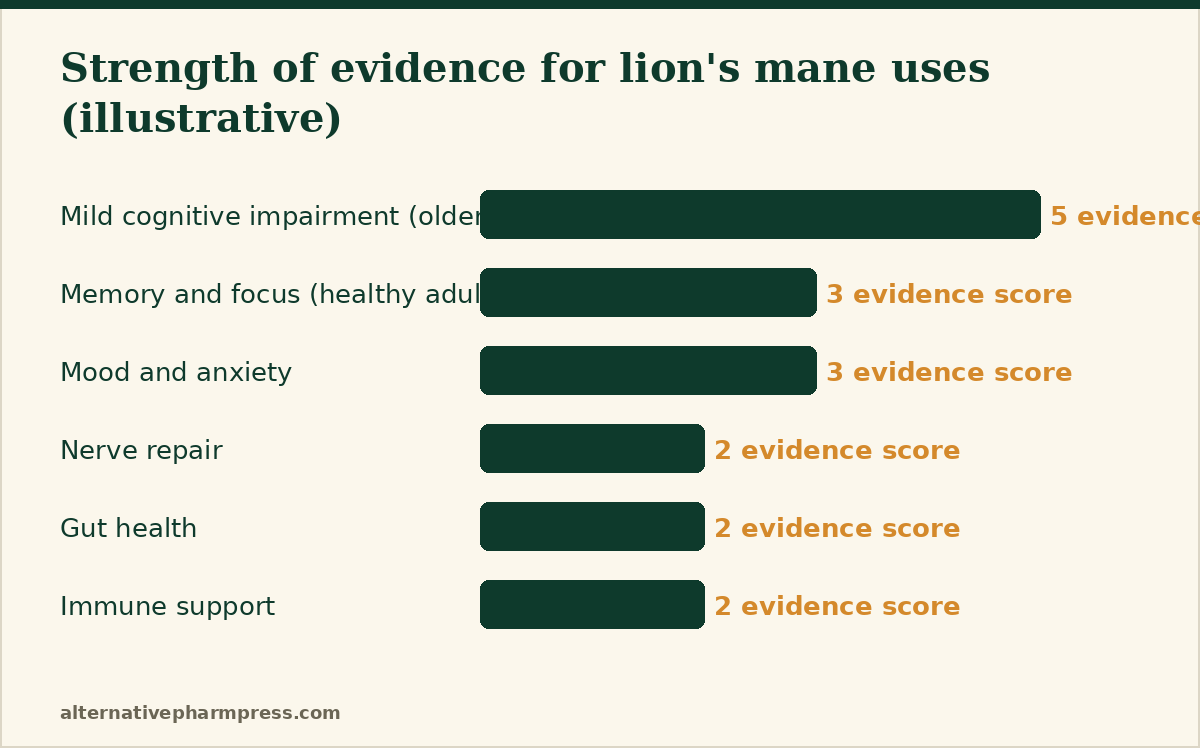
The chart is an illustrative ranking based on the number and quality of human studies, not a measured score.
1. Memory and mild cognitive impairment
The most cited human study is a small Japanese trial from 2009 in which older adults with mild cognitive impairment took lion’s mane powder for 16 weeks. Cognitive scores improved compared with placebo — but declined again after they stopped. A later trial in adults with early Alzheimer’s disease using an erinacine-enriched mycelium product reported some benefits on cognitive measures. These studies are small, and larger confirmatory trials are needed.
Verdict: the most promising use, with modest supporting evidence in older adults.
2. Focus and memory in healthy adults
A few small trials in younger, healthy adults have measured cognitive performance after single doses or several weeks of use. Results have been mixed — some found faster performance on specific tasks, others found little difference. We track new data in lion’s mane in 2026: trials, market and cognition.
Verdict: possible small effects; not a reliable focus booster.
3. Mood, anxiety and sleep
Small studies, including one in women with menopausal symptoms and others in people with overweight or obesity, reported reductions in self-reported anxiety and depression. These were small and short. Animal studies suggest anti-inflammatory and neurogenic effects that could plausibly influence mood.
Verdict: early, encouraging signals; not a substitute for treatment.
4. Nerve repair
Animal studies show faster recovery after nerve injury in rodents given lion’s mane extracts. There’s no meaningful human trial data for peripheral nerve repair yet.
Verdict: interesting animal research only.
5. Gut health
Lion’s mane has traditionally been used for digestive complaints. Lab and animal research suggests protective effects on the stomach lining and potential prebiotic effects of its polysaccharides. Human data is very limited.
6. Immune support
Like other mushrooms, lion’s mane contains beta-glucans that interact with immune cells. Most evidence comes from animal studies. For immune-focused mushrooms with more research, see turkey tail vs reishi and chaga vs reishi.
Fruiting body vs mycelium: why it matters
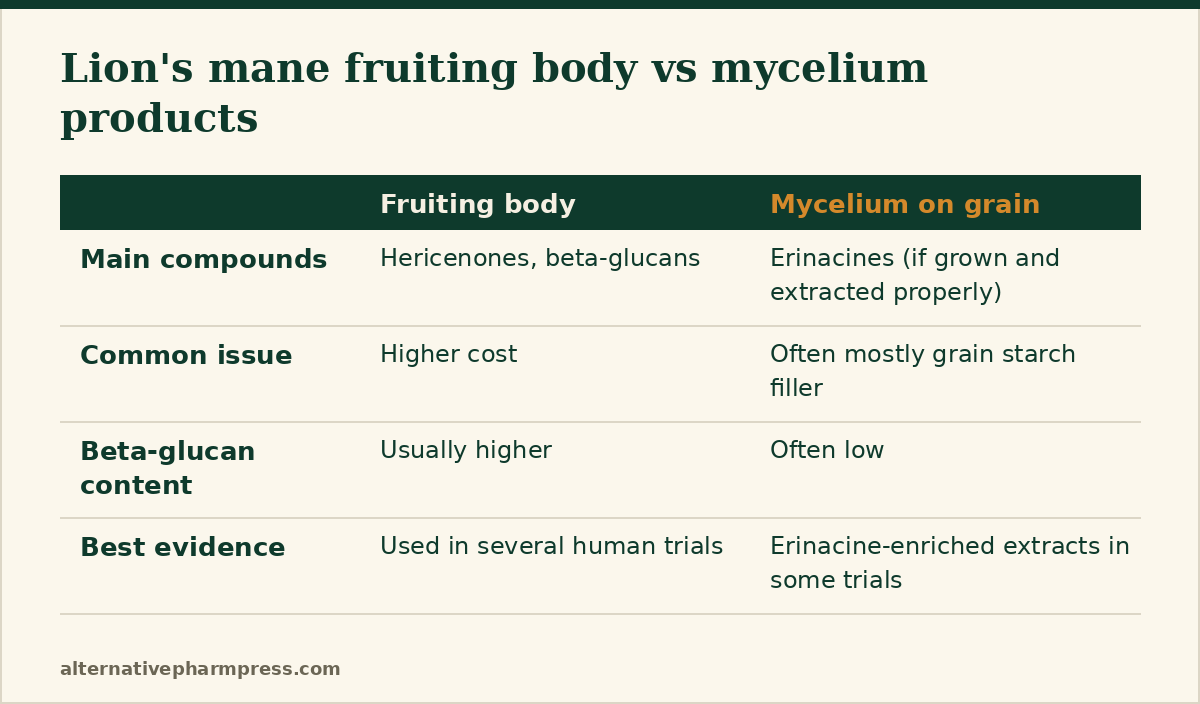
Many US supplements are made from mycelium grown on grain (such as oats or rice). The finished powder can contain a lot of leftover grain starch, diluting the active compounds. Fruiting-body products tend to contain more beta-glucans. Some high-quality mycelium extracts are specifically standardized for erinacines. The key is disclosure and testing, not the source alone.
How much lion’s mane do studies use?
Human studies have used a wide range — from about 750 mg to 3 g per day of powdered fruiting body, and lower doses of concentrated extracts. Benefits in the most-cited trials appeared after several weeks to months. There’s no established optimal dose, and products differ so much in concentration that comparing milligrams across brands is tricky.
Side effects and safety
Lion’s mane is a culinary mushroom and is generally well tolerated. Reported issues include:
- Mild stomach upset or nausea
- Skin rash or itching, and rare allergic reactions (avoid if allergic to mushrooms)
- Rare reports of breathing difficulty in people with mushroom allergies
- Possible interactions with blood thinners and diabetes medications, based on lab data
Read the full rundown in lion’s mane side effects. Pregnant and breastfeeding people should avoid supplements due to lack of data.
How to choose a lion’s mane supplement

Our best lion’s mane brands roundup only includes products with transparent sourcing and testing.
Lion’s mane vs other brain supplements
Lion’s mane is often compared with bacopa, which has more consistent human memory data, and with cordyceps and reishi for broader wellness. See bacopa vs lion’s mane, reishi vs lion’s mane, lion’s mane vs cordyceps and our nootropics beginner’s guide.
Eating lion’s mane as food
Fresh lion’s mane is a delicious culinary mushroom with a seafood-like texture often compared to crab or lobster. Eating it regularly provides fiber and some of the same compounds as supplements, though at lower concentrations than extracts. Look for it at farmers markets or specialty grocers. It’s best cooked — torn into pieces and pan-seared until golden.
Lion’s mane in mushroom coffees and gummies
Lion’s mane is one of the most common ingredients in mushroom coffees and functional gummies. These products are convenient, but they often contain small amounts — sometimes a few hundred milligrams or less per serving — alongside other mushrooms. Check the label for milligrams of lion’s mane per serving and whether it’s fruiting body or mycelium. If you’re serious about matching research doses, a dedicated extract or powder usually gives better control. Our article on whether mushroom gummies work covers this in detail.
Realistic expectations
If you try lion’s mane, set realistic expectations:
- Effects are subtle. Most people won’t notice dramatic changes, especially within days.
- Give it time. Studies that found benefits typically ran for eight to sixteen weeks.
- Track something specific. For example, how often you lose your train of thought, or a simple memory test app score, rather than a vague sense of “clarity.”
- Combine with the basics. Sleep, exercise and nutrition remain the foundation of brain health.
- Stop if you react. Itching, rash or breathing difficulty are signs to stop and seek advice.
How lion’s mane compares with other “brain” mushrooms
- Cordyceps is promoted for energy and exercise performance rather than memory; its evidence is centred on endurance and fatigue.
- Reishi is associated with calm, sleep and immune support; it’s often described as the “relaxing” mushroom.
- Chaga is promoted for antioxidant content; it’s high in oxalates, which matters for people prone to kidney stones.
- Turkey tail has the strongest clinical research of any functional mushroom — but for immune support alongside cancer treatment, not cognition.
Lion’s mane is unique among these for its nerve-growth-factor research, which is why it dominates the “brain” segment. Many blends combine all five, but at doses too small for any one to match research amounts.
Questions to ask a lion’s mane brand
Before buying, it’s reasonable to email a brand and ask:
- Is your product made from fruiting bodies, mycelium or both?
- If mycelium, what substrate is it grown on, and how much residual grain starch is in the final product?
- What extraction method do you use (hot water, alcohol, dual extraction)?
- Do you test for beta-glucans, and can I see the results by batch?
- Do you test for heavy metals, pesticides and microbes?
A good brand will answer clearly. Vague replies about “proprietary processes” are a warning sign.
Who might consider lion’s mane
Based on current evidence, lion’s mane is most reasonable for older adults curious about supporting cognitive health alongside medical care, and for people interested in culinary mushrooms or broad wellness. It’s not a treatment for dementia, depression or nerve damage, and anyone with those conditions should work with a clinician. People with mushroom allergies, those on blood thinners or diabetes medications, and anyone pregnant or breastfeeding should check with a healthcare provider first.
FAQ
What is lion’s mane good for?
Lion’s mane is most studied for supporting cognitive function in older adults with mild cognitive impairment. Evidence for focus, mood, nerve repair and gut health is early.
How long does lion’s mane take to work?
In studies showing benefits, effects appeared after several weeks to months of daily use.
Is lion’s mane safe?
It’s generally well tolerated. Side effects can include stomach upset and allergic skin reactions. People with mushroom allergies should avoid it.
Is fruiting body or mycelium lion’s mane better?
Fruiting body products tend to have more beta-glucans, while some mycelium extracts are enriched for erinacines. Choose a product that discloses its source, extraction and testing.
Can lion’s mane help with anxiety?
Small studies suggest it may reduce self-reported anxiety and depression, but the evidence is early and it’s not a replacement for treatment.
Does lion’s mane work?
Small human trials suggest modest benefits for memory or mood in some groups, but results are mixed and products vary. It isn’t a proven treatment for any condition.
How much lion’s mane is too much?
There’s no established upper limit. Human studies have used daily amounts of a few grams of fruiting body powder for weeks to months without serious problems, but long-term data is limited. Follow the label and stop if you get side effects.