

Delta-8 THC is sold in many places as a legal hemp product, but that doesn’t protect you from a drug test. Delta-8 is metabolized into compounds that standard tests detect, and they can linger for days to weeks. If you’re wondering how long delta-8 stays in your system, the answer depends on how often you use it, how much you take, your body composition and which test is used.
This guide explains how delta-8 is processed, typical detection windows for different tests, factors that shorten or lengthen them, and why “detox” products are unreliable.
Key takeaways
- Delta-8 is metabolized into THC-COOH, which standard drug tests detect; most tests can’t tell delta-8 from delta-9.
- Urine: roughly 1–3 days after a single use, up to 30+ days with heavy daily use.
- Blood: hours to a few days; saliva: about 1–3 days; hair: up to 90 days.
- Frequency, dose, body fat, metabolism and product type all affect detection time.
- There’s no proven quick detox; time is the only reliable method.
How delta-8 is processed
Delta-8 THC is a cannabinoid closely related to delta-9 THC. After you take it, the liver converts it into 11-hydroxy-delta-8-THC (active) and then delta-8-THC-COOH (inactive). THC-COOH is fat-soluble, so it can be stored in fat tissue and released slowly over time. That’s why regular users can test positive for weeks.
For background, read delta-8 vs delta-9 THC and does delta-8 show up on drug tests?.
Why drug tests can’t tell delta-8 from delta-9
Standard urine immunoassay tests look for THC-COOH using antibodies. Delta-8-THC-COOH is similar enough in structure that it cross-reacts with these tests. Even confirmation tests (GC-MS or LC-MS) may report positive THC unless the lab specifically separates delta-8 and delta-9 metabolites. Telling an employer “it was delta-8” usually doesn’t change the outcome.
Detection windows by test type
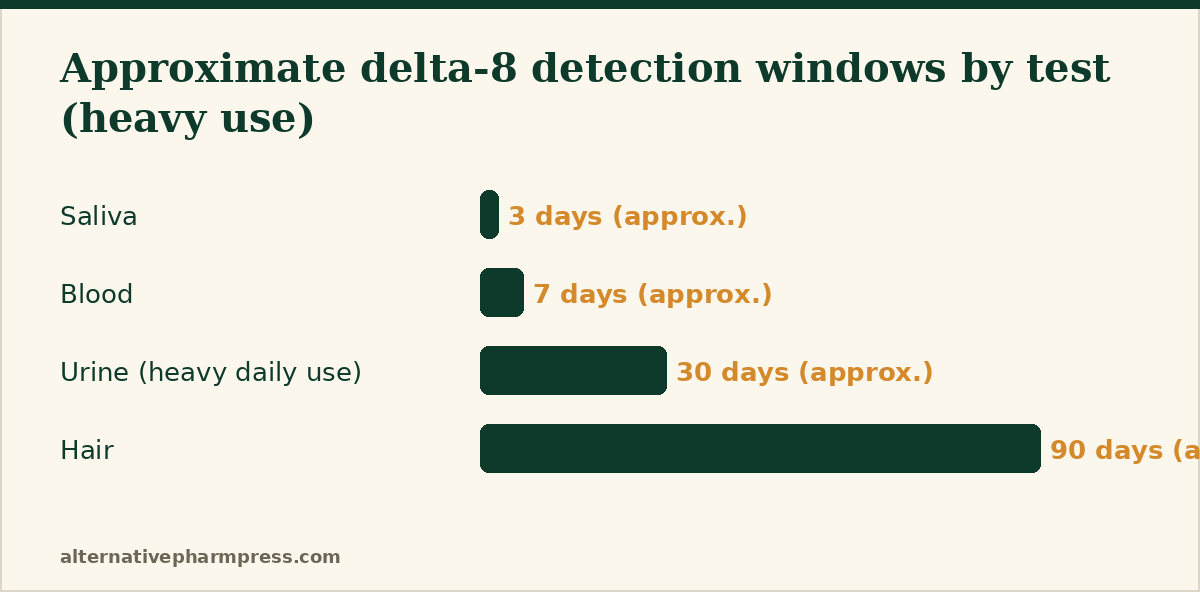
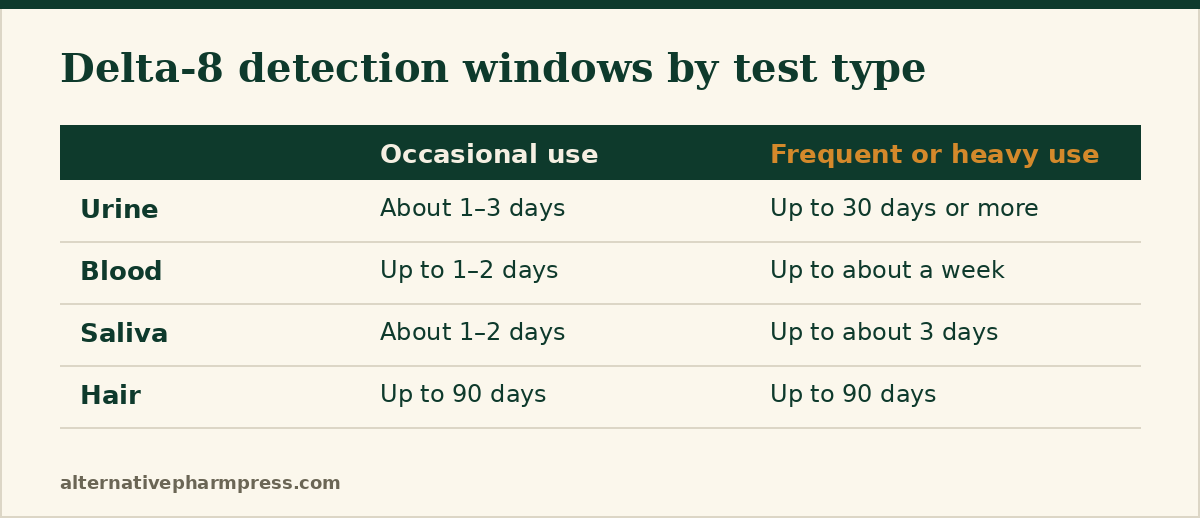
These are estimates based mainly on delta-9 THC research; delta-8-specific data are limited. Individual results vary.
Urine tests
Urine tests are the most common for workplace and probation screening. They detect THC-COOH at cutoff levels (commonly 50 ng/mL for the initial screen). Occasional users usually test negative within a few days; daily heavy users may test positive for a month or longer.
Blood tests
Blood tests detect active THC and metabolites for a shorter time and are more often used after accidents or for suspected impairment.
Saliva tests
Saliva (oral fluid) tests detect recent use, typically within one to three days. They’re increasingly used at roadside checks and some workplaces.
Hair tests
Hair tests can detect use up to about 90 days, though they’re less reliable for occasional use and can be influenced by hair type and treatments.
Factors that affect detection time
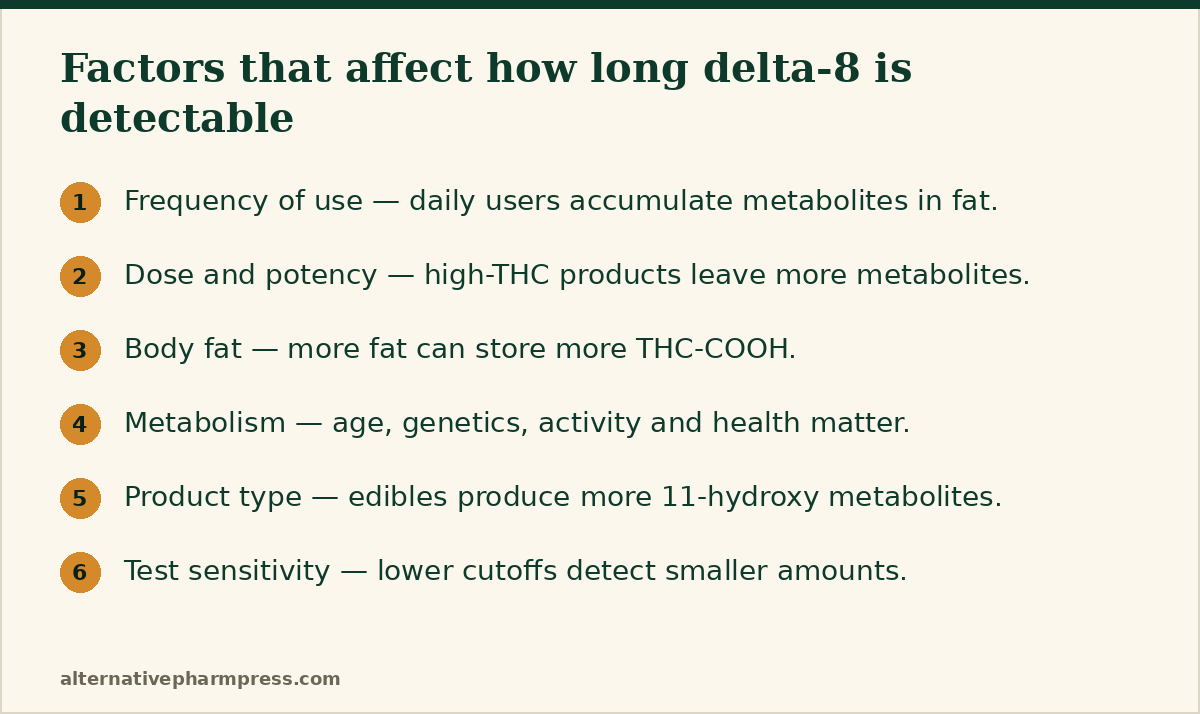
Frequency matters most
A single use is typically cleared much faster than daily use. With frequent use, THC-COOH builds up in fat tissue and is released slowly, extending detection windows.
Edibles vs vapes
Edibles are processed through the liver first, producing more 11-hydroxy metabolites, which may slightly affect detection. Vapes deliver THC quickly but with lower total metabolite load per session for some users. See delta-8 gummies guide and delta-8 carts safety.
Does delta-8 stay in your system longer than delta-9?
There’s no strong evidence that delta-8 lingers significantly longer or shorter than delta-9. Both produce similar metabolites. Delta-8 is somewhat less potent, so some people use more of it, which may increase metabolite levels.
Detox myths
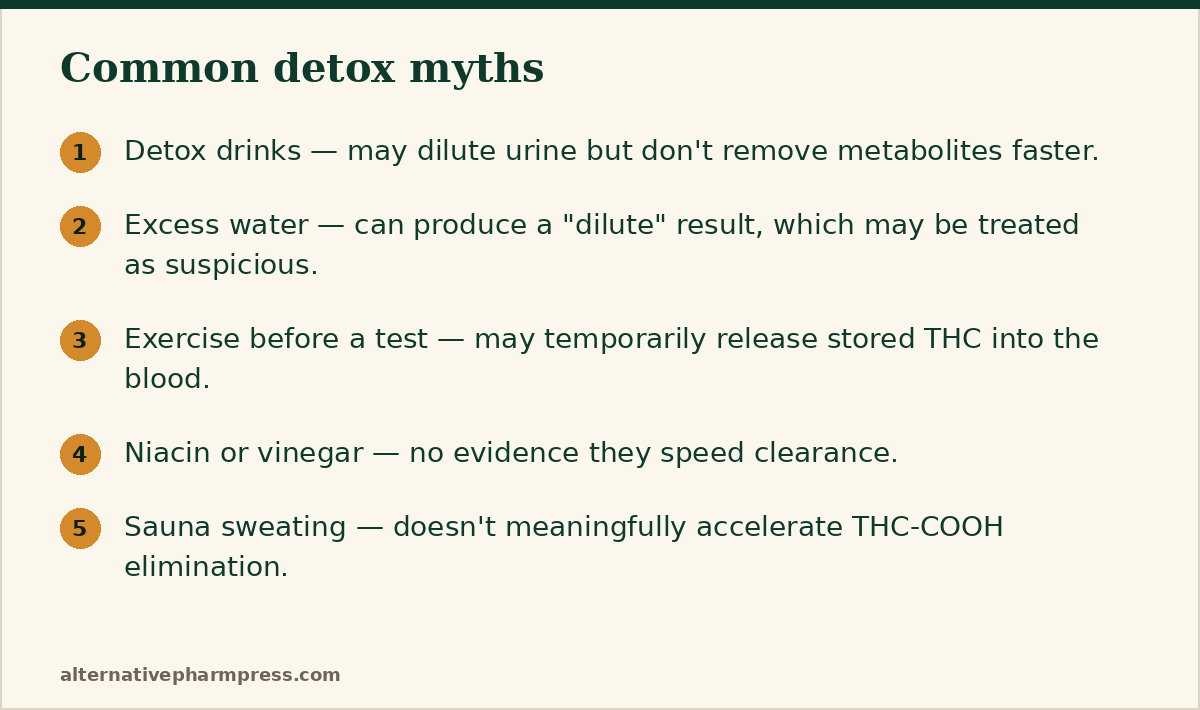
The only reliable way to clear delta-8 is time. A healthy diet, hydration and regular exercise support general health, but they won’t dramatically shorten detection windows. Products claiming to guarantee passing a test are unproven and may be considered tampering.
Other products that can cause positive tests
- Full-spectrum CBD containing small amounts of THC. See can CBD fail a drug test?.
- THCA products, which convert to THC when heated. See how long THCA stays in your system.
- HHC and THC-P, which may cross-react with tests. See HHC vs delta-8 and THC-P vs delta-8.
- Mislabeled products containing more THC than listed.
If you’re facing a drug test
- Stop use as early as possible.
- Know the test type and cutoff levels.
- Don’t rely on detox products.
- Be honest if appropriate — some employers and programs have policies on hemp products, but most treat a THC positive the same.
- Understand your rights — some states protect off-duty cannabis use; others don’t.
Legal context
Delta-8’s legal status varies by state and is tightening federally. Federal legislation passed in late 2025 restricts intoxicating hemp-derived products. See delta-8 legal states 2026, legal status of delta-8 and federal hemp law explained.
How delta-8 effects compare with detection
Feeling sober doesn’t mean you’ll test negative. Delta-8’s noticeable effects typically last a few hours for vapes and six to eight hours or more for edibles. Metabolites remain long after effects fade. Conversely, a negative test doesn’t necessarily mean you’re unimpaired — for example, very recent use may not show up in urine immediately.
Impairment and driving
Delta-8 can impair coordination, reaction time and judgment. Driving under the influence of delta-8 is illegal in many places, just like delta-9. Saliva and blood tests may be used to assess recent use after a traffic stop or accident. Avoid driving for at least several hours after inhaling and longer after edibles.
Workplace and probation considerations
Many employers, especially in safety-sensitive industries, maintain zero-tolerance THC policies regardless of source. Federal workplaces and Department of Transportation testing follow strict federal rules. Probation and parole programs commonly treat any THC positive as a violation. If you’re subject to testing, the safest choice is to avoid THC-containing hemp products entirely.
Estimating your own detection window
There’s no reliable calculator for detection times, but you can think in rough categories. A single use by someone who rarely uses cannabis is often undetectable in urine within a few days. Use a few times a week may extend detection to around a week or two. Daily use, especially of high-potency products, can extend detection beyond a month. These are generalizations; home test kits can give a rough indication, though they may not match lab sensitivity.
Medical and legal considerations of a positive test
A positive THC result from delta-8 is legally treated the same as one from marijuana in most testing programs. Medical review officers may ask about prescriptions, but hemp products typically aren’t accepted as a valid explanation. If you’re in a medical cannabis program, rules vary by state and employer.
Understanding cutoff levels
Drug tests don’t simply detect “any” THC metabolite. They use cutoff levels — a threshold concentration above which a sample is considered positive. Many workplace urine screens use 50 ng/mL for the initial immunoassay, with a lower cutoff (often 15 ng/mL) for confirmation testing. Some programs use more sensitive 20 ng/mL screens. A lower cutoff means a longer detection window. Two people with identical use patterns could get different results simply because they’re tested against different thresholds.
Half-life and why it varies
The elimination half-life of THC metabolites is the time it takes for levels to fall by half. For occasional users, THC-COOH may clear relatively quickly. For chronic heavy users, the apparent half-life can stretch to several days because metabolites are steadily released from fat stores. That’s why heavy users may see a slow, gradual decline in test levels rather than a sudden drop to zero.
Second-hand exposure
Being around someone vaping delta-8 is unlikely to cause a positive test under typical conditions. Studies of passive cannabis smoke exposure found that only extreme exposure in unventilated spaces produced detectable levels, and usually below standard cutoffs. Sharing edibles or vapes, of course, does count as use.
FAQ
How long does delta-8 stay in your urine?
About 1–3 days after a single use, and up to 30 days or more with heavy daily use.
Will delta-8 show up on a drug test?
Yes. Delta-8 produces THC-COOH, which standard drug tests detect, and most tests can’t distinguish it from delta-9.
How long does delta-8 stay in your blood?
Usually up to a day or two for occasional users and up to about a week for heavy users.
Can I flush delta-8 out of my system quickly?
No method reliably speeds clearance. Detox drinks and excess water may dilute urine but don’t remove metabolites faster.
Does a delta-8 vape stay in your system as long as gummies?
Detection depends more on frequency and total dose than format, though edibles produce more liver metabolites.
Can a saliva test detect delta-8?
Yes, typically for about one to three days after use.