
If you’ve shopped for kratom, you’ve seen “Maeng Da.” It’s the most recognized name in the market, usually marketed as the strongest or most potent kratom you can buy. Many vendors sell red, green and white versions, plus “super,” “premium” and “enhanced” variations.
So what is Maeng Da kratom really — a region, a plant variety or a marketing label? And is it actually stronger? This guide explains the name, the variations and what lab testing tells us.
Key takeaways
- “Maeng Da” is commonly said to come from a Thai term often translated as “pimp grade,” implying top quality.
- It isn’t a place. It usually refers to selected or grafted trees believed to produce higher alkaloid content, or simply a premium marketing tier.
- Red, green and white Maeng Da differ mainly by vein color and drying process.
- Lab results show Maeng Da isn’t consistently stronger than other strains; batch and vendor matter more.
- The only reliable measure of potency is mitragynine content on a lab report.
What does “Maeng Da” mean?
The name is widely said to come from Thai slang meaning something like “pimp grade” — a way of signaling the best, most potent kratom. Stories about its origin vary: some vendors say Maeng Da was developed in Thailand by grafting different kratom trees to create a more potent strain; others say it simply names leaves selected from the most productive trees. Because commercial kratom today is grown mostly in Indonesia, most Maeng Da on the market doesn’t come from Thailand at all.
In practice, “Maeng Da” is best understood as a brand-like tier rather than a precise botanical category. Different vendors use it to describe different products.
Red, green and white Maeng Da
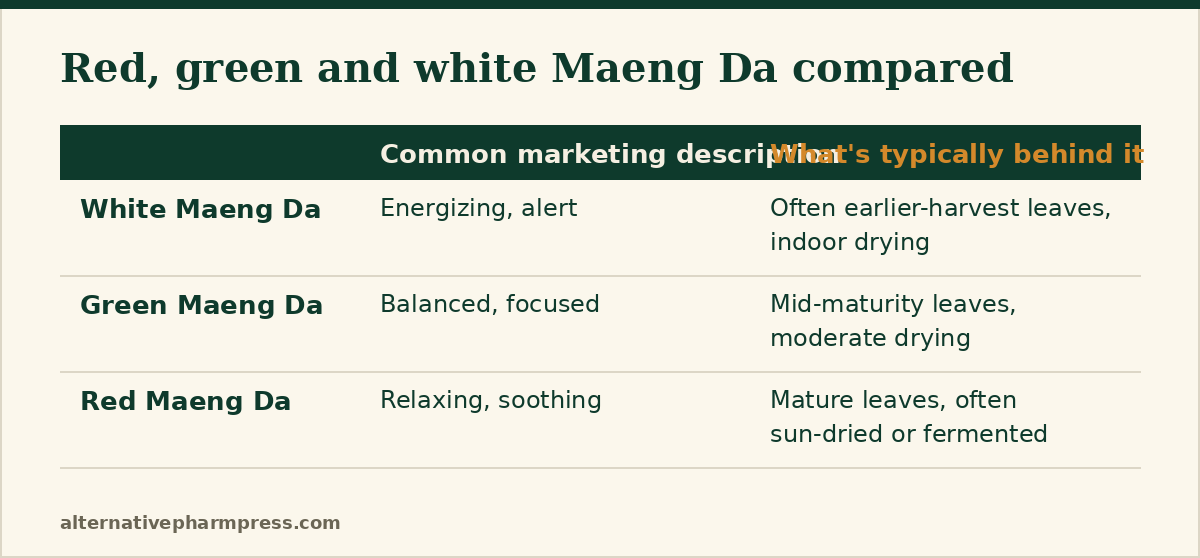
As with all kratom, vein color reflects leaf maturity and drying technique, which can shift alkaloid ratios somewhat. But testing consistently shows that the differences between colors are often smaller than the differences between batches. Read more in red vs white kratom, white vs green kratom and green Malay vs green Maeng Da.
Is Maeng Da stronger?
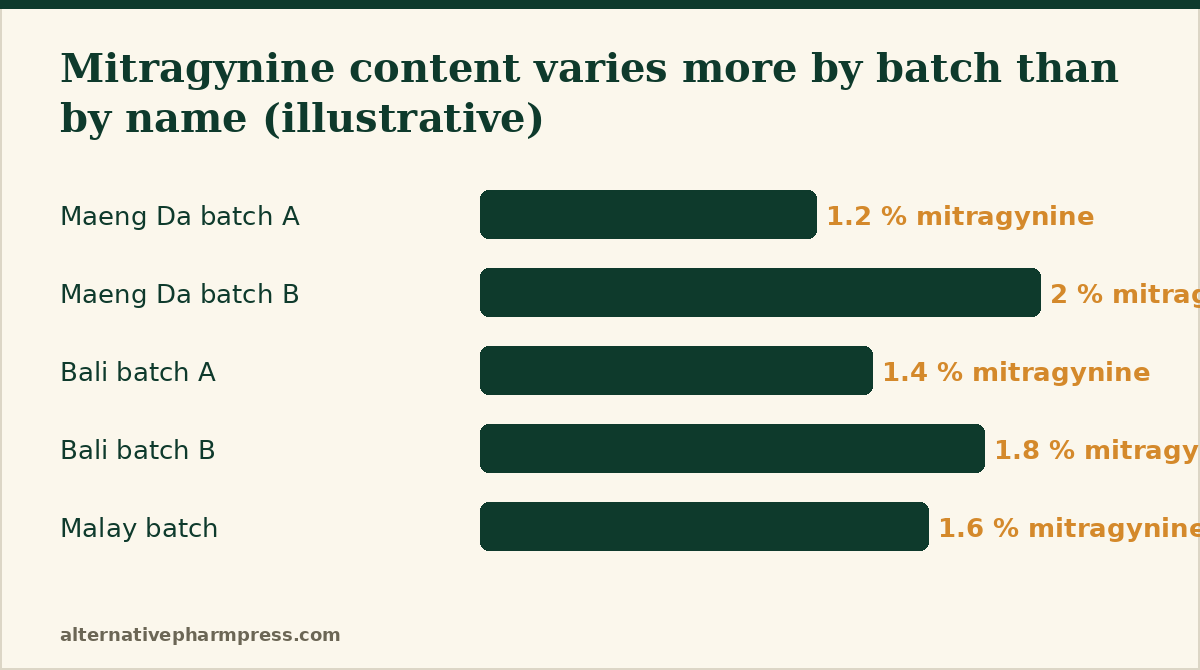
The values above are illustrative, not from specific products. Independent testing of kratom products has found mitragynine content commonly ranging from roughly 1% to 2% of leaf weight, with wide overlap between strain names. Some Maeng Da batches test high; others test average. Without a lab report, “Maeng Da” alone tells you very little about potency.
Beware “enhanced” Maeng Da
Products labeled “super,” “ultra,” “enhanced” or “plus” Maeng Da may be leaf blended with extract, which dramatically increases potency — and in some cases 7-OH may be present. Always check whether the product is plain leaf or contains extract. See kratom extract vs leaf and what is 7-OH.
Maeng Da vs other popular strains
| Name | Typical marketing | Reality |
|---|---|---|
| Maeng Da | “Strongest,” premium | Potency varies; often a premium tier |
| Bali | Smooth, relaxing | Often a general Indonesian blend |
| Borneo | Balanced | Region name, broadly used |
| Malay | Long-lasting | Name may not reflect origin |
| Thai | Energizing | Often not actually from Thailand |
See Maeng Da vs Bali, Borneo vs Bali and kratom strains explained.
How to evaluate a Maeng Da product
- Check the lab report for mitragynine percentage (or mg per gram) and 7-OH.
- Confirm it’s plain leaf, not extract-enhanced, unless you specifically intend otherwise.
- Look for heavy metal and microbial testing.
- Match the batch number on your package to the COA.
- Buy from compliant vendors that follow state Kratom Consumer Protection Acts.
Guides: how to read a kratom lab report, kratom COA red flags and best kratom brands.
Effects and dosing considerations
Maeng Da follows the same dose-dependent pattern as other kratom: lower amounts tend to feel stimulating, higher amounts sedating and opioid-like. Because Maeng Da is often marketed as strong, people sometimes take more than they would of other strains — or, conversely, take their usual amount of a batch that’s genuinely more potent. A digital scale and the batch’s mitragynine percentage are the best way to stay consistent. See what kratom is used for and the kratom powder guide.
Safety reminders
- Dependence and withdrawal develop with regular daily use; see kratom withdrawal.
- Avoid combining with alcohol, benzodiazepines, gabapentin or opioids; see kratom and alcohol.
- Rare liver injury has been reported; see kratom liver injury.
- Avoid if pregnant or breastfeeding.
- Check your state’s laws — see kratom laws by state.
Why the Maeng Da name is so popular
Maeng Da has become shorthand for “the good stuff,” which makes it valuable for marketing. Vendors know customers search for it and are willing to pay more. That’s not necessarily deceptive — some vendors reserve the name for batches that test higher — but it means the label alone isn’t a guarantee. Vendors who publish mitragynine percentages for every batch let you judge for yourself.
How potency claims should be backed up
A vendor claiming its Maeng Da is “the strongest” should be able to show batch-specific mitragynine results from an independent lab. Typical leaf kratom tests at around 1–2% mitragynine. A batch at the higher end of that range may reasonably be called potent. If a “leaf” product claims dramatically higher numbers, it may contain added extract — which changes the product category entirely.
Storage and freshness
Like all kratom powder, Maeng Da should be kept in an airtight, opaque container away from heat, light and humidity. Alkaloids slowly degrade over time, so potency can drop after many months. If you buy in bulk, divide it into smaller containers and only open one at a time.
Grafting, selection and the “super strain” story
Kratom trees can be propagated from cuttings and grafted, and farmers naturally select productive trees. Some vendors describe Maeng Da as the result of deliberate grafting decades ago to create a high-alkaloid lineage. There’s no published genetic study confirming a distinct “Maeng Da” cultivar, and with kratom grown across many farms and regions, it’s unlikely that every product sold under the name shares the same genetics.
What is well established is that alkaloid content depends on many factors: tree genetics, age, soil, climate, leaf maturity at harvest, drying and storage. Any of these can push a batch higher or lower. The name on the bag can’t tell you which way a particular batch went — only testing can.
Common Maeng Da product variations
- Red, green and white Maeng Da — vein color variations, the most common.
- Gold or yellow Maeng Da — usually leaf dried longer or blended; often marketed as smooth.
- “Super” or “premium” Maeng Da — may mean selected leaves, a higher-testing batch, or extract enhancement. Ask which.
- Maeng Da capsules — the same leaf in capsules; check fill weight. See kratom capsules guide.
- Maeng Da extracts and shots — concentrated products with much higher potency per serving.
Pricing and value
Maeng Da often costs more than other strains. Whether that’s worthwhile depends on the batch’s tested potency. A useful way to compare value is to calculate cost per milligram of mitragynine: multiply the grams in the bag by the mitragynine percentage (as mg per gram), then divide the price by that total. A cheaper “Bali” with a good lab result can be better value than an expensive Maeng Da with an average one.
FAQ
What does Maeng Da mean?
It’s commonly said to come from Thai slang often translated as “pimp grade,” signaling top quality. In practice it’s a premium marketing tier rather than a precise strain.
Is Maeng Da the strongest kratom?
Not consistently. Lab testing shows potency varies more between batches and vendors than between strain names.
What’s the difference between red, green and white Maeng Da?
They differ mainly by vein color and drying process, which may shift alkaloid ratios somewhat. Marketing links them to relaxing, balanced and energizing effects.
Where does Maeng Da kratom come from?
Despite its Thai name, most Maeng Da sold today is grown in Indonesia.
How can I tell if Maeng Da is enhanced?
Check the label and lab report. Words like “super,” “ultra” or “enhanced,” or unusually high alkaloid percentages, suggest added extract.
Is Maeng Da good for beginners?
Beginners are often advised to start with a small amount of any plain, lab-tested leaf. Because Maeng Da is marketed as strong, it’s especially important to weigh doses and avoid enhanced versions.
Does Maeng Da cause more dependence than other strains?
Dependence relates to how much and how often you use kratom, not the strain name. Higher-potency batches and extracts can accelerate tolerance.