
In the world of cannabis concentrates, live resin has a reputation for flavor. Made from plants frozen immediately after harvest, it preserves aromatic compounds that are usually lost during drying. In the hemp market, THCA live resin has become a popular product in carts, dabs and “sauce” — often marketed as the premium alternative to distillate.
This guide explains how THCA live resin is made, what it contains, how it compares with other concentrates, how potent it is and what to look for on a lab report.
Key takeaways
- Live resin is extracted from fresh-frozen plants, preserving more terpenes than dried material.
- It’s typically made with hydrocarbon solvents (butane, propane), which must be purged; testing for residual solvents is essential.
- THCA live resin often contains 60–85% THCA, plus terpenes and minor cannabinoids.
- Once heated, THCA converts to delta-9 THC — it’s intoxicating and will show up on drug tests.
- Federal and state rules moving to total THC put THCA concentrates under growing legal pressure.
What makes resin “live”?
Most cannabis extracts start with plants that are dried and cured, a process that can take days to weeks. During drying, many volatile terpenes evaporate or degrade. Live resin skips drying: plants are harvested and flash-frozen (often with dry ice or liquid nitrogen) and kept frozen until extraction. The result is a concentrate with a terpene profile closer to the living plant — brighter, more complex aroma and flavor.
How THCA live resin is made
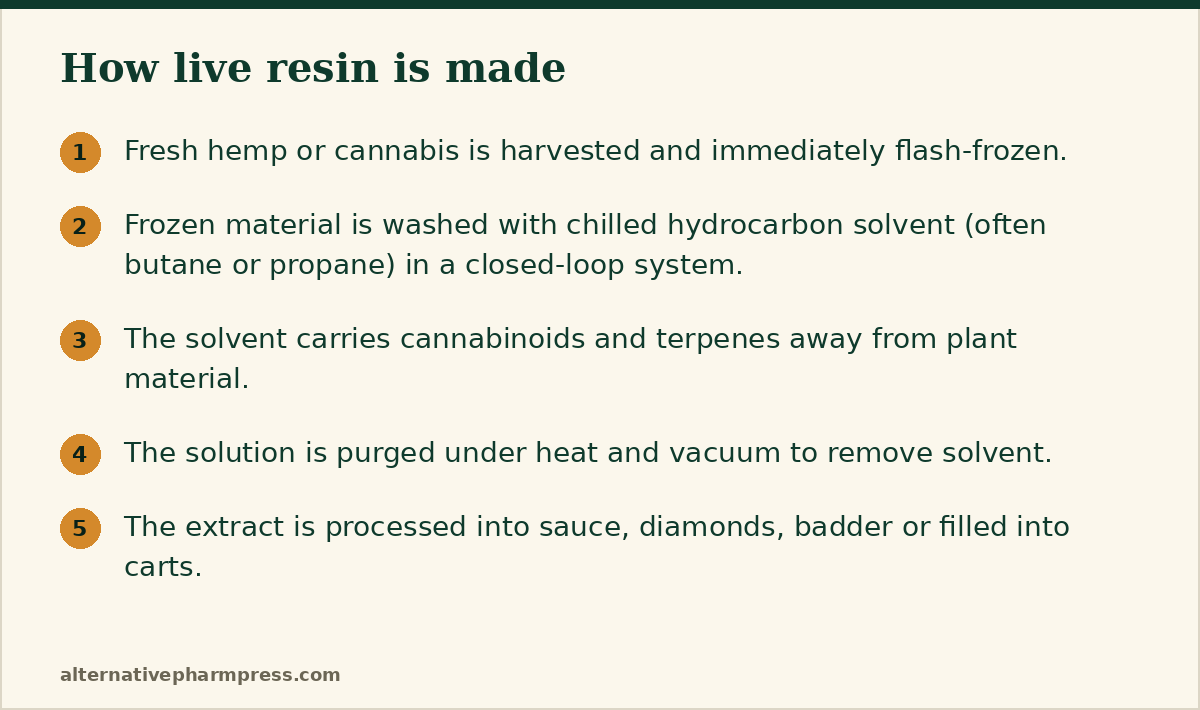
Closed-loop hydrocarbon systems recycle solvent and keep the process sealed. After extraction, the material is purged — gently heated under vacuum — to remove residual solvent. Purging must be thorough; leftover butane or propane above safety limits is a quality and safety issue.
What THCA live resin contains
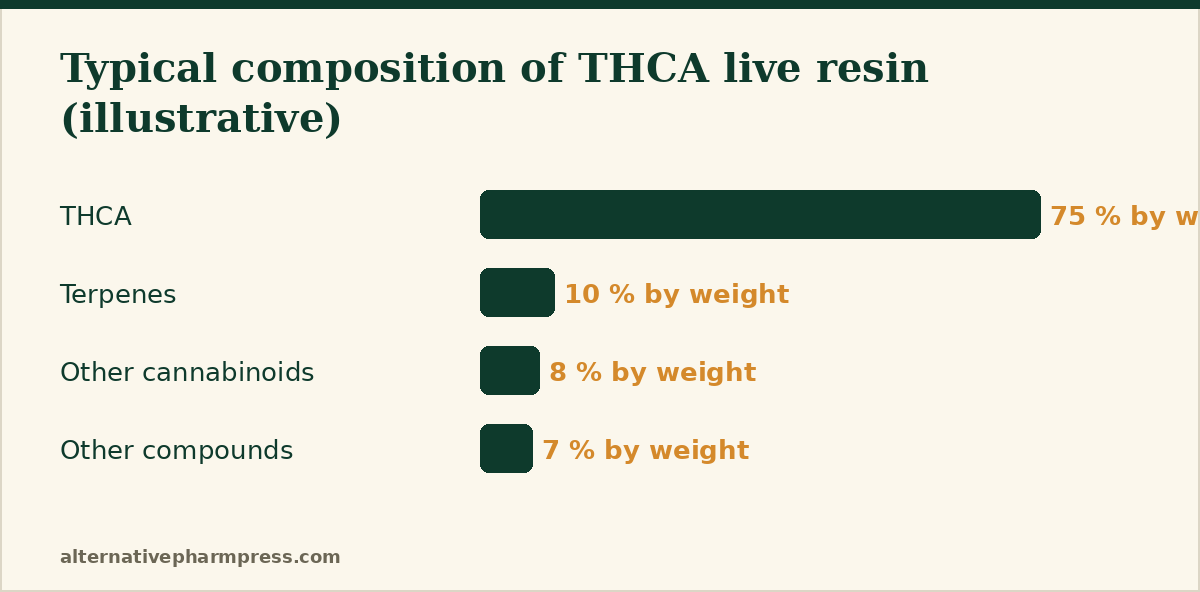
Values are illustrative; real products vary. A typical THCA live resin contains:
- THCA — the main cannabinoid, often 60–85%.
- Terpenes — commonly 5–15%, much higher than in distillate.
- Minor cannabinoids — CBGA, CBDA, small amounts of delta-9 THC and others.
- Other plant compounds — flavonoids and lipids in small amounts.
Live resin vs distillate vs rosin
| Concentrate | How it’s made | Terpenes | Typical THCA/THC | Notes |
|---|---|---|---|---|
| Live resin | Fresh-frozen, hydrocarbon extraction | High | 60–85% THCA | Strong flavor; needs solvent testing |
| Distillate | Extracted and distilled, then terpenes often re-added | Low natural; often added back | 85–95% cannabinoid | Flavorless base; often converted cannabinoids |
| Live rosin | Fresh-frozen, ice-water hash, then pressed with heat | High | 60–80% THCA | Solventless; often most expensive |
| THCA diamonds | Crystallized from live resin “sauce” | Low in crystals; high in sauce | 90%+ THCA crystals | Very potent |
See our deeper comparisons in distillate vs live resin and live resin vs live rosin.
Sauce, badder, diamonds: live resin textures
Live resin comes in different consistencies depending on how it’s processed:
- Sauce — a terpene-rich liquid often containing THCA crystals (“diamonds and sauce”).
- Badder / budder — whipped into a creamy, cake-batter texture.
- Sugar — grainy, sugar-like crystals in terpene liquid.
- Shatter-like — glassy, less common for live resin.
- Carts — live resin in vape cartridges, sometimes blended with distillate.
How potent is THCA live resin?
Once heated (dabbed or vaped), THCA converts into delta-9 THC. A 75% THCA live resin delivers roughly 66% potential THC using the standard 0.877 conversion factor. That’s far stronger than flower, which typically produces 15–25% THC. A tiny dab is a large dose for most people. Read does THCA get you high? for the chemistry.
Effects and the “entourage” claim
Many users report live resin feels fuller or more nuanced than distillate, often attributing this to the entourage effect — the idea that terpenes and minor cannabinoids modify THC’s effects. The concept is plausible and popular, but scientific evidence for strong terpene-driven differences in human effects is still limited. Flavor differences, however, are real and noticeable.
What a good COA shows
- Cannabinoid profile: THCA, delta-9 THC, and total THC (THCA × 0.877 + delta-9).
- Terpene profile: total and individual terpenes.
- Residual solvents: butane, propane and others within safe limits.
- Heavy metals, pesticides and microbes.
- Batch number matching the product, from an accredited lab.
Pesticide testing is especially important for concentrates because contaminants in plants are concentrated along with cannabinoids.
Safety considerations
- Potency: very easy to take a large dose; start with a tiny amount.
- Residual solvents: choose products with full solvent testing.
- Inhalation: dabbing at very high temperatures can produce irritating compounds; lower-temperature dabs are gentler.
- Hardware: for carts, see hardware concerns in our delta-8 carts safety guide.
- Mental health: high-THC concentrates are associated with greater risk of anxiety and, in vulnerable people, psychosis.
- Drug tests: THCA concentrates produce positive THC results; see how long THCA stays in your system.
Legal status
THCA live resin entered the market under the 2018 Farm Bill’s delta-9-only definition of hemp. Federal legislation passed in late 2025 shifts hemp to a total-THC standard and restricts intoxicating hemp products, which affects THCA concentrates directly. Many states have their own restrictions. See federal hemp law explained, is THCA legal after the federal change? and THCA legal status by state.
How to store live resin
Live resin’s terpenes are volatile. To preserve flavor and potency:
- Keep it in an airtight glass or silicone container.
- Store in a cool, dark place; refrigeration can extend freshness (let it reach room temperature before opening to avoid condensation).
- Avoid repeated exposure to heat and light, which degrade terpenes and convert THCA.
Common misunderstandings about live resin
“Live resin is solventless.” No — that’s live rosin. Live resin is usually made with hydrocarbon solvents.
“More terpenes always mean better effects.” Terpenes strongly influence flavor; their effect on how a high feels is less clearly established.
“Live resin carts are always pure live resin.” Some “live resin” carts blend live resin with distillate. Check the ingredients and the COA.
“Hemp live resin is weaker than dispensary live resin.” Once heated, high-THCA hemp concentrate can be just as potent as marijuana concentrate.
How live resin is used
People use THCA live resin in several ways:
- Dabbing — vaporizing small amounts on a heated surface (a “dab rig” or electronic device). Lower temperatures preserve terpenes and are gentler on the lungs.
- Vape cartridges — live resin in a cart is heated by a coil. Hardware quality matters.
- Topping flower — sprinkling small amounts onto flower in a bowl or joint, which greatly increases potency.
All of these deliver THC quickly, so effects arrive within minutes. Because concentrates are so potent, the amount needed is tiny — often the size of a grain of rice or smaller.
Who should avoid concentrates
Concentrates aren’t a good choice for people new to cannabis, anyone with a personal or family history of psychosis or bipolar disorder, people with heart conditions, those who are pregnant or breastfeeding, people under 21 and anyone subject to drug testing. High-potency products are linked to higher risks of dependence and cannabis-related mental health problems, especially with frequent use.
Why price varies so much
Live resin is usually more expensive than distillate, and live rosin is often more expensive still. Several factors drive the price:
- Fresh-frozen input material must be harvested and frozen quickly and kept cold, which adds cost and logistics.
- Yield — extracting from wet, frozen plant material typically yields less concentrate per pound than dried material.
- Equipment and compliance — closed-loop hydrocarbon systems and testing are expensive.
- Genetics — terpene-rich cultivars command premium prices.
A suspiciously cheap “live resin” cart may be mostly distillate with added terpenes. Ask for the terpene profile and the cannabinoid breakdown on the COA. Natural live resin typically shows a broad terpene profile and THCA rather than mostly decarboxylated THC.
Reading terpene results
Terpene panels list compounds like myrcene (earthy, musky), limonene (citrus), beta-caryophyllene (peppery), pinene (pine), linalool (floral) and terpinolene (fresh, herbal). Total terpenes of 5–15% are common in live resin. These numbers help you predict flavor and compare batches. Claims that a specific terpene produces a specific effect — “myrcene makes you sleepy,” for example — are popular but not well supported by human research.
FAQ
What is THCA live resin?
It’s a concentrate made from flash-frozen hemp or cannabis, extracted to preserve terpenes, with THCA as the main cannabinoid.
Is live resin solventless?
No. Live resin usually uses hydrocarbon solvents like butane or propane. Live rosin is the solventless alternative.
How strong is THCA live resin?
Often 60–85% THCA, which converts to roughly 50–75% THC when heated — far stronger than flower.
Does THCA live resin get you high?
Yes, when heated by dabbing or vaping, THCA converts to delta-9 THC, which is intoxicating.
Is THCA live resin legal?
It’s under increasing legal restriction as federal and state rules move to total-THC standards. Check your state’s current law.