
Gummies, chocolates, mints, honey sticks, coffee pods and sparkling drinks — CBD edibles are the best-selling way to take cannabidiol. They’re tasty, discreet and come in pre-measured doses. But edibles behave differently in the body than oils or vapes, and understanding that helps you choose the right product and dose.
This guide covers how CBD edibles are absorbed, how long they take to work, why bioavailability is low, how to dose and what to check before buying.
Key takeaways
- Edibles are digested and processed by the liver, so onset is slower — often 30 minutes to 2 hours.
- Oral CBD bioavailability is low, commonly estimated in the single digits to about 20%.
- Taking CBD with a fatty meal can significantly increase absorption.
- Common edible doses range from 5 mg to 50 mg per piece; clinical trial doses were much higher.
- Check for batch-matched COAs, THC content and drug interactions.
How CBD edibles are absorbed
When you eat a CBD gummy, it travels through your stomach to your small intestine, where CBD is absorbed into the bloodstream. From there it passes through the liver, which breaks down a large share before it reaches the rest of the body — the “first-pass effect.” What remains circulates and acts on targets throughout the body. For the basics of how CBD works, see CBD meaning.
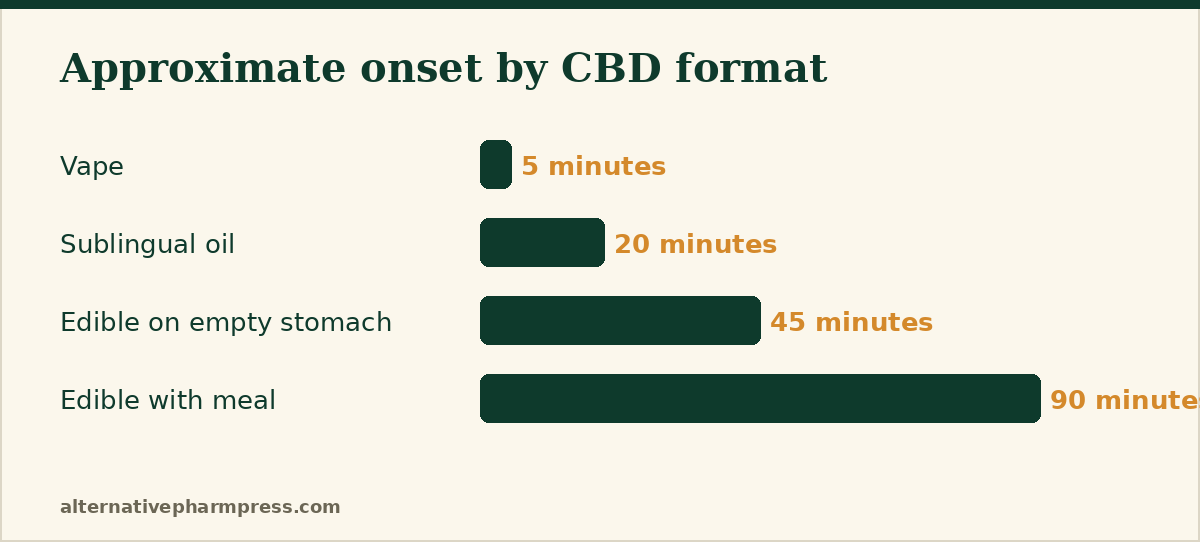
Onset times are approximate and vary from person to person.
Why bioavailability matters
Bioavailability is the share of a dose that reaches your bloodstream. For oral CBD, it’s low — studies commonly estimate somewhere between about 6% and 20%, depending on the formulation and whether it’s taken with food. That means a 25 mg gummy may deliver only a few milligrams to circulation.
The fat effect
CBD is fat-soluble. Research has found that taking CBD with a high-fat meal can increase absorption several-fold compared with fasting. Practical implications:
- Taking an edible with or after a meal containing fat generally increases its effect.
- Effects may be less predictable if you sometimes take it fasting and sometimes with food.
- Some products include oils or emulsifiers to improve absorption.
Water-soluble and “nano” CBD
Some drinks and edibles use emulsified “water-soluble” CBD, which may absorb faster and more consistently. Early pharmacokinetic data is encouraging but limited, and quality varies by manufacturer.
Edibles vs oils vs other formats
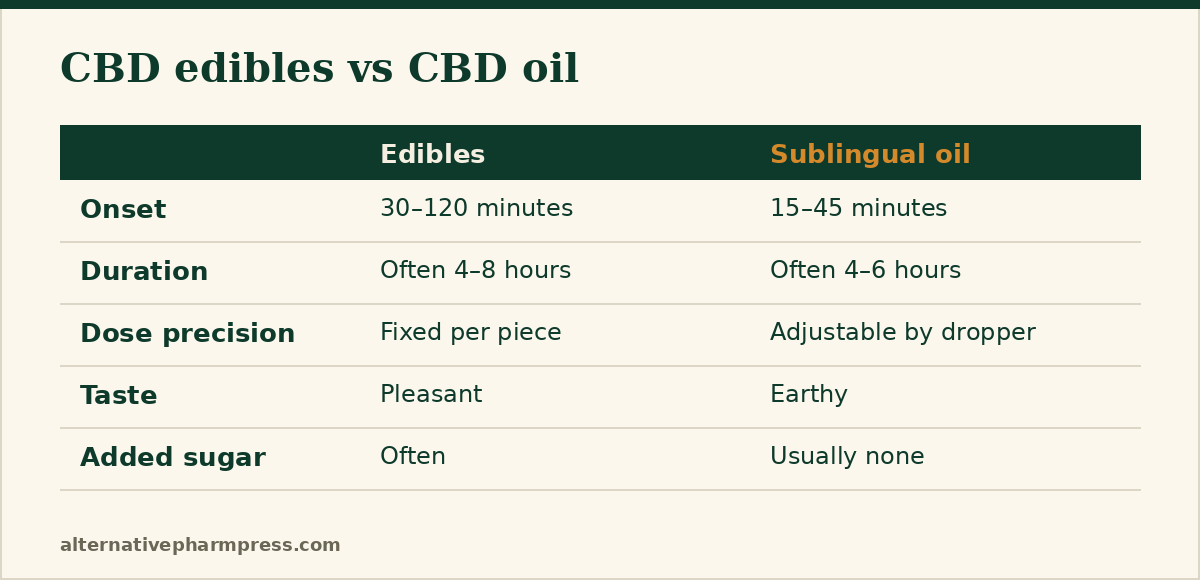
Edibles are convenient and long-lasting, while oils offer more flexible dosing and slightly faster onset when held under the tongue. Read the full comparison in CBD gummies vs CBD oil and CBD tincture vs CBD oil.
How much CBD is in an edible?
| Edible type | Typical CBD per piece |
|---|---|
| Gummies | 10–50 mg |
| Chocolates (per square) | 5–25 mg |
| Mints | 2–10 mg |
| Beverages (per can) | 5–50 mg |
| Capsules or softgels | 10–50 mg |
For context, the FDA-approved CBD medicine Epidiolex uses doses calculated per kilogram of body weight that are far higher than typical consumer products. Studies on anxiety have often used single doses of 300–600 mg. That doesn’t mean higher doses are better for everyday use, but it explains why low-dose edibles may have subtle effects.
How to dose CBD edibles
There’s no official consumer dose. A common, cautious approach:
- Start low — for example, 10–20 mg.
- Take it consistently with or without food (consistency matters more than which).
- Wait at least two hours before judging effects.
- Increase gradually every few days if needed.
- Keep a log of dose, timing and effects.
If you take medications, talk to your doctor or pharmacist before starting.
What to check on the label
- mg of CBD per piece and per package
- Spectrum — full-spectrum (may contain up to 0.3% THC), broad-spectrum or isolate
- THC content per piece
- Batch number matching a third-party COA
- Testing for pesticides, heavy metals, solvents and microbes
- Sugar and allergens
- No disease claims
See what to check when buying CBD online and best CBD gummies.
Drug tests and THC
Full-spectrum edibles can contain enough THC to cause a positive drug test with regular use. If you’re tested, choose broad-spectrum or isolate products with full cannabinoid panels. Read can CBD fail a drug test? and full-spectrum vs broad-spectrum CBD.
Drug interactions
CBD inhibits liver enzymes (CYP3A4 and CYP2C19) that metabolize many medications, including some blood thinners, anti-seizure drugs, antidepressants and blood pressure medicines. Edibles’ slower absorption doesn’t reduce this concern. See CBD and blood pressure medication.
Safety considerations
- Side effects: drowsiness, diarrhea, appetite changes and fatigue.
- Liver: high doses have raised liver enzymes in clinical trials.
- Pregnancy and breastfeeding: the FDA advises against CBD use.
- Children and pets: keep edibles locked away — they look like candy, and full-spectrum products contain THC.
- Dependence: CBD isn’t considered addictive. See is CBD addictive?
CBD edibles for sleep
Many people take CBD edibles at night. Some evidence suggests CBD may help sleep indirectly by reducing anxiety, but trials are mixed. Some sleep edibles add melatonin or CBN. See CBD for sleep: what the human trials found and CBN vs melatonin.
Storage
Store edibles in a cool, dry place away from sunlight. Heat can melt gummies and chocolate, redistributing CBD unevenly. Check expiration dates — CBD slowly degrades over time, especially with heat and light.
Legal status
Hemp-derived CBD with no more than 0.3% delta-9 THC is federally legal, but the FDA hasn’t approved CBD as a food additive or dietary supplement, and states set their own rules. Federal hemp law changes in 2026 add per-container THC limits that affect some full-spectrum edibles. See the federal hemp THC limit and CBD.
Homemade CBD edibles
Some people make their own edibles by adding CBD oil to recipes. This works, but dosing is tricky: CBD may not distribute evenly through a batch, and high baking temperatures can degrade some cannabinoids. If you try it, mix the oil thoroughly into a fat-based ingredient (like butter or coconut oil), divide the batch into evenly sized portions, and calculate the CBD per portion by dividing the total CBD by the number of pieces. Label homemade edibles clearly and store them away from children.
CBD edibles and exercise recovery
Athletes increasingly use CBD edibles after workouts. CBD is not on the World Anti-Doping Agency’s prohibited list (though other cannabinoids are), but full-spectrum products may contain THC, which is prohibited in competition. Research on CBD for exercise recovery is limited and mixed. If you’re a tested athlete, look for products certified by third-party sport programs and choose isolate or verified broad-spectrum.
Why some people feel nothing from CBD edibles
It’s common to hear “I tried CBD gummies and felt nothing.” Several factors explain that:
- Low dose. A 10 mg gummy with low bioavailability may deliver only a milligram or two to the bloodstream.
- Inaccurate labels. Testing has repeatedly found products containing less CBD than advertised.
- Expectations. CBD isn’t intoxicating. Its effects, when present, tend to be subtle — less tension, easier relaxation — rather than a noticeable “feeling.”
- Timing. Taking an edible on an empty stomach and judging it after 30 minutes may be too early.
- Individual variation. Genetics, metabolism and body weight all influence response.
- The goal itself. For many uses, the evidence that CBD works at consumer doses is limited.
If you’ve tried a well-tested product at a moderate dose consistently for a couple of weeks without benefit, CBD may simply not be effective for your goal.
Choosing between gummies, chocolates and drinks
- Gummies offer the most variety and fixed doses, but often contain sugar or sugar alcohols.
- Chocolates provide fat that may aid absorption; doses per square can vary if not well mixed.
- Drinks frequently use water-soluble CBD for faster onset, but doses are often low and cans can be expensive.
- Capsules and softgels aren’t usually called edibles but deliver measured doses without sugar.
FAQ
How long do CBD edibles take to work?
Usually 30 minutes to two hours, depending on food, metabolism and the product.
How long do CBD edible effects last?
Often four to eight hours, though effects are subtle for many people.
Are CBD edibles less effective than oil?
Oral bioavailability is low for both when swallowed. Holding oil under the tongue may improve absorption slightly. Taking either with fatty food increases absorption.
How many mg of CBD should I take in an edible?
Many people start with 10–20 mg and adjust gradually. Talk to a healthcare provider if you take medications.
Can CBD edibles make you fail a drug test?
Full-spectrum edibles can, because they may contain small amounts of THC. Broad-spectrum and isolate products carry lower risk.
Should I take CBD edibles with food?
Taking CBD with a meal containing some fat generally increases absorption. Consistency — taking it the same way each time — helps you judge effects.