
Amanita muscaria — the red-and-white fly agaric — has gone from fairy-tale illustration to wellness product. Gummies, tinctures, teas and dried caps are marketed with a long list of benefits: better sleep, less anxiety, pain relief, help with alcohol cravings, improved mood and spiritual insight.
Some of these claims trace back to genuine scientific interest in muscimol, the mushroom’s main active compound. Others are folklore or marketing. This guide compares the most common amanita muscaria benefits claims with what the evidence actually shows.
Key takeaways
- Amanita’s main actives are ibotenic acid (excitatory) and muscimol (a strong GABA-A agonist).
- Muscimol research is real but early, mostly in animals and lab models, with a few small controlled human studies of purified muscimol.
- There are no robust human trials showing amanita products improve sleep, anxiety, pain or addiction.
- Amanita poisoning can cause vomiting, confusion, delirium and seizures.
- The FDA says amanita and its constituents are not approved food ingredients.
Why scientists are interested in muscimol
Muscimol binds strongly to GABA-A receptors, the brain’s main inhibitory (calming) system — the same system targeted by benzodiazepines, alcohol and some sleep medications, though muscimol binds at a different site. Because of this, researchers have used muscimol for decades as a lab tool to temporarily “switch off” brain regions in animal studies. More recently, interest has grown in whether controlled, purified muscimol could have therapeutic uses, for example in sleep or neurological conditions.
That’s a long way from a gas-station gummy. Read the background in what are amanita muscaria gummies and our report on amanita muscaria in 2026.
Claim-by-claim evidence check
1. Sleep
Claim: Amanita helps you fall asleep and sleep deeply. Evidence: Muscimol’s GABA-A activity makes sedation plausible, and many users report drowsiness. But sedation isn’t the same as healthy sleep, and there are no well-designed trials showing amanita products improve sleep quality. Sedating substances can also worsen sleep architecture or cause next-day grogginess.
2. Anxiety and stress
Claim: Amanita calms anxiety. Evidence: Again, the GABA mechanism is plausible, but no controlled human studies support amanita for anxiety. Combining it with anti-anxiety medications or alcohol could be dangerous. For options with evidence, see supplements for anxiety.
3. Pain
Claim: Amanita relieves chronic pain. Evidence: Some animal studies suggest muscimol affects pain signaling. Traditional topical use for joint pain exists in parts of Europe. There’s no solid human evidence for amanita products as pain treatments.
4. Alcohol and drug cravings
Claim: Amanita reduces alcohol cravings or helps people quit. Evidence: This claim circulates widely online but rests on anecdotes. Substituting one sedative for another isn’t a recognized treatment, and mixing amanita with alcohol increases risk. Effective, evidence-based treatments for alcohol use disorder exist, including medications such as naltrexone and acamprosate.
5. Mood and depression
Claim: “Microdosing” amanita improves mood. Evidence: Anecdotal. Amanita isn’t a classic psychedelic and doesn’t act on serotonin receptors like psilocybin. See amanita muscaria vs psilocybin and microdosing psilocybin.
6. Neuroprotection
Claim: Amanita protects the brain. Evidence: Some lab work explores muscimol’s effects in neurological models. Meanwhile, ibotenic acid — also present in amanita — is an excitotoxin used in research to damage brain tissue in animals. That’s a strong reason for caution, not reassurance.
The ibotenic acid problem
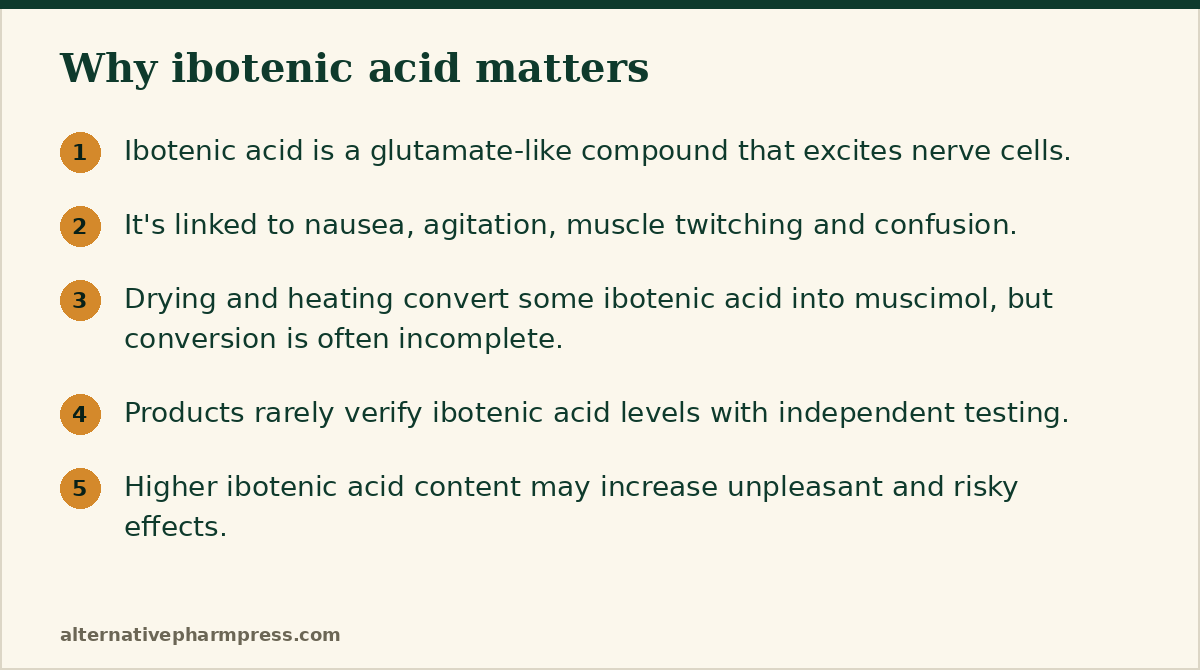
Many amanita products are “decarboxylated” to convert ibotenic acid into muscimol. Done well, this reduces some unpleasant effects. Done poorly, products can still contain substantial ibotenic acid. Labels claiming “ibotenic acid free” need verification from an accredited lab.
Safety risks
- Poisoning symptoms: nausea, vomiting, sweating, salivation, dizziness, confusion, agitation, hallucinations, muscle jerks, seizures and coma in severe cases.
- Delayed onset: effects may start an hour or more after ingestion, leading people to take more.
- Interactions: dangerous with alcohol, benzodiazepines, sleep aids, gabapentinoids and other sedatives.
- Misidentification: foraged mushrooms can be confused with deadly Amanita species.
- Adulteration: some “mushroom” gummies have contained undisclosed synthetic compounds and been linked to hospitalizations and recalls.
- Children and pets: gummies look like candy and can cause severe poisoning.
Emergency: If someone shows confusion, seizures, extreme agitation or can’t be woken after taking amanita, call 911 or Poison Control at 1-800-222-1222.
Legal and regulatory status
Amanita muscaria isn’t federally scheduled in the US, but the FDA has said that it and its constituents aren’t approved food additives or generally recognized as safe, which affects gummies and edibles. Some states have restricted amanita products, and rules are evolving. Always check local law.
How to evaluate an amanita product (if you’re considering one)
We don’t recommend amanita products. If an adult chooses to use one anyway:
- Insist on a batch-matched COA listing muscimol and ibotenic acid in mg per serving.
- Check for screening of synthetic adulterants and contaminants.
- Avoid products making disease or treatment claims.
- Start with a very small amount, wait at least two hours and never combine with other substances.
- Have a sober companion and don’t drive.
Better-studied alternatives
Depending on your goal:
- Sleep: sleep hygiene, CBT for insomnia and, if appropriate, clinician-guided treatment. See CBN vs melatonin.
- Stress and anxiety: therapy, exercise, and supplements with more research such as ashwagandha or L-theanine.
- Brain health: non-psychoactive mushrooms like lion’s mane — see what lion’s mane is good for.
Traditional and historical use
Amanita muscaria has a documented history of ritual use among some Siberian peoples, where it was consumed — often dried — in shamanic practice. Historical accounts describe intense, unpredictable experiences, and traditional users had knowledge of preparation that modern buyers lack. In parts of Eastern Europe, it was also used as a topical folk remedy and as a fly killer (hence “fly agaric,” from soaking it in milk to attract and stupefy flies). Historical use is interesting, but it isn’t evidence of safety or benefit for modern products sold in gummy form.
Why the hype outpaces the science
Several forces push amanita claims beyond the evidence. It’s federally unscheduled, so it can be sold where psilocybin can’t. It rides the broader wave of interest in psychedelics and “plant medicine.” And because muscimol does act on real brain pathways, marketers can point to genuine mechanisms while skipping the absence of human trials. Healthy skepticism means asking for controlled human evidence before believing claims — and for amanita, that evidence isn’t there yet.
What future research could show
Researchers are exploring purified muscimol in controlled settings, including for sleep and neurological disorders. If well-designed human trials eventually show benefits, those findings would apply to measured pharmaceutical-grade muscimol under medical supervision — not to variable wild-harvested mushroom products.
How to spot misleading amanita marketing
Amanita sellers often use language that sounds scientific but isn’t supported by evidence. Common red flags include:
- “Clinically proven” without links to published human trials of the actual product.
- “Ibotenic acid free” without a third-party lab report showing the measurement.
- “Natural alternative to sleeping pills” or “anxiety medication” — these are unapproved drug claims.
- “Legal psychedelic” or “magic mushroom” branding that encourages people to expect psilocybin-like effects.
- Testimonials as evidence, especially when presented without any discussion of side effects.
- No information about who manufactures the product or where the mushrooms come from.
Trustworthy information sources acknowledge uncertainty, discuss risks and distinguish between research on purified muscimol and consumer mushroom products.
Who should never use amanita products
Even setting aside the lack of proven benefits, some groups face clear additional risk: people who are pregnant or breastfeeding; anyone with epilepsy or a seizure history; people with liver or kidney disease; anyone taking sedatives, antipsychotics or antidepressants; people with a history of psychosis; and children and adolescents. Older adults may also be more sensitive to confusion and falls.
FAQ
What are the benefits of amanita muscaria?
Sellers claim benefits for sleep, anxiety, pain and cravings, but there are no robust human trials supporting these claims. Research on muscimol is early.
Does amanita muscaria help with sleep?
Its main compound, muscimol, is sedating, but there’s no strong evidence that amanita products improve healthy sleep.
Is amanita muscaria a psychedelic?
Not in the classic sense. It acts on GABA and glutamate systems rather than serotonin receptors like psilocybin, producing sedative, dreamlike effects.
Is amanita muscaria safe?
It carries real risks, including vomiting, confusion, seizures and dangerous interactions, and products are often mislabeled.
Is amanita muscaria legal?
It isn’t federally scheduled, but the FDA doesn’t consider it an approved food ingredient, and some states restrict it.
Can amanita muscaria be microdosed safely?
There’s no research establishing a safe or effective microdose. Potency varies widely between products, and ibotenic acid content is often unknown.
Does cooking or drying amanita make it safe?
Drying and heating convert some ibotenic acid into muscimol, which may reduce some unpleasant effects, but it doesn’t make amanita safe. Muscimol itself is potent and sedating.