
Walk into a kava bar and the menu will likely offer both kava and kratom. Both are plant-based, both are marketed as alternatives to alcohol, and both are sold as powders, drinks and capsules. It’s no wonder people treat them as interchangeable.
They aren’t. Kava vs kratom is a comparison between two plants from different families, different parts of the world, with different active compounds acting on different brain systems — and, crucially, different risks. This guide lays the differences out side by side.
Key takeaways
- Kava is a Pacific Island root; kratom is a Southeast Asian tree leaf.
- Kava works mainly through GABA-related and ion-channel pathways; kratom’s alkaloids act on opioid and adrenergic receptors.
- Kava is relaxing and sociable; kratom is stimulating at low doses and sedating at high doses.
- Kratom carries a clear risk of dependence and withdrawal; kava generally does not.
- Both have been linked to rare liver injury, and neither should be mixed with alcohol or sedatives.
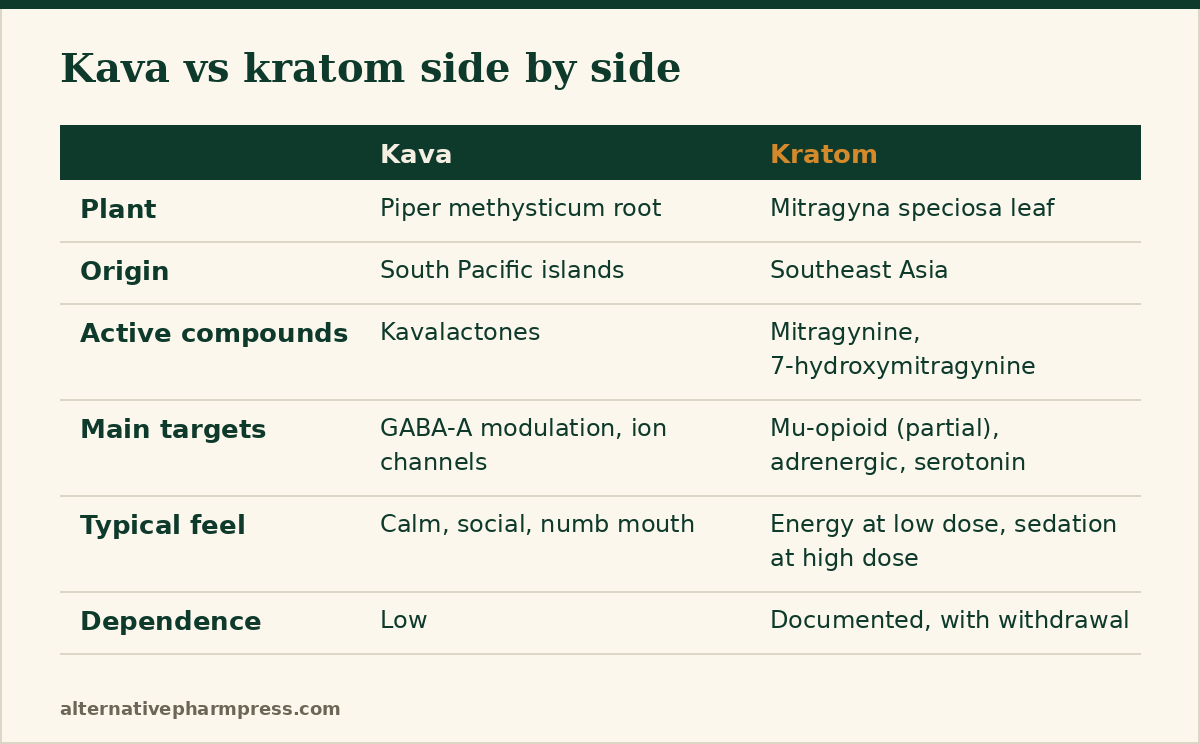
Kava vs kratom at a glance
Where they come from
Kava (Piper methysticum) is a shrub in the pepper family, grown in Vanuatu, Fiji, Tonga, Samoa and Hawai’i. Its roots are dried, ground and traditionally kneaded in water to make a muddy, earthy drink shared at ceremonies and social gatherings. Read our full guide to what kava is.
Kratom (Mitragyna speciosa) is a tree in the coffee family, native to Thailand, Malaysia, Indonesia and Papua New Guinea. Its leaves have traditionally been chewed or brewed by laborers to fight fatigue. See what kratom is used for.
How they work
Kava: kavalactones
Kava’s active compounds are kavalactones — six major ones account for most of its effect. They modulate GABA-A receptors (a calming signaling system), influence sodium and calcium channels, and may affect dopamine and noradrenaline. Kava does not act on opioid receptors.
Kratom: indole alkaloids
Kratom’s main alkaloid, mitragynine, is a partial agonist at mu-opioid receptors and also acts on adrenergic and serotonin receptors. A minor alkaloid and metabolite, 7-hydroxymitragynine (7-OH), is a much more potent opioid agonist. This opioid-receptor activity explains both kratom’s pain-relieving effects and its dependence potential. Learn more in kratom and the opioid receptor and what is 7-OH.
Effects compared
| Kava | Kratom | |
|---|---|---|
| Onset | 20–30 minutes | 15–45 minutes |
| Duration | 2–4 hours | 2–5 hours |
| Low dose | Mild relaxation, sociability | Energy, alertness, sociability |
| Higher dose | Heavy relaxation, drowsiness, “kava legs” | Sedation, pain relief, opioid-like effects |
| Mental clarity | Usually clear-headed | Varies; can feel foggy at high doses |
| Common side effects | Numb mouth, upset stomach, drowsiness | Nausea, constipation, dizziness, itching |
People often describe kava as a “calm, chatty” feeling with a clear mind, while kratom feels more like strong coffee at low doses and a mild painkiller at higher doses.
Dependence and withdrawal: the biggest difference
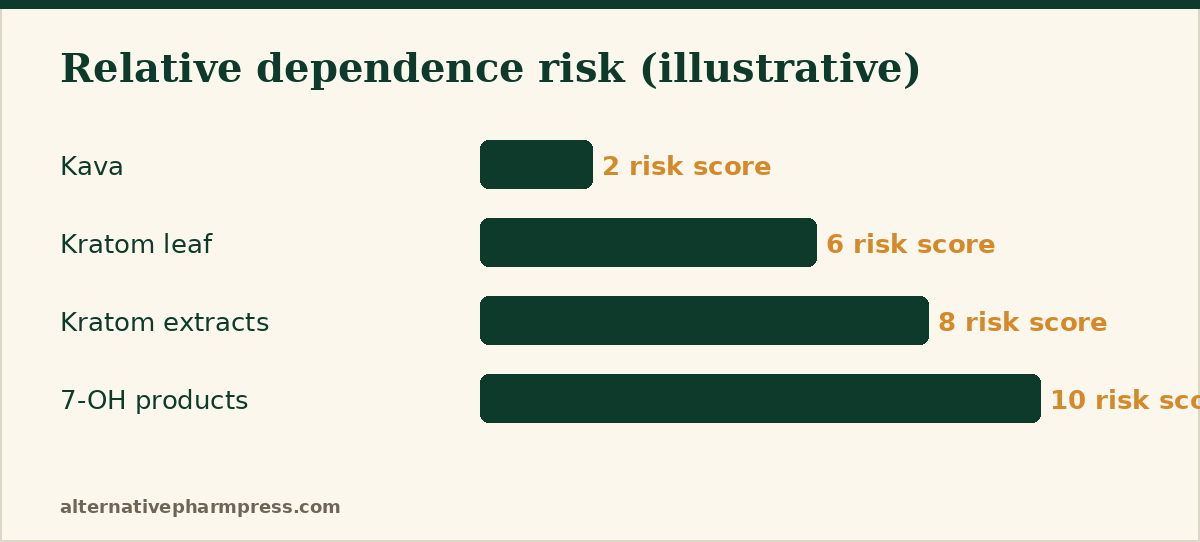
The chart is an illustrative ranking, not a measured score.
Kratom can cause physical dependence with regular daily use. Withdrawal symptoms — irritability, aches, runny nose, insomnia, diarrhoea, cravings — are well documented and can resemble mild opioid withdrawal. Concentrated extracts and especially 7-OH products raise that risk substantially. See kratom withdrawal and 7-OH withdrawal.
Kava is not generally considered physically addictive. Heavy, long-term users may develop tolerance to the taste or a habit of daily use, but classic withdrawal syndromes are not a recognized feature.
Safety compared
Liver
Both plants have been linked to rare cases of liver injury:
- Kava: Reports in Europe in the early 2000s led to temporary bans. Risk seems tied mainly to solvent extracts, poor-quality cultivars and inclusion of stems and peelings. Noble kava prepared traditionally with water appears lower-risk.
- Kratom: Case reports describe liver injury typically appearing after weeks of use, more often with higher doses. See kratom and liver injury.
Other risks
- Kava: heavy use can cause kava dermopathy (dry, scaly skin), and kava impairs driving.
- Kratom: risk of serious harm rises when combined with other depressants; deaths involving kratom almost always involve other substances. See can you overdose on kratom?
Drug interactions
Both should be kept away from alcohol, benzodiazepines, sleep aids and other sedatives. Kratom also interacts with opioids, gabapentin and drugs metabolized by CYP3A4 and CYP2D6. Kava may interact with medications that stress the liver and with dopamine-related drugs. See kratom and alcohol.
Can you mix kava and kratom?
Some bars sell “kava-kratom” blends, and some people drink both in the same session. Combining them stacks sedating effects and makes it harder to judge how impaired you are. It also combines two substances with rare liver-injury signals. If you choose to try both, don’t take them at the same time, start low with each separately, and never add alcohol. Avoid driving.
Legal status
| Kava | Kratom | |
|---|---|---|
| US federal | Legal; sold as food or supplement | Legal federally; not scheduled |
| US states | Legal in all states | Banned in several states; regulated by KCPAs in others |
| 7-OH | Not applicable | Increasingly restricted or banned |
| International | Restricted in some countries; legal in Pacific nations | Controlled in many countries |
Kratom laws change frequently. Check our kratom laws by state index and the list of states that ban kratom.
Which is “better”?
Neither plant is a medicine, and choosing between them depends on why you’re considering them:
- If you want social relaxation without a hangover, kava is closer to that goal and carries lower dependence risk.
- If you’re drawn to kratom for pain or opioid withdrawal, talk to a clinician first — kratom can create its own dependence, and evidence-based treatments exist.
- If you want focus or energy, neither is ideal; look at better-studied options in our best nootropic brands guide.
For a related comparison, see kava vs kanna and kratom vs kanna.
Quality and testing: what to look for
Both kava and kratom are agricultural products sold with limited oversight, so quality varies widely. The checks overlap:
- Batch-specific lab reports. For kava, look for kavalactone content and confirmation that the batch is noble kava (not tudei). For kratom, look for mitragynine and 7-OH content per gram or per serving.
- Contaminant testing. Heavy metals (lead, arsenic, cadmium, mercury), microbes such as salmonella and E. coli, and yeast and mold counts.
- Clear origin. Reputable kava vendors name the island and cultivar; reputable kratom vendors name the region and harvest information.
- No disease claims. Products claiming to treat anxiety, pain or addiction are not legally compliant supplements, which suggests the seller cuts other corners too.
Kratom has been the subject of several FDA salmonella recalls, and both plants can pick up heavy metals from soil. Our guides to kratom COA red flags and signs a brand is third-party tested show what a trustworthy report looks like.
How kava bars serve each one
If your first experience of either plant is at a kava bar, here’s what to expect. Kava is usually served in a coconut shell or small cup, by the “shell,” and bartenders often recommend starting with one or two shells and waiting 20–30 minutes. Many bars rotate cultivars from different islands and describe them as “heady” or “heavy.” Kratom is usually served as a brewed tea or a flavored drink by the cup, sometimes in canned form. Strength varies far more than with kava, especially if extracts are used. Ask how many grams of leaf go into a serving and whether anything contains 7-OH. See our guide to kratom drinks for what to ask.
Questions to ask yourself first
Before trying either plant, it helps to be honest about your goals:
- Am I looking for a social drink, or relief from a health problem? If it’s the latter, a clinician can help you find options with stronger evidence.
- Do I take any medications? Both plants can interact with common prescriptions.
- Do I have a history of dependence on alcohol, opioids or other substances? Kratom in particular can be risky in that situation.
- Will I need to drive? Both kava and kratom can impair driving.
FAQ
Is kava the same as kratom?
No. Kava is a Pacific Island root that works mainly through GABA-related pathways, while kratom is a Southeast Asian leaf whose alkaloids act on opioid receptors.
Which is stronger, kava or kratom?
They’re different rather than stronger or weaker. Kratom has more potent opioid-like effects at high doses, while kava produces relaxation without opioid activity.
Is kava addictive like kratom?
Kava is not generally considered physically addictive. Kratom can cause dependence and withdrawal with regular use.
Can you take kava and kratom together?
Combining them increases sedation and makes impairment harder to judge. If you try both, don’t take them at once and never add alcohol.
Are kava and kratom legal?
Kava is legal across the US. Kratom is federally legal but banned in several states, and 7-OH products face growing restrictions.
Does kava or kratom show up on a drug test?
Standard drug panels don’t test for either. Specialised tests can detect kratom alkaloids, and kava is rarely tested for. See our guide on whether kratom shows up on a drug test for details.
Which is safer for daily use?
Neither is recommended for heavy daily use. Kava’s main concerns with daily use are skin changes and possible liver strain, while kratom’s main concern is dependence and withdrawal. Regular breaks reduce risk for both.
Is kava addictive?
Kava isn’t considered physically addictive the way alcohol or opioids are, but heavy regular use can cause skin changes and has been linked to liver problems. Avoid mixing it with alcohol.