

Lion’s mane (Hericium erinaceus) is one of the most popular functional mushrooms, sold in capsules, powders, gummies, coffees and tinctures for focus, memory and nerve health. But labels vary enormously: one product suggests 250 mg a day, another 3 grams, and a third lists an “8:1 extract” without explaining what that means.
This guide explains what doses human studies used, how fruiting body and mycelium products differ, how to interpret extract ratios and beta-glucan numbers, timing, side effects and how to compare products sensibly. It isn’t medical advice.
Key takeaways
- Human studies have commonly used about 1–3 grams per day of fruiting body powder or equivalent extract, often for 8–16 weeks.
- Fruiting body and mycelium products differ chemically; mycelium grown on grain can be high in starch.
- Extract ratios (like 8:1) describe concentration, not quality; beta-glucan content is a more useful comparison.
- Many gummies and coffees contain far less than studied amounts.
- Lion’s mane is generally well tolerated; rare allergic reactions and digestive upset are reported.
Doses used in human studies
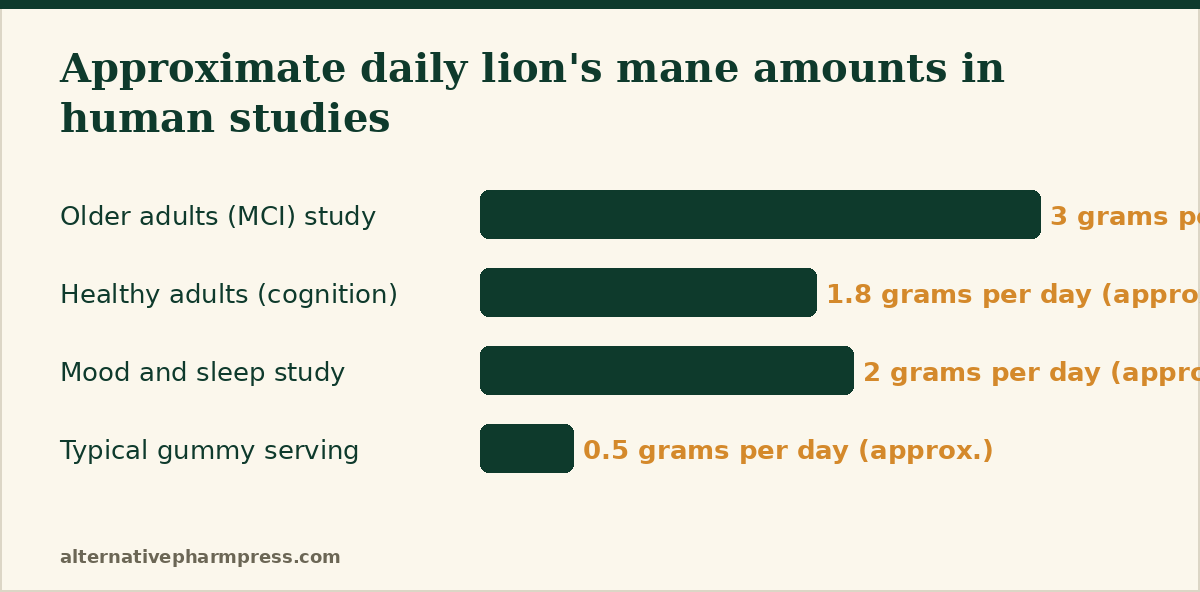
Values are approximate. A frequently cited Japanese trial gave older adults with mild cognitive impairment about 3 grams of fruiting body powder daily for 16 weeks and found improvements on a cognitive scale that faded after stopping. Other small trials in healthy adults and people with mood or sleep complaints used roughly 1–2 grams daily of fruiting body or extract. Results have been mixed, and studies are small. Read what is lion’s mane good for? and lion’s mane 2026 trials.
Fruiting body vs mycelium
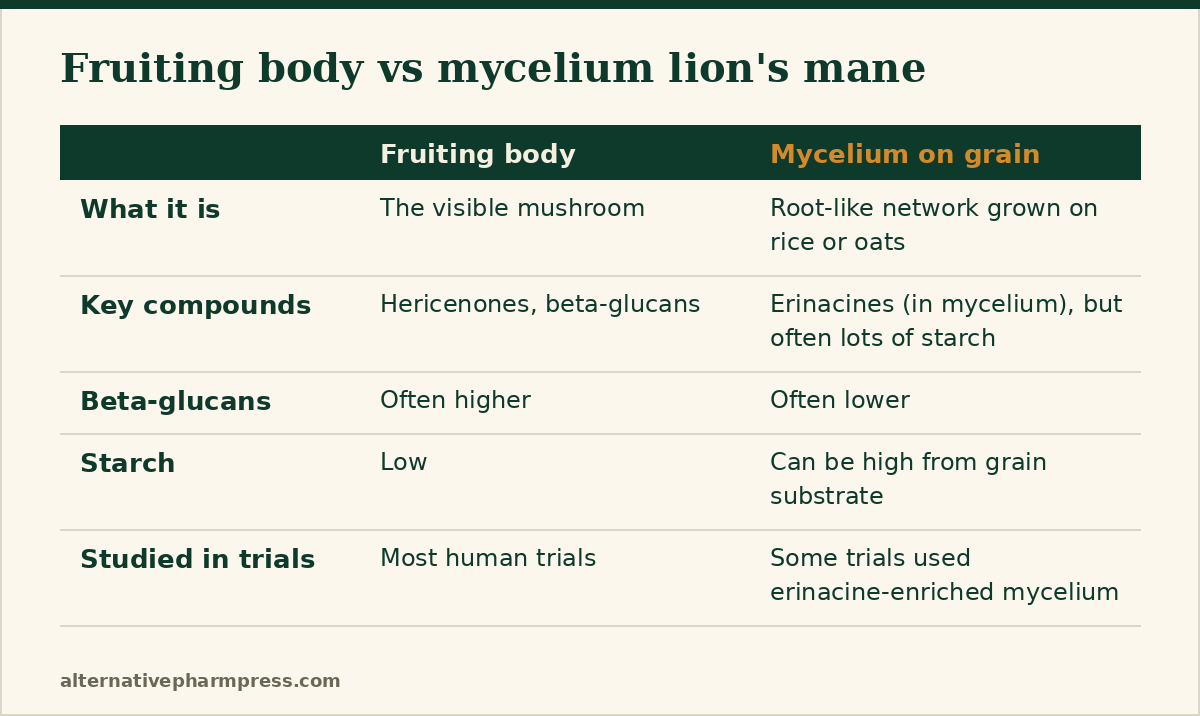
Both forms contain interesting compounds: hericenones are found mainly in the fruiting body, while erinacines are concentrated in mycelium. The problem is that many mycelium products are grown on grain and sold with the grain included, diluting mushroom content. A few trials used specially cultivated, erinacine-enriched mycelium, which differs from typical grain-based products. See functional mushrooms in 2026: label problems.
Understanding extract ratios
An “8:1 extract” means about 8 grams of dried mushroom were used to make 1 gram of extract. In theory, 500 mg of an 8:1 extract represents 4 grams of raw mushroom. In practice, ratios don’t tell you which compounds were retained or lost, and manufacturers calculate them differently. Two products with the same ratio can differ widely in active content.
Beta-glucan percentage is often more informative. A product that lists, for example, “more than 25% beta-glucans” measured by a recognized method (such as the Megazyme assay) gives you something concrete to compare. Products that list only “polysaccharides” may include starch.
How to compare products
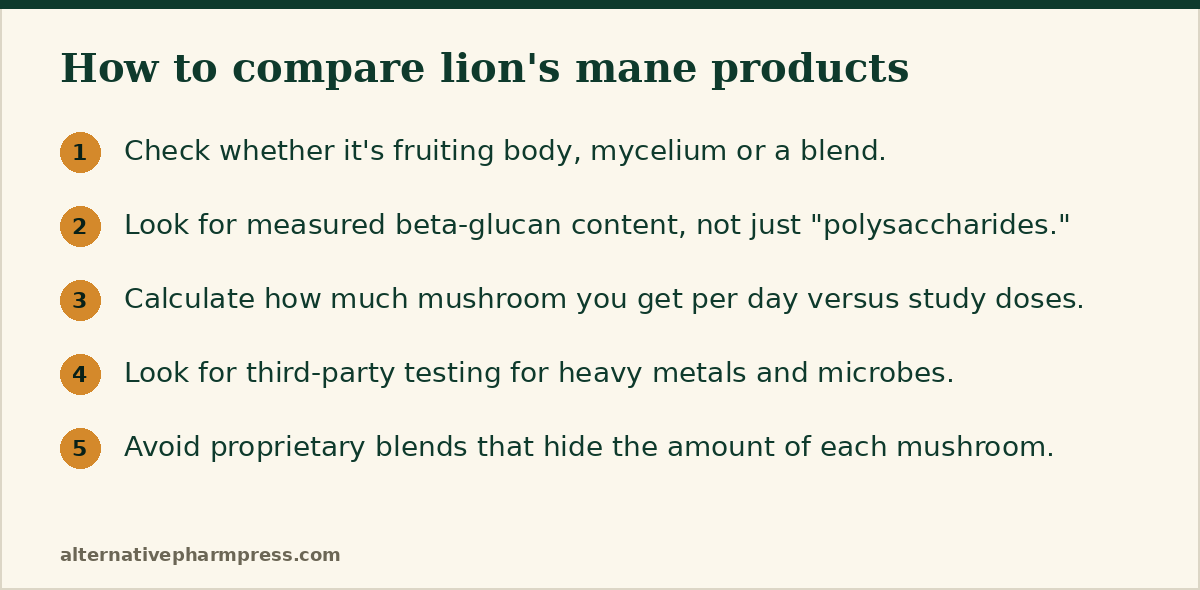
For brand comparisons, see best lion’s mane brands 2026.
Format-by-format dose check
- Capsules: often 500 mg–1 g each; you may need two to four capsules to reach study-level amounts.
- Powders: easy to measure in grams; mix into coffee, tea or smoothies.
- Gummies: frequently 250–500 mg or less per serving; check the label. See do mushroom gummies work?.
- Mushroom coffee: often a few hundred milligrams split across several mushrooms. See mushroom coffee.
- Tinctures: concentrations vary; dual extracts may contain both water- and alcohol-soluble compounds.
- Fresh culinary lion’s mane: delicious, but fresh mushrooms are mostly water, so you’d need a large amount to match dried doses.
Timing and consistency
Studies that found effects generally used lion’s mane daily for several weeks to months. There’s little evidence about the best time of day; many people take it in the morning with food. Consistency matters more than timing. Some people split the daily amount into two doses to reduce stomach upset.
How long before you notice anything?
In trials, effects were typically measured after 8–16 weeks. Some users report subtle changes sooner, but a fair personal trial is at least two months at a consistent, study-level dose. Track something specific — like a memory task, focus during work or mood — before and during use. In the older-adult trial, benefits faded within weeks of stopping, which suggests any effects may depend on continued use.
Side effects and safety
Lion’s mane is generally well tolerated. Reported side effects include:
- Digestive upset — bloating, nausea or loose stools.
- Skin rash or itching — rare allergic reactions.
- Breathing difficulty — very rare reports in people with mushroom allergies.
People with mushroom or mold allergies should be cautious. Lab studies suggest lion’s mane might affect blood clotting and blood sugar, so people on blood thinners or diabetes medications should talk to a clinician. Pregnant or breastfeeding people should avoid supplements due to limited data. Read lion’s mane side effects.
More isn’t always better
Taking much more than studied amounts hasn’t been shown to produce greater benefits and may increase digestive side effects and cost. If 2–3 grams a day for two to three months produces no noticeable change, adding more is unlikely to help.
Combining lion’s mane with other nootropics
Lion’s mane is often stacked with other mushrooms or nootropics such as cordyceps, bacopa or L-theanine. Combining several ingredients makes it hard to know what’s working. If you want to test lion’s mane, try it on its own first. Compare options in bacopa vs lion’s mane, lion’s mane vs cordyceps and reishi vs lion’s mane.
Cost per effective dose
To compare value, calculate the cost of reaching your target daily amount. For example, if a capsule product needs four capsules to reach 2 grams and a bottle holds 120 capsules, it lasts 30 days. Compare that monthly cost with a bulk powder that provides the same amount. Factor in testing and beta-glucan content, not just price.
Lion’s mane for older adults
Older adults are among the most studied groups for lion’s mane, mainly because of interest in mild cognitive impairment. Results are encouraging but preliminary. Lion’s mane shouldn’t replace evaluation for memory problems, which can have treatable causes such as vitamin B12 deficiency, thyroid problems, sleep apnea, medication side effects or depression. Anyone noticing memory changes should see a clinician.
Cooking with lion’s mane
Fresh lion’s mane has a mild, seafood-like flavor and a texture some compare to crab or lobster. It’s delicious sautéed, roasted or used in plant-based dishes. Culinary use is a pleasant way to include it in your diet, though amounts are hard to compare with supplement doses. Cook it thoroughly, and if you forage wild mushrooms, be absolutely certain of identification.
Running a fair personal trial
If you want to find out whether lion’s mane helps you, a simple structure works better than casual use. Pick one goal, such as remembering names, staying focused during long tasks or feeling less mentally foggy in the afternoon. Rate it daily for two weeks before starting. Then take a consistent, study-level amount of a tested fruiting body product every day for eight to twelve weeks, keeping caffeine, sleep and other supplements as steady as you can. Keep rating. Afterward, stop for two to four weeks and see whether anything changes. This won’t rule out placebo, but it gives you much better information than a general impression.
Why results vary so much
Differences in product quality, dose, duration, the person’s age and baseline cognition all affect results. Older adults with mild cognitive concerns may respond differently from healthy young adults who already perform well on cognitive tests. Expectation also plays a role: lion’s mane is heavily promoted online, which can make people more likely to notice improvements. Controlled trials help account for this, and the mixed results suggest effects, if present, are modest.
Storage
Keep powders and capsules sealed in a cool, dry place. Mushroom powders absorb moisture and can clump or spoil. Discard products that smell musty or change color.
FAQ
How much lion’s mane should I take per day?
Human studies commonly used about 1–3 grams daily of fruiting body powder or equivalent extract. Follow product directions and talk to a clinician if you take medications.
Is fruiting body or mycelium lion’s mane better?
Most human trials used fruiting body products. Mycelium grown on grain can be high in starch, though some specialized mycelium extracts have been studied.
What does an 8:1 lion’s mane extract mean?
It means about 8 grams of mushroom were used to make 1 gram of extract. Beta-glucan content is usually a more useful measure.
How long does lion’s mane take to work?
Studies measured effects after 8–16 weeks of daily use.
Can I take too much lion’s mane?
High amounts may cause digestive upset and haven’t shown extra benefits. Stick close to studied amounts.
Are lion’s mane gummies strong enough?
Many contain much less than studied doses. Check the label to see how much you’re getting per day.