
Long before capsules, shots and extracts, kratom leaves were chewed fresh or brewed into tea in Thailand, Malaysia and Indonesia. Farmers and laborers drank it to cope with long, physically demanding workdays. Today, kratom tea remains popular with people who dislike the gritty texture of powder, and it’s served in kava and kratom bars across the U.S.
This guide covers traditional preparation, what brewing does to kratom’s alkaloids, how tea compares with other formats, modern variations, safety considerations and the legal landscape.
Key takeaways
- Kratom tea is made by steeping or simmering kratom leaf or powder in hot water, then straining.
- Kratom’s main alkaloid, mitragynine, is fairly stable in hot water for normal brewing times, though very long boiling may degrade some alkaloids.
- Adding an acid like lemon juice is a common practice, though evidence it greatly improves extraction is limited.
- Tea may feel gentler and faster for some people than swallowing powder, but strength varies widely.
- Kratom tea carries the same dependence, interaction and liver risks as other kratom forms.
Traditional kratom use in Southeast Asia
In rural Thailand and Malaysia, kratom (Mitragyna speciosa, called ketum or biak) was traditionally used in small amounts. Workers would chew a few fresh leaves or drink a weak tea to fight fatigue, ease aches and endure heat. Kratom was also used in social settings and in folk medicine for diarrhea, coughs and pain. In some areas, modern drinks called “4×100” mix boiled kratom with soda and other substances, raising public health concerns. For an overview, read what kratom is used for.
How kratom tea is made
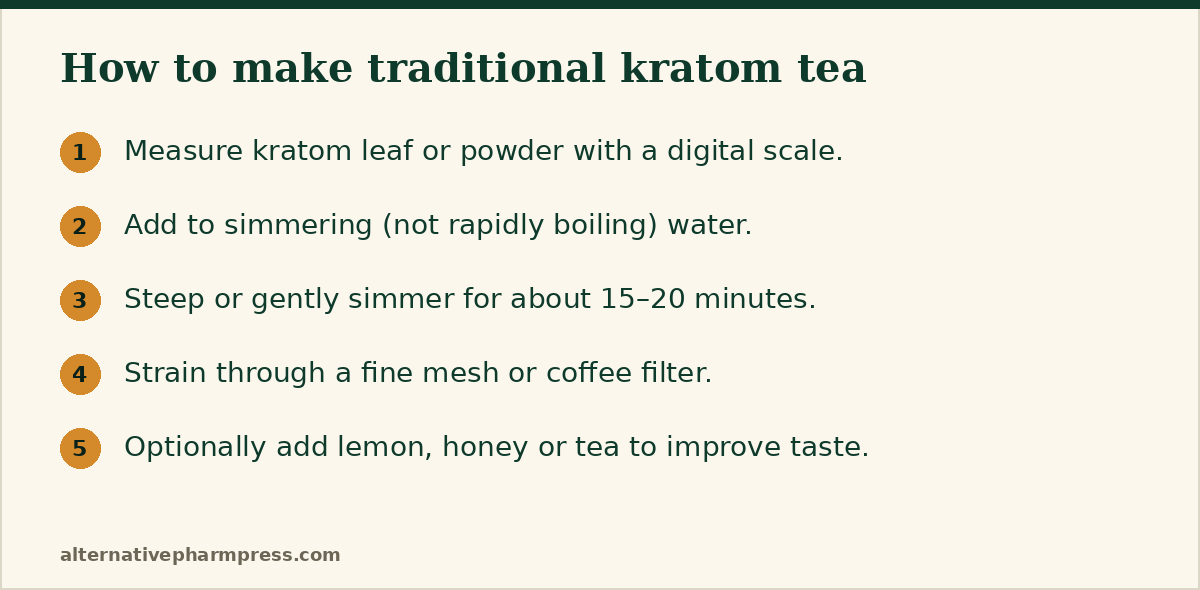
Many people add lemon or lime juice before simmering, based on the idea that acidity helps release alkaloids. Some also mix kratom tea with green or black tea to soften the bitterness. Because kratom’s taste is bitter and earthy, honey, ginger or flavored teas are common additions.
Does brewing affect potency?
Mitragynine dissolves reasonably well in hot water. Studies of kratom alkaloid stability have found mitragynine fairly stable under normal brewing temperatures and times, though prolonged high heat or strongly acidic conditions over long periods may degrade some alkaloids. In practice, steeping for 15–20 minutes is common. Leftover sludge can still contain alkaloids, so some people steep a second time.
Because brewing extracts only part of what’s in the leaf, tea strength depends on:
- How much kratom you use.
- Water temperature and steep time.
- Leaf vs fine powder — powder releases alkaloids faster.
- Whether you consume the sediment.
- The batch’s alkaloid content — which varies widely. See kratom strains explained.
Kratom tea vs powder vs capsules
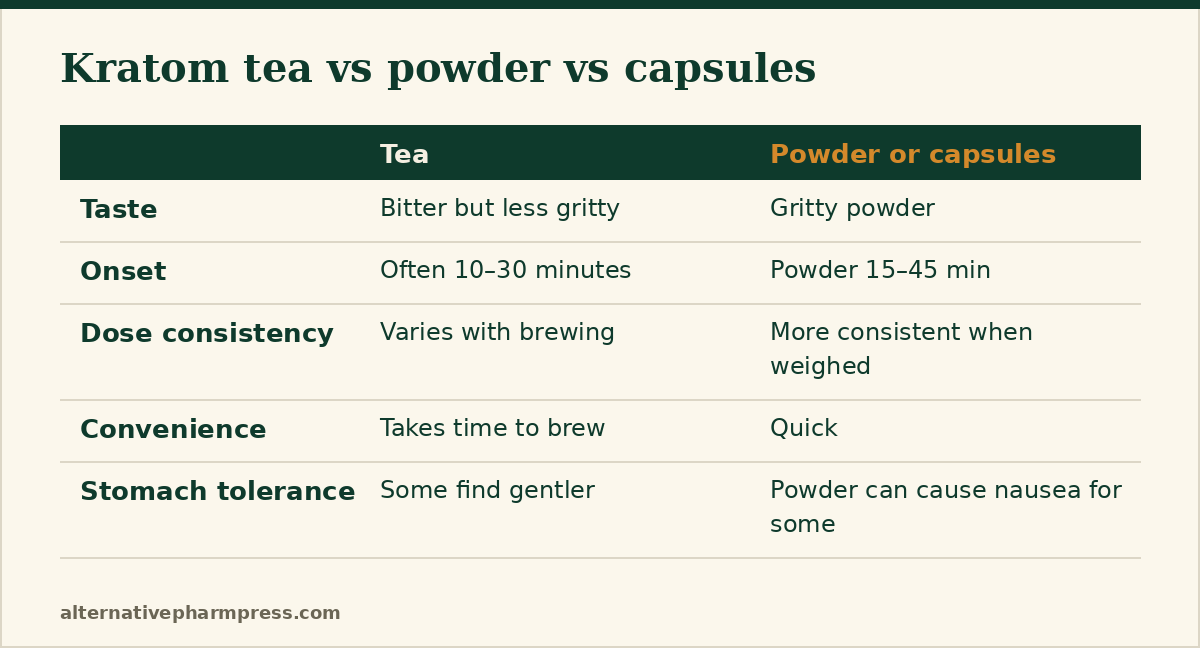
Learn more in kratom powder guide, kratom capsules guide and kratom capsules vs powder.
Modern variations
Kratom tea bags
Pre-portioned kratom tea bags offer convenience but can make it harder to know how much kratom you’re consuming. Check the grams per bag and the batch COA.
Cold brew and iced kratom
Some people make cold-brewed kratom or iced kratom tea by steeping in the fridge for hours or by chilling a hot brew. Extraction in cold water is slower.
Kratom bars and ready-to-drink beverages
Kava and kratom bars often serve kratom tea mixed with juices or sodas. Ready-to-drink kratom beverages and shots are also common, and some contain extracts or 7-OH, making them much stronger than traditional tea. Read kratom drinks and kava vs kratom.
Effects and duration
Kratom effects depend on dose. Many users describe lower amounts as stimulating and higher amounts as sedating and opioid-like. Tea effects often begin within 10–30 minutes and may last two to five hours. Because tea strength varies, it’s easy to under- or over-estimate how much you’ve taken.
Safety considerations
- Dependence and withdrawal — daily use can lead to physical dependence. See kratom withdrawal and kratom detox.
- Drug interactions — avoid combining with alcohol, benzodiazepines, gabapentin or opioids. See kratom and alcohol.
- Liver injury — rare but reported. See kratom liver injury.
- Caffeine combinations — mixing kratom with strong tea or coffee can increase heart rate and jitteriness. See kratom and caffeine.
- Contamination — choose lab-tested products. See how to read a kratom lab report.
- Pregnancy and breastfeeding — avoid.
Tips for a more consistent brew
- Weigh the kratom rather than using spoons.
- Use the same steep time and temperature each time.
- Keep the same product and batch to reduce variability.
- Label any stored tea with the amount of kratom used.
- Refrigerate leftovers and use within a few days.
- Don’t brew large batches you might drink without tracking amounts.
Legal status
Kratom’s legal status varies by state and locality. Some states ban it; others regulate it under Kratom Consumer Protection Acts. Federal agencies have taken action on 7-OH, and rules continue to change. See kratom laws by state, kratom states banned 2026 and KCPA explained.
Kratom tea in research
Much of the research on traditional kratom use comes from surveys of people in Malaysia and Thailand who drink kratom tea daily. These studies describe patterns of use, dependence and withdrawal, and some note that long-term users often consume multiple glasses per day. Some research has found that regular users report dependence and withdrawal, while health effects from traditional use appear less severe than with many other opioids. However, traditional tea differs from modern concentrated products, and findings don’t necessarily apply to extracts or 7-OH.
Common mistakes with kratom tea
- Assuming tea is weaker — a strong brew can be just as potent as powder.
- Drinking multiple cups quickly — effects can stack.
- Adding kratom to energy drinks — increases stimulant effects.
- Combining with alcohol — dangerous interaction.
- Leaving tea unlabeled in the fridge — others may drink it.
Storage
Store dry kratom leaf or powder in an airtight, opaque container in a cool, dry place. Brewed tea should be refrigerated and used within a few days. Discard tea that smells off or develops mold.
Who should avoid kratom tea
Kratom isn’t appropriate for everyone. People who are pregnant or breastfeeding, have liver disease, a history of substance use disorder, heart conditions or a seizure disorder, or take medications that interact with kratom should avoid it. Anyone under 21 should not use kratom, and many states set a minimum age of 18 or 21 for purchase. If you’re considering kratom to manage pain, anxiety or opioid withdrawal, talk to a healthcare provider about safer, evidence-based options first.
Is kratom tea “more natural”?
Brewing kratom can feel more traditional and natural than taking pressed tablets or shots, and in a sense it is closer to how the plant was historically used. But natural doesn’t automatically mean safe. Kratom leaf still acts on opioid receptors, can cause dependence and interacts with other substances. What makes traditional use different is usually the amount and pattern: small, spaced-out servings rather than frequent large doses or concentrated extracts.
Fresh leaves vs dried powder
In Southeast Asia, many traditional users chewed fresh kratom leaves, removing the tough central vein first. Fresh leaves aren’t widely available outside growing regions, so most tea outside Asia is brewed from dried, crushed leaf or fine powder. Crushed leaf is easier to strain and produces a clearer tea; fine powder releases alkaloids faster but leaves more sediment. Some people prefer crushed leaf specifically because it makes the drink more pleasant and the amount steeped easier to estimate.
Flavor tips
Kratom tea is famously bitter. Common ways to improve the taste include:
- Brewing with ginger, cinnamon or mint.
- Adding honey, agave or a little sugar.
- Mixing with citrus juice once it has cooled slightly.
- Combining with chamomile or rooibos, which add flavor without caffeine.
Avoid mixing kratom tea with alcohol or highly caffeinated drinks, which can create unsafe combinations.
FAQ
How do you make kratom tea?
Simmer measured kratom leaf or powder in hot water for about 15–20 minutes, strain and optionally add lemon or honey.
Is kratom tea stronger than powder?
Not necessarily. It depends on how much kratom you use and how it’s brewed. Strong tea can be just as potent as powder.
Does lemon juice make kratom tea stronger?
It’s a common practice, but evidence that it significantly improves alkaloid extraction is limited.
How long does kratom tea last?
Effects typically last two to five hours. Brewed tea can be refrigerated for a few days.
Is kratom tea safe?
It carries the same risks as other kratom forms, including dependence, interactions and rare liver injury. Avoid combining it with alcohol or other depressants.
Can I make kratom tea with capsules?
You can open capsules and brew the powder, but it’s simpler to use bulk powder or leaf so you can weigh the amount accurately.