
Concentrated 7-hydroxymitragynine (7-OH) tablets, shots and gummies have spread rapidly through gas stations, smoke shops and online stores. People often search for a 7-OH dosage chart, hoping to find a safe amount. The difficult truth is that there’s no established safe dose — and several features of these products make dosing especially risky.
This article doesn’t provide dosing instructions. Instead, it explains why 7-OH is hard to dose, what factors increase danger, and what harm-reduction steps can lower risk for people who use it.
Key takeaways
- 7-OH is a potent mu-opioid receptor agonist, far more potent than mitragynine, kratom’s main alkaloid.
- There are no clinical studies establishing a safe or effective dose of 7-OH in humans.
- Product labels may be inaccurate, and potency can vary between batches and brands.
- Tolerance builds quickly, leading people to escalate — and to be at high risk after a break.
- Combining 7-OH with alcohol, benzodiazepines, gabapentin or opioids greatly increases overdose risk.
If someone is unresponsive, breathing slowly or has blue lips, call 911 immediately and give naloxone if available. In the U.S., Poison Control is 1-800-222-1222. See does naloxone reverse 7-OH?.
Why 7-OH is different from kratom leaf
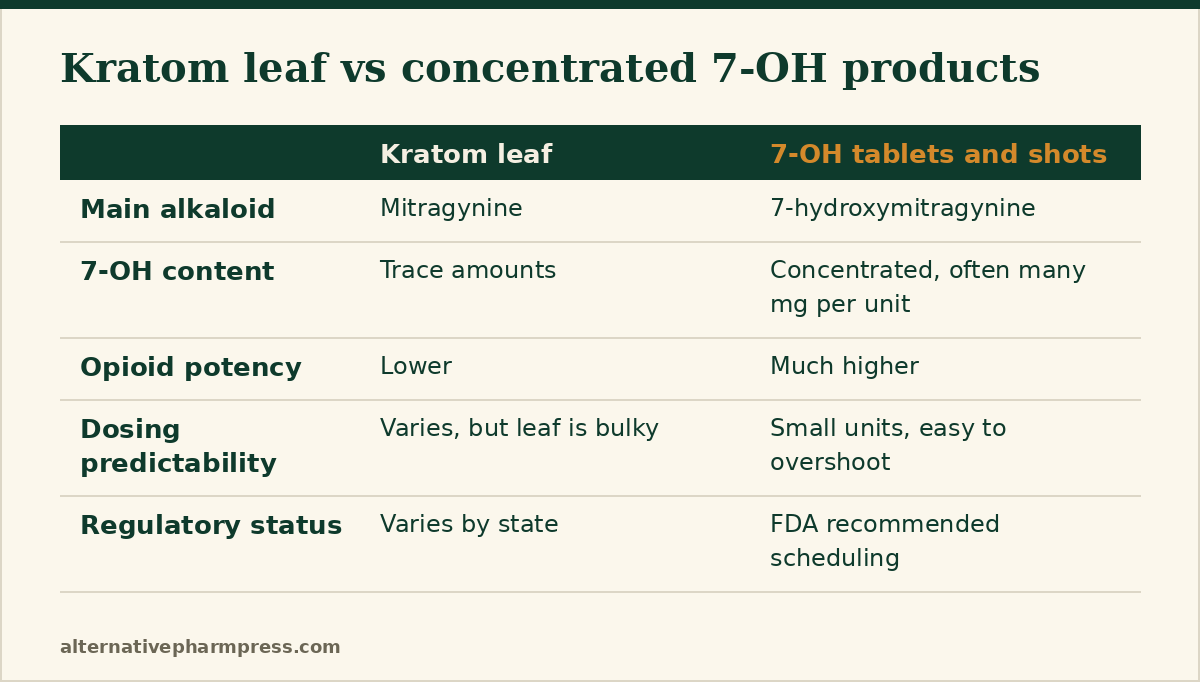
Kratom leaf naturally contains only trace amounts of 7-OH — often well under 2% of total alkaloids. Concentrated 7-OH products are made by converting mitragynine into 7-OH or concentrating it, then pressing it into tablets or mixing it into drinks. A single tablet may contain far more 7-OH than a large serving of leaf. For background, read what is 7-OH and 7-OH vs traditional kratom.
Why there’s no safe dose chart
No human dosing research
There are no clinical trials establishing safe or effective 7-OH doses in people. What’s known comes from animal studies, lab pharmacology, case reports and user anecdotes. Animal studies show 7-OH can produce strong opioid effects and dependence.
Labels may be wrong
Independent testing of kratom and 7-OH products has found that labeled amounts don’t always match actual content. A tablet labeled at one strength might contain more or less. Some products contain other alkaloids or substances not listed. Read how to read a kratom lab report and kratom COA red flags.
Individual variation
People metabolize 7-OH differently. Body size, liver function, genetics, other medications and prior opioid exposure all influence effects. A dose one person tolerates could cause serious problems for another.
Tolerance and escalation
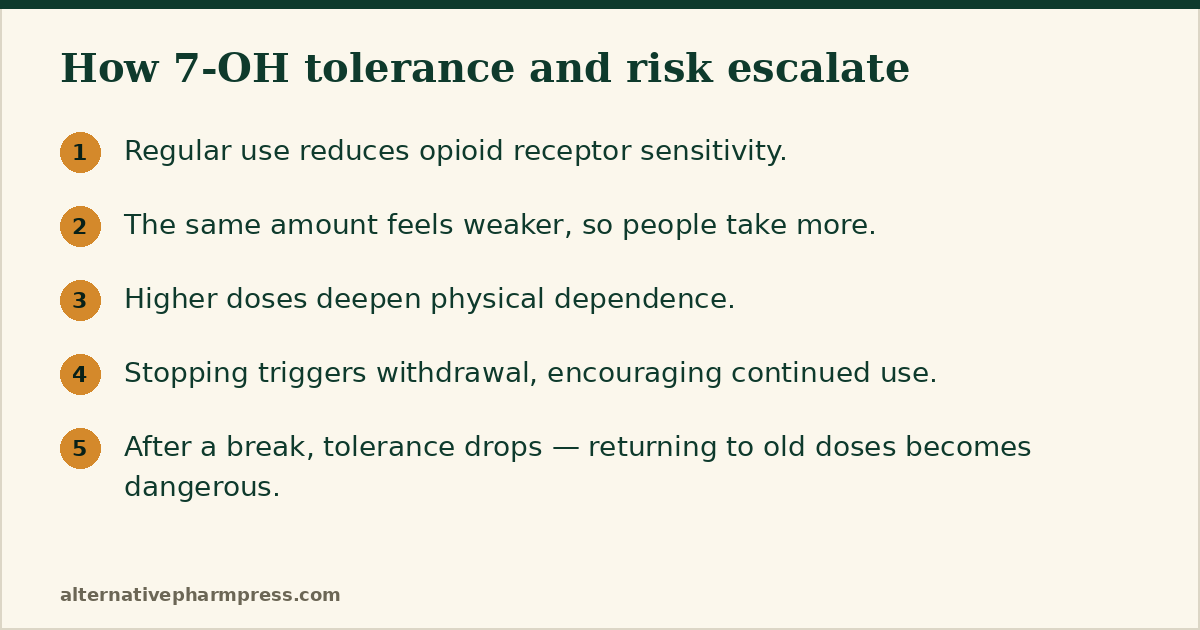
Tolerance to 7-OH appears to develop quickly. Many users report escalating from one unit to several within weeks. This cycle increases dependence and withdrawal severity. It also creates a dangerous situation after abstinence: tolerance falls, but people may return to their previous amount. Read 7-OH tolerance.
Overdose risk factors
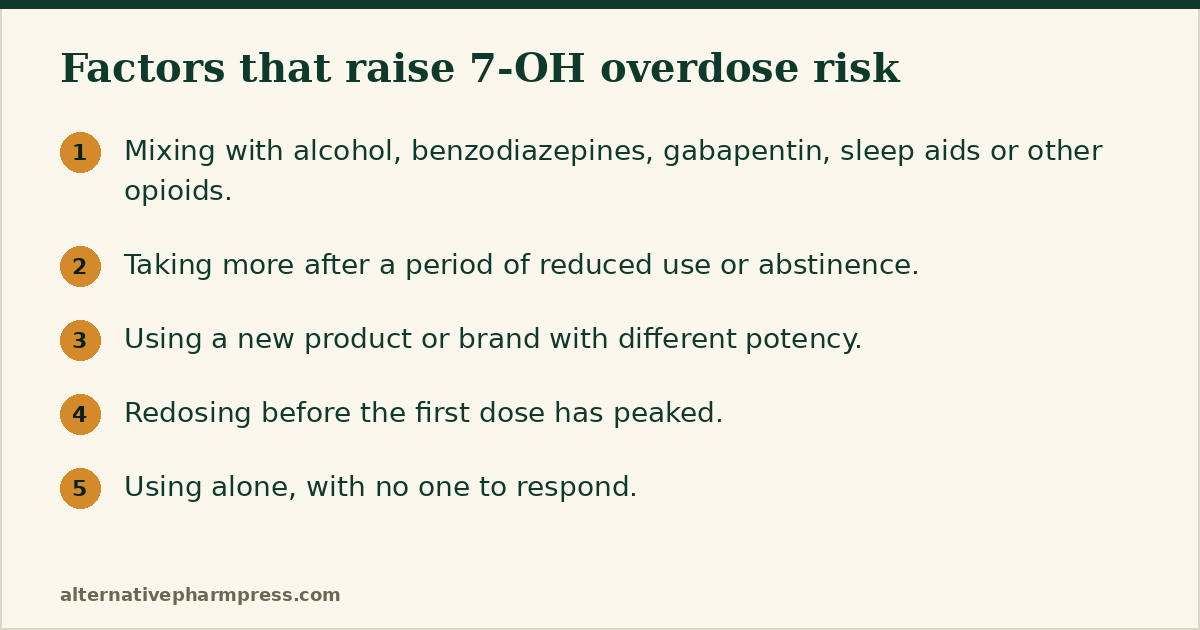
Research suggests 7-OH might cause less respiratory depression than classic opioids at equivalent doses due to signaling differences, but this hasn’t been confirmed in humans and doesn’t eliminate risk. Deaths and serious poisonings involving 7-OH products have been reported, often with other substances. See can you overdose on kratom?.
Dependence and withdrawal
Daily 7-OH use can lead to dependence that resembles opioid dependence. Withdrawal symptoms include muscle aches, restlessness, sweating, diarrhea, insomnia, anxiety and strong cravings. Many people find 7-OH withdrawal more intense than kratom leaf withdrawal. Read 7-OH withdrawal and kratom detox.
Harm-reduction steps
For people who choose to use 7-OH despite the risks, harm-reduction approaches can reduce danger:
- Don’t mix with depressants — alcohol, benzodiazepines, gabapentin, pregabalin, sleep aids or other opioids.
- Avoid redosing quickly — effects can take time to peak.
- Be extra careful with a new product or after any break from use.
- Don’t use alone — or use a never-use-alone hotline where available.
- Carry naloxone and make sure people around you know how to use it.
- Keep products away from children and pets — accidental ingestion can be dangerous.
- Seek lab-tested products, while recognizing that testing doesn’t make 7-OH safe.
- Consider tapering or treatment if use becomes daily.
Signs you should seek help
- Using more than intended or more often.
- Cravings or difficulty cutting back.
- Withdrawal when you miss a dose.
- Spending significant money or time on 7-OH.
- Using despite problems at work, home or with health.
Effective treatment exists. Medications used for opioid use disorder, such as buprenorphine, have been used for kratom and 7-OH dependence. See Suboxone for kratom withdrawal. In the U.S., the SAMHSA National Helpline (1-800-662-4357) provides free, confidential referrals.
Regulatory status
The FDA has warned about concentrated 7-OH products and recommended that 7-OH be scheduled under the Controlled Substances Act. Several states have banned or restricted 7-OH products. See where DEA scheduling stands and FDA 7-OH scheduling news.
Why tablets and gummies feel deceptively simple
A single tablet or gummy looks like a clear, fixed dose — much like a pill from a pharmacy. That impression can be misleading. Pharmaceutical tablets are manufactured under strict controls that ensure each one contains the labeled amount. 7-OH products aren’t held to those standards, and some brands’ tablets have tested well above or below their labels. Splitting tablets doesn’t fix the problem, since the active ingredient may not be evenly distributed. Gummies and shots add more variability, because 7-OH may be unevenly mixed.
Detection and drug tests
Standard drug panels don’t usually detect 7-OH, but specialized tests can. Some workplace, legal and treatment programs use expanded panels that include kratom alkaloids. See how long 7-OH stays in your system.
Comparing 7-OH formats
Different formats add their own risks. Tablets are compact and easy to take in multiples. Shots and drinks may contain several servings in one bottle. Gummies can be mistaken for candy by children. Vapes deliver 7-OH quickly, which can make effects more intense. Read 7-OH gummies vs tablets, 7-OH tablets guide and 7-OH vapes.
Talking to a doctor about 7-OH
Many people avoid telling clinicians about kratom or 7-OH use, worried about judgment. Honest disclosure helps a doctor check for drug interactions, recognize withdrawal or liver problems and offer treatment options. If you’re using 7-OH to manage pain, anxiety or opioid withdrawal, a clinician can discuss safer, evidence-based alternatives.
Why redosing is especially risky
Oral 7-OH products may take time to reach peak effect, and food in the stomach can delay absorption further. A common pattern in poisoning reports is someone taking a dose, feeling little after a short time, and taking more — only for both doses to peak together. Waiting longer before deciding whether to take more is one of the most important ways to avoid accidental overdose with any oral opioid-like product.
Special risks for people with opioid history
People who previously used prescription opioids or heroin and turned to 7-OH as a substitute face particular risks. Some switch believing 7-OH is a “natural” or safer option; others use it to manage withdrawal. Tolerance from past opioid use may make 7-OH feel weaker at first, encouraging high doses. If someone has also stopped other opioids recently, their tolerance may be lower than they think. Mixing 7-OH with leftover prescription pills or illicit opioids — which may contain fentanyl — sharply increases overdose danger. Evidence-based treatment such as buprenorphine or methadone is generally far safer than self-managing with unregulated 7-OH.
Children, pets and accidental exposure
Poison centers have reported cases of children and pets ingesting kratom and 7-OH products. Gummies, flavored shots and small tablets can look like candy or medicine. Symptoms in children can include drowsiness, vomiting, slowed breathing and seizures. Keep products in locked, child-resistant containers out of sight, and call Poison Control or emergency services immediately if a child or pet may have swallowed any amount.
What “lab tested” does and doesn’t mean
A lab report can confirm what a specific batch contained at the time of testing. It can’t make a potent opioid-like product safe, guarantee that every tablet in a bottle is identical or protect against interactions with other substances. Use COAs to avoid mislabeled or contaminated products, but don’t treat them as a safety guarantee. Make sure the report is from an accredited independent lab, matches the batch number on your package and lists 7-OH content in milligrams per unit.
Tapering off 7-OH
Because 7-OH withdrawal can be intense, many people find abrupt stopping very difficult. A medically supervised taper or a transition to buprenorphine is often more successful than trying to cut back alone. If you do taper, make reductions small and gradual, avoid switching between products with different potencies and tell someone you trust about your plan. Withdrawal symptoms are uncomfortable but usually not life-threatening for healthy adults; severe depression, dehydration or thoughts of self-harm need urgent attention.
FAQ
What is a safe dose of 7-OH?
There’s no established safe dose. Human dosing research is lacking, labels may be inaccurate and individual responses vary widely.
Is 7-OH stronger than kratom?
Yes. Concentrated 7-OH products are much more potent opioid agonists than kratom leaf, which contains only trace 7-OH.
Can you overdose on 7-OH?
Yes. Serious poisonings and deaths have been reported, especially when 7-OH is combined with other depressants.
Why do people take more 7-OH over time?
Tolerance develops quickly, so the same amount feels weaker. Escalating doses increase dependence and risk.
What should I do if someone takes too much 7-OH?
Call 911, give naloxone if available, support breathing and stay with them until help arrives.
Can I get help quitting 7-OH?
Yes. Medications such as buprenorphine, counseling and support programs can help. In the U.S., call SAMHSA at 1-800-662-4357.