
7-OH first spread as tablets, then gummies and shots. Now it’s being sold as vapes — disposable pens and cartridges containing 7-hydroxymitragynine. To some buyers they look like just another vape. To toxicologists and addiction specialists, they’re a worrying development.
This guide explains what 7-OH vapes are, why inhaling a potent opioid receptor agonist changes the risk profile, what’s in the devices and how regulators are responding.
Key takeaways
- 7-OH vapes deliver 7-hydroxymitragynine, a potent mu-opioid agonist derived from kratom, through the lungs.
- Inhalation produces faster onset and sharper peaks, which tends to increase reinforcement, compulsive use and dependence.
- There’s almost no research on inhaled 7-OH — on dosing, lung safety or the chemicals produced by heating it.
- Vapes make it easy to take many doses quickly, without a clear sense of total intake.
- 7-OH is banned or restricted in many states, and federal scheduling has been recommended.
What is 7-OH?
7-hydroxymitragynine is an alkaloid found in trace amounts in kratom leaves and produced in the body from mitragynine. Concentrated 7-OH — usually made by chemically converting mitragynine — is many times more potent at opioid receptors than kratom leaf. Read the full background in what is 7-OH and 7-OH tablets explained.
Why the route of use matters
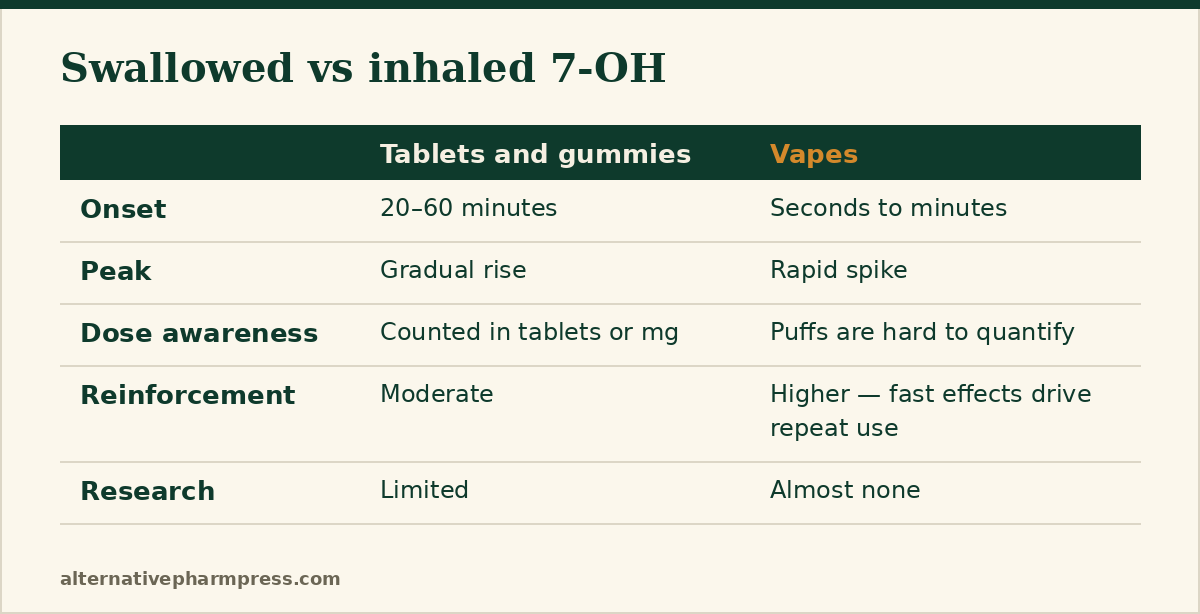
In addiction science, a well-established principle is that faster delivery to the brain tends to increase a drug’s addictive potential. Smoked or vaped substances reach the brain within seconds, producing a sharp peak that reinforces repeated use. That’s part of why smoked cocaine and nicotine vapes are particularly hard to quit compared with slower forms.
Applied to 7-OH, inhalation could:
- Intensify euphoria and reinforcement, encouraging frequent “hits.”
- Shorten the time between doses, as effects fade faster than with tablets.
- Accelerate tolerance and dependence.
These are reasonable inferences from pharmacology, but there’s no direct research on 7-OH vaping to confirm or quantify them.
The “puff problem”: unknown doses
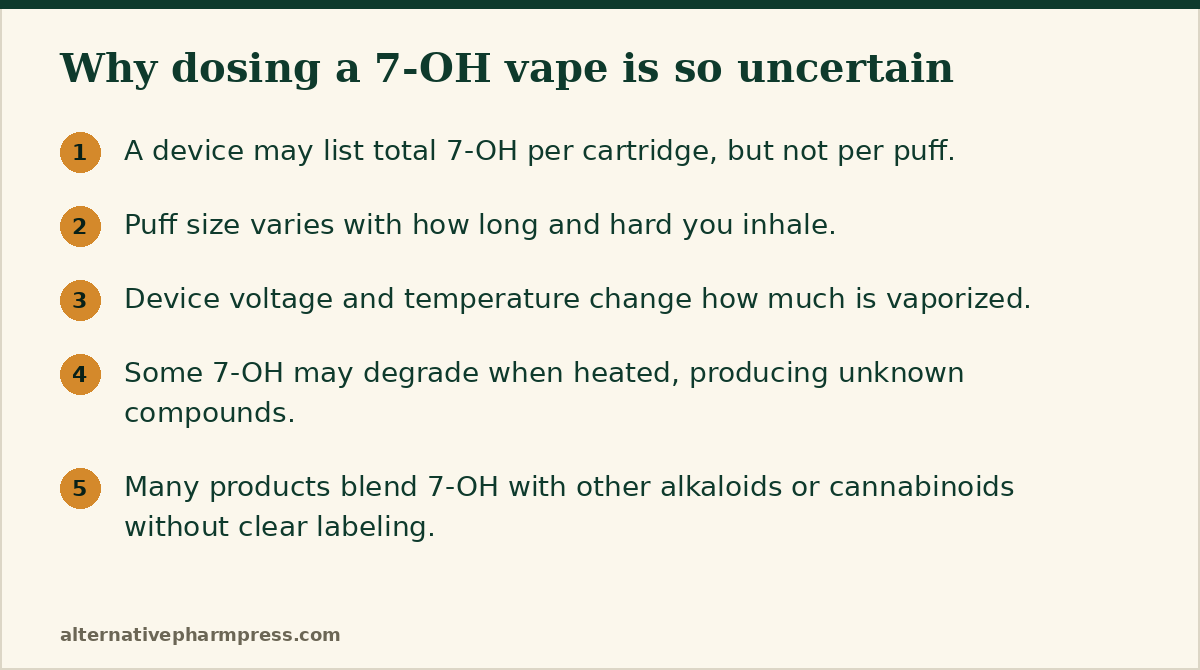
With tablets, you can count. With vapes, it’s very difficult to know how much you’ve taken, which raises the risk of accidental overconsumption — especially when combined with alcohol or sedatives.
What’s in a 7-OH vape?
Contents vary and are often poorly disclosed:
- 7-OH — sometimes with mitragynine or other kratom alkaloids
- Carrier liquids — such as propylene glycol, vegetable glycerin or other solvents
- Flavorings — many not tested for inhalation safety
- Other actives — some products blend kratom alkaloids with cannabinoids
Vape hardware also matters. Low-quality devices can leach metals into the liquid, and overheated carriers can produce irritants. Our delta-8 carts safety guide explains hardware and cutting-agent risks that apply to any vape.
Health risks
- Dependence and withdrawal: opioid-like withdrawal — anxiety, sweating, aches, diarrhea, insomnia and cravings — after regular use. See 7-OH withdrawal.
- Respiratory depression: high doses, especially with other depressants, can slow breathing.
- Lung effects: unknown. Inhaling heated alkaloids, solvents and flavorings may irritate the airways.
- Interactions: dangerous with alcohol, benzodiazepines, gabapentin, pregabalin, sleep aids and other opioids.
- Youth exposure: vapes are popular with teenagers, and 7-OH vapes may be sold without strict age verification.
Emergency: If someone is very drowsy, unresponsive or breathing slowly after using a 7-OH vape, call 911. Give naloxone (Narcan) if available — it’s sold over the counter in the US.
Legal status
7-OH is under intense regulatory scrutiny. In 2025, the FDA recommended scheduling 7-OH under the Controlled Substances Act and warned companies selling it. Several states have banned or restricted 7-OH, often limiting it to natural trace levels in kratom products, and some localities have removed products from shelves. Vape-specific rules (such as flavored-vape bans) may also apply. See 7-OH scheduling update, FDA 7-OH news and kratom laws by state.
How 7-OH vapes compare with kratom leaf
The gap between a 7-OH vape and traditional kratom is enormous. Kratom leaf contains mostly mitragynine with trace 7-OH, is swallowed, and acts gradually. A 7-OH vape delivers a concentrated potent agonist to the brain within seconds. Treating them as the same product is a serious mistake. See 7-OH vs traditional kratom and mitragynine vs 7-hydroxymitragynine.
If you use 7-OH and want to stop
Withdrawal from 7-OH can be intense, and quitting alone is hard. Effective options exist:
- Talk to a clinician — many now treat 7-OH dependence like other opioid dependence.
- Medications such as buprenorphine can ease withdrawal and support recovery. Read about buprenorphine-based treatment.
- Support — the SAMHSA National Helpline (1-800-662-4357) is free, confidential and available 24/7.
Advice for parents
If you find a vape with “7-OH,” “7-hydroxy” or kratom branding, treat it as a potentially serious opioid exposure risk rather than “just a vape.” Watch for signs such as pinpoint pupils, unusual drowsiness, itching, constipation and withdrawal symptoms when the device runs out. Keep naloxone at home, and talk openly with your teen about what the product is.
Why regulators are especially concerned about vapes
Public health agencies have been grappling with youth vaping for years, and 7-OH vapes combine two concerns: a format that’s popular with young people and a potent opioid-receptor agonist. Several features make regulators particularly wary:
- Discreet use. Vapes are easy to hide and use frequently throughout the day.
- Flavors. Sweet and fruity flavors appeal to younger users.
- Retail access. Smoke shops and convenience stores may not consistently check IDs.
- Lack of data. No studies have assessed the safety of inhaling 7-OH, its breakdown products or its carrier liquids.
These factors are a large part of why some states and cities have moved quickly against 7-OH products in general and vapes in particular.
Harm reduction if someone uses 7-OH vapes anyway
We don’t recommend 7-OH in any form. For people who use it regardless, harm-reduction steps include: never using alone, keeping naloxone on hand, avoiding alcohol and sedatives, taking long breaks between puffs to judge effects, using the lowest-strength product available and tracking use honestly. If use becomes daily, talk to a clinician before trying to stop abruptly.
Lessons from other inhaled drugs
History offers several warnings about what happens when a substance moves to an inhaled format:
- Nicotine: the shift from cigarettes to high-nicotine salt vapes made frequent, discreet dosing easy and contributed to rapid uptake among teenagers.
- Cocaine: smoked forms produced far higher rates of compulsive use than snorted powder because of the fast, intense peak.
- Opioids: smoking heroin or fentanyl delivers rapid effects and frequent redosing, contributing to dependence and overdose.
- Synthetic cannabinoids: sprayed onto plant material and smoked, they caused unpredictable, sometimes severe poisonings.
The common thread is that inhalation shortens the loop between taking a substance and feeling its effects. That loop is what drives habit formation. With 7-OH, which is already potent and dependence-forming, a vape format is likely to strengthen that loop further.
What researchers would need to study
To understand 7-OH vapes properly, scientists would need to measure how much 7-OH is delivered per puff at different device settings, what compounds form when 7-OH and carrier liquids are heated, how quickly blood levels rise compared with tablets, and how these factors relate to dependence and breathing effects. None of this has been published. Until it is, every 7-OH vape is effectively an uncontrolled experiment on its user.
Signs of escalating use
Watch for patterns such as carrying the vape everywhere, using it within minutes of waking, needing more puffs for the same effect, feeling anxious or sick when it runs out, and spending more than planned. These are signs of dependence and worth discussing with a clinician.
FAQ
What is a 7-OH vape?
It’s a vape pen or cartridge containing 7-hydroxymitragynine, a potent kratom-derived opioid receptor agonist, designed to be inhaled.
Are 7-OH vapes more addictive than tablets?
Likely. Inhaled drugs reach the brain faster, which generally increases reinforcement and dependence risk, though 7-OH vaping hasn’t been studied directly.
Are 7-OH vapes safe for the lungs?
Their lung safety is unknown. Heated alkaloids, solvents and flavorings may irritate the airways.
Can you overdose on a 7-OH vape?
Yes, high doses — particularly with alcohol or sedatives — can cause dangerous sedation and slowed breathing. Call 911 in an emergency.
Are 7-OH vapes legal?
It depends on location. Many states ban or restrict 7-OH, and federal scheduling has been recommended.
Do 7-OH vapes show up on drug tests?
Standard panels usually don’t test for 7-OH, but expanded and specialized panels can detect it, and testing is becoming more common.
Is a 7-OH vape the same as a kratom vape?
Not usually. “Kratom vapes” often contain concentrated or converted alkaloids rather than anything resembling leaf. Check the alkaloid breakdown on the lab report.