
As concentrated 7-hydroxymitragynine (7-OH) products spread through gas stations and smoke shops, more people are asking a practical safety question: if someone takes too much, will naloxone (Narcan) help? The short answer is that naloxone is expected to work against 7-OH’s opioid effects, and poison centers advise giving it to anyone with signs of opioid overdose — but there are important caveats.
This guide explains how 7-OH interacts with opioid receptors, what the evidence says about naloxone, why mixed-substance use complicates the picture, the warning signs of overdose and exactly what to do in an emergency.
Key takeaways
- 7-OH is a potent partial agonist at mu-opioid receptors, the same receptors targeted by morphine and fentanyl.
- Naloxone blocks mu-opioid receptors, so it is expected to reverse 7-OH-related breathing depression, and case reports describe responses.
- Poison centers and public health agencies advise: if someone shows opioid overdose signs, give naloxone and call 911.
- Overdoses often involve other substances (alcohol, benzodiazepines, gabapentin, fentanyl), which naloxone may not fully reverse.
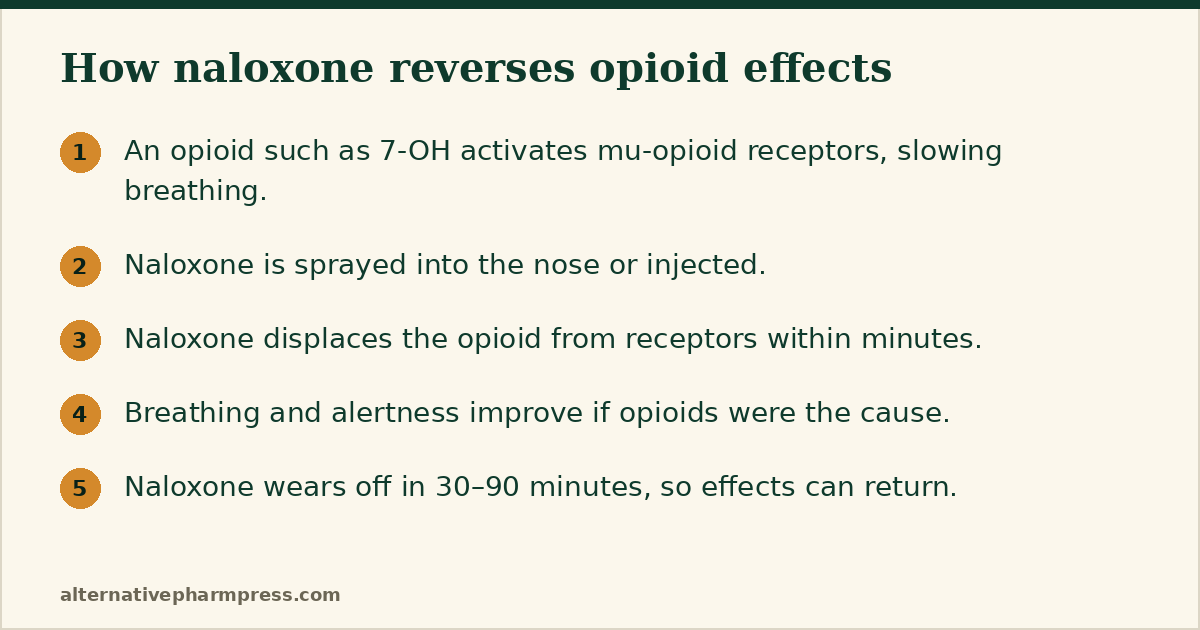
- Naloxone wears off in 30–90 minutes; the person needs medical observation even if they wake up.
Emergency first: If someone is unresponsive, breathing slowly or not at all, or has blue lips, call 911 (or your local emergency number) now, give naloxone if available, and start rescue breathing or CPR if trained. In the U.S., Poison Control is 1-800-222-1222.
How 7-OH acts on the body
7-OH is a minor alkaloid in kratom leaf and a metabolite of mitragynine, kratom’s main alkaloid. Laboratory studies show 7-OH binds mu-opioid receptors with much higher potency than mitragynine — in some assays, more potently than morphine. Modern “7-OH” tablets, shots and gummies concentrate this compound far beyond what’s found in leaf. For background, see what is 7-OH and mitragynine vs 7-hydroxymitragynine.
Research suggests 7-OH may be “G-protein biased,” meaning it could cause less respiratory depression than classic opioids at equivalent doses. However, this finding comes largely from cell and animal studies, and bias doesn’t mean zero risk. At high doses, or combined with other depressants, breathing can still slow dangerously.
How naloxone works
Naloxone is an opioid receptor antagonist. It binds mu-opioid receptors more tightly than most opioids and displaces them, temporarily blocking their effects. It’s available as a nasal spray (Narcan and generics), an injection and an auto-injector, and is sold over the counter in the U.S.
Does naloxone reverse 7-OH? The evidence
Pharmacology
Because 7-OH’s opioid effects run through mu-opioid receptors, naloxone is expected to block them. Animal studies have shown naloxone can blunt 7-OH’s pain-relieving and other opioid-like effects, consistent with this mechanism.
Case reports
Published reports of kratom-related toxicity describe patients with depressed breathing or consciousness who improved after naloxone, though responses have been variable. Some patients needed repeat doses; others responded only partially, often because other substances were involved. As concentrated 7-OH products are newer, the case literature specifically on these products is still emerging, but poison centers have reported rising calls linked to them.
Partial agonism and high receptor affinity
Some opioids with strong receptor binding (for example buprenorphine) can be harder to reverse and may require higher naloxone doses. Whether 7-OH behaves this way in humans isn’t well established. The practical takeaway is the same: give naloxone, call for help and be ready to give a second dose if there’s no response in two to three minutes.
Why mixed-substance overdoses matter
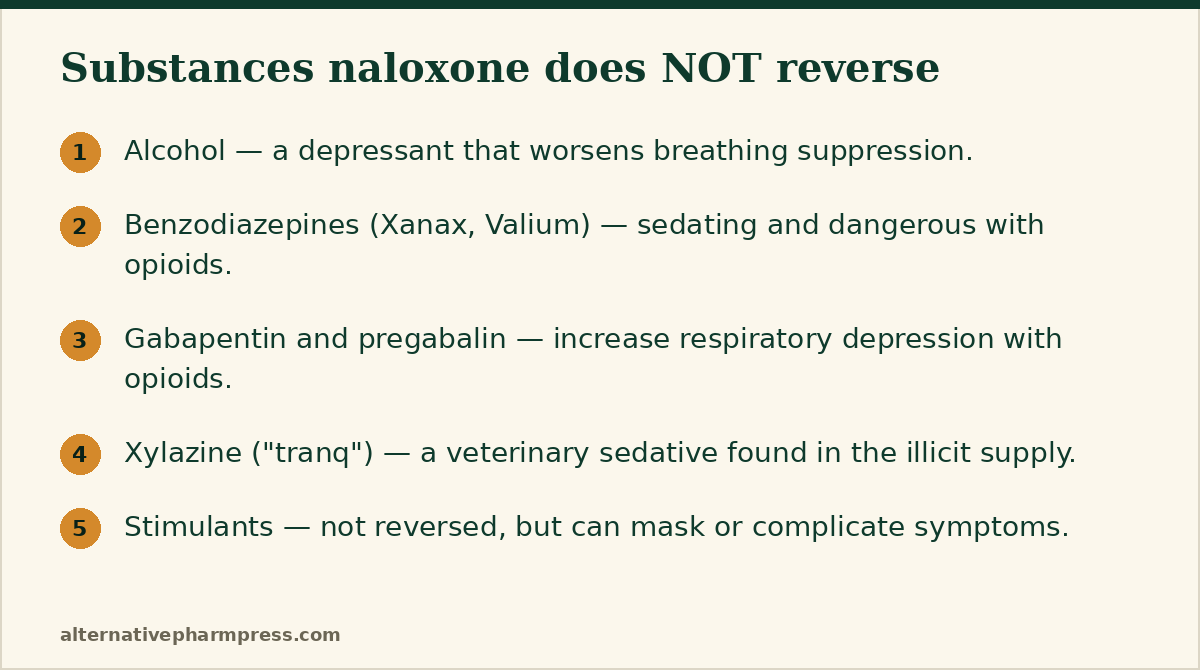
Many people who use kratom or 7-OH also use other substances. If someone took 7-OH with alcohol or a benzodiazepine, naloxone may reverse the opioid part but not the sedative part, so they may remain drowsy or breathe poorly. This is why emergency care is essential even when naloxone seems to work. Read kratom and alcohol for more on dangerous combinations.
There’s also the risk of contamination. Illicit or poorly regulated products can contain fentanyl or other synthetic opioids. Naloxone helps with fentanyl, but more than one dose may be needed.
Signs of an opioid overdose
- Unresponsive or very hard to wake.
- Slow, shallow or stopped breathing; snoring or gurgling sounds.
- Pinpoint pupils.
- Blue or gray lips and fingertips.
- Limp body and pale, clammy skin.
- Slow or absent pulse.
If you see these signs after 7-OH, kratom extract or any opioid use, act immediately.
What to do: step by step
- Try to wake them — shout their name and rub your knuckles firmly on the breastbone.
- Call 911 (or local emergency services). Many U.S. states have Good Samaritan laws offering some legal protection when calling for help in an overdose.
- Give naloxone — one spray in one nostril (for nasal spray), following package directions.
- Support breathing — give rescue breaths if trained, or start CPR if there’s no breathing or pulse.
- Place them in the recovery position if breathing, on their side to prevent choking.
- Give a second dose after 2–3 minutes if there’s no response, using the other nostril.
- Stay with them until help arrives. Effects of naloxone may wear off before 7-OH does.
What happens after naloxone is given
When naloxone works, the person may wake up quickly — sometimes confused, irritable or in sudden opioid withdrawal (sweating, nausea, vomiting, agitation, body aches). This can be distressing but is generally not life-threatening for adults. Stay calm, explain what happened and keep them from taking more of anything. Because naloxone can wear off in 30–90 minutes while 7-OH may last longer, the person should be evaluated in an emergency department. For more on what withdrawal looks like, see 7-OH withdrawal.
Who should carry naloxone
Public health agencies recommend that anyone who uses opioids — or lives with, cares for or socializes with someone who does — carry naloxone. That includes people using concentrated 7-OH products, high-dose kratom extracts or prescription opioids. Naloxone is available over the counter at U.S. pharmacies and often free through local health departments and harm-reduction programs.
Reducing overdose risk with 7-OH
- Avoid combining 7-OH with alcohol, benzodiazepines, gabapentin, sleep aids or other opioids.
- Don’t use alone; if you do, consider a never-use-alone hotline where available.
- Know the potency — concentrated 7-OH products are far stronger than kratom leaf. See 7-OH vs traditional kratom.
- Be careful after a break — tolerance drops quickly; see 7-OH tolerance.
- Keep naloxone nearby and tell friends where it is.
- Store products away from children and pets; accidental ingestion can be dangerous.
Can you overdose on kratom leaf?
Fatal overdoses involving kratom leaf alone appear to be rare, and most reported deaths involve multiple substances. Concentrated 7-OH products are a different category with higher potency. Read can you overdose on kratom? for the broader evidence.
Regulatory context
The FDA has warned about concentrated 7-OH products and recommended scheduling 7-OH under the Controlled Substances Act; several states have banned or restricted it. See where DEA scheduling stands and FDA 7-OH scheduling news. Regardless of legal status, overdose response steps remain the same.
Getting help for dependence
If you or someone you know is using 7-OH daily and struggling to cut back, effective treatment exists. Medications used for opioid use disorder, including buprenorphine, have been used for kratom-related dependence; see Suboxone for kratom withdrawal. In the U.S., the SAMHSA National Helpline (1-800-662-4357) offers free, confidential treatment referrals 24/7.
Naloxone myths to set aside
“Naloxone only works on heroin and fentanyl.” It works on any drug that acts through mu-opioid receptors, which includes prescription opioids and, by mechanism, 7-OH.
“Giving naloxone to someone who didn’t take opioids will hurt them.” Naloxone has no meaningful effect in people without opioids in their system, so giving it when unsure is considered safe.
“If they wake up, they’re fine.” Effects can return as naloxone wears off. Keep watching them and get medical care.
“Calling 911 will get everyone arrested.” Laws vary, but many states protect people who call for help during an overdose. Saving a life comes first.
FAQ
Does Narcan work on 7-OH?
Naloxone (Narcan) blocks mu-opioid receptors, which is where 7-OH acts, so it’s expected to reverse 7-OH’s opioid effects. Case reports describe responses, though other substances can complicate results.
How many doses of naloxone might be needed?
Often one is enough, but give a second dose after 2–3 minutes if there’s no response. Potent or mixed substances may require more.
Should I give naloxone if I’m not sure what they took?
Yes. Naloxone is very safe and won’t harm someone who hasn’t taken opioids. Give it and call 911.
Can someone overdose again after naloxone wears off?
Yes. Naloxone lasts 30–90 minutes, and 7-OH may last longer, so breathing problems can return. Medical observation is essential.
Does naloxone reverse kratom leaf?
Naloxone may help with opioid-like effects from kratom, though serious toxicity from leaf alone is uncommon and often involves other substances.
Is it legal to carry naloxone?
Yes. In the U.S., naloxone nasal spray is available over the counter without a prescription.