
CBD lotions, creams, balms, roll-ons and salves fill pharmacy shelves and sports stores. They’re marketed for sore muscles, achy joints, dry skin and even acne. Unlike gummies or oils, they’re applied directly to the skin, which raises an obvious question: does CBD lotion actually get absorbed, and does it work?
This guide explains how CBD interacts with skin, what research shows for pain and skin conditions, how topical and transdermal products differ, drug-test considerations, safety, and how to choose a quality product.
Key takeaways
- Skin has its own endocannabinoid system, with cannabinoid receptors in skin cells, nerves and immune cells.
- Most CBD lotions are topical: CBD stays mainly in the skin and nearby tissue, with little reaching the bloodstream.
- Transdermal patches and gels are designed to push CBD into circulation, using penetration enhancers.
- Evidence for topical CBD in pain and skin conditions is promising but limited, mostly small studies.
- Many topicals also contain menthol, camphor, arnica or capsaicin, which may explain part of the effect.
How CBD interacts with skin
The skin is the body’s largest organ, and it contains CB1 and CB2 receptors, along with other targets CBD interacts with such as TRPV1 and PPAR receptors. These are found in skin cells (keratinocytes), oil glands (sebocytes), hair follicles, immune cells and sensory nerves. Lab research suggests the skin’s endocannabinoid system helps regulate inflammation, oil production, itch and barrier function.
That’s why researchers are interested in CBD for skin and local pain: in principle, it can reach relevant receptors without needing to circulate through the whole body. For background on CBD, read CBD meaning.
Topical vs transdermal: what’s the difference?
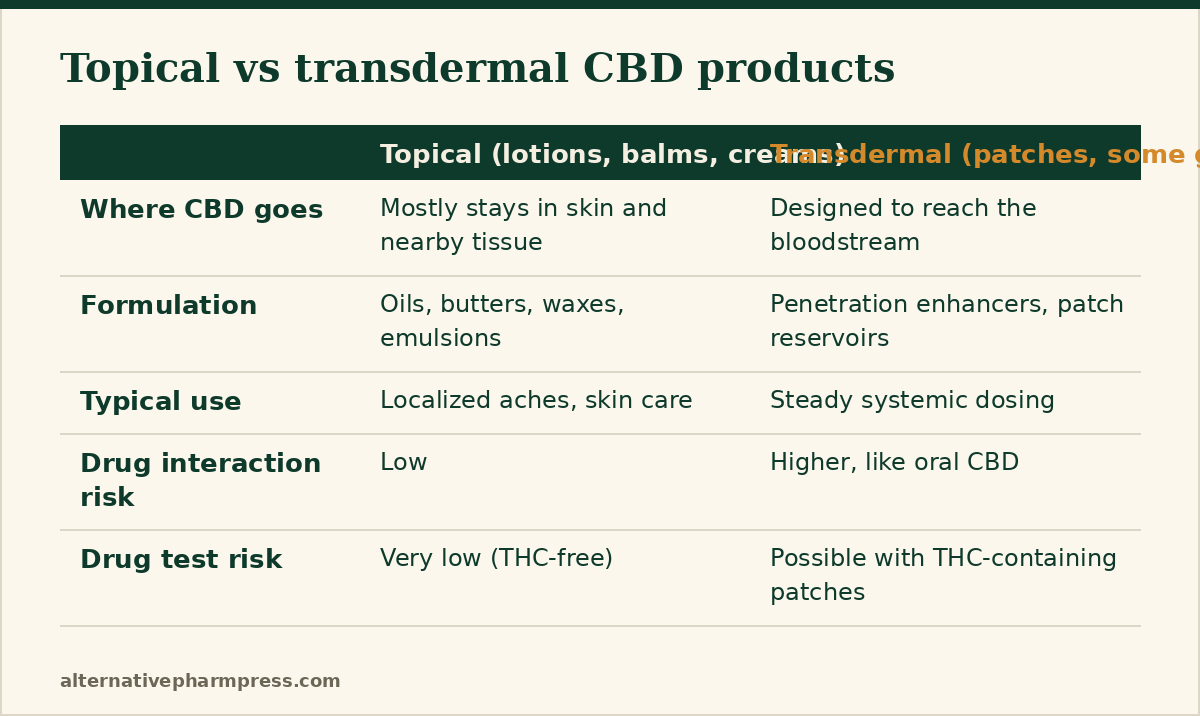
The outer skin layer, the stratum corneum, is a strong barrier. CBD is lipophilic (fat-loving), which helps it enter the upper skin layers, but getting through to the bloodstream in meaningful amounts requires special formulation. Most lotions aren’t designed to do that.
What the research shows
Joint and muscle pain
Animal studies have shown that topical CBD gel reduced joint swelling and pain behaviors in arthritis models. Human evidence is thinner. A few small trials and observational studies of topical CBD for hand arthritis, thumb joint pain and peripheral neuropathy have reported improvements in pain or symptoms, but sample sizes were small and some lacked strong placebo controls. Larger, well-controlled trials are needed. For oral options, see CBD gummies for pain relief.
Skin conditions
Lab research suggests CBD can reduce oil production and inflammation in sebocytes, which is why it’s studied for acne. Small studies have explored CBD ointments for eczema, psoriasis and scars, and some found improvements in itch, hydration or appearance. Research on epidermolysis bullosa, a rare blistering disorder, includes case reports of topical CBD use. Overall, evidence is early.
Itch
Cannabinoid-based creams have been studied for itch (pruritus), with some small studies reporting reduced itching. Again, the evidence base is limited.
Why other ingredients matter
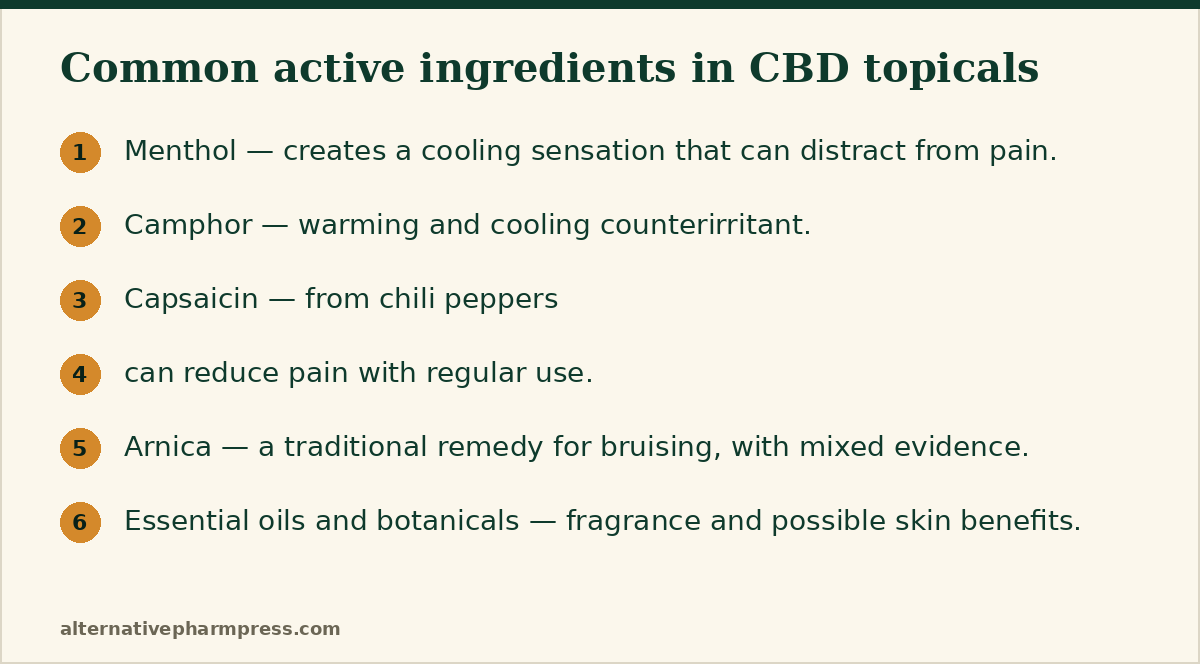
Many CBD rubs feel effective right away because of menthol or camphor. That doesn’t mean CBD isn’t contributing, but it makes it hard to tell what’s doing the work. If you want to test CBD’s effect, compare a plain CBD topical with a similar product without CBD.
How to use a CBD topical
- Clean and dry the area.
- Patch test first on a small area to check for irritation.
- Apply a generous layer and massage it in; the massage itself may help.
- Reapply as directed — often two to four times a day for ongoing aches.
- Wash your hands after applying, especially with menthol or capsaicin products.
- Avoid broken skin, eyes and mucous membranes.
Dose and concentration
Topical potency is usually listed as total milligrams of CBD in the container. A 1,000 mg jar sounds strong, but what matters more is concentration per application. A 100 g jar with 1,000 mg contains about 10 mg of CBD per gram of product. Compare products by mg of CBD per gram or per mL, not just total milligrams.
Drug tests
Topicals applied to intact skin are unlikely to cause a positive drug test, especially THC-free products. However, full-spectrum topicals contain small amounts of THC, and transdermal patches with THC are designed to deliver it into the bloodstream. If you’re tested, choose broad-spectrum or isolate topicals and check the COA. See can CBD fail a drug test? and full-spectrum vs broad-spectrum CBD.
Safety and side effects
Topical CBD is generally well tolerated. Possible issues include:
- Skin irritation or allergic reactions, often from fragrances, essential oils, menthol or preservatives.
- Burning or stinging from capsaicin products.
- Interactions — unlikely with topicals but possible with transdermal patches that deliver CBD into circulation. See CBD and blood pressure medication.
Pregnant or breastfeeding people should check with a healthcare provider, and children’s use should be guided by a pediatrician.
How to choose a CBD topical
- Batch-specific COA showing CBD content and THC levels.
- Concentration per gram clearly stated.
- Full ingredient list, including fragrances and other actives.
- Contaminant testing — heavy metals, pesticides and residual solvents.
- Spectrum that fits your needs (isolate or broad-spectrum if drug tested).
- No disease claims like curing arthritis or eczema.
For more shopping tips, see what to check when buying CBD online and best CBD brands 2026.
CBD lotion vs CBD oil for pain
| Feature | CBD lotion/topical | CBD oil (oral) |
|---|---|---|
| Where it acts | Localized area | Whole body |
| Onset | Minutes (often from menthol) to an hour | 15 minutes to 2 hours |
| Drug interactions | Low | Possible |
| Best for | Specific sore spots | Widespread pain or sleep |
| Drug test risk | Very low | Possible with full-spectrum |
Some people combine a topical for a specific area with an oral product for overall effects. Compare formats in CBD tincture vs CBD oil and CBD oil vs hemp oil.
CBD in skincare: serums, masks and creams
Beyond pain rubs, CBD appears in face serums, moisturizers and masks. Cosmetic brands highlight antioxidant and soothing properties. Lab data suggest CBD may reduce inflammatory signals and oil production, which is why it’s popular in products for sensitive or acne-prone skin. Many skincare products contain relatively low CBD concentrations, and it’s hard to separate CBD’s effect from the rest of the formula. If you have a diagnosed skin condition, talk with a dermatologist about evidence-based treatments.
Hemp seed oil is not CBD
Some products list “hemp seed oil” or “cannabis sativa seed oil” prominently. Hemp seed oil is a nourishing moisturizer, but it contains little or no CBD. If you want CBD, check the label for cannabidiol content and confirm with a COA. Read CBD oil vs hemp oil for the difference.
Regulation and labeling
In the U.S., CBD topicals are often sold as cosmetics. Cosmetics don’t require FDA approval before sale, but they must be safe and properly labeled, and they can’t make drug claims such as treating arthritis or eczema. Products claiming to treat disease may be considered unapproved drugs. Hemp-derived CBD topicals must also comply with THC limits. State rules vary, and federal hemp changes in 2026 add limits on THC per container that can affect full-spectrum products. See the federal hemp THC limit and CBD.
Making the most of a trial
If you want to see whether a CBD topical helps, test it methodically. Pick one specific area — for example, a sore knee — and rate pain or stiffness morning and evening for a week without the product. Then apply the topical consistently for two to three weeks and keep rating. Note whether you also changed activity, sleep or other medications. If there’s no clear improvement, it may not be worth the cost. If it helps, try a lower-cost product with similar CBD concentration to see whether the brand matters.
Who might benefit most
People with localized pain, such as a sore knee or wrist, or those who want to avoid oral CBD’s drug interactions, may find topicals a reasonable option to try. They’re also practical for people who are drug tested, provided they use THC-free products. Topicals are less likely to help widespread pain, deep joint pain in large joints like hips, or symptoms like poor sleep and anxiety.
FAQ
Does CBD lotion really work?
Some small studies and many users report benefits for localized pain and skin conditions, but strong clinical evidence is limited. Added ingredients like menthol may contribute.
Does CBD lotion get into your bloodstream?
Most topical lotions deliver little CBD into the bloodstream. Transdermal patches and some gels are designed to reach circulation.
Can CBD lotion make you fail a drug test?
It’s unlikely with THC-free products on intact skin. Full-spectrum topicals and THC transdermal patches carry more risk.
How often should I apply CBD cream?
Many products suggest two to four times a day as needed. Follow label directions and stop if irritation occurs.
Is CBD lotion good for arthritis?
Some small studies suggest benefit for hand or thumb arthritis, but larger trials are needed. It may be worth trying alongside other treatments.
Can I use CBD lotion on my face?
Many people use CBD skincare on their face. Patch test first and avoid products with heavy fragrance if you have sensitive skin.