
Pain is one of the most common reasons people try CBD, and gummies are one of the most popular ways to take it. They’re tasty, pre-dosed and discreet. But do CBD gummies for pain relief actually work, and if so, for what kinds of pain?
This guide summarizes what human research shows, explains how gummy dosing and absorption affect results, covers safety and drug interactions, and offers a practical checklist for choosing a gummy.
Key takeaways
- Human evidence for CBD alone in pain is limited and mixed; many positive studies involve THC:CBD combinations or topical CBD.
- Some small trials and surveys suggest benefits for arthritis, neuropathic pain and sleep disrupted by pain, but larger controlled trials often show modest or no effect.
- Gummies have low and slow oral bioavailability; effects can take 1–2 hours and vary widely.
- CBD can interact with medications, including blood thinners and some pain drugs, and high doses can affect the liver.
- Choose gummies with batch-specific COAs, clear CBD per gummy and known THC content.
How CBD might affect pain
CBD interacts with several systems involved in pain and inflammation. Lab and animal studies suggest it may:
- Influence TRPV1 receptors, which play a role in pain signaling.
- Affect serotonin 5-HT1A receptors, linked to mood and pain perception.
- Reduce inflammatory signaling in some models.
- Modulate the endocannabinoid system indirectly, rather than strongly activating CB1 or CB2 receptors.
These mechanisms are plausible, but results in animals don’t always translate to people. For the basics, see CBD meaning and does CBD get you high?.
What human studies show
Arthritis
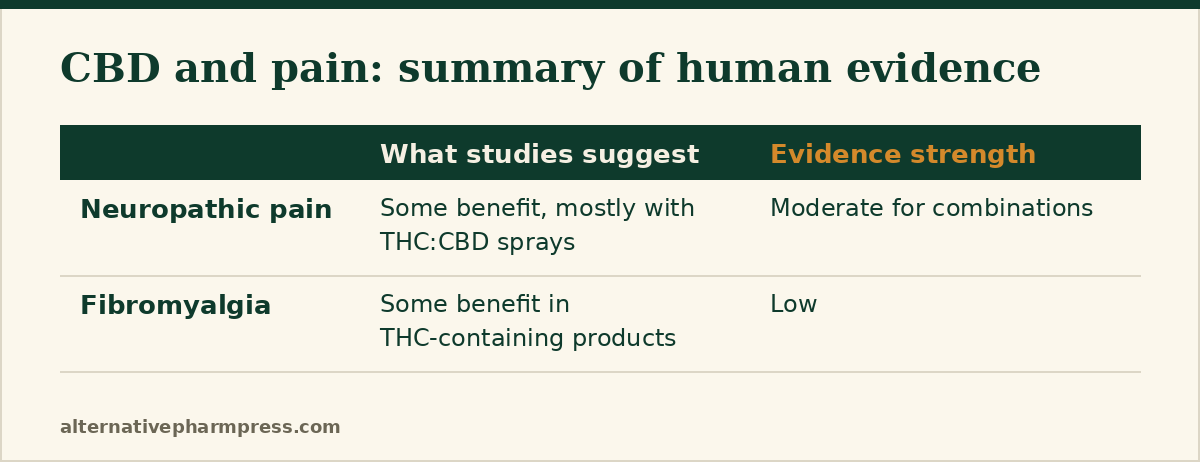
Surveys of arthritis patients often report that CBD users feel benefits in pain and sleep. However, a randomized controlled trial of oral CBD in hand osteoarthritis and psoriatic arthritis found no significant difference from placebo in pain. Topical CBD has some small studies showing benefit, though high-quality evidence is still limited.
Neuropathic pain
Nabiximols (Sativex), a mouth spray containing roughly equal amounts of THC and CBD, has shown benefit in some trials for multiple sclerosis-related pain and spasticity and is approved in several countries. Results for CBD alone in neuropathic pain are less consistent.
Chronic pain overall
Systematic reviews of cannabinoids for chronic pain generally find small to moderate effects, mostly from THC-containing products, with side effects increasing as THC dose rises. Evidence specifically for CBD-only gummies at typical retail doses is sparse.
Why gummies are tricky for pain
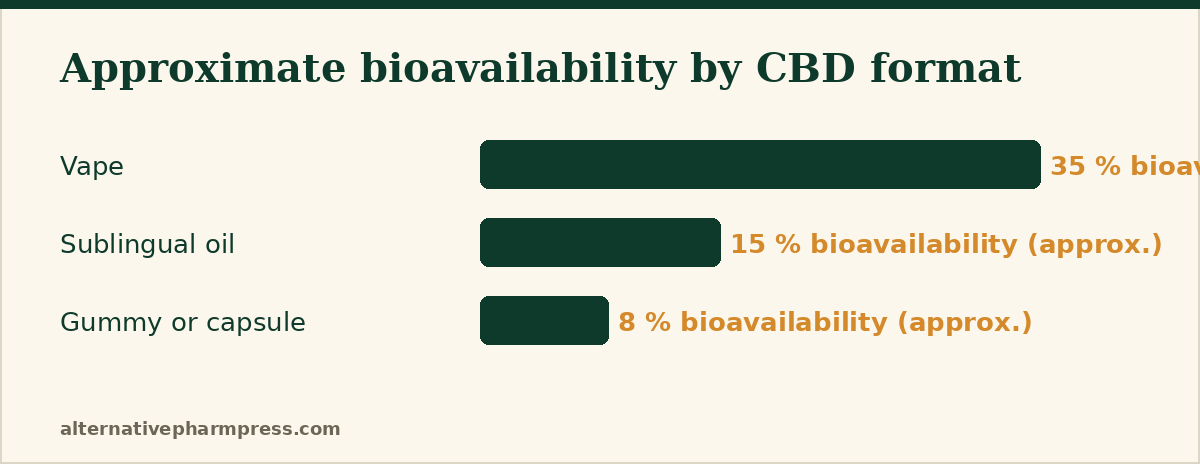
Oral CBD passes through the digestive system and liver before reaching circulation, so a large share is broken down. Estimates for oral bioavailability are often in the single digits to low teens. Taking gummies with a meal containing fat can significantly increase absorption.
Gummies also have delayed onset — often 30 minutes to two hours — and longer duration. That makes them less useful for sudden pain flares but potentially suitable for steady, all-day use. Compare formats in CBD gummies vs CBD oil and CBD edibles.
Dosing considerations
Retail gummies often contain 10–25 mg of CBD each. Clinical studies for pain and other conditions have used a wide range, from about 20 mg up to several hundred milligrams daily. Because individual responses vary and evidence is limited, many clinicians who discuss CBD suggest starting low, increasing slowly and tracking results.
A simple self-tracking approach:
- Rate your pain (0–10) and sleep for a week before starting.
- Start with one gummy daily with food.
- Increase gradually every week if needed, without exceeding label guidance or your clinician’s advice.
- Track pain, sleep, function and side effects.
- Reassess after 4–6 weeks — if there’s no meaningful improvement, CBD may not be worth the cost.
Full-spectrum, broad-spectrum or isolate?
- Full-spectrum gummies contain small amounts of THC and other cannabinoids. Some people find them more effective, possibly due to THC or the “entourage effect,” but they can affect drug tests.
- Broad-spectrum gummies remove most THC but keep other compounds.
- Isolate gummies contain only CBD.
Learn more in full-spectrum vs broad-spectrum CBD and CBD isolate vs full-spectrum. If you’re drug tested, read can CBD fail a drug test?.
Side effects and drug interactions
Common side effects include drowsiness, diarrhea, appetite changes and fatigue. At high doses, CBD has been linked to elevated liver enzymes, particularly in combination with certain medications.
CBD inhibits liver enzymes (CYP3A4 and CYP2C19, among others) that metabolize many drugs. Interactions of concern include:
- Blood thinners such as warfarin.
- Certain anti-seizure medications.
- Some opioids and other pain medications.
- Sedatives and sleep aids — additive drowsiness.
- Some blood pressure and heart medications — see CBD and blood pressure medication.
Talk to a pharmacist or doctor before combining CBD with prescription medicines.
Who should be cautious
- Pregnant or breastfeeding people.
- People with liver disease.
- Anyone taking multiple medications.
- Older adults, who may be more sensitive to drowsiness and dizziness.
- Children — only under medical supervision.
How to choose a CBD gummy for pain
- Batch-specific COA from an accredited lab, matching the product.
- CBD per gummy that matches the label within a reasonable margin.
- THC content clearly stated, including delta-9 per gummy.
- Contaminant testing: heavy metals, pesticides, residual solvents, microbes.
- Sensible ingredients — watch for high sugar or added melatonin if you don’t want it.
- No disease claims — reputable brands avoid promising to cure conditions.
For brand-level comparisons, see best CBD gummies 2026, best CBD brands 2026 and what to check when buying CBD online.
Gummies plus other pain strategies
CBD works best, if at all, as part of a broader approach. Evidence-based options for chronic pain include physical therapy, graded exercise, weight management, sleep improvement, cognitive behavioral therapy and appropriate medications. Talk to a healthcare provider about combining approaches, and don’t stop prescribed treatments without guidance.
Topical vs oral CBD for joint and muscle pain
For localized pain — a sore knee, an aching shoulder — some people prefer topical CBD creams or balms. Topicals act near the skin and underlying tissues, with little reaching the bloodstream, which lowers the risk of drug interactions. A few small studies suggest topical CBD may help localized pain, but high-quality trials are limited. Gummies, by contrast, act systemically and may be more relevant for widespread pain or pain that disrupts sleep. Some people use both.
CBD gummies and sleep disrupted by pain
Many people with chronic pain sleep poorly, and poor sleep makes pain feel worse. Some report that CBD gummies at night help them rest. Evidence for CBD and sleep is mixed; read CBD for sleep: what human trials found and CBN vs CBD for a closer look. If your nighttime gummy also contains melatonin or CBN, factor that into how you judge results.
The placebo factor
Pain is strongly influenced by expectation, attention and mood. In many CBD trials, the placebo group also improves meaningfully, which is why controlled studies matter. That doesn’t mean your experience isn’t real — placebo effects can be genuine relief — but it does mean that personal testimonials and online reviews can’t tell you whether CBD itself is responsible. Tracking your symptoms carefully, and stopping to see whether pain changes, gives you better information.
Cost and value
Daily CBD use adds up. A month of gummies at 25–50 mg per day can cost a meaningful amount. To compare value, calculate the cost per milligram of CBD using the COA, not just the package price. If you’ve tried a reasonable dose for a month or more without clear benefit, it’s reasonable to stop rather than keep escalating.
FAQ
Do CBD gummies help with pain?
Some people report benefits, but controlled human evidence for CBD-only gummies is limited and mixed. Stronger evidence exists for THC:CBD combinations in specific conditions.
How long do CBD gummies take to work for pain?
Usually 30 minutes to two hours, with effects lasting several hours. Consistent daily use may be needed to judge results.
How many mg of CBD should I take for pain?
There’s no established dose. Many people start with 10–25 mg daily with food and increase gradually, tracking results. Discuss dosing with a clinician if you take medications.
Are CBD gummies better than CBD oil for pain?
Oil under the tongue may act somewhat faster and absorb slightly better. Gummies are convenient and consistent. The best choice depends on preference and needs.
Can CBD gummies interact with pain medication?
Yes. CBD can affect how the liver processes certain drugs, including some opioids and other medications. Check with a pharmacist.
Will CBD gummies make me high?
CBD itself isn’t intoxicating. Full-spectrum gummies contain small amounts of THC; some products have been found to contain more THC than labeled.