
Among cannabis concentrates, few look as striking as THCA diamonds — clear, crystalline chunks that can test above 90% THCA. Often sold swimming in terpene-rich “sauce,” they’re prized for purity and potency. In the hemp market, THCA diamonds have become a popular premium product.
This guide explains how THCA diamonds form, how they compare with other concentrates, how potent they become once heated, how people use them and what to check on a certificate of analysis.
Key takeaways
- THCA diamonds are crystallized THCA, typically 90–99% pure.
- They usually form slowly from live resin “sauce”, a process called crystallization or “diamond mining.”
- Raw THCA isn’t intoxicating, but heating converts it to delta-9 THC, making diamonds extremely potent.
- Diamonds alone have little flavor; terpene sauce supplies aroma.
- Hemp THCA diamonds face growing legal restrictions as rules move to total-THC standards.
What are THCA diamonds?
THCA (tetrahydrocannabinolic acid) is the natural acidic form of THC found in raw cannabis and hemp. Under the right conditions, THCA molecules arrange themselves into a crystal lattice — much like sugar or salt crystals — forming solid, glassy structures. These are THCA diamonds.
Because they’re nearly pure THCA, diamonds contain very little else: few terpenes, minimal plant compounds and only trace other cannabinoids. For the basics on THCA, read does THCA get you high? and THCA vs delta-9 THC.
How THCA diamonds are made
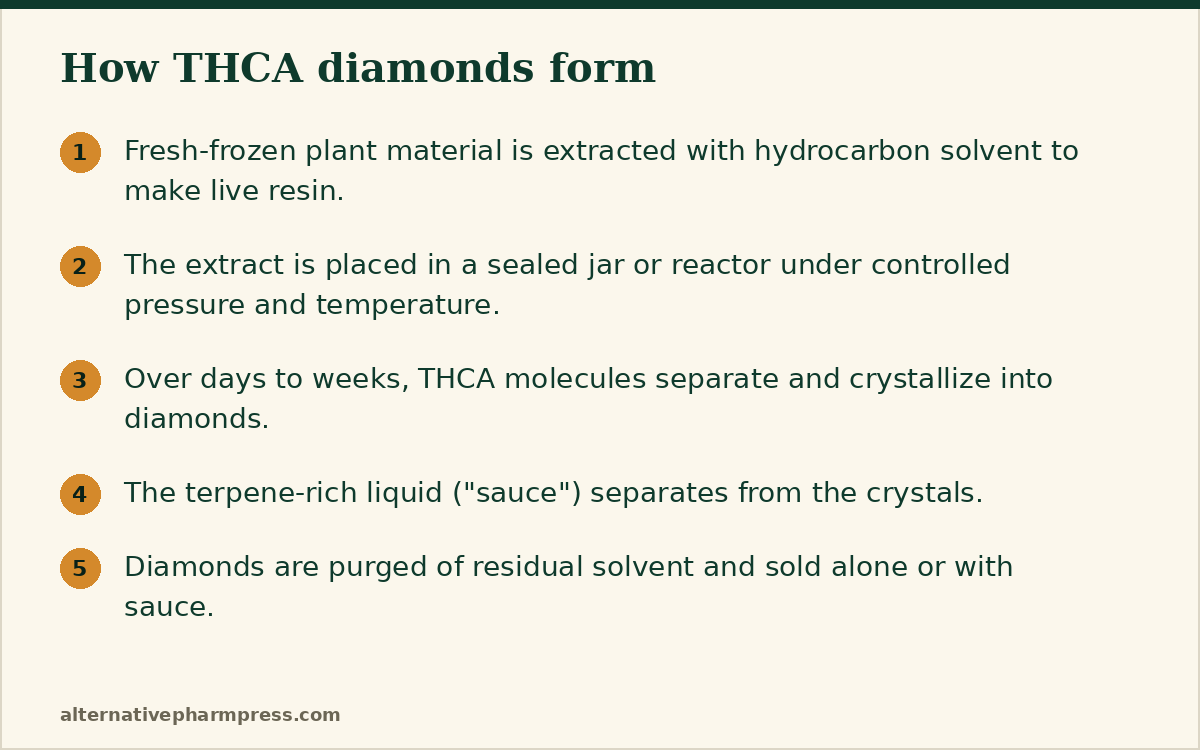
This slow process — sometimes called “jar tech” or “diamond mining” — relies on supersaturation: as conditions change, THCA comes out of solution and builds crystals. Processors can also make diamonds more quickly with solvent-based recrystallization, which produces very pure but sometimes smaller crystals. For background on the starting material, see THCA live resin.
Diamonds vs sauce vs isolate
How potent are THCA diamonds?
When heated, THCA undergoes decarboxylation, losing a carboxyl group and becoming delta-9 THC. Because THCA is heavier than THC, labs use a conversion factor of 0.877 to estimate potential THC.
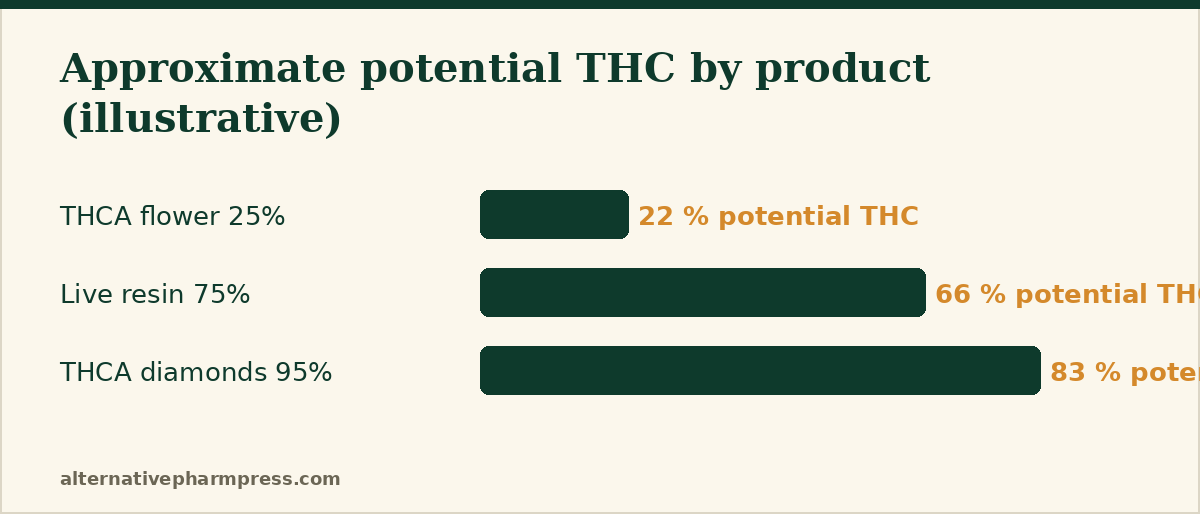
A 95% THCA diamond can yield roughly 83% potential THC. In practice, not all THCA converts and some is lost during vaporization, but diamonds remain among the strongest cannabis products available. A very small amount produces strong effects. See distillate vs live resin for comparison.
How people use THCA diamonds
- Dabbing — vaporizing a small piece on a heated surface. Lower temperatures preserve flavor and reduce harshness.
- Electronic dab devices — “e-rigs” allow temperature control.
- Topping flower — crushing diamonds and adding to flower in a bowl or joint; this greatly increases potency.
- Homemade edibles — diamonds can be decarboxylated and infused into oils, though dosing is difficult.
Raw THCA diamonds don’t produce a high unless heated. Swallowing them raw delivers THCA, not THC, though some conversion may occur with heat during cooking.
Effects and potency risks
Because diamonds are so potent, they can produce intense effects quickly:
- Strong euphoria and altered perception.
- Rapid heart rate, dizziness or anxiety.
- Paranoia or panic, especially for less experienced users. See THC and anxiety.
- Impairment lasting several hours.
High-potency products are associated with greater risk of dependence and, in vulnerable people, psychosis, especially with frequent use.
What a good COA shows
- THCA percentage and total THC (THCA × 0.877 + delta-9 THC).
- Residual solvents — butane, propane, pentane and others within safe limits.
- Pesticides — important because contaminants concentrate during extraction.
- Heavy metals and microbes.
- Batch number and date matching the product, from an accredited lab.
A diamond product with impressive THCA numbers but no residual solvent testing is a red flag. See THCA vs CBD for how THCA is labeled compared with other cannabinoids.
Diamonds and drug tests
Once heated and inhaled, THCA becomes THC, which is metabolized to THC-COOH — the compound standard drug tests detect. THCA diamonds will cause positive results just like marijuana. Read how long THCA stays in your system.
Legal status
THCA diamonds became widely available in the hemp market because the 2018 Farm Bill defined hemp by delta-9 THC content only, leaving THCA unregulated. Federal legislation passed in late 2025 moves hemp to a total-THC standard and restricts intoxicating hemp products, directly affecting THCA concentrates. Many states already restrict them. See federal hemp law explained, is THCA legal after December 11, 2026? and THCA legal status by state.
Storage tips
- Keep diamonds in an airtight glass container.
- Store in a cool, dark place; heat and light degrade THCA and terpenes.
- Avoid repeated warming; THCA can slowly convert to THC over time with heat.
- Let refrigerated jars reach room temperature before opening to prevent moisture.
Common myths about THCA diamonds
“Diamonds are the purest and therefore the safest concentrate.” Purity refers to THCA content, not safety. Residual solvents, pesticides and extreme potency all matter.
“Hemp diamonds are weaker than dispensary diamonds.” Once heated, THCA is chemically the same whether it comes from hemp or marijuana.
“Diamonds don’t get you high.” Raw THCA isn’t intoxicating, but heating converts it to THC, producing strong effects.
“Bigger diamonds are better.” Crystal size reflects the crystallization process, not necessarily quality or potency.
Who should avoid THCA diamonds
Diamonds aren’t suitable for people new to cannabis, anyone with a personal or family history of psychosis or bipolar disorder, people with heart conditions, those who are pregnant or breastfeeding, people under 21 and anyone subject to drug testing. Never drive after using cannabis concentrates.
Why diamonds cost what they do
Diamonds take time, equipment and careful process control. Crystallization can take days to weeks, and processors must purge solvent thoroughly and test each batch. Diamond prices often reflect input material quality, the amount of sauce included and lab testing costs. Unusually cheap “diamonds” may be THCA isolate pressed into shapes, or products with limited testing. Ask for the full COA and, ideally, photos of the batch.
Diamonds vs isolate: are they the same thing?
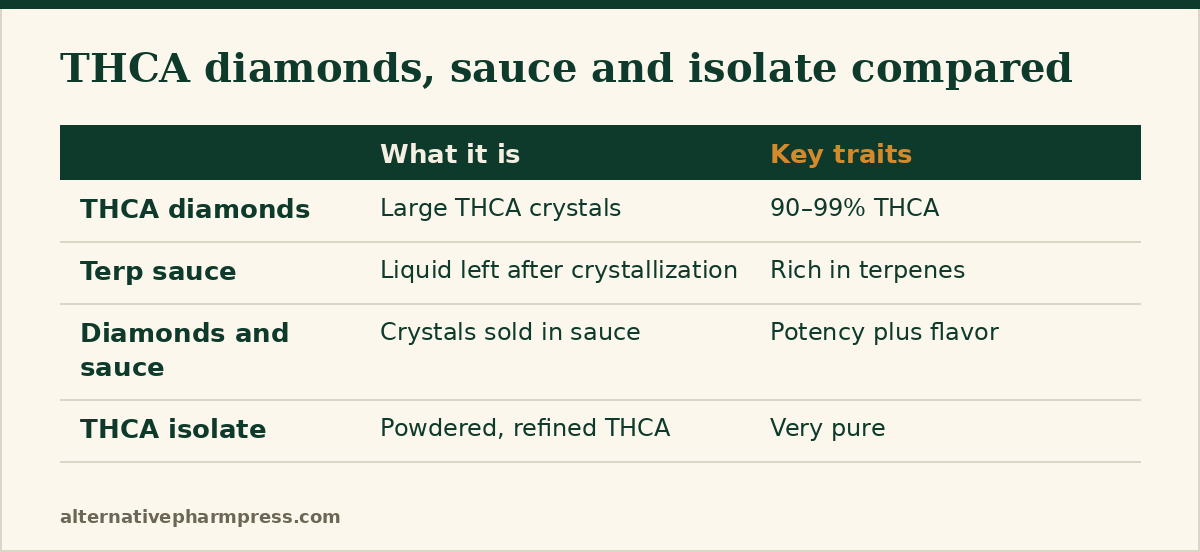
Chemically, both are mostly THCA. The difference lies in process and form: diamonds grow slowly as large crystals, often from live resin, while isolate is typically produced through faster refining and appears as a fine powder or small crystals. Diamonds sold with sauce carry terpenes from the original plant; isolate usually has none. If a product is labeled “diamonds” but looks like powder, it may be isolate.
Dabbing temperature and harm reduction
Temperature changes the experience and the risks of using diamonds. Very hot dabs — where the surface glows or the vapor is harsh — can degrade terpenes and produce irritating byproducts. Lower-temperature dabs, often in the range of roughly 450–600°F (230–315°C) on electronic devices, produce smoother vapor and better flavor. Practical harm-reduction tips include:
- Start with a piece smaller than a grain of rice and wait at least 15 minutes before more.
- Use temperature-controlled devices rather than torches when possible.
- Clean equipment regularly to avoid inhaling residue.
- Don’t mix with alcohol or other substances, which increases impairment.
- Have water and a snack nearby, and use in a safe, familiar setting.
- Never drive for at least several hours after use.
Do diamonds have an “entourage effect”?
Pure diamonds contain very little besides THCA, which is why many people prefer diamonds and sauce for a fuller experience. The entourage effect — the idea that terpenes and minor cannabinoids shape the high — is widely discussed but scientifically uncertain. What’s clear is that sauce adds flavor and aroma. Whether it meaningfully changes effects for any individual is harder to say.
How to spot low-quality or fake diamonds
- Cloudy, wet or sticky crystals without the expected clarity may indicate poor purging or added material.
- A COA without residual solvent results leaves a major safety question unanswered.
- Potency claims above 99% with no supporting lab data should be treated skeptically.
- Labels that don’t distinguish THCA from total THC may be confusing or non-compliant.
- Sellers who can’t name the lab or provide a batch-specific report should be avoided.
FAQ
What are THCA diamonds?
They’re crystalline concentrates made almost entirely of THCA, typically testing between 90% and 99% purity.
Do THCA diamonds get you high?
Not raw, but heating converts THCA to delta-9 THC, making diamonds extremely potent when dabbed or vaporized.
How are THCA diamonds made?
Usually by slowly crystallizing THCA out of live resin extract under controlled pressure and temperature over days or weeks.
Will THCA diamonds show up on a drug test?
Yes. Heated THCA becomes THC, which produces positive results on standard drug tests.
Are THCA diamonds legal?
They face increasing restrictions as federal and state laws move to total-THC standards. Check your state’s current rules.
What’s the difference between diamonds and sauce?
Diamonds are crystallized THCA with little flavor; sauce is the terpene-rich liquid left after crystallization. They’re often sold together.