

THCP and THCA both appear on hemp shop shelves, often in similar vapes, gummies and pre-rolls. The names differ by one letter, which leads to plenty of confusion. In reality they’re very different compounds with different origins, potency and legal risks.
This guide compares THCP vs THCA side by side so you understand what you’re buying — and why both can surprise first-time users.
Key takeaways
- THCA is the non-intoxicating acid precursor of delta-9 THC found abundantly in raw cannabis; heat turns it into THC.
- THCP (tetrahydrocannabiphorol) is a rare cannabinoid discovered in 2019, with a longer side chain that makes it bind CB1 far more strongly in lab tests.
- Commercial THCP is almost always synthesized from CBD, not extracted.
- Both will very likely cause a positive THC drug test once consumed.
- Both face tightening legal restrictions, as federal and state rules shift to total-THC and intoxicating-hemp limits.
THCP vs THCA at a glance
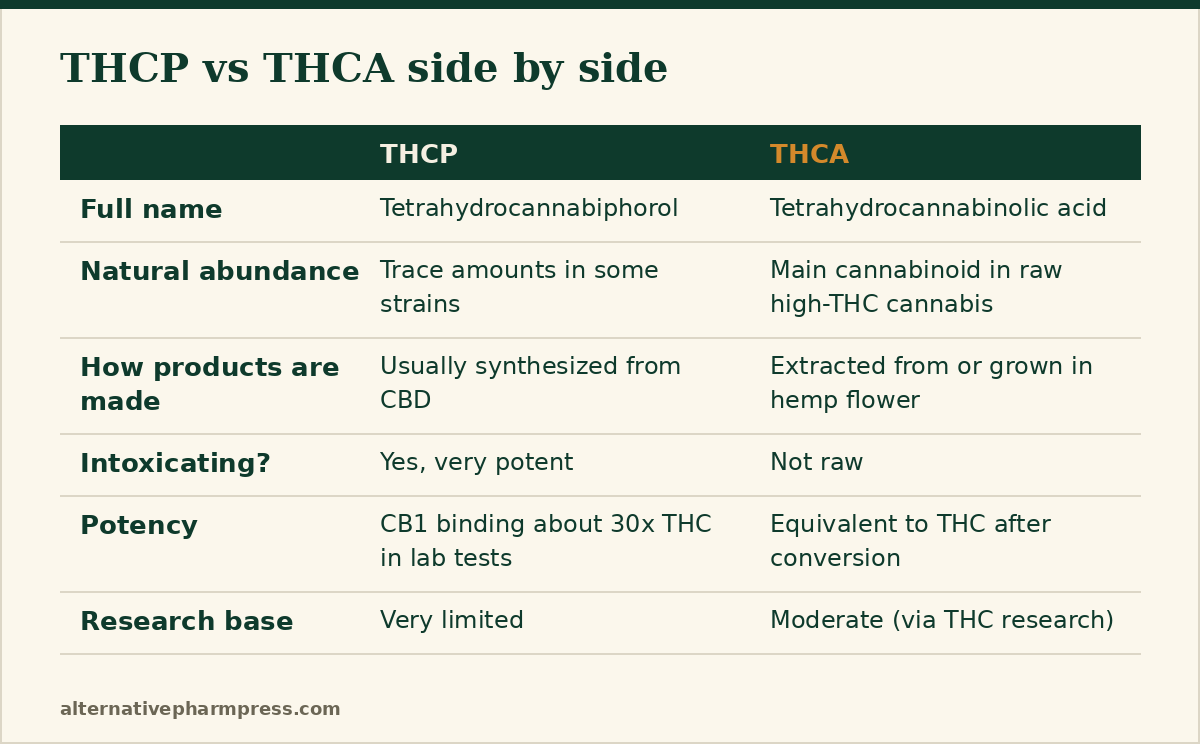
What is THCA?
THCA is the form in which cannabis plants make most of their THC. It carries an extra carboxyl group that keeps it from fitting well into the brain’s CB1 receptor, so raw THCA isn’t intoxicating. When it’s heated — smoked, vaped, dabbed or baked — it decarboxylates into delta-9 THC. That’s why THCA flower, vapes and concentrates produce effects much like marijuana. We explain the chemistry in does THCA get you high? and compare it with delta-9 in THCA vs delta-9 THC.
What is THCP?
THCP was identified by Italian researchers in 2019 in a cannabis strain. Its structure is similar to delta-9 THC, but it has a seven-carbon alkyl side chain instead of THC’s five. That longer tail appears to let it lock onto CB1 receptors more tightly. In lab binding studies, THCP showed roughly 30 times the CB1 affinity of delta-9 THC, and it produced THC-like effects at lower doses in mice.
Binding affinity doesn’t translate directly into “30 times stronger” for people — dose, absorption and metabolism all matter — but users consistently describe THCP as much more potent than delta-8 or delta-9, with longer-lasting effects. There are essentially no controlled human studies on THCP.
Because natural THCP exists only in trace amounts, commercial THCP is made in labs, typically by chemically converting CBD through multi-step synthesis. That raises the same quality questions as delta-8: residual solvents, reagents and unidentified byproducts.
Potency compared
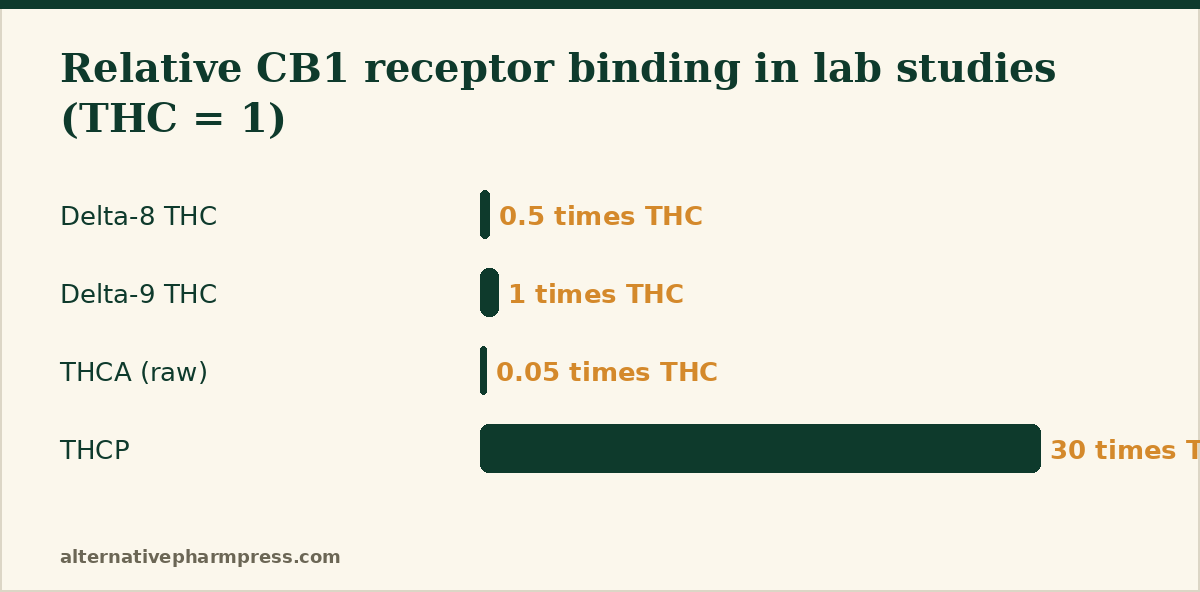
Figures are approximate and based on lab binding studies, which don’t directly predict human effects. Raw THCA’s binding is very weak, but THCA becomes delta-9 THC (=1) when heated.
What this means in practice:
- THCA products behave like regular THC products once heated. Potency is determined by THCA percentage (for example, 25% THCA flower is roughly 22% potential THC).
- THCP products are often blended with delta-8 or delta-9 because tiny amounts of THCP have strong effects. A vape advertising “THCP” might contain only a few percent THCP alongside other cannabinoids.
Effects and side effects
THCA (heated): euphoria, relaxation, altered perception, increased appetite; at higher doses anxiety, racing heart and impaired coordination — the familiar THC profile.
THCP: users report similar effects but more intense and longer-lasting, with a higher likelihood of anxiety, paranoia, dizziness, nausea and next-day grogginess, especially among less experienced users. Because there’s so little research, the safety margin isn’t well understood.
If you’re new to cannabinoids, THCP is not a good starting point. Its potency makes accidental overconsumption more likely. Start with low-dose products you can measure, and never combine with alcohol or driving.
Drug tests
Both are very likely to cause a positive result:
- THCA converts into delta-9 THC, producing the standard THC-COOH metabolite. See how long THCA stays in your system.
- THCP metabolites may cross-react with THC immunoassays, and many THCP products also contain delta-8 or delta-9. Assume a positive result.
Legal status
Both sit in a shifting legal landscape:
- The 2018 Farm Bill defined hemp by delta-9 THC concentration, which left room for THCA flower and converted cannabinoids such as THCP.
- The DEA has indicated that synthetically derived tetrahydrocannabinols are controlled, and many legal experts consider lab-synthesized THCP to fall into that category.
- Federal legislation passed in late 2025 moves hemp toward total-THC limits and restricts intoxicating hemp-derived products — affecting both THCA and THCP. See federal hemp law explained, hemp ban 2026 and hemp ban product impact.
- Many states already ban THCP specifically, or ban all intoxicating hemp-derived cannabinoids.
Check our THCA legal status by state guide and is THCA legal after the federal change? before buying.
Quality and testing
For either compound, insist on a batch-matched certificate of analysis showing:
- Cannabinoid content (THCA, delta-9, THCP, delta-8 and others)
- Residual solvents, heavy metals, pesticides and microbial testing
- For THCP: ideally screening for synthesis byproducts and unknown compounds
Our reviews of the best THC-P products and guide to distillate vs live resin explain what to look for in concentrates and vapes.
Which is “better”?
They serve different purposes:
- THCA is essentially a legal pathway (where still legal) to conventional THC effects, with decades of cannabis research behind those effects.
- THCP is a novel, highly potent cannabinoid with almost no human research, made by synthesis.
For most people, THCA (or regulated cannabis where legal) is the more predictable option. THCP adds potency and uncertainty that few users need.
How THCP products are typically sold
Because THCP is so potent, you’ll rarely find a product that’s pure THCP. More often you’ll see:
- Vape carts and disposables blending a small percentage of THCP with delta-8, delta-9 or HHC distillate and terpenes.
- Gummies with a few milligrams of THCP alongside larger amounts of delta-8 or delta-9.
- Pre-rolls and “moon rocks” — hemp flower sprayed or coated with distillate containing THCP.
This blending makes it hard to know how much THCP you’re actually getting. Read the cannabinoid panel on the COA rather than relying on the front label.
How THCA products are typically sold
THCA appears in more “natural” formats because it occurs in large amounts in the plant:
- THCA flower and pre-rolls — hemp bred to produce high THCA with low delta-9 at harvest.
- Concentrates — diamonds, sauce, badder and live resin, often 70–99% THCA.
- Vapes — THCA distillate or live resin; the heating element converts it to THC.
THCA’s potency is easier to estimate because you can apply the standard conversion (THCA × 0.877) to the lab result.
Why the side chain matters: a quick chemistry lesson
Cannabinoids share a similar core structure, but small changes produce big differences. One of the most important features is the alkyl side chain — a tail of carbon atoms attached to one end of the molecule.
- CBDV and THCV have a three-carbon chain (propyl).
- CBD and delta-9 THC have a five-carbon chain (pentyl).
- THCP and CBDP have a seven-carbon chain (heptyl).
In general, a longer chain helps the molecule anchor more firmly in the CB1 receptor’s binding pocket. That’s why THCP binds so strongly, and why THCV, with its shorter chain, behaves differently at low doses. THCA, by contrast, has the standard five-carbon chain but carries an extra carboxylic acid group that blocks effective binding until it’s removed by heat.
How THCP is made — and why that matters for safety
Commercial THCP synthesis typically starts with CBD isolate from hemp. Through a series of chemical reactions using acids, catalysts and solvents, manufacturers rearrange and extend the molecule. Each step can leave residues or create side products that aren’t fully characterized. Unlike pharmaceutical manufacturing, hemp-derived cannabinoid production is lightly regulated, and many products are never tested for synthesis byproducts.
That’s not unique to THCP — delta-8, HHC and other converted cannabinoids share the same concern — but THCP’s potency means that even small labeling errors can produce large differences in effect. A product labeled “2% THCP” that actually contains 6% could easily overwhelm an unsuspecting user.
Practical harm-reduction tips
- Choose the lowest-strength product available and take a single small dose.
- Wait — at least 15 minutes for inhaled products and two hours for edibles — before taking more.
- Avoid mixing with alcohol or other substances.
- Keep products locked away from children and pets; potent cannabinoids are especially dangerous to them.
- Have a plan to rest somewhere safe if effects are stronger than expected.
FAQ
Is THCP stronger than THCA?
Raw THCA isn’t intoxicating. Once heated, THCA becomes delta-9 THC. THCP binds CB1 receptors far more strongly than THC in lab tests and is generally reported to be much more potent.
Is THCP natural?
THCP occurs naturally in trace amounts, but commercial THCP is almost always synthesized from CBD.
Will THCP or THCA show up on a drug test?
Both are very likely to cause a positive THC drug test.
Is THCP legal?
Its legal status is uncertain. Many states ban it, synthetic THCs may be federally controlled, and federal hemp rules are tightening.
Which should a beginner choose?
Neither is ideal for beginners, but THCP’s potency makes it especially risky. Start with low, measurable doses of better-understood products, where legal.