
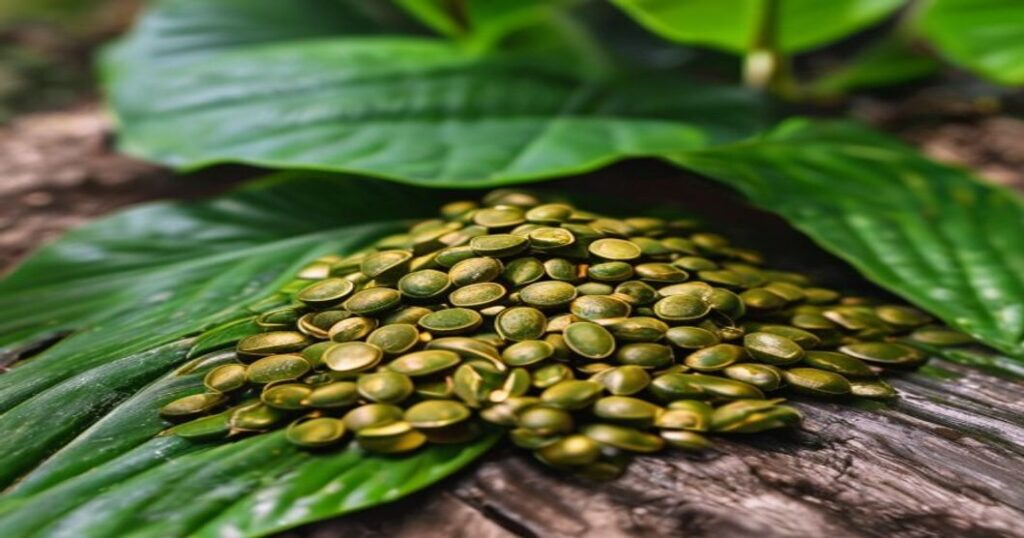
Kratom is the leaf of Mitragyna speciosa, a tropical tree in the coffee family (Rubiaceae) native to Southeast Asia. Its main alkaloid, mitragynine, acts on opioid receptors. Users describe stimulant-like effects at lower amounts and opioid-like effects at higher ones. Kratom is not an approved medicine in the US, and it carries real risks, including dependence.1,2,3
That short answer hides a lot of variation. The word “kratom” is now printed on everything from dried leaf powder to tablets of concentrated 7-hydroxymitragynine (7-OH), a far more potent compound that natural leaf contains only in traces. Those products are not interchangeable, and US regulators now treat them very differently.
This plain-language guide explains what kratom is, where it comes from, what is in it, how it is sold, what research shows about its effects and risks, where the law stands as of 24 October 2026, how to read a label and lab report, and when to get help. It gives no dosing advice and does not recommend using kratom.
At a glance
| Question | Short answer |
|---|---|
| What is kratom? | Leaves of Mitragyna speciosa, a Southeast Asian tree1 |
| Main active compounds | Mitragynine; trace 7-OH; more than 50 alkaloids in all1,2 |
| How it acts | Mitragynine and 7-OH are partial agonists at the mu-opioid receptor3 |
| Reported effects | Energy and alertness at lower amounts; pain relief and sedation at higher amounts (self-reported) |
| Approved medical uses | None in the US2 |
| Main risks | Dependence and withdrawal, rare liver injury, drug interactions, contamination |
| US federal status (24 Oct 2026) | Leaf not scheduled; DEA notice would schedule concentrated 7-OH and MP products |
| Best quality check | A batch-matched certificate of analysis (COA) from an independent lab |
What is kratom? The plant and where it comes from
Kratom trees can reach about 25 metres, with glossy dark-green leaves whose central veins range from white to green to bright red. The species is native to central and southern Thailand, northern Malaysia, Sumatra, Borneo, the Philippines and New Guinea.1 Only the leaves are used.4
The leaves accumulate more than 50 related compounds called monoterpene indole alkaloids.1 How much of each a leaf contains depends on growing region, season, leaf age and how the leaf was dried, which is one reason two bags of kratom can behave differently.5,6
Traditional use in Southeast Asia
Kratom has been consumed in Southeast Asia for centuries. People chewed fresh leaves or brewed them into tea and other drinks, and its energising effect was valued in farming communities to prolong physical work. It was also used for pain, and there are records of use in religious ceremonies.4 Our guide to how kratom tea is traditionally prepared covers that history.
Traditional use has not meant legal acceptance at home. Thailand first restricted kratom under a 1943 law, later listed it as a Category 5 narcotic, and removed it from the narcotics list only on 24 August 2021.7 In Malaysia, mitragynine has been listed under the Poisons Act 1952 since 2003, which controls its import, sale and use.8
What’s in kratom: mitragynine, 7-OH and MP
Three compounds matter most for understanding today’s market.
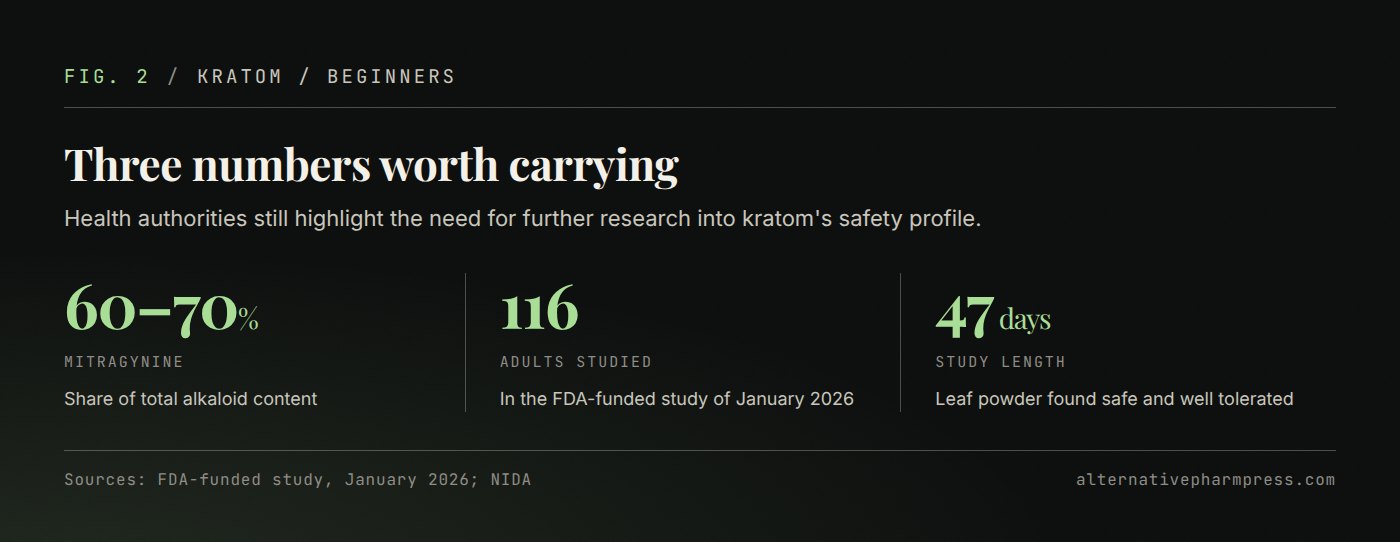
- Mitragynine is usually the most abundant alkaloid in the leaf, reported at around two-thirds of total alkaloid content.4 Lab studies show it is a partial agonist at the human mu-opioid receptor and blocks kappa- and delta-opioid receptors.3 Its pharmacology differs from classic opioids, which is why researchers call it “atypical”. Our explainer on kratom and the opioid receptor goes deeper.
- 7-hydroxymitragynine (7-OH) makes up less than 2% of total alkaloids in natural leaf, but is considerably more potent at the mu-opioid receptor.2,9 The body also makes it: in mouse and human liver preparations, CYP3A enzymes convert mitragynine into 7-OH, and in mice this metabolite explained most of mitragynine’s opioid-receptor pain relief.10
- Mitragynine pseudoindoxyl (MP) is a rearrangement product of 7-OH. The DEA describes it as made by synthetic modification of mitragynine or 7-OH and about 100 times more potent than mitragynine at the mu-opioid receptor in preclinical work.9 It has been temporarily in Schedule I since 26 August 2026.11
Put simply, whole leaf is dominated by a weaker, partial opioid agonist, while newer concentrated products are built around much stronger relatives. Our side-by-side on mitragynine vs 7-hydroxymitragynine sets out the chemistry.
How kratom is sold, and why the products differ
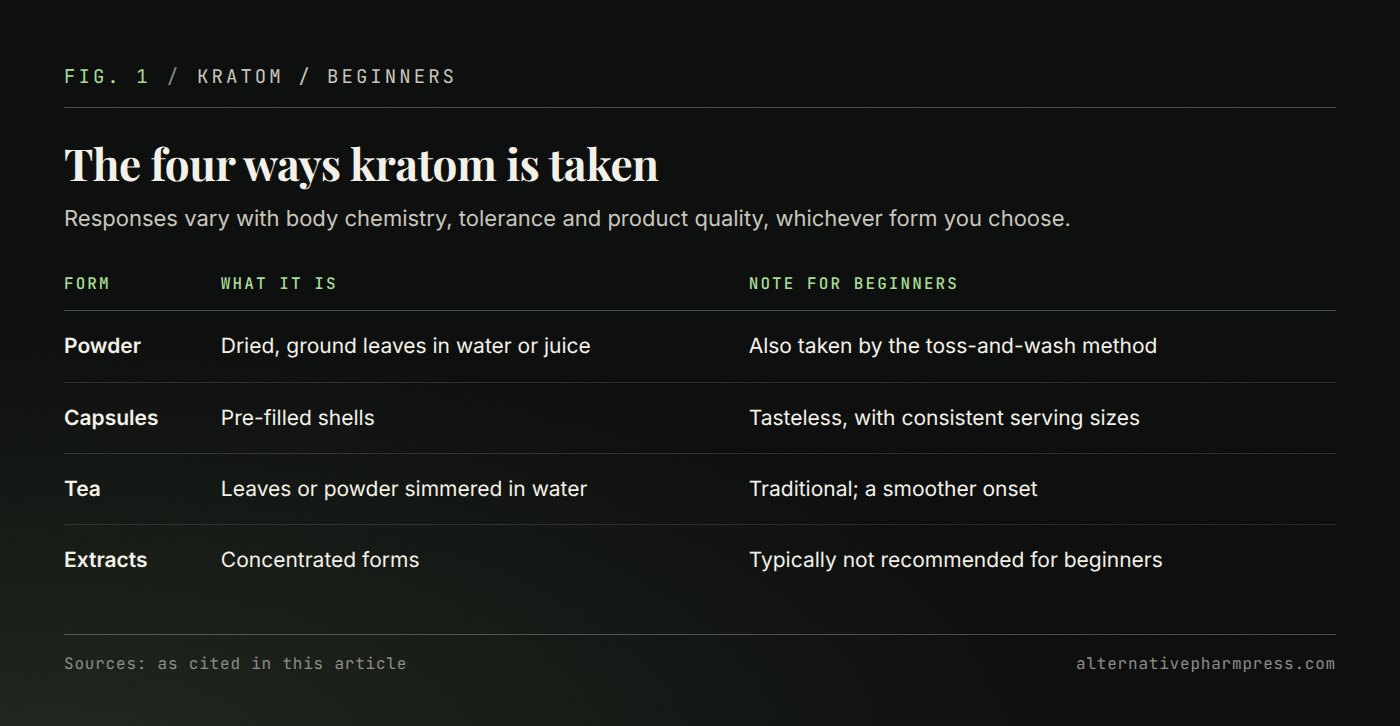
In US shops and online, “kratom” covers several very different product types.
| Product type | What it is | Main alkaloid | Key point |
|---|---|---|---|
| Leaf powder | Dried, ground leaf, often sold by vein colour | Mitragynine | Content varies by batch and harvest |
| Capsules | Leaf powder in gelatine or plant capsules | Mitragynine | Same leaf, pre-measured |
| Tea or brewed drinks | Leaf steeped or boiled in water | Mitragynine | Closest to traditional use |
| Extracts and shots | Concentrated leaf alkaloids in liquid, resin or tablets | Mitragynine, at higher strength | Strength depends on the extract |
| 7-OH and MP products | Tablets, gummies, shots with semi-synthetic 7-OH or MP | 7-OH or MP | Far more potent; targeted by the DEA |
Leaf products are fairly consistent in type, if not in strength. When researchers analysed 341 products used by kratom consumers in a 2022 nationwide study, nearly all were whole-leaf material with similar alkaloid profiles matching Mitragyna speciosa, and they found no adulteration with illicit or prescription drugs.12,13 Capsules and powder are the same leaf in different packaging; see kratom capsules vs powder and our guide to kratom extract vs powder.
Concentrated 7-OH and MP products are a different category. They have spread since 2024. A 2026 potency analysis estimated that, relative to morphine, mitragynine has about one-eighth the mu-opioid potency, while 7-OH and MP are roughly four to five times as potent. Mean opioid exposure per serving ranged from about 2.7 morphine milligram equivalents for powders to 31 for tablets.14 The authors’ firm consults for governments and companies, and the estimates rest on animal and lab data, but the direction is clear. The DEA counted about 250 7-OH products on sale between September 2024 and February 2025.9
Older warnings point the same way. In 2016, toxicologists found commercial kratom products with 7-OH levels far above those in raw leaf, suggesting deliberate fortification.15 In July 2025 the FDA recommended scheduling 7-OH products, stating it was not focused on natural kratom leaf.16 Our guide to 7-OH vs traditional kratom lists the practical differences.
Strains and vein colours
Leaf powder is usually sold under “strain” names that combine a vein colour (red, green, white) with a place (Bali, Borneo, Malay) or grade (Maeng Da). In Southeast Asia no such distinction is traditionally made. When one study had a vendor’s red, green and white products tested, their alkaloid content did not differ significantly, even though users described different effects.4 Our hub on kratom strains explained covers what the labels do and do not mean.
What does kratom do? What the research shows
Kratom’s effects appear to depend on amount. Users and researchers describe stimulation and alertness at lower amounts and pain relief and sedation at moderate to higher amounts.4,1 Most of this comes from self-reports rather than controlled trials.
- Large surveys. In a 2016 online survey of 8,049 US users, people reported using kratom mainly for pain, mood or emotional problems, and withdrawal from prescription opioids. Negative effects, mostly nausea and constipation, clustered at higher and more frequent use.17
- Real-time tracking. A 2024 study followed 357 US adults through 13,401 use events over 15 days on their phones. In the moment, people used kratom mainly for energy, productivity and pain. Most use looked non-problematic, but heavier use was linked to signs of physical dependence, and problems usually began when avoiding withdrawal became the reason to dose.13
- A controlled trial. In a small double-blind study in Malaysia, 26 men who drank kratom daily held their hand in ice water longer one hour after a kratom drink (on average 11 to 25 seconds) but not after a matched placebo.18 The men were long-term daily users, so the result may not apply to others.
What is missing is just as important: there are no large, long-term randomised trials of kratom for pain, mood, opioid withdrawal or anything else, and the FDA has approved no kratom drug.2 Our kratom research overview summarises the wider literature, and our explainer on why there is no official kratom dose covers the dosing question without giving dosing advice.
Is kratom an opioid?
Not in the legal sense, but it acts on the same system. Mitragynine and 7-OH bind and partially activate the mu-opioid receptor, the main target of morphine and oxycodone.3 The FDA lists opioid-type effects, including physical dependence, among kratom’s risks.2 Kratom alkaloids also act on adrenergic and serotonin systems, which may explain the stimulant side.13
The difference is one of degree. Leaf is dominated by a weaker partial agonist; concentrated 7-OH and MP products behave much more like conventional opioids.14 That gap is why US regulators now separate the two.
Kratom risks and side effects
Dependence, tolerance and withdrawal
In a survey of 293 regular users in Malaysia, more than half had severe kratom dependence and 45% moderate dependence. Physical withdrawal symptoms included muscle spasms and pain, trouble sleeping, watery eyes and nose, hot flushes, fever, reduced appetite and diarrhoea. Restlessness, tension, anger, sadness and nervousness were common psychological symptoms.19 The FDA also reports withdrawal signs in newborns exposed to kratom before birth.2 Read more in our guides to how kratom tolerance develops and 7-OH withdrawal.
Liver injury
Liver injury is rare but documented. A 2020 review found 26 published case reports and abstracts, plus cases in a US drug-induced liver injury network and FDA databases. Symptoms such as abdominal discomfort, jaundice, itching and dark urine began a median of about three weeks after starting kratom (range 2 to 49 days), and biopsies were mostly cholestatic. The authors concluded kratom likely causes liver injury, on low-quality human evidence.20 See kratom and liver injury.
Drug interactions
Kratom can change how the body handles some medicines. In 12 healthy adults, a single cup of kratom tea raised exposure to midazolam, a drug cleared by the CYP3A enzyme, by about 39% and peak levels by about 50%, with no effect on a CYP2D6 probe drug.21 Many opioids, benzodiazepines and other medicines use CYP3A. Our guide to kratom and drug interactions lists affected drug classes, and kratom and alcohol covers that combination.
Contamination: Salmonella and heavy metals
Kratom is a minimally processed plant product, and contamination has caused harm. A 2017 to 2018 outbreak linked to kratom caused 199 Salmonella infections in 41 states, with 54 people admitted to hospital.22 FDA testing of 30 kratom products found lead and nickel at levels the agency said could put heavy, long-term users many times above safe daily exposure.23
Deaths and combined use
CDC data from 27 states between July 2016 and December 2017 found kratom in 152 of 27,338 overdose deaths, and it was ruled a cause in 91. Only seven of those 91 had kratom alone detected; fentanyl was found in 65% of the kratom-positive deaths.24 Kratom rarely appears alone in fatal cases, but combining it with opioids, sedatives or alcohol raises the risk.
Children
Accidental exposures happen, mostly in toddlers. In 169 poison centre cases in children under 12, 97% were unintentional, and exposures to 7-OH or MP carried about 2.5 times the odds of serious breathing or neurological effects compared with mitragynine.25 Fruit-flavoured 7-OH gummies are a particular concern.16
Is kratom legal? Status in October 2026
US federal law. Kratom leaf and mitragynine are not controlled substances. The FDA’s position is that kratom cannot be lawfully sold as a dietary supplement, food additive or drug.2
The DEA is moving against concentrated products. On 14 October 2026 it withdrew a July notice and published a revised notice of intent to temporarily place 7-OH and MP in Schedule I above a threshold. A product would be covered if it holds more than 1 mg per gram (or per millilitre for liquids), or if its mitragynine-to-7-OH (or 7-OH plus MP) ratio is below 100. The order cannot be published before 13 November 2026, and there is no comment period.9 Plain leaf below that line is not scheduled, although the DEA notes trace 7-OH occurs in botanical kratom and says below-threshold products are not “deemed safe”. As of 24 October 2026, 7-OH is not yet federally scheduled. Mitragynine pseudoindoxyl, MGM-15 and MGM-16 are already in Schedule I.11 Our 7-OH scheduling explainer tracks each step.
US states. Rules differ widely. Some states and cities ban kratom, while others regulate it with age limits and labelling rules under a Kratom Consumer Protection Act. Check our guide to where kratom is legal in the US before buying or travelling.
Elsewhere. Thailand decriminalised kratom in 2021, Malaysia controls mitragynine, and Australia lists Mitragyna speciosa as a prohibited Schedule 9 substance.7,8,26
How to read a kratom label and COA
A label tells you what the seller claims; a certificate of analysis (COA) shows what a lab found. Our step-by-step guide to reading a kratom lab report walks through a real example. The essentials:
- Know what you are buying. “Leaf”, “powder” or “tea” should mean whole leaf. “Extract”, “enhanced”, “7-OH”, “7-hydroxy” or “MP” signals a concentrated or semi-synthetic product with a very different risk profile.
- Match the batch. The lot number on the COA should match the pack, with a recent test date and a named, independent lab you can contact.
- Check mitragynine as a percentage. Thai field samples ranged from roughly 0.3% to 4.9% of dry weight, depending on season and region.5 A “leaf” product reporting far more suggests extract or fortification.
- Look for a 7-OH number. In natural leaf it is a trace. Look for a figure, or “below LOQ” with the limit stated, from a method that confirms identity; some mass spectrometry methods can falsely identify 7-OH.27 Under the DEA’s revised notice, more than 1 mg per gram or a mitragynine-to-7-OH ratio below 100 would fall in Schedule I.9
- Check heavy metals and microbes. Numeric results for lead, arsenic, cadmium and mercury, plus Salmonella and E. coli reported as not detected.
- Treat health claims as a red flag. Products promising to treat pain, anxiety or opioid withdrawal are making unlawful drug claims.
Our list of kratom COA red flags covers common tricks, and our best kratom brands of 2026 list explains how we judge lab transparency. If you are drug tested, see does kratom show up on a drug test: standard panels do not look for it, but dedicated tests do.
When to seek help
Get urgent medical help, or call 911 in the US, if someone who has taken kratom or a 7-OH product has slow or shallow breathing, is hard to wake, has blue lips, a seizure, chest pain or severe confusion. Naloxone can reverse the opioid effects of 7-OH, so use it if available.28 For a possible poisoning, including a child swallowing a product, US Poison Help is free and open 24 hours a day on 1-800-222-1222.29
See a doctor promptly for yellowing of the skin or eyes, dark urine, itching or persistent abdominal pain, which can signal liver injury.20 If you are struggling to cut down, or withdrawal keeps you dosing, treatment works. In a US case series of 28 people with kratom use disorder, most stayed in buprenorphine-naloxone treatment and stopped testing positive for mitragynine.30 SAMHSA’s free, confidential National Helpline is open 24/7 on 1-800-662-4357.31 Talk to a clinician before stopping heavy daily use, because withdrawal can be hard to manage alone.
Frequently asked questions
What is kratom in simple terms?
Kratom is a plant product made from the leaves of Mitragyna speciosa, a tree native to Southeast Asia in the coffee family. The leaves contain alkaloids, mainly mitragynine, that act on opioid receptors in the brain. People take it as powder, capsules or tea, and report stimulant-like effects at lower amounts and opioid-like effects at higher ones. It is not an approved medicine in the US.2,3
What does kratom do to your body?
Mitragynine and 7-OH partially activate the mu-opioid receptor, which can relieve pain and cause sedation, and kratom also affects adrenergic and serotonin systems, which may explain its stimulant effects.3,13 Common side effects include nausea and constipation. Regular use can lead to tolerance, dependence and withdrawal, and rare cases of liver injury have been reported.17,19,20
Is kratom safe for beginners?
No kratom product has been shown to be safe in controlled long-term studies, and there is no official dose. Product strength varies by batch, and concentrated 7-OH products are far more potent than leaf.14 Kratom can interact with medicines, alcohol and sedatives.21 Anyone considering it should talk to a doctor or pharmacist first, especially if they take prescription drugs.
Is kratom the same as 7-OH?
No. 7-OH (7-hydroxymitragynine) is a minor alkaloid making up less than 2% of the alkaloids in natural leaf, but it is much more potent at opioid receptors.2 Many products now sold as “kratom” contain concentrated, semi-synthetic 7-OH. The DEA’s October 2026 notice targets those products above a threshold, not plain leaf.9
Is kratom legal in the US?
Kratom leaf is not federally scheduled as of 24 October 2026, but the FDA says it cannot be lawfully sold as a supplement or food.2 The DEA intends to temporarily schedule 7-OH and MP products above a threshold, with an order possible from 13 November 2026.9 Some states and cities ban kratom, and others set age and labelling rules.
Is kratom addictive?
It can be. In a survey of 293 regular users in Malaysia, more than half had severe dependence and 45% moderate dependence, with withdrawal symptoms such as muscle aches, poor sleep, restlessness and diarrhoea.19 A US study found most users reported non-problematic use, but problems usually began when people used kratom to avoid withdrawal.13
Does kratom show up on a drug test?
Not on standard workplace panels, which do not look for mitragynine. Laboratories can detect mitragynine with dedicated mass spectrometry methods; one US forensic lab reported 1,001 positive blood specimens over 27 months.32 Methods that separate 7-OH from look-alike compounds also exist.27 Anyone subject to testing should assume kratom can be found if the lab is asked to look for it.
What does kratom feel like?
People describe mild stimulation at lower amounts and sedation, pain relief and euphoria at higher amounts. Effects vary widely with the product, the person and tolerance, and side effects such as nausea and dizziness are common.
Is kratom safe?
Kratom carries real risks, including dependence, withdrawal, constipation, rare liver injury and dangerous interactions with other sedating drugs. Risks rise with concentrated extracts and 7-OH products. Talk to a clinician if you take other medications.
Sources
- Ransden KE, Ramachandria P, Laforest LC, Kanumuri SRR, Sharma A, McCurdy CR, Nadakuduti SS. Comparative analysis of monoterpene indole alkaloid composition and genotypic variation in Thai Mitragyna speciosa. Front Plant Sci. 2026;17:1821609. DOI: 10.3389/fpls.2026.1821609. PMID: 42158609. pubmed.ncbi.nlm.nih.gov
- US Food and Drug Administration. FDA and Kratom. FDA Public Health Focus; content current as of 2 December 2025. fda.gov
- Kruegel AC, Gassaway MM, Kapoor A, Váradi A, Majumdar S, Filizola M, Javitch JA, Sames D. Synthetic and Receptor Signaling Explorations of the Mitragyna Alkaloids: Mitragynine as an Atypical Molecular Framework for Opioid Receptor Modulators. J Am Chem Soc. 2016;138(21):6754-6764. DOI: 10.1021/jacs.6b00360. PMID: 27192616. pubmed.ncbi.nlm.nih.gov
- Huisman G, Menke M, Grundmann O, Schreiber R, Mason N. Examining the Psychoactive Differences between Kratom Strains. Int J Environ Res Public Health. 2023;20(14):6425. DOI: 10.3390/ijerph20146425. PMID: 37510657. pubmed.ncbi.nlm.nih.gov
- Sengnon N, Vonghirundecha P, Chaichan W, Juengwatanatrakul T, Onthong J, Kitprasong P, et al. Seasonal and Geographic Variation in Alkaloid Content of Kratom (Mitragyna speciosa (Korth.) Havil.) from Thailand. Plants (Basel). 2023;12(4):949. DOI: 10.3390/plants12040949. PMID: 36840297. pubmed.ncbi.nlm.nih.gov
- Zhang M, Lyndon A, Kanumuri SRR, Sharma A, Pearson BJ, McCurdy CR, Chen J. Alkaloid biosynthesis in medicinal crop kratom (Mitragyna speciosa) varies with postharvest, genetic, and seasonal factors. Front Plant Sci. 2025;16:1653916. DOI: 10.3389/fpls.2025.1653916. PMID: 41090093. pubmed.ncbi.nlm.nih.gov
- Tilleke & Gibbins. Thailand decriminalizes kratom in amended Narcotics Act. 2021. tilleke.com
- Malay Mail. Home minister: proposed industrialisation of cannabis, ketum in Malaysia needs control mechanism. 6 October 2022. malaymail.com
- Drug Enforcement Administration. Schedules of Controlled Substances: Temporary Placement of 7-Hydroxymitragynine and Mitragynine Pseudoindoxyl Above a Specified Threshold in Schedule I (notice of intent). Federal Register. 14 October 2026;91 FR 65370. Document 2026-20943. Docket DEA-1570. federalregister.gov
- Kruegel AC, Uprety R, Grinnell SG, Langreck C, Pekarskaya EA, Le Rouzic V, et al. 7-Hydroxymitragynine Is an Active Metabolite of Mitragynine and a Key Mediator of Its Analgesic Effects. ACS Cent Sci. 2019;5(6):992-1001. DOI: 10.1021/acscentsci.9b00141. PMID: 31263758. pubmed.ncbi.nlm.nih.gov
- Vicente LLP. DEA places three kratom-related substances in Schedule I as 7-OH scheduling remains pending. 9 September 2026. vicentellp.com
- Sharma A, Smith KE, Kuntz MA, Berthold EC, Elashkar OI, Guadagnoli N, et al. Chemical Analysis and Alkaloid Intake for Kratom Products Available in the United States. Drug Test Anal. 2025;17(10):1974-1984. DOI: 10.1002/dta.3906. PMID: 40377101. pubmed.ncbi.nlm.nih.gov
- Smith KE, Panlilio LV, Feldman JD, Grundmann O, Dunn KE, McCurdy CR, Garcia-Romeu A, Epstein DH. Ecological Momentary Assessment of Self-Reported Kratom Use, Effects, and Motivations Among US Adults. JAMA Netw Open. 2024;7(1):e2353401. DOI: 10.1001/jamanetworkopen.2023.53401. PMID: 38277146. pubmed.ncbi.nlm.nih.gov
- Heywood J, Farnham H, Jackson E, Steimel K, Brown S, Riordan A. Beyond kratom: Concentrated 7-hydroxymitragynine and mitragynine pseudoindoxyl products, an MME potency assessment. Regul Toxicol Pharmacol. 2026;173:106272. DOI: 10.1016/j.yrtph.2026.106272. PMID: 42838255. pubmed.ncbi.nlm.nih.gov
- Lydecker AG, Sharma A, McCurdy CR, Avery BA, Babu KM, Boyer EW. Suspected Adulteration of Commercial Kratom Products with 7-Hydroxymitragynine. J Med Toxicol. 2016;12(4):341-349. DOI: 10.1007/s13181-016-0588-y. PMID: 27752985. pubmed.ncbi.nlm.nih.gov
- US Department of Health and Human Services. FDA takes steps to restrict 7-OH opioid products threatening American consumers (recommendation to schedule certain 7-OH products). 29 July 2025. hhs.gov
- Grundmann O. Patterns of Kratom use and health impact in the US: Results from an online survey. Drug Alcohol Depend. 2017;176:63-70. DOI: 10.1016/j.drugalcdep.2017.03.007. PMID: 28521200. pubmed.ncbi.nlm.nih.gov
- Vicknasingam B, Chooi WT, Rahim AA, Ramachandram D, Singh D, Ramanathan S, et al. Kratom and Pain Tolerance: A Randomized, Placebo-Controlled, Double-Blind Study. Yale J Biol Med. 2020;93(2):229-238. PMID: 32607084. pubmed.ncbi.nlm.nih.gov
- Singh D, Müller CP, Vicknasingam BK. Kratom (Mitragyna speciosa) dependence, withdrawal symptoms and craving in regular users. Drug Alcohol Depend. 2014;139:132-137. DOI: 10.1016/j.drugalcdep.2014.03.017. PMID: 24698080. pubmed.ncbi.nlm.nih.gov
- Schimmel J, Dart RC. Kratom (Mitragyna Speciosa) Liver Injury: A Comprehensive Review. Drugs. 2020;80(3):263-283. DOI: 10.1007/s40265-019-01242-6. PMID: 31919755. pubmed.ncbi.nlm.nih.gov
- Tanna RS, Nguyen JT, Hadi DL, Layton ME, White JR, Cech NB, Oberlies NH, Rettie AE, Thummel KE, Paine MF. Clinical Assessment of the Drug Interaction Potential of the Psychotropic Natural Product Kratom. Clin Pharmacol Ther. 2023;113(6):1315-1325. DOI: 10.1002/cpt.2891. PMID: 36924284. pubmed.ncbi.nlm.nih.gov
- Schwensohn C, Nsubuga J, Cronquist L, Jose G, Mastel L, McCullough L, et al. A Multiple-Serotype Outbreak of Salmonella Infections Linked to Kratom, United States, 2017-2018. Foodborne Pathog Dis. 2022;19(9):648-653. DOI: 10.1089/fpd.2022.0013. PMID: 35917511. pubmed.ncbi.nlm.nih.gov
- US Food and Drug Administration. Laboratory Analysis of Kratom Products for Heavy Metals. FDA Public Health Focus; content current as of 3 April 2019. fda.gov
- Olsen EO, O’Donnell J, Mattson CL, Schier JG, Wilson N. Notes from the Field: Unintentional Drug Overdose Deaths with Kratom Detected: 27 States, July 2016-December 2017. MMWR Morb Mortal Wkly Rep. 2019;68(14):326-327. DOI: 10.15585/mmwr.mm6814a2. PMID: 30973850. pubmed.ncbi.nlm.nih.gov
- Hoffmann NA, Lee SC, Oakland CL, Cole JB, Olives TD, Fuchs RT, Pepin LC. Risk of respiratory and neurologic effects in children ingesting kratom and related alkaloids. Am J Emerg Med. 2026;110:325-327. DOI: 10.1016/j.ajem.2026.08.044. PMID: 42715782. pubmed.ncbi.nlm.nih.gov
- Australian Border Force. ABF seizes psychoactive plant in Sydney. 21 August 2024 (updated 22 September 2024). abf.gov.au
- Sheehan D, Li Y, Meckler E, Upton R, Zhang M. Avoiding False Identification of 7-Hydroxymitragynine in Kratom Products Using a Multicriteria LC-MS Confirmation. J Am Soc Mass Spectrom. 2026;37(5):1303-1312. DOI: 10.1021/jasms.6c00088. PMID: 41989479. pubmed.ncbi.nlm.nih.gov
- Gour A, Mukhopadhyay S, Henderson A, Awad A, Seabra MA, Pullman M, et al. From Kratom to Semi-Synthetic Opioids: The Rise and Risks of MGM-15. Drug Test Anal. 2025;17(12):2384-2389. DOI: 10.1002/dta.3952. PMID: 40936282. pubmed.ncbi.nlm.nih.gov
- America’s Poison Centers. About Poison Help (1-800-222-1222). Accessed 24 October 2026. poisonhelp.org
- Broyan VR, Brar JK, Allgaier Student T, Allgaier JT. Long-term buprenorphine treatment for kratom use disorder: A case series. Subst Abus. 2022;43(1):763-766. DOI: 10.1080/08897077.2021.2010250. PMID: 35112990. pubmed.ncbi.nlm.nih.gov
- Substance Abuse and Mental Health Services Administration. SAMHSA’s National Helpline. Accessed 24 October 2026. samhsa.gov
- Papsun DM, Chan-Hosokawa A, Friederich L, Brower J, Graf K, Logan B. The Trouble With Kratom: Analytical and Interpretative Issues Involving Mitragynine. J Anal Toxicol. 2019;43(8):615-629. DOI: 10.1093/jat/bkz064. PMID: 31424079. pubmed.ncbi.nlm.nih.gov
This article is for educational purposes only and is not medical or legal advice. Products discussed here are not intended to diagnose, treat, cure or prevent any disease. Laws vary by location and change often, so verify the rules that apply where you are. Always talk to a licensed healthcare provider before use, especially if you are under 21, pregnant or nursing, taking medication, or managing a health condition.