
After capsules and injections, the newest BPC-157 format is the nasal spray. Sellers market it as needle-free, fast-acting and sometimes as a way to deliver the peptide “directly to the brain” for mood, focus or concussion recovery. Searches for BPC-157 nasal spray have grown quickly.
This article explains how nasal delivery of peptides works in principle, what we know (and don’t know) about BPC-157 nasal sprays specifically, and the quality, safety and regulatory issues to consider.
Key takeaways
- The nose offers a large, blood-rich surface and a possible nose-to-brain pathway, which is why some medicines use nasal delivery.
- Absorption of peptides through the nose is usually low and variable without special formulation technology.
- There are no published human studies of BPC-157 nasal sprays — on absorption, brain delivery or effects.
- Non-sterile or poorly preserved sprays risk infection and irritation.
- BPC-157 is not FDA-approved, is sold as “research use only” and is banned in sport.
Why the nose is an interesting route
Nasal sprays are used for decongestants, allergy steroids, migraine drugs, emergency naloxone and some hormones. The inside of the nose has a thin lining with many blood vessels, so certain drugs can enter the bloodstream quickly without passing through the stomach and liver.
There’s also the nose-to-brain idea. The olfactory region at the top of the nasal cavity connects closely with the brain via olfactory and trigeminal nerve pathways. Researchers have explored whether drugs can travel along these pathways to bypass the blood-brain barrier. Intranasal insulin and oxytocin have been studied this way, with mixed results.
Why peptides are hard to deliver through the nose
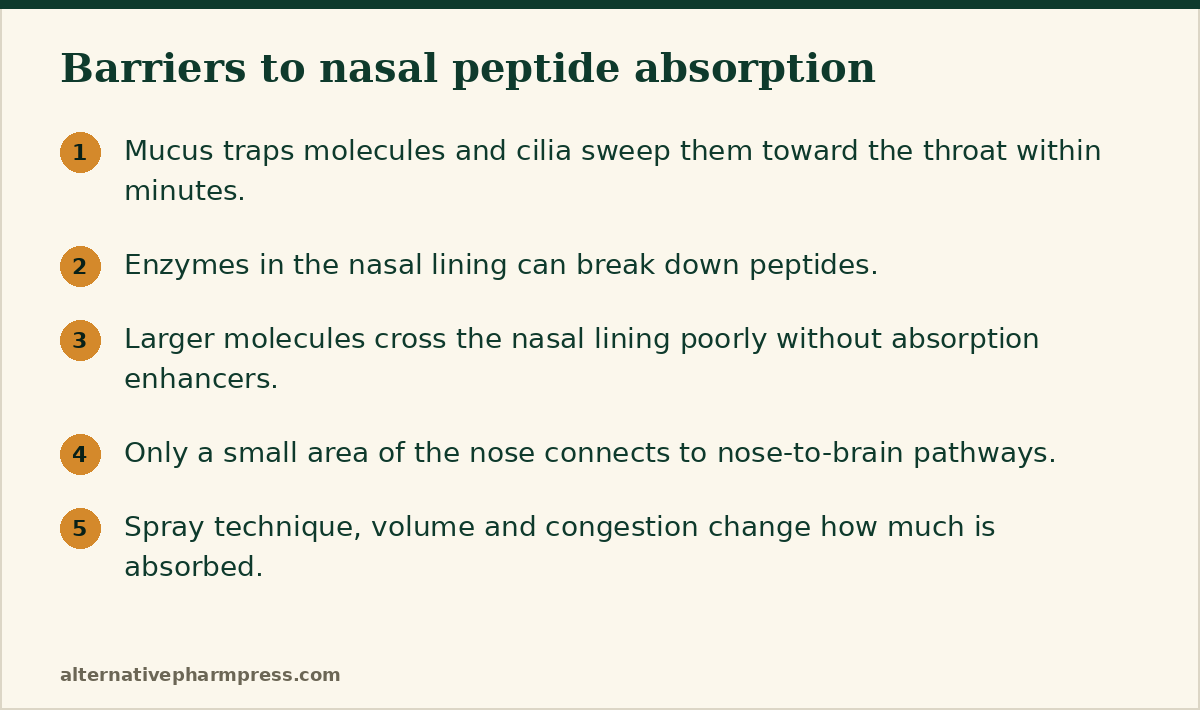
Pharmaceutical nasal peptides often use absorption enhancers, special devices and carefully studied formulations. Even then, bioavailability can be modest. A homemade-style spray of BPC-157 in saline doesn’t have that engineering behind it.
What we know about BPC-157 nasal spray specifically
Very little. BPC-157 research is mostly in rodents, using oral, injected or topical routes. We haven’t found published studies measuring BPC-157 absorption through the human nose, its concentration in the brain after nasal use, or clinical outcomes. Claims that a nasal spray helps with concussion, anxiety, brain fog or depression rely on extrapolation from animal studies of other routes, plus anecdotes.
For context on the overall evidence, read BPC-157 benefits and oral BPC-157 capsules vs injections.
Nasal spray vs other BPC-157 formats
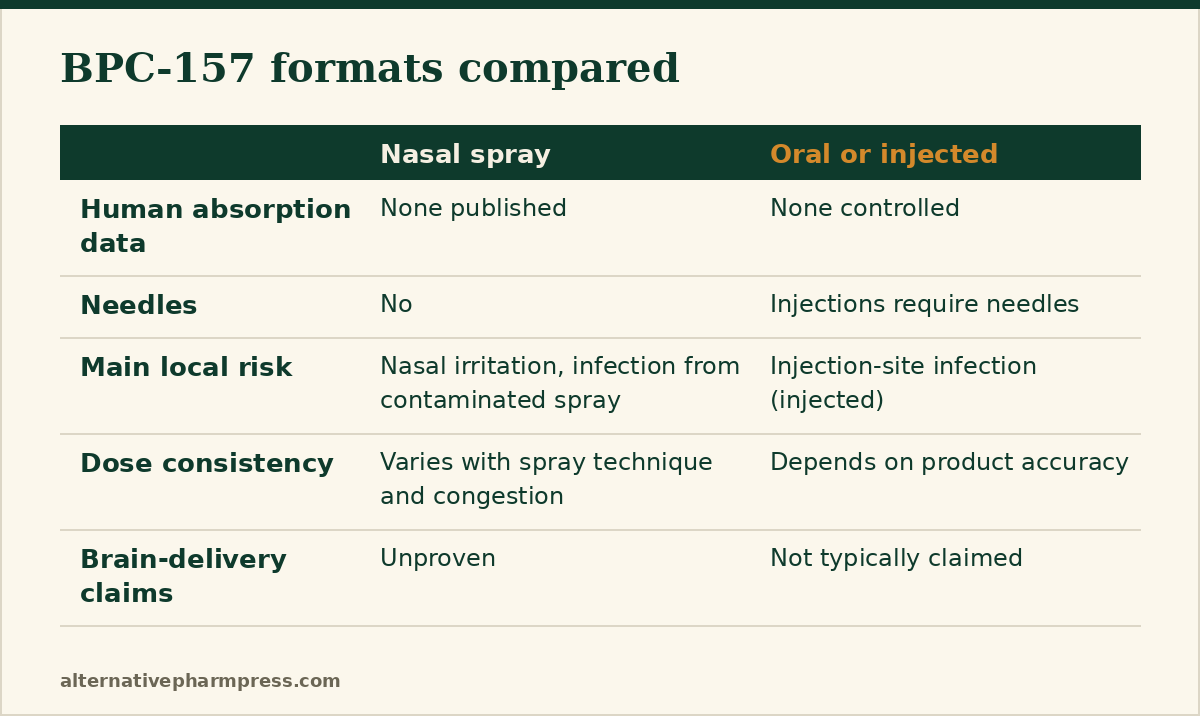
Quality and sterility concerns
Anything sprayed into the nose should be sterile or properly preserved. Concerns with gray-market peptide sprays include:
- Microbial contamination — multi-dose bottles without preservatives can grow bacteria or fungi after opening.
- Endotoxins — bacterial residues found in some research peptide products can cause inflammation.
- Unknown concentration — dose per spray depends on accurate formulation.
- Peptide degradation — BPC-157 in solution may break down over time, especially without refrigeration.
- Irritating additives — some preservatives or solvents can irritate nasal tissue.
Learn how to evaluate testing in how to read a peptide COA.
Safety unknowns
- Long-term safety of BPC-157 in any form is unknown; see BPC-157 side effects and safety.
- Nasal side effects could include irritation, nosebleeds, congestion or infection.
- Brain effects — if nose-to-brain delivery occurred, the consequences of BPC-157 in brain tissue haven’t been studied in humans.
- Theoretical tumor concern related to angiogenesis applies here too.
- Pregnancy and breastfeeding: no data; avoid.
Regulatory and legal status
BPC-157 isn’t an approved drug. The FDA flagged it among bulk drug substances with safety concerns for compounding, and gray-market products carry “research use only” labels. Nasal sprays marketed for human use with health claims fall outside legal channels. WADA prohibits BPC-157 for tested athletes. See the FDA advisory vote on BPC-157 and what research-use-only means.
What about other nasal peptides?
Nasal sprays are also marketed for semax and selank, peptides developed in Russia where they’re approved for some uses. They have more nasal-specific research than BPC-157, though evidence outside Russia is limited. See selank vs semax. Approved intranasal medicines elsewhere include naloxone, certain migraine drugs and some hormone treatments — all developed with specific formulation research.
Concussion and brain health claims
Some sellers market BPC-157 nasal spray for concussion recovery. Concussion care has a growing evidence base: graded return to activity, managing symptoms, sleep, vestibular therapy and specialist follow-up when symptoms persist. Using an unapproved peptide could delay recognizing a serious problem. Anyone with a head injury and worsening headache, vomiting, confusion or weakness needs urgent medical evaluation.
How to think about new delivery formats
When a new format appears, ask:
- Has anyone measured how much reaches the bloodstream (or brain) in humans?
- Is the formulation designed for that route, with appropriate preservatives and absorption technology?
- Is the product sterile and tested?
- Do claims match the evidence, or are they borrowed from studies of other routes?
For BPC-157 nasal sprays, the answers are currently “no,” “usually not,” “often unclear” and “mostly borrowed.”
The marketing pattern to watch for
New peptide formats often follow a predictable marketing path. First, a mechanism is described (“the nose connects to the brain”). Next, research on a different compound or route is cited (“intranasal insulin reached the brain in studies”). Then anecdotes fill the gap (“users report clearer thinking within days”). The missing step is direct evidence that this specific product, given this way, does what’s claimed. When you see the pattern, treat the claims as hypotheses rather than facts.
Practical risks of DIY nasal sprays
Some people make their own nasal sprays by reconstituting research peptide powder in saline or bacteriostatic water and transferring it to a spray bottle. Beyond the uncertainty about the peptide itself, this introduces hygiene risks: non-sterile bottles, contamination each time the nozzle touches the nose, and no preservative system designed for nasal use. Bacteriostatic water contains benzyl alcohol, which isn’t intended for repeated nasal application and may irritate tissue.
Storage and stability questions
Peptides are fragile molecules. In dry, freeze-dried form they can stay stable for months when kept cold and away from light. Once dissolved in water, the clock starts. Heat, repeated temperature swings, light and contamination can all break the chain of amino acids into fragments that may be inactive. A nasal spray bottle that lives in a warm bathroom or a gym bag for weeks is a poor environment for any peptide.
Most gray-market sellers don’t publish stability data showing how long their spray stays at label strength after opening. Without that, there’s no way to know whether the last spray in the bottle contains anything close to the first. Pharmaceutical nasal products, by contrast, must show stability over their full shelf life and in-use period.
What a responsible seller would disclose
If you’re evaluating any peptide nasal product, a credible supplier should be able to answer these questions in writing:
- Exact concentration in mg per mL and the volume delivered per spray.
- Preservative system and why it’s suitable for nasal use.
- Sterility and endotoxin testing for the finished spray, not just the raw powder.
- Identity and purity testing (HPLC and mass spectrometry) for the batch.
- Stability data after opening, and recommended storage.
- Batch number printed on the bottle that matches the lab report.
A product that can’t answer most of these is effectively an unknown solution in a spray bottle.
How nasal sprays are evaluated for approved drugs
When regulators review a nasal medicine, they look at much more than the active ingredient. They examine droplet size (which determines where in the nose the spray lands), spray pattern, dose uniformity from first to last spray, irritation in animal and human tissue, and how much drug reaches the blood over time. Many promising nasal formulations fail at one of these steps. This is why “it works as an injection, so it should work as a spray” isn’t a safe assumption for any compound.
Talking to a clinician
If you’re considering BPC-157 for an injury, gut problem or brain-related symptom, a clinician can review evidence-based options first and help you weigh unknowns honestly. Bring the exact product and its lab report, and mention any medications, history of cancer or pregnancy plans. Sports medicine physicians, physiotherapists and gastroenterologists can often offer treatments with stronger evidence for the underlying problem.
FAQ
How long does a BPC-157 nasal spray last once opened?
There’s no published stability data for most products. Peptides in solution can degrade with heat, light and contamination, so potency after opening is uncertain.
Does BPC-157 nasal spray work?
There are no published human studies showing BPC-157 nasal spray is absorbed effectively or produces benefits. Claims are extrapolated from animal research on other routes.
Can BPC-157 nasal spray reach the brain?
Nose-to-brain delivery is a real research area, but it hasn’t been demonstrated for BPC-157 in humans.
Is BPC-157 nasal spray safe?
Its safety is unknown. Non-sterile sprays risk infection and irritation, and long-term effects of BPC-157 haven’t been studied.
Is nasal BPC-157 better than injections?
There’s no human evidence comparing them. Nasal sprays avoid needles but add uncertainty about absorption.
Is BPC-157 nasal spray legal?
BPC-157 isn’t FDA-approved and is sold as a research chemical. It’s prohibited in sport.