
If there’s one nootropic combination with real research behind it, it’s L-theanine and caffeine. Found together naturally in tea, the pair has been studied in dozens of small trials. Many people take them as a supplement stack — often 200 mg of L-theanine with 100 mg of caffeine — hoping for focused energy without the jitters.
This guide explains how each compound works, what research shows about the combination, common ratios and timing, side effects and who should be cautious.
Key takeaways
- Caffeine blocks adenosine receptors, increasing alertness; L-theanine is an amino acid from tea that promotes relaxed alertness.
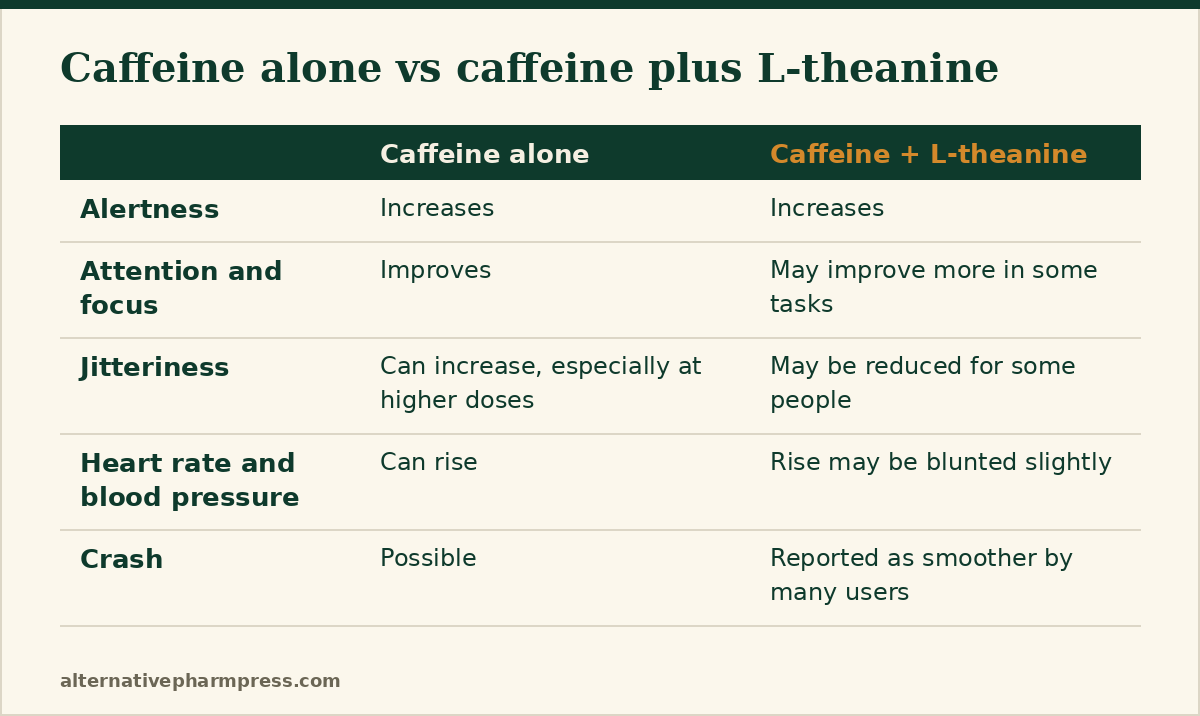
- Small trials suggest the combination may improve attention, task switching and alertness more than caffeine alone, and may reduce jitteriness for some people.
- A common supplement ratio is 2:1 L-theanine to caffeine (e.g., 200 mg L-theanine + 100 mg caffeine).
- Effects typically begin within 30–60 minutes and last a few hours.
- Caffeine’s risks still apply: sleep disruption, increased heart rate and anxiety in sensitive people.
How caffeine works
Caffeine blocks adenosine receptors in the brain. Adenosine builds up during waking hours and promotes sleepiness, so blocking it boosts alertness, attention and reaction time. Caffeine also increases heart rate and can cause jitteriness, anxiety and stomach upset at higher doses.
How L-theanine works
L-theanine is an amino acid found mainly in tea leaves (Camellia sinensis). It crosses the blood-brain barrier and appears to:
- Increase alpha brain-wave activity, associated with relaxed alertness.
- Modulate neurotransmitters such as GABA, dopamine and serotonin.
- Reduce stress responses in some studies, such as lowering heart rate under stress.
L-theanine alone usually doesn’t cause sedation at typical doses.
Why combine them?
What the research shows
Several small randomized, placebo-controlled studies have tested L-theanine and caffeine together:
- Attention and task switching — some studies found the combination improved accuracy and speed on attention tasks compared with placebo, and sometimes compared with caffeine alone.
- Alertness and mood — participants often reported feeling more alert and less tired.
- Reduced distraction — some EEG studies suggest less susceptibility to distraction.
- Blood pressure — L-theanine may blunt caffeine-induced blood pressure increases in some people.
Limitations include small sample sizes, short-term testing (often a single dose) and variable doses. Benefits are generally modest. For broader context, see nootropics beginners guide.
Common ratios and doses
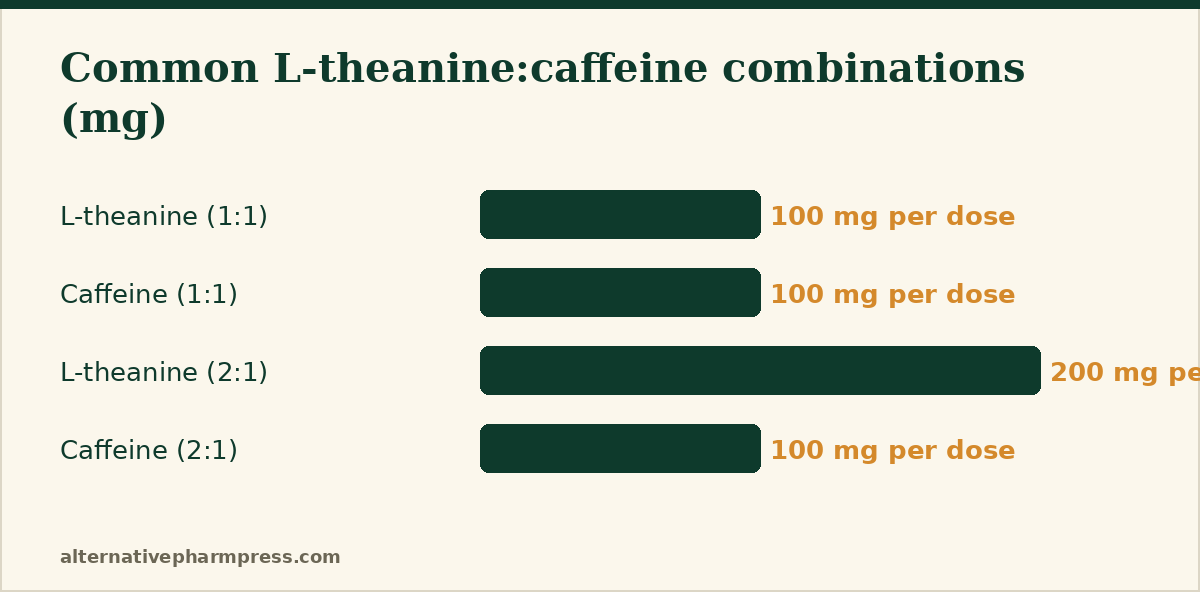
- 1:1 — e.g., 100 mg L-theanine + 100 mg caffeine.
- 2:1 — e.g., 200 mg L-theanine + 100 mg caffeine (very common in supplements).
- Studies used L-theanine from about 50 to 250 mg and caffeine from 40 to 150 mg.
For reference, a cup of brewed coffee has roughly 95 mg of caffeine; a cup of green tea has about 30–50 mg of caffeine and 10–30 mg of L-theanine.
Timing
Effects typically begin within 30–60 minutes. Many people take the stack in the morning or before demanding tasks. Because caffeine’s half-life is about five hours, avoid taking it in the late afternoon or evening if you’re sensitive to sleep disruption.
Getting L-theanine and caffeine from tea vs supplements
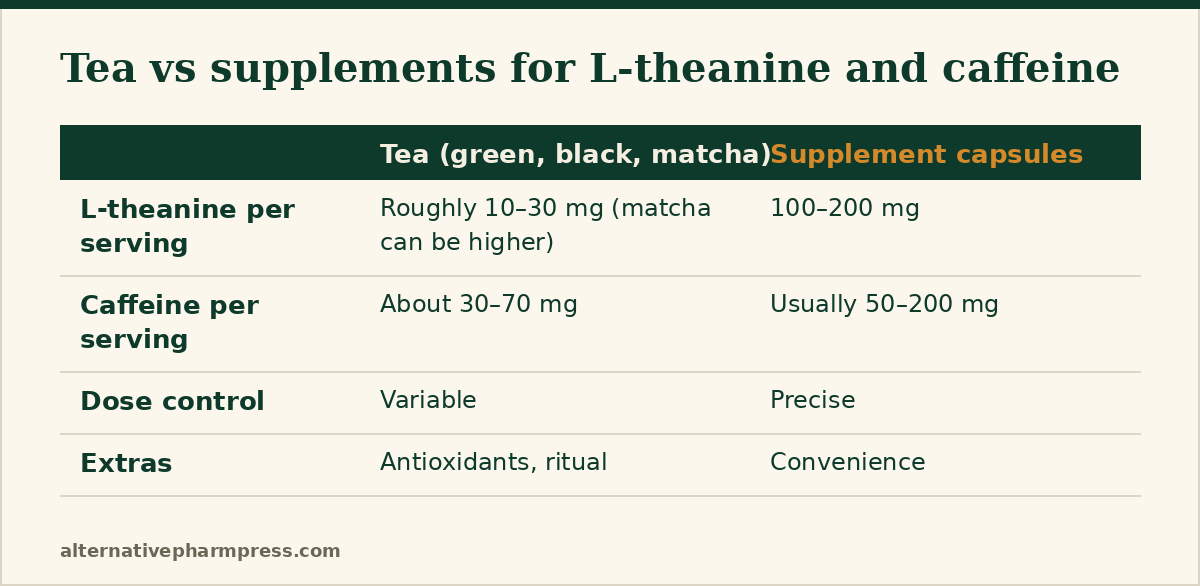
Matcha, made from powdered whole tea leaves, contains more L-theanine and caffeine than brewed green tea. Supplements allow higher L-theanine doses closer to those studied.
Side effects and safety
L-theanine is generally well tolerated; side effects are rare and may include headache or mild stomach upset. Caffeine side effects include:
- Insomnia if taken too late.
- Rapid heart rate, palpitations.
- Anxiety or jitteriness at higher doses.
- Stomach upset.
- Dependence and withdrawal headaches with regular use.
The FDA notes that up to about 400 mg of caffeine per day is generally not associated with dangerous effects in healthy adults.
Who should be cautious
- Pregnant or breastfeeding people (limit caffeine per medical advice).
- People with heart arrhythmias, high blood pressure or anxiety disorders.
- Anyone taking stimulant medications or medications that interact with caffeine.
- People on blood pressure medications — L-theanine may lower blood pressure slightly.
- Children and teens.
How to try the stack sensibly
- Count total caffeine from all sources.
- Start with a modest dose, such as 100 mg L-theanine + 50–100 mg caffeine.
- Take it earlier in the day.
- Assess effects on focus, mood and sleep over several days.
- Compare with caffeine alone to see whether L-theanine adds value for you.
- Avoid stacking with energy drinks or pre-workouts.
L-theanine in products
L-theanine is found in many nootropic products: drinks, pouches, gummies and capsules. Check the amount — some products include only small “label dressing” doses. See nootropic energy drinks, nootropic drinks and nootropic pouches.
L-theanine on its own
Some people take L-theanine alone for relaxation or sleep support. Small studies suggest it may reduce stress responses and improve sleep quality in some people, though evidence is limited. Unlike sedatives, L-theanine doesn’t usually cause drowsiness. For other options, see best supplements for anxiety and ashwagandha vs rhodiola.
Tolerance
Caffeine tolerance develops with regular use, reducing its alerting effects. L-theanine doesn’t appear to cause tolerance in the same way. Cycling caffeine or taking breaks can help restore sensitivity.
Who might benefit most
People who enjoy coffee but feel jittery or anxious after drinking it may find adding L-theanine helpful. Students and knowledge workers who want sustained attention during long tasks often use the stack. Gamers and programmers frequently report subjective improvements in focus. Results vary, and some people notice little difference compared with caffeine alone. The stack isn’t a substitute for sleep, exercise or treatment of conditions like ADHD.
L-theanine and ADHD
Some small studies have explored L-theanine, alone or with caffeine, in children and adults with ADHD, with mixed results. The stack shouldn’t replace evidence-based ADHD treatment, and people taking prescription stimulants should talk to their clinician before adding caffeine supplements, as effects can add together.
The role of expectations
Because the stack is popular and widely praised online, expectation may influence how people feel. Double-blind studies are designed to account for this, and they still show modest effects for some measures. In everyday life, a simple personal test — alternating days with and without L-theanine while keeping caffeine the same — can help you see whether it makes a difference for you.
Quality and labeling
L-theanine supplements are sold under brand names like Suntheanine, which is a patented form made through fermentation. Generic L-theanine is also available. Look for products that list the amount of L-theanine per capsule, and choose brands with third-party testing to confirm purity. Avoid products with proprietary blends that hide the dose.
Building a personal routine
Many people find the stack works best as part of a broader routine rather than a quick fix. A typical pattern might be a morning coffee with an L-theanine capsule, followed by a focused work block, then a short walk or break. Avoiding caffeine after early afternoon protects sleep, which is one of the most important factors for next-day focus. On days when you’re well rested, you may need less caffeine to feel alert.
Matcha: a natural version of the stack
Matcha is made by grinding shade-grown tea leaves into powder, so you consume the whole leaf. Shade-growing increases L-theanine levels. A typical serving of matcha may provide around 30–70 mg of caffeine and a meaningful amount of L-theanine, though content varies by grade and serving size. Many people describe matcha as producing calm, steady energy — consistent with the effects reported for the supplement stack. Matcha also contains antioxidants such as EGCG.
Interactions to consider
Caffeine interacts with a number of medications, including some antibiotics (like ciprofloxacin), certain antidepressants, theophylline and stimulant medications. L-theanine may modestly lower blood pressure and could, in theory, add to the effects of blood pressure medications or sedatives. If you take prescription medications, ask a pharmacist before starting a supplement stack.
FAQ
What does L-theanine do with caffeine?
It may enhance attention and alertness while reducing jitteriness and caffeine-related stress responses for some people.
What’s the best ratio of L-theanine to caffeine?
A 2:1 ratio (e.g., 200 mg L-theanine + 100 mg caffeine) is common, though studies used various ratios.
How long does the L-theanine and caffeine stack last?
Effects often last three to five hours, depending on caffeine dose and individual metabolism.
Is L-theanine safe to take daily?
It’s generally well tolerated in studies. Caffeine’s daily limits and side effects still apply.
Can I get enough L-theanine from tea?
Tea contains L-theanine, but usually less than supplement doses used in studies. Matcha contains more than brewed green tea.
Does L-theanine help with sleep?
Some small studies suggest it may improve sleep quality, but taking it with caffeine at night could disrupt sleep.