
TB-500 is one of the most talked-about recovery peptides, often paired with BPC-157 in “healing stacks.” Sellers market it for faster recovery from tendon, ligament and muscle injuries, improved flexibility and reduced inflammation. But what is TB-500 exactly, and what does the research actually show?
This overview explains how TB-500 relates to thymosin beta-4 (Tβ4), summarizes animal and early human studies, discusses safety questions and quality issues, and covers its regulatory and sporting status.
Key takeaways
- Thymosin beta-4 is a naturally occurring 43-amino-acid protein involved in cell migration, blood vessel formation and tissue repair.
- TB-500 usually refers to a synthetic fragment of Tβ4 (often the active region around amino acids 17–23), though products vary.
- Animal studies suggest roles in wound healing, heart repair, eye surface repair and muscle and tendon healing.
- Human research on full-length Tβ4 exists for some uses (eye drops, wound gels); TB-500 itself lacks clinical trials.
- TB-500 isn’t FDA-approved, is sold as research use only and is banned by WADA.
Thymosin beta-4 vs TB-500
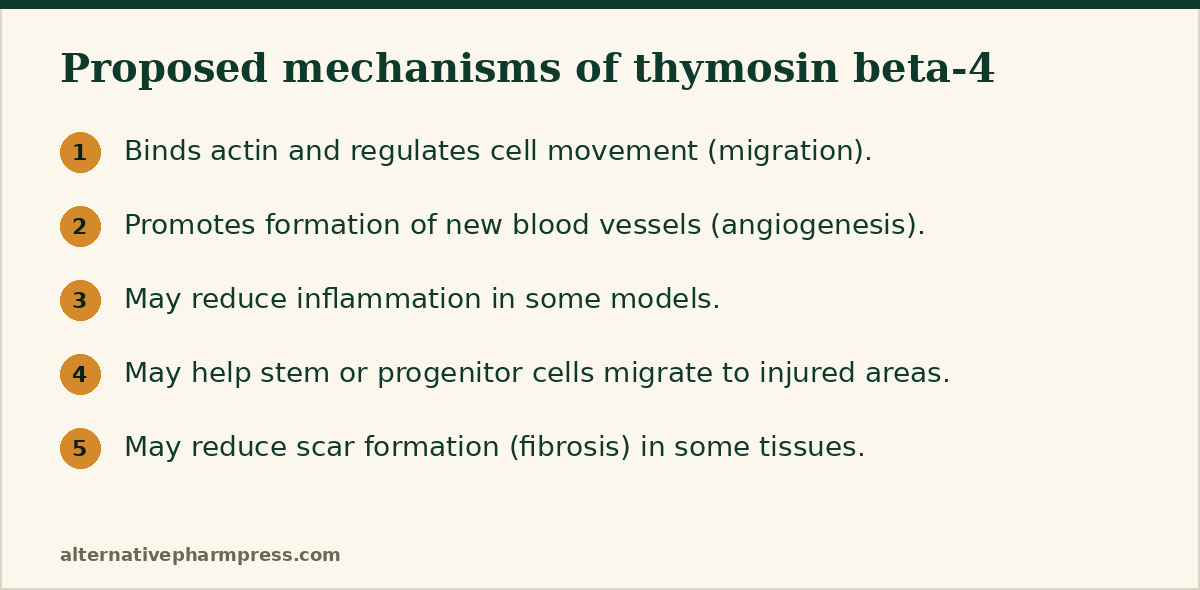
Thymosin beta-4 is found in nearly all human cells and is especially abundant in platelets and white blood cells. Its main known function is binding actin, a protein that forms the cell’s internal scaffolding. By regulating actin, Tβ4 influences cell movement, which is important for wound healing and tissue repair.
TB-500 is a term used in the peptide market for synthetic versions related to Tβ4. Some products are the full-length peptide; others are shorter fragments containing the actin-binding region (sometimes described as “LKKTETQ”). Because labeling varies, it’s often unclear what a given vial contains. For a glossary entry, see TB-500.
Proposed mechanisms
What the research shows
Wound healing
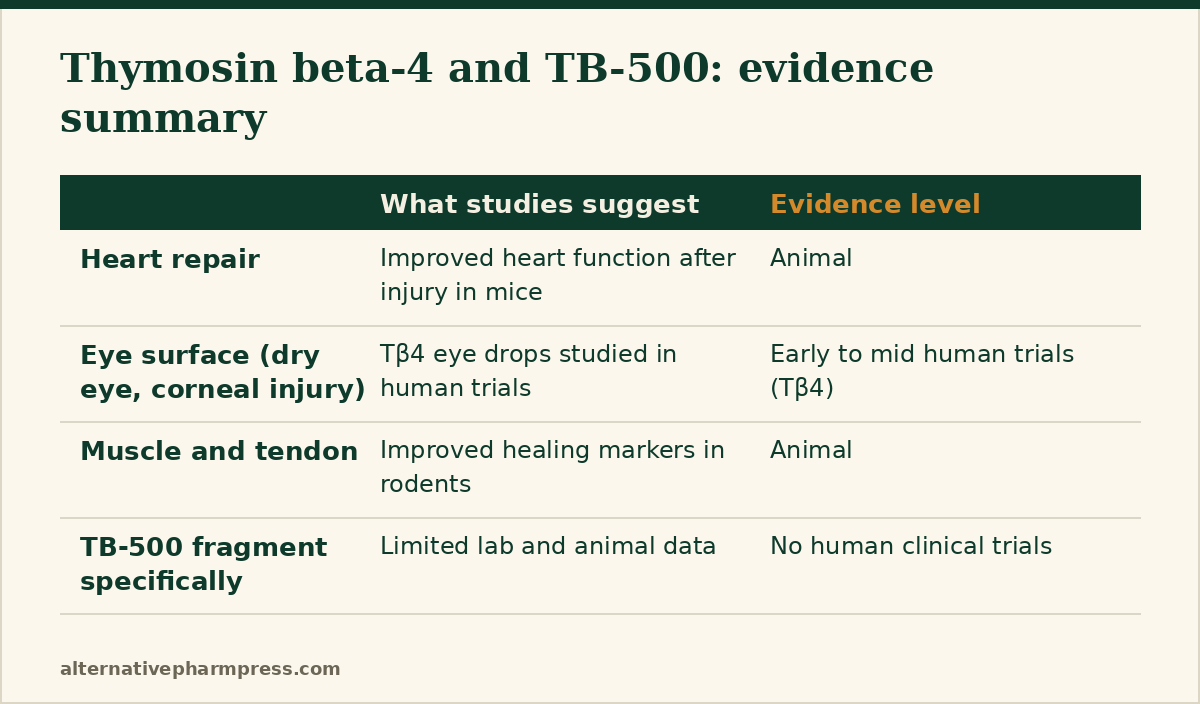
Animal studies have shown that Tβ4 can speed wound closure and increase blood vessel growth. Small human studies tested Tβ4 gels for chronic wounds such as pressure ulcers and venous ulcers, with some signs of benefit but not definitive results.
Heart repair
Mouse studies found that Tβ4 improved heart function and survival after heart attack, possibly by activating cardiac progenitor cells and promoting blood vessel growth. These findings generated excitement, but human cardiac trials haven’t confirmed benefits.
Eye surface
Tβ4 eye drops (sometimes called RGN-259) have been tested in human trials for dry eye and neurotrophic keratopathy, a condition affecting corneal healing. Some trials reported improvements in symptoms or healing; others missed primary endpoints.
Muscle, tendon and ligament
Rodent studies suggest Tβ4 may improve muscle regeneration and tendon healing. These findings underpin TB-500’s popularity in sports and fitness circles, but human trials for these uses are lacking.
TB-500 in “healing stacks”
TB-500 is often combined with BPC-157, marketed as complementary — BPC-157 for local repair, TB-500 for systemic effects. There’s no human research on this combination. Read BPC-157 vs TB-500, BPC-157 and TB-500 stack and wolverine peptide stack.
Safety questions
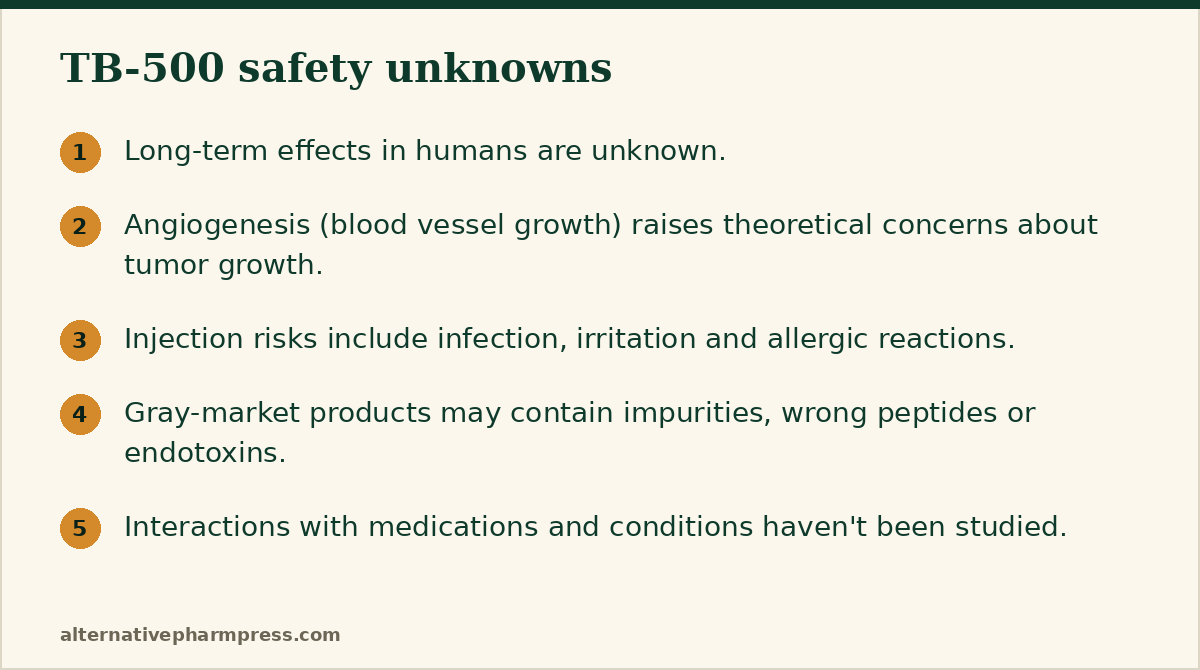
The theoretical cancer concern stems from Tβ4’s role in angiogenesis and cell migration; some research has found elevated Tβ4 levels in certain tumors. Whether supplemental TB-500 affects cancer risk is unknown, but people with a history of cancer should be especially cautious.
Quality concerns
Because TB-500 is sold as a “research chemical,” products may vary in identity and purity. Testing has found some peptide products mislabeled or contaminated. Read how to read a peptide COA, research-use-only meaning and best research peptide suppliers.
Regulatory and sport status
TB-500 isn’t FDA-approved for any use. The FDA has raised concerns about compounding certain peptides, and regulatory scrutiny has increased. The World Anti-Doping Agency (WADA) prohibits TB-500 and Tβ4 at all times. Athletes have been sanctioned for TB-500 use, and it’s also banned in horse racing, where it has been detected in testing. Read research peptides in 2026.
Evaluating TB-500 claims
When reading TB-500 marketing, ask:
- Is the claim based on Tβ4 or TB-500? Much research involves full-length Tβ4.
- Is it from animals or humans?
- What dose and route were used?
- Who funded or published it?
- Are anecdotes presented as evidence? See BPC-157 before and after for how to read stories critically.
Evidence-based recovery options
For tendon, ligament and muscle injuries, approaches with stronger evidence include progressive loading exercises guided by a physical therapist, rest and activity modification, proper sleep and nutrition, and medical evaluation for severe injuries. Some injuries benefit from bracing, injections or surgery. Discuss options with a sports medicine professional.
Horse racing and TB-500
TB-500 has a long history in horse racing, where it was used to aid recovery and allegedly improve performance. Racing authorities banned it and developed tests to detect it. This history contributed to TB-500’s reputation in human fitness communities, though the evidence base in horses is also limited.
Dosing claims
Online protocols for TB-500 often recommend loading phases and maintenance doses, typically in milligrams per week. These protocols aren’t based on human clinical trials. Without established dosing, safety and effectiveness are uncertain. Read BPC-157 dosage for a related discussion of peptide dosing claims.
How TB-500 is typically sold
TB-500 is usually sold as freeze-dried (lyophilized) powder in vials, which users reconstitute with bacteriostatic water and inject under the skin or into muscle. Some sellers offer pre-mixed vials, nasal sprays or oral products, though absorption by these routes is even less understood. Reconstitution and injection introduce risks of contamination and dosing errors, especially for people without medical training.
Comparing TB-500 with approved treatments
For most injuries people use TB-500 for, there are established treatments: physical therapy, graded exercise, anti-inflammatory medications when appropriate, injections such as corticosteroids in specific cases, and surgery for severe tears. These options have known risks and benefits from clinical research. TB-500 doesn’t — its risks and benefits in humans remain largely unknown.
Why animal results don’t always translate
Rodent injury models are useful for exploring biology, but they often differ from human injuries in important ways. Mice and rats heal faster, have different tissue structures and are often studied with surgically created injuries under controlled conditions. Doses are usually scaled by body weight in ways that may not reflect how a peptide behaves in people. Many compounds that showed promise in animal healing studies have failed in human trials. That’s why researchers consider human clinical trials essential before drawing conclusions about benefits or safety.
The difference between a promising molecule and a proven treatment
Thymosin beta-4 is a genuinely interesting molecule, and pharmaceutical companies have invested in developing it for specific uses such as eye and wound healing. That’s very different from evidence that injecting a gray-market TB-500 fragment will speed recovery from a hamstring strain. The path from lab discovery to approved treatment involves dose-finding, safety studies and large controlled trials — steps TB-500 hasn’t completed for musculoskeletal uses.
Questions to ask before considering TB-500
- What exactly is in the vial — full-length thymosin beta-4 or a fragment?
- Has the batch been independently tested for identity, purity, sterility and endotoxins?
- What’s my diagnosis, and have I tried treatments with stronger evidence?
- Do I have any history of cancer or conditions where angiogenesis could be a concern?
- Am I subject to anti-doping rules in my sport or competition?
- Who will monitor me for side effects?
Storage and handling claims
Sellers often advise refrigerating reconstituted TB-500 and using it within a few weeks. Peptides can degrade with heat, light and repeated temperature changes, and there’s no public stability data for most gray-market products. Even with careful storage, potency over time is uncertain.
Signs of an injection problem
People who inject peptides at home should know the signs of infection: increasing redness, warmth, swelling, pain or pus at the injection site, fever or red streaks spreading from the area. These require prompt medical attention. Allergic reactions, such as hives, swelling of the face or lips, or difficulty breathing, are emergencies.
FAQ
What is TB-500?
TB-500 is a synthetic peptide related to thymosin beta-4, often a fragment containing its active region, marketed for tissue repair.
What are TB-500’s benefits?
Animal studies of thymosin beta-4 suggest roles in wound healing, heart repair and muscle and tendon healing. TB-500 itself lacks human clinical trials.
Is TB-500 safe?
Its safety in humans isn’t established. Concerns include theoretical cancer risk, injection complications and product quality.
Is TB-500 the same as thymosin beta-4?
Not exactly. TB-500 often refers to a synthetic fragment, though products vary. Much research involves full-length thymosin beta-4.
Is TB-500 legal?
It’s not FDA-approved and is sold as a research chemical. It’s banned in sport by WADA.
Does TB-500 help with tendon injuries?
Rodent studies of thymosin beta-4 suggest possible benefits, but there are no human clinical trials showing TB-500 speeds tendon healing. Physical therapy has much stronger evidence.
Can TB-500 be detected in drug tests?
Yes. Anti-doping labs test for TB-500 and thymosin beta-4 in athletes and racehorses.