
THCA carts — vape cartridges marketed as hemp-derived — have become one of the best-selling products in smoke shops and online. Sellers often explain that THCA isn’t THC, so the products are legal hemp. But inside a heated cartridge, the chemistry changes quickly.
This guide explains what’s actually in a THCA cart, how different cart types compare, the risks from cutting agents and hardware, how strong they are, drug test implications and how the legal landscape is changing.
Key takeaways
- THCA is the non-intoxicating acid form of THC, but heat converts it to delta-9 THC, so THCA carts are intoxicating.
- Many “THCA carts” contain THCA-derived distillate, which may already be largely converted to delta-9 THC.
- Live resin THCA carts keep more natural terpenes; distillate carts often use added terpenes.
- Watch for cutting agents, hardware metals and missing residual solvent testing.
- THCA carts will cause positive drug tests and face tightening federal and state rules.
What is THCA, and why does heat matter?
THCA (tetrahydrocannabinolic acid) is the compound cannabis plants produce naturally. It has an extra carboxyl group that prevents it from binding effectively to CB1 receptors, so raw THCA doesn’t cause a high. Heat removes that group in a process called decarboxylation, producing delta-9 THC. Vaporizing in a cartridge supplies plenty of heat. For the chemistry, read does THCA get you high? and THCA vs delta-9 THC.
What’s really in a THCA cart?
Why THCA carts often contain lots of delta-9
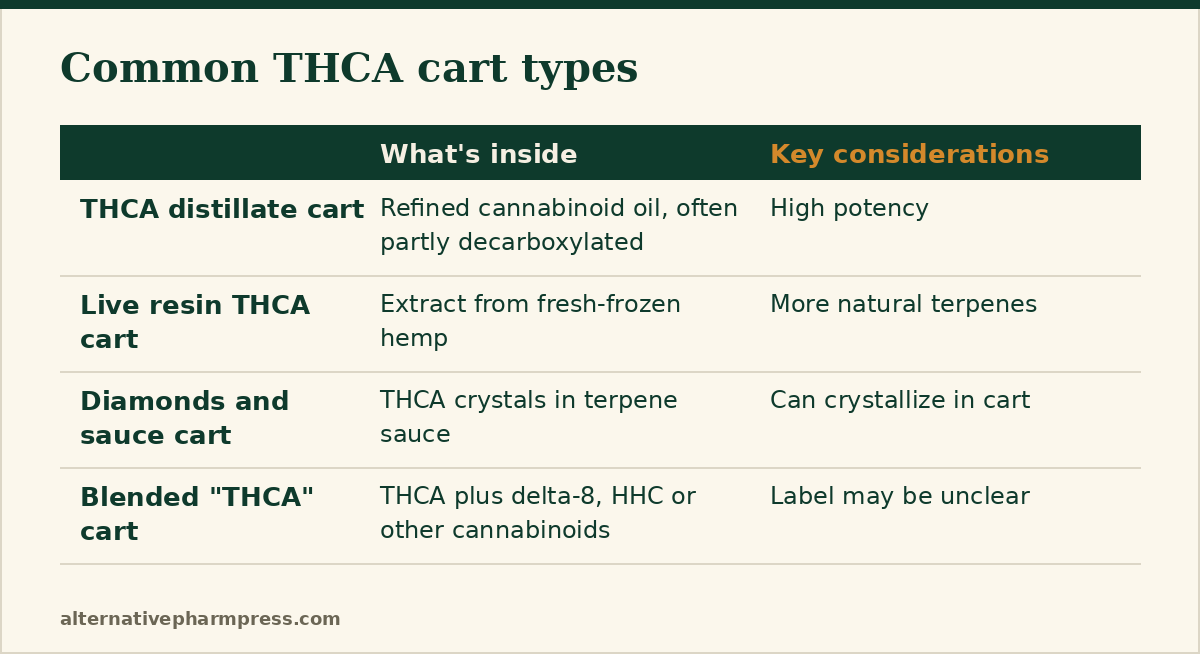
THCA tends to crystallize at room temperature, which can clog cartridges. To keep oil liquid and consistent, some processors use distillate that has been partially or fully decarboxylated — meaning a “THCA cart” may contain a large proportion of delta-9 THC before you even use it. The label might still emphasize THCA. Look for the delta-9 THC and total THC values on the COA.
How strong are THCA carts?
Most carts contain 70–95% cannabinoids. When heated, THCA converts to THC using a factor of about 0.877. A cart testing at 85% THCA can deliver roughly 75% potential THC — comparable to dispensary cartridges. That’s far stronger than flower.
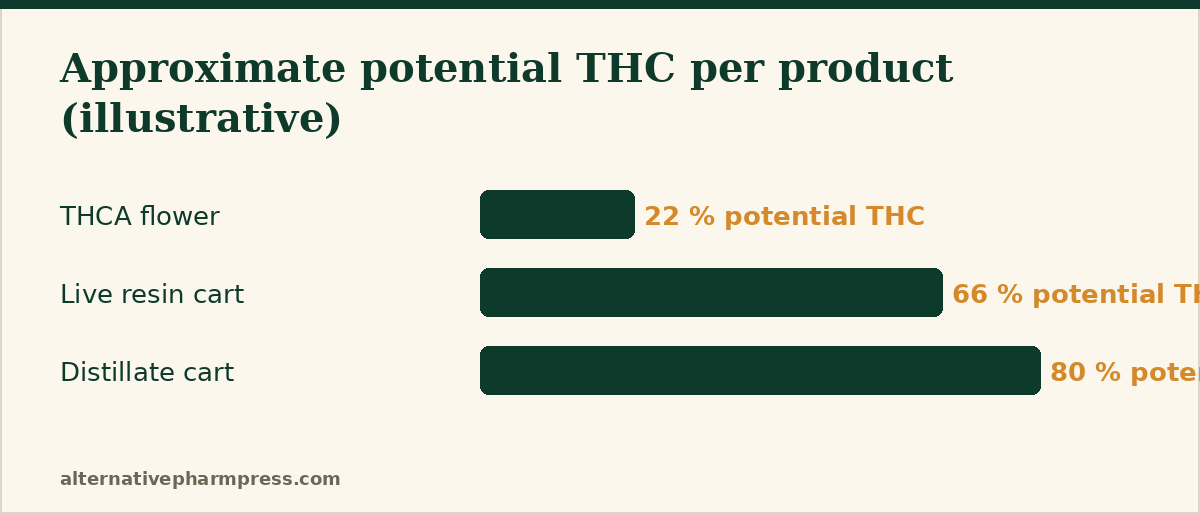
Even one or two puffs can produce strong effects in people without tolerance. Effects usually begin within minutes and last one to three hours. Read THC and anxiety for why high doses can trigger panic.
Cutting agents and additives
Unregulated cartridges may contain additives used to thin oil or add flavor:
- Vitamin E acetate — strongly linked to the 2019 EVALI lung-injury outbreak.
- MCT oil and other edible oils — inhaling heated oils can cause lung inflammation.
- PEG and PG/VG — can produce harmful compounds when overheated.
- Synthetic or food-grade flavorings — not tested for inhalation safety.
The simplest carts contain only cannabinoid oil and cannabis-derived terpenes. Our delta-8 carts safety guide covers EVALI and additives in more depth.
Hardware concerns
Studies of cannabis cartridges have found metals including lead, nickel, chromium and copper leaching from cartridge components, especially after storage. Look for brands that test filled cartridges for heavy metals, avoid ultra-cheap hardware and use moderate voltage.
Disposables vs 510 carts
510-thread carts attach to a separate battery, letting you choose temperature or voltage. Disposables combine oil and battery; they’re convenient but voltage and materials are unknown, and they create electronic waste. Lithium batteries should be recycled properly. For broader comparisons, see best delta-8 vapes and carts.
What a THCA cart COA should show
- Full cannabinoid panel — THCA, delta-9 THC, total THC, plus delta-8, HHC or others if present.
- Residual solvents — butane, propane, ethanol and others within limits.
- Heavy metals — ideally on the filled cart.
- Pesticides and microbes.
- Cutting-agent screening where available.
- Batch number and date matching your product, from an accredited lab.
A COA showing THCA but omitting delta-9 or total THC values is incomplete.
Drug tests
THCA carts deliver THC, which is metabolized into THC-COOH — the compound drug tests detect. Regular use will cause positive results. Read how long THCA stays in your system.
Health and safety risks
- Respiratory effects — coughing, throat irritation; stop if you develop chest pain or shortness of breath.
- Mental health — high-THC products raise risks of anxiety, dependence and, in vulnerable people, psychosis.
- Cardiovascular effects — increased heart rate; caution with heart conditions.
- Accidental exposure — store carts away from children and pets.
- Impaired driving — never drive after using.
Legal status
THCA carts relied on the 2018 Farm Bill’s delta-9-only definition of hemp. Federal legislation passed in late 2025 moves hemp to a total-THC standard and restricts intoxicating hemp-derived products, directly affecting THCA carts. Many states already prohibit them or restrict sales. See federal hemp law explained, hemp ban product impact and THCA legal status by state.
How to spot a questionable THCA cart
- No batch-specific COA, or a COA for a different product.
- Missing delta-9 or total THC values.
- Unusual flavors like candy or dessert with no terpene source listed.
- Very low price for a high-potency cart.
- Burnt, metallic or harsh taste.
- Leaking or cracked hardware.
Why THCA carts sometimes clog or crystallize
Because THCA naturally tends to form crystals, carts filled with high-THCA extract can crystallize over time, especially in cool environments. This can block airflow and cause uneven hits. Some processors address this by blending, adding terpenes or using decarboxylated distillate. If a cart crystallizes, gently warming it with a battery’s preheat function may help, but avoid overheating. Persistent crystallization or harsh hits may signal quality issues.
Live resin vs distillate carts: which is better?
Live resin carts generally offer fuller flavor and a broader terpene profile, while distillate carts provide consistent potency at a lower price, often with added terpenes. Neither is automatically safer — what matters is testing for solvents, metals and additives. Many “live resin” carts are blended with distillate, so read the ingredient list and COA. For a deeper comparison, see distillate vs live resin and THCA live resin.
Using a THCA cart more carefully
If you’re an adult using THCA carts where they’re legal, a few habits reduce risk. Take one small puff and wait at least 10–15 minutes before taking more; vaped THC acts fast, but intensity builds. Use a battery with adjustable voltage and keep it on the lower end to reduce harsh vapor and overheating. Avoid mixing with alcohol, which increases impairment and nausea. Store carts upright and away from heat. If a cart tastes burnt, chemical or metallic, stop using it. And keep products locked away from children, pets and anyone underage.
Why “it’s just hemp” can be misleading
The hemp label describes a legal category based on the plant’s chemistry before processing. It says nothing about how intoxicating a finished product is. A THCA cart and a dispensary THC cart can deliver nearly identical effects once heated. The major differences tend to be in oversight: state-licensed cannabis markets usually require standardized testing, packaging and tracking, while hemp-derived products have often been sold with fewer controls. That gap is one reason regulators have moved to close the THCA loophole.
Questions to ask before buying
- What lab tested this batch, and is the lab accredited?
- What’s the total THC, including converted THCA?
- Is the oil distillate, live resin or a blend?
- What are the terpenes, and are they cannabis-derived or botanical?
- Was the filled cartridge tested for heavy metals?
- Is the product legal where I live?
If a seller can’t answer these clearly, consider it a warning sign.
FAQ
Do THCA carts get you high?
Yes. Heating converts THCA to delta-9 THC, which is intoxicating. Many carts also contain significant delta-9 THC before use.
Are THCA carts legal?
They’re under increasing restriction as federal and state laws move to total-THC standards. Check your state’s current rules.
Are THCA carts safe?
They carry risks from high potency, additives and hardware metals. Products with full testing and simple ingredients are lower risk, but no inhaled product is risk-free.
Will a THCA cart show up on a drug test?
Yes. THCA carts deliver THC, which produces positive results on standard drug tests.
What’s the difference between a THCA cart and a delta-9 cart?
Once heated, there’s little difference — both deliver delta-9 THC. The distinction is mainly legal labeling based on source and pre-heated chemistry.
Why does my THCA cart taste burnt?
A burnt taste often means the voltage is too high, the cart is nearly empty or the wick is dry. Lower the voltage, and stop using a cart that tastes harsh, chemical or metallic.
How long does a THCA cart high last?
Usually one to three hours, with peak effects within the first 30 minutes.