
Disclosure: Some links on this page go to brands we cover. We may earn a commission if you buy through them, at no extra cost to you. This does not change our ratings. How we make money.
The best kratom powder comes from a vendor that passes the American Kratom Association’s GMP audit and publishes a lot-matched certificate of analysis showing mitragynine percentage, a numeric 7-OH result, heavy metals and microbes including Salmonella. On those checks, Kingdom Kratom leads from our directory, followed by Kats Botanicals, Super Speciosa and Kraken Kratom.
This is a buying guide about paperwork, not effects. We did not lab-test any powder and we do not rate strains or strength. Every brand detail below comes from the vendor’s own website or the AKA’s public vendor list, checked in October 2026. Kratom carries real risks, including dependence, and nothing here is a recommendation to use it.
Quick comparison: kratom powder brands that publish lab data
| Brand | On AKA GMP list | Mitragynine shown before purchase | 7-OH shown | How you find the COA |
|---|---|---|---|---|
| Kingdom Kratom | Yes | 28 mg per 2 g serving (Green Maeng Da) | Below 0.01 mg/g (limit of detection) | Lot-number lookup; raw-ingredient certificates |
| Kats Botanicals | Yes | On the COA | Tested, per its testing page | QR code or lot number |
| Super Speciosa | No (not listed when checked) | 1.3%+ minimum; 31 mg per serving (Green Maeng Da) | On full report | QR code or 7-digit batch number |
| Kraken Kratom | Yes | Not on its lab-testing page | Not stated | On request only |
What separates good kratom powder from the rest
Strain names and vein colours tell you little about quality. These checks tell you more.
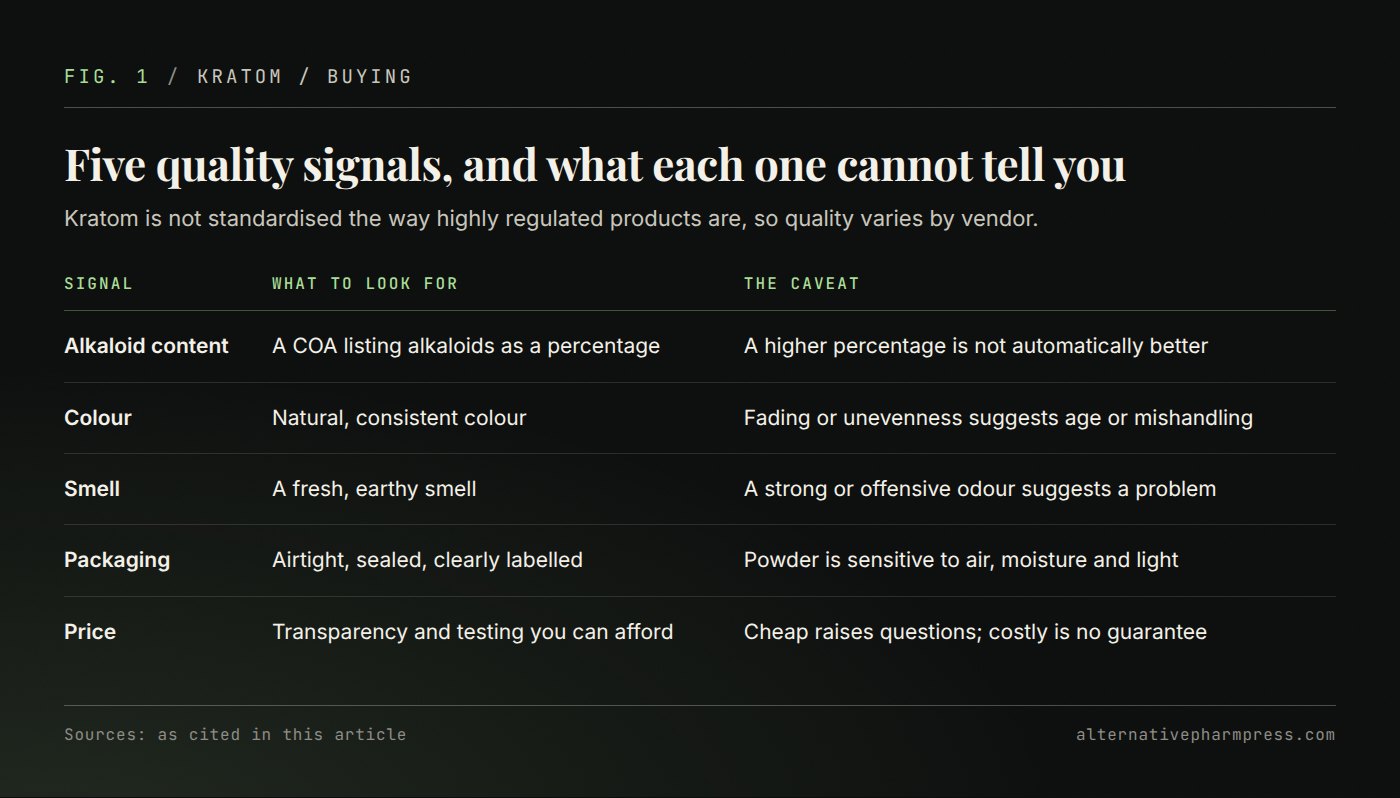
1. AKA GMP qualification
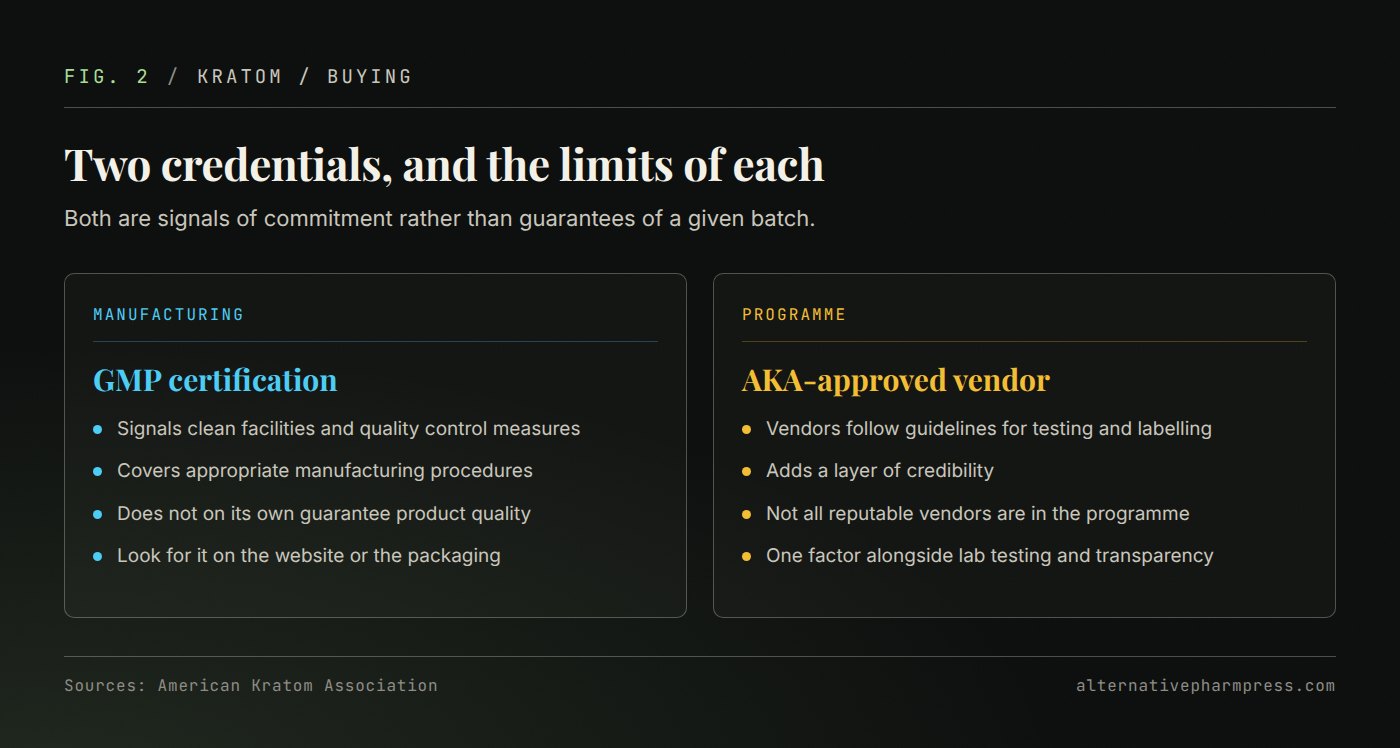
The AKA’s GMP Standards Program requires vendors to pass an independent audit every year, using AKA-approved auditors and labs, against manufacturing standards “largely based on” the federal supplement rules in 21 CFR 111. The AKA states that it “does not endorse the quality of the product,” and that the status certifies facilities and processes, not individual products.1 Check any claim against the AKA’s qualified vendors list.2 A vendor saying “GMP” or “cGMP” on its own site is not the same thing.
2. A batch COA with mitragynine as a percentage
Mitragynine is the main alkaloid, and leaf varies widely. Thai field samples ranged from about 0.3% to 4.9% of leaf weight by season and region,3 and two US retail powders tested at roughly 0.8% and 1.1%.4 A COA tied to your lot number is the only way to know where your bag sits. Our guide on how to read a kratom lab report explains each line.
3. A numeric 7-OH result
Natural leaf contains only trace 7-hydroxymitragynine, under 2% of total alkaloids.5 A COA should give a number or a stated limit of detection, from a method that confirms 7-OH rather than inferring it; a 2026 study showed some methods can misidentify it.6 This matters more than ever under the DEA’s pending threshold, covered below.
4. Heavy metals
When the FDA tested 30 kratom products in 2019, it found lead and nickel “at concentrations that exceed safe exposure for oral daily drug intake,” with nickel up to 29,000 ng/g in one sample.7 Look for lead, arsenic, cadmium and mercury results, ideally against a named limit.
5. Microbes, including Salmonella
A 2018 Salmonella outbreak linked to kratom sickened 199 people in 41 states, and 38% of those with information were hospitalised. Most reported using powder.8 A good COA covers Salmonella, E. coli, yeast and mould and total aerobic count.
6. Finished-product testing and honest labelling
Some vendors test the raw leaf batch, not the packed product. Both are useful, but know which you are reading. And plain leaf should be labelled as plain leaf: “enhanced,” “high MIT” or “5X” powders contain added extract, which our guide to kratom extract vs powder explains.
Verified in our directory
1. Kingdom Kratom, best for alkaloid and 7-OH figures before you buy
Kingdom Kratom was founded in San Antonio, Texas, in 2017 by Michael Auerbach, sources leaf directly from Indonesian farms and appears on the AKA GMP list.2 Its powders include Green, White and Red Maeng Da, Red Bali, Super White Borneo and blends, in sizes from 25 g to 1 kg.
What sets it apart is the data on the product page. Its Green Maeng Da powder is listed as “Mitragyna Speciosa leaf, green vein, Maeng Da strain,” with “no additives, no fillers,” 28 mg of mitragynine per 2 g serving (about 1.4%), 7-OH below 0.01 mg/g, the limit of detection, and a mitragynine-to-7-OH ratio of 1,400:1. Two points to read carefully. The ratio appears to be worked out from the detection limit (28 mg divided by 0.02 mg), so it is a floor, not a measured value. And the lot lookup says its certificates are for “the raw kratom ingredient batch(es) used to produce this lot” and are “not a test of the finished product.” The lookup page does not list which panels are run, so open the certificate for your lot to confirm metals and microbes. Kingdom also sells extracts, which are a separate, stronger category. Orders by 1pm Central ship the same day, and it offers a satisfaction guarantee.
Read our Kingdom Kratom Green Maeng Da review, see the Kingdom Kratom directory profile or visit kingdomkratom.com.
Industry picks (not in our directory)
These vendors publish or offer lab results. We have not verified them in our directory, so open the current report for your lot before you buy.
2. Kats Botanicals, best for the most complete described test panel
Kats Botanicals is on the AKA GMP list.2 Its testing page describes the fullest panel we found: mitragynine and 7-OH by HPLC, GC-MS and TLC; a check that alkaloids have not been “extracted or depleted”; lead, arsenic, mercury and cadmium by ICP-MS; Salmonella, E. coli, mould, coliforms and total aerobic plate count; and pesticide screening. It says failing batches are destroyed, and its GMP page describes pasteurising raw material. A QR code or the lot number on the pack opens the results at its COA page.
Two notes. The COA page describes results as tests “conducted on the materials used in the manufacturing process,” and the lab is not named. And Kats sells “Super Maeng Da” powders “enhanced to 3%+ MIT,” while its own testing page says mitragynine “typically sits at or below 2%” in quality dried leaf. Those are enhanced products, not plain leaf.
3. Super Speciosa, best for named accredited labs
Super Speciosa names its labs, Cora Science and Murray-Brown Laboratories, both ISO 17025 accredited and checkable through PJLA. A QR code or the seven-digit batch number on the bag opens that batch’s report, which tests up to five alkaloids. The brand says it runs a full microbial panel, judges heavy metals against NSF dietary supplement guidelines and rejects batches that fail.9 Its Green Maeng Da powder is labelled “Raw Leaf Only,” with a “minimum of 1.3%+ mitragynine” and 31 mg of mitragynine per serving.
The caution is AKA status. The product page says it is “Produced in a GMP-qualified & FDA-registered facility,” and the homepage cites “cGMP standards,” but Super Speciosa was not on the AKA’s GMP qualified vendors list when we checked in October 2026.2 It also sells Enhanced powders, described as “extract powder + raw kratom leaf powder,” so make sure you are buying the leaf line if that is what you want. See superspeciosa.com.
4. Kraken Kratom, best for an AKA-listed vendor that supplies COAs on request
Kraken Kratom is on the AKA GMP list and describes itself as the “first American Kratom Association Good Manufacturing Practices Qualified Kratom Vendor.”2 Its lab-testing page sets out a clear panel for its tea products: identity, arsenic, cadmium, lead and mercury by AOAC method 2013.06, and aerobic plate count, yeast and mould, coliforms, E. coli and Salmonella. The drawback is access: COAs are available on request through a form rather than published, and the page does not give mitragynine or 7-OH figures. That is why it ranks last. See krakenkratom.com.
Happy Hippo Herbals and The Golden Monk are also on the AKA list, but the certificate pages we checked did not set out which panels they run. For the wider vendor picture, including 7-OH brands, see our best kratom brands of 2026.
Red flags when buying kratom powder
- No COA, or “available on request” only. A report you cannot read before paying is a weaker promise.
- A COA with no lot number, or one that does not match the number on your bag.
- Mitragynine but no 7-OH result. After October 2026 that is the number regulators care about.
- “Plain leaf” above the natural range. Leaf above roughly 2% mitragynine may be enhanced; ask.
- An unnamed lab, or accreditation you cannot check.
- Missing contaminant panels. Potency without metals and microbes is half a report.
- Health claims. Promises to treat pain, anxiety or withdrawal are a warning sign about the seller.
Our list of 7 red flags on a kratom COA shows what each looks like on paper, and 5 signs a brand is actually third-party tested covers the vendor side.
Kratom powder, capsules or extract?
Powder is the most transparent format: you weigh it in grams and can match it to a leaf COA. Capsules hold the same leaf in pre-measured portions, in a shell that hides what is inside; our ranking of the best kratom capsules of 2026 applies the same checks, and kratom capsules vs powder compares the two. Extracts are a different product with concentrated alkaloids and higher risk. Our kratom dosage explainer covers why there is no official serving.
Kratom powder and the DEA’s 7-OH threshold
On 14 October 2026 the DEA published a revised notice of intent to temporarily place 7-OH and mitragynine pseudoindoxyl in Schedule I when a product contains more than 1 mg per gram (or per millilitre), or when its mitragynine-to-7-OH ratio is below 100. The order cannot be published before 13 November 2026. Mitragynine and plain leaf are not scheduled by this action, though the DEA says below-threshold products are not thereby deemed safe.5 As of 25 October 2026, 7-OH itself is not yet federally scheduled.
Genuine leaf powder should sit far below both lines. Kingdom’s published 7-OH figure, below 0.01 mg/g, is a hundredth of the concentration limit. The risk is powder that has been enhanced or adulterated, which is why a numeric 7-OH result now belongs on every COA. Our explainer on where 7-OH scheduling stands follows the process.
Separately, the FDA does not consider kratom lawful as a dietary supplement or food ingredient, and warns of liver toxicity, seizures and substance use disorder.10 Several states ban kratom and others regulate it, so check our kratom legal status by state guide before you order, and read about kratom and liver injury and drug interactions.
Are you a kratom brand?
If you sell kratom powder and want to be considered for this guide, we assess brands on lab transparency, not ad spend. You can register your brand in our directory or apply to be reviewed and listed. Send current, lot-matched COAs showing mitragynine, 7-OH, heavy metals and microbials, along with your AKA GMP status. Directory placement is clearly disclosed and never disguised as editorial.
Frequently asked questions
What is the best kratom powder?
On lab transparency, Kingdom Kratom is our directory pick, publishing mitragynine and 7-OH figures on its product page. Kats Botanicals describes the fullest test panel, and Super Speciosa names its accredited labs, though it is not on the AKA GMP list. The best kratom powder for any buyer is one with a lot-matched COA covering alkaloids, metals and microbes.
What should a kratom powder COA include?
A lot number matching your bag, the lab’s name, mitragynine as a percentage or milligrams per gram, a numeric 7-OH result or limit of detection, lead, arsenic, cadmium and mercury, and microbial results including Salmonella and E. coli. It should also say whether the test covers the finished product or the raw leaf batch.
What mitragynine percentage is normal for kratom powder?
Natural leaf varies. Thai field samples ranged from about 0.3% to 4.9% by season and region, and two US retail powders tested near 0.8% and 1.1%. The plain-leaf powders we checked state about 1.3% to 1.4%, and one vendor says quality leaf typically sits at or below 2%. Figures well above that usually mean added extract, so check whether the product is labelled enhanced.
Is AKA GMP the same as FDA approval?
No. The FDA does not approve kratom products. AKA GMP qualification is a voluntary programme requiring an annual independent audit against standards largely based on 21 CFR 111. The AKA says it does not endorse product quality and certifies facilities and processes, not products, so you still need the lot COA.
Is Super Speciosa AKA GMP qualified?
It was not on the American Kratom Association’s GMP qualified vendors list when we checked in October 2026. Its site says products are made in a “GMP-qualified” facility to cGMP standards, which is a different claim. It does name two ISO 17025 accredited labs and publishes batch reports by QR code or batch number.
Will the DEA’s 7-OH rule affect kratom powder?
Plain leaf powder should not be affected. The DEA’s October 2026 notice targets products with more than 1 mg of 7-OH per gram or a mitragynine-to-7-OH ratio below 100, and natural leaf carries only trace 7-OH. Enhanced or adulterated powders deserve closer checking. The order cannot be published before 13 November 2026.
Is kratom safe?
Kratom carries real risks, including dependence, withdrawal, constipation, rare liver injury and dangerous interactions with other sedating drugs. Risks rise with concentrated extracts and 7-OH products. Talk to a clinician if you take other medications.
Sources
- American Kratom Association. GMP Standards Program. Accessed 25 October 2026. americankratom.org
- American Kratom Association. GMP Qualified Vendors. Accessed 25 October 2026. americankratom.org
- Sengnon N, Vonghirundecha P, Chaichan W, Juengwatanatrakul T, Onthong J, Kitprasong P, et al. Seasonal and Geographic Variation in Alkaloid Content of Kratom (Mitragyna speciosa (Korth.) Havil.) from Thailand. Plants (Basel). 2023;12(4):949. DOI: 10.3390/plants12040949. PMID: 36840297. pubmed.ncbi.nlm.nih.gov
- Todd DA, Kellogg JJ, Wallace ED, Khin M, Flores-Bocanegra L, Tanna RS, et al. Chemical composition and biological effects of kratom (Mitragyna speciosa): In vitro studies with implications for efficacy and drug interactions. Sci Rep. 2020;10(1):19158. DOI: 10.1038/s41598-020-76119-w. PMID: 33154449. pubmed.ncbi.nlm.nih.gov
- Drug Enforcement Administration. Schedules of Controlled Substances: Temporary Placement of 7-Hydroxymitragynine and Mitragynine Pseudoindoxyl Above a Specified Threshold in Schedule I (notice of intent). Federal Register. 14 October 2026;91 FR 65370. Document 2026-20943. federalregister.gov
- Sheehan D, Li Y, Meckler E, Upton R, Zhang M. Avoiding False Identification of 7-Hydroxymitragynine in Kratom Products Using a Multicriteria LC-MS Confirmation. J Am Soc Mass Spectrom. 2026;37(5):1303-1312. DOI: 10.1021/jasms.6c00088. PMID: 41989479. pubmed.ncbi.nlm.nih.gov
- US Food and Drug Administration. Laboratory Analysis of Kratom Products for Heavy Metals. 3 April 2019. fda.gov
- Centers for Disease Control and Prevention. Multistate Outbreak of Salmonella Infections Linked to Kratom (Final Update). 24 May 2018. archive.cdc.gov
- Super Speciosa. Lab Lookup. Accessed 25 October 2026. superspeciosa.com
- US Food and Drug Administration. FDA and Kratom. Content current as of 2 December 2025. fda.gov
Editorial note: A directory listing is not a paid editorial endorsement, and our editorial team operates independently of advertising. Some listings, reviews and coupons may be affiliate or paid placements, which do not influence our standards. Brand details were checked on each brand’s website and the AKA list in October 2026 and can change; we did not lab-test any product.
This article is for educational purposes only and is not medical or legal advice. Products discussed here are not intended to diagnose, treat, cure or prevent any disease. Laws vary by location and change often, so verify the rules that apply where you are. Always talk to a licensed healthcare provider before use, especially if you are under 21, pregnant or nursing, taking medication, or managing a health condition.