
Turkey tail (Trametes versicolor, also called Coriolus versicolor) is a fan-shaped bracket fungus with bands of brown, tan and white that look like the tail of a wild turkey. It grows on dead logs on nearly every continent, and it has a longer clinical research record than almost any other "functional" mushroom.
That research is concentrated in a specific area: extracts called PSK and PSP used alongside conventional cancer treatment in Japan and China. Turning those findings into everyday supplement claims takes care. This guide explains what turkey tail contains, what the studies show, where the evidence is thin, and how to judge a product.
Key takeaways
- Best-studied use: PSK, a turkey tail extract, has been used in Japan since the 1970s as an add-on to chemotherapy for some cancers.
- Immune effects: the mushroom’s polysaccharides activate immune cells in lab and human studies, but that is not the same as preventing illness.
- Gut health: small trials suggest turkey tail extracts act as a prebiotic and shift gut bacteria.
- Not a cancer treatment on its own: it should never replace standard care, and it should be discussed with an oncologist.
- Generally well tolerated: side effects are usually mild, but product quality varies widely.
What is turkey tail?
Turkey tail is a polypore, meaning it releases spores through tiny pores on its underside rather than gills. It is tough and leathery, so it is not eaten like a culinary mushroom. Traditionally it has been prepared as a tea or decoction, and today it is mostly sold as powders, capsules and hot-water extracts.
It has a long history in traditional Chinese medicine and in Japanese folk practice. Modern interest began in the 1960s and 1970s, when Japanese researchers isolated a protein-bound polysaccharide that became a prescription drug. If you’re new to the category, our overview of functional mushroom research is a good starting point.
The active compounds: PSK and PSP
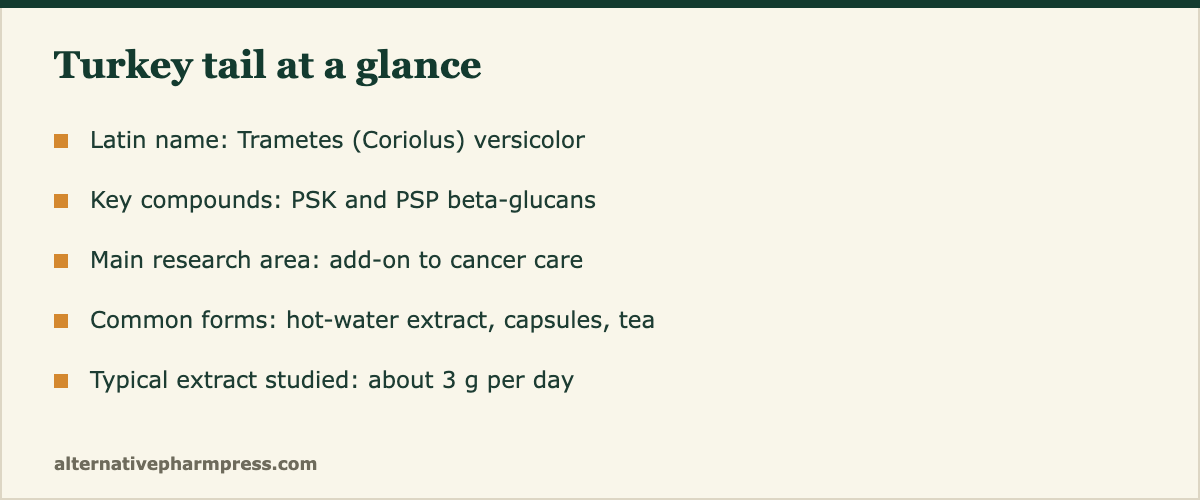
Most of turkey tail’s studied activity comes from two protein-bound polysaccharides:
- PSK (polysaccharide-K, sold as Krestin): developed in Japan and approved there in 1977 as an adjunct to cancer treatment.
- PSP (polysaccharide peptide): developed in China from a different strain, with similar uses.
Both are large beta-glucan molecules bound to proteins. Beta-glucans are recognized by receptors on immune cells, which is the main proposed mechanism for turkey tail’s effects. Whole mushroom powders contain these compounds too, but in much lower and less consistent amounts than standardized extracts.
Turkey tail and cancer care
This is the area with the most human data, and it’s important to describe it accurately.
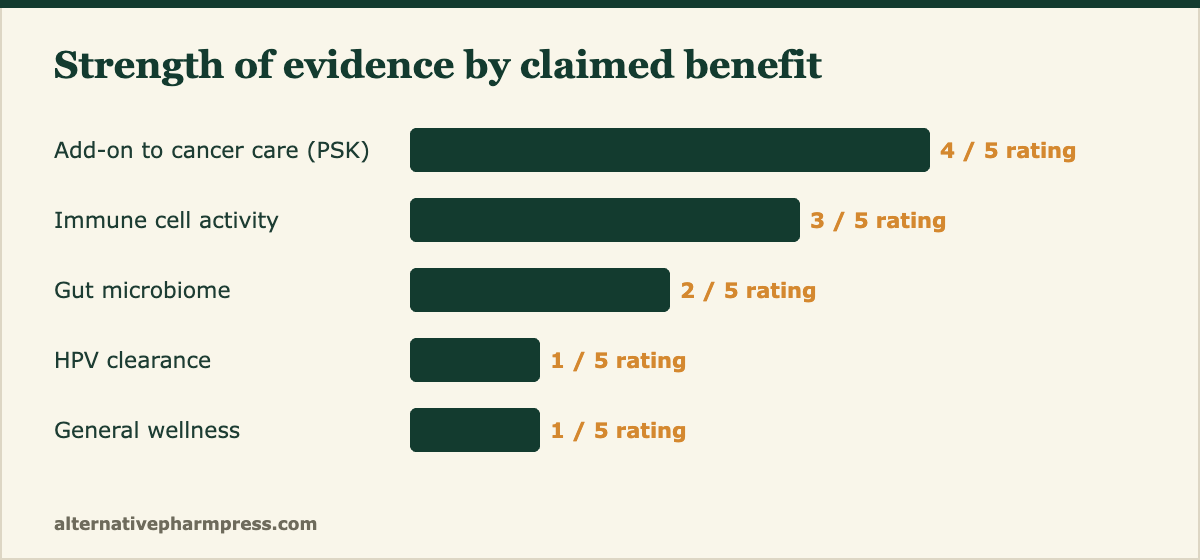
In Japan, PSK has been studied in randomized trials as an add-on to surgery and chemotherapy, mainly for gastric and colorectal cancer. Several trials and meta-analyses reported improved survival when PSK was added to standard treatment. However, many of those trials are older, were conducted in a specific clinical setting, and don’t always meet current trial standards. PSK is not approved as a drug in the United States.
In the U.S., a small phase 1 trial funded by the National Institutes of Health tested turkey tail powder in women with breast cancer who had finished radiation. Doses up to 9 grams per day were well tolerated, and the researchers observed signs of immune recovery, such as higher lymphocyte counts and natural killer cell activity. That was a safety and dosing study, not proof that turkey tail improves cancer outcomes.
Memorial Sloan Kettering Cancer Center’s integrative medicine service summarizes turkey tail as having immune-stimulating effects with some evidence of benefit as an adjunct in certain cancers, while noting the need for better trials. That is a fair summary of the current state.
Important: If you’re undergoing cancer treatment, talk to your oncology team before taking turkey tail or any supplement. It should never be used instead of evidence-based treatment.
Immune support claims
Many products market turkey tail for "immune support." Lab and small human studies show that turkey tail polysaccharides can increase the activity of certain immune cells. That doesn’t automatically translate into fewer colds or better overall health in healthy people. There are no large trials showing turkey tail prevents common infections.
There has also been small-scale research on turkey tail extracts and human papillomavirus (HPV). One small study using a gel containing Coriolus versicolor extract reported improved clearance of cervical lesions, but the trial was small and the findings need replication.
Turkey tail and gut health
Turkey tail polysaccharides aren’t fully digested, so they reach the colon, where gut bacteria can ferment them. A small randomized study in healthy volunteers found that PSP shifted the gut microbiome in ways consistent with a prebiotic effect, similar in some respects to a known prebiotic fiber. Animal research points in the same direction.
These findings are interesting but early. If gut health is your goal, food-based fiber from vegetables, legumes and whole grains has much stronger evidence behind it.
Other claims you’ll see
Turkey tail is also marketed for energy, longevity, blood sugar and athletic performance. Evidence for these is limited to animal studies, lab experiments or nothing at all. Veterinary interest has also grown since a small University of Pennsylvania study in dogs with hemangiosarcoma reported longer survival with a turkey tail extract, but that was a small, uncontrolled study.
How turkey tail compares with other mushrooms
Turkey tail is usually grouped with reishi, chaga and shiitake as an "immune" mushroom, while lion’s mane and cordyceps are marketed for focus and energy. Each has a different research profile. Our turkey tail vs reishi comparison covers the differences, and our reishi benefits guide looks at reishi’s evidence for sleep and immunity.
Safety and side effects
Turkey tail appears to be well tolerated in most studies. Reported side effects include:
- Digestive upset such as gas, bloating or loose stools.
- Darkened stools or nail discoloration in some reports with PSK.
- Rare allergic reactions.
Because it influences immune activity, people taking immunosuppressants, people with autoimmune conditions and transplant recipients should talk to a doctor first. There’s limited safety data during pregnancy and breastfeeding, so it’s best avoided. Anyone on chemotherapy should only use it with their oncologist’s approval, because supplements can interact with treatment or complicate care.
How to choose a turkey tail product
Product quality is one of the biggest problems in the mushroom supplement market. Many products are made from mycelium grown on grain, which can contain a lot of starch and fewer of the polysaccharides found in the fruiting body.

A label that lists only "polysaccharides" can be misleading, because starch is also a polysaccharide. Beta-glucan content, measured with a specific test, is a better indicator. For more on this problem, see our guide to whether mushroom gummies work and our 2026 functional mushroom market overview.
How much turkey tail is used in studies?
Studies have used a range of preparations, so there’s no single standard dose. The U.S. breast cancer trial used up to 9 grams per day of mushroom powder, while PSK studies in Japan commonly used about 3 grams per day of extract. Commercial supplements often contain far less. Follow the label of a reputable product, and talk to a healthcare provider if you have a medical condition.
Making turkey tail tea
Some people prefer a traditional decoction. Dried turkey tail is simmered in water for an hour or longer to extract the polysaccharides, then strained. It has an earthy, mild flavor. Only use mushrooms from a trusted supplier, because foraging carries a real risk of misidentification.
Capsules, powders, gummies and coffee blends
Turkey tail now appears in many formats. Capsules and hot-water extract powders are the easiest way to know how much you’re taking. Gummies and mushroom coffee blends often combine several species in small amounts, which makes it hard to know whether you’re getting a meaningful dose of any one of them. If you like the idea of a mushroom blend, our mushroom coffee guide explains what to look for on those labels.
Who might consider turkey tail?
People most often look at turkey tail when they want general immune support, when they’re curious about prebiotic-style supplements, or when a cancer care team has discussed integrative options. For healthy adults, it’s a low-risk experiment if the product is well made, but it’s not a substitute for the basics that have strong evidence behind them: sleep, vaccination, physical activity and a fiber-rich diet. For people with serious illness, the right approach is to talk it through with the treating team rather than starting on your own.
Bottom line
Turkey tail is one of the few functional mushrooms with meaningful human research, but most of that research involves specific extracts used alongside cancer treatment in Asia. Evidence for broader immune or wellness benefits is weaker. It’s generally safe, but quality varies, so choose products that disclose their source and beta-glucan content, and talk to your doctor if you have a serious health condition.
FAQ
What is turkey tail mushroom good for?
It’s best studied as an add-on to cancer treatment using standardized extracts like PSK. Smaller studies suggest immune and gut effects.
Can turkey tail cure cancer?
No. Some studies suggest it may help as an adjunct to standard treatment, but it’s not a cure or a replacement for care.
Is turkey tail safe to take daily?
It appears well tolerated in studies, with mostly mild digestive side effects. Check with a doctor if you have a medical condition.
What’s the difference between PSK and PSP?
Both are protein-bound polysaccharides from turkey tail. PSK was developed in Japan and PSP in China from a different strain.
Is fruiting body or mycelium better?
Fruiting body extracts typically contain more beta-glucans. Mycelium on grain may contain more starch. Look for tested beta-glucan content.
Can I give turkey tail to my dog?
Some veterinarians use it, and a small study in dogs with cancer was encouraging. Ask your vet before giving any supplement.