
Usually not. Standard 5- and 10-panel tests and the federal workplace panel do not look for kratom, mitragynine or 7-OH, so kratom does not show up on a drug test unless the lab is asked to find it. Dedicated kratom tests exist, and pain clinics, addiction services, forensic labs and some employers order them.1,5
Those dedicated tests come in two forms: an immunoassay screen for mitragynine, the main kratom alkaloid, and mass spectrometry (LC-MS/MS) methods that can also pick up 7-hydroxymitragynine (7-OH) and mitragynine pseudoindoxyl. Several large US laboratories now offer them as add-ons.3,4,6
This guide explains which tests find kratom, how long it may be detectable in urine, blood, saliva and hair, what the false-positive evidence shows, and what changes if 7-OH is scheduled. It describes detection science only. It is not a guide to beating a test, and published windows vary too much to be relied on.
At a glance
| Question | What the evidence shows |
|---|---|
| Standard 5- or 10-panel, or federal workplace test | No kratom analytes on the panel1 |
| Kratom-specific tests | Mitragynine immunoassay (50 ng/mL cut-off) and LC-MS/MS for mitragynine, 7-OH and pseudoindoxyl3,4,6 |
| Who orders them | Pain management, addiction treatment, emergency and forensic toxicology, criminal justice; some employers on request4,5 |
| Urine | No controlled study; labs cite up to about 5 days, or 1 to 9 days for 7-OH7,8 |
| Blood | Mitragynine half-life about 23 hours in chronic users, up to 68 hours in a dosing study10,11 |
| Saliva (oral fluid) | 48 hours or less, according to one laboratory7 |
| Hair | Mitragynine found; 7-OH found by one method and missed by another12,13 |
| False opiate or fentanyl positive | Not expected; one report of false methadone-metabolite (EDDP) screens2,15 |
| Pure 7-OH products | Mitragynine immunoassay barely reacts to 7-OH (0.14%)4 |
Does kratom show up on a standard 5- or 10-panel drug test?
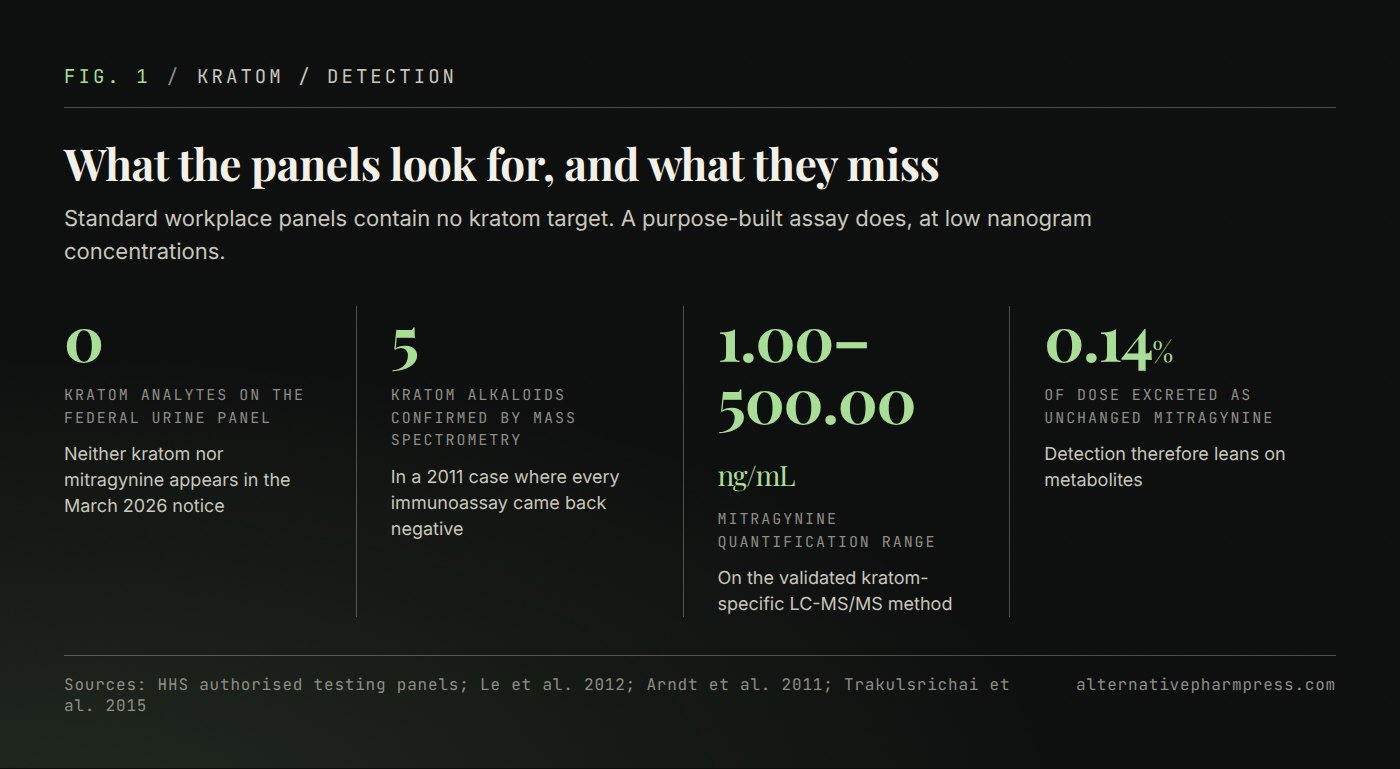
No. Most US workplace testing follows the federal template. The current urine panel, restated by HHS in March 2026, covers the marijuana metabolite, the cocaine metabolite, codeine, morphine, hydrocodone, hydromorphone, oxycodone, oxymorphone, 6-acetylmorphine, PCP, fentanyl, norfentanyl and the amphetamines, including MDMA and MDA. The oral fluid panel is similar. Kratom and mitragynine are not mentioned.1 Most private 5- and 10-panel tests follow that template.
There is a chemical reason too. Immunoassay screens use antibodies shaped to a specific structure. Mitragynine is an indole alkaloid, not a morphine-type molecule, even though it acts at the mu-opioid receptor. Similar effects do not produce cross-reactivity; similar shape does.
A German forensic case shows the gap. A patient’s urine was negative on immunoassays for opiates, oxycodone, methadone, buprenorphine, benzodiazepines, amphetamines and THC, yet LC-MS/MS on the same sample found five kratom alkaloids, including mitragynine. It also found about 9 mg/L of O-desmethyltramadol, a synthetic opioid apparently added to the herbal product.2
The same logic applies to other botanicals and cannabinoids. Our guide to whether CBD can make you fail a drug test explains why THC, not CBD, is the usual problem there.
Will kratom show up on a UA if the lab tests for it?
Yes. A urinalysis (UA) can find kratom when a kratom test is ordered, and there are two main kinds.
Kratom immunoassay screens
Thermo Fisher’s CEDIA Mitragynine assay screens urine at a 50 ng/mL cut-off and is labelled for criminal justice and forensic use only. In the maker’s data it matched LC-MS/MS results in 100 patient samples. It reacts strongly to mitragynine but only weakly to related alkaloids: cross-reactivity was 0.14% for 7-OH and 0.20% for paynantheine and speciociliatine.4 Labcorp describes an immunoassay screen with mass spectrometry confirmation, and Quest offers a mitragynine urine test with confirmation for clinical monitoring.9,5
Mass spectrometry (LC-MS/MS)
LC-MS/MS identifies each compound by its mass and fragments. A method published in 2012 quantifies mitragynine in urine from 1 to 500 ng/mL and monitors two metabolites and 7-hydroxymitragynine; it has been used in clinical and forensic work.3 Aegis Sciences now runs urine and oral fluid tests covering mitragynine, 7-OH and mitragynine pseudoindoxyl.6
Researchers have also found that two other alkaloids, speciociliatine and speciogynine, often exceed mitragynine in unhydrolysed urine, and that 7-OH appeared in 63% of the kratom-positive samples they studied.19
Who tests for kratom?
- Pain management and addiction treatment. Quest suggests testing pain patients with an inconsistent response to prescribed opioids, people who report self-detoxing, and new patients entering pain or substance use programmes.5 Swedish psychiatric and addiction services detected mitragynine in routine oral fluid samples, often alongside buprenorphine, loperamide and tapentadol.14
- Emergency, forensic and criminal justice testing. The commercial immunoassay is marketed for criminal justice and forensic use.4 Whether a particular probation or court programme adds it is set locally.
- Employers. Federally regulated programmes cannot add kratom on their own, because the panel is set by HHS.1 Private employers can buy add-on tests from commercial labs, but we found no data on how many do.
- The military. A Defense Department memorandum of 15 September 2025 prohibited all kratom, mitragynine and 7-OH products for service members from 31 December 2025, and the Army issued its own ban in June 2026.21,22 An Air Force notice says kratom will not produce a positive result on a routine DoD drug test, so the ban does not by itself mean routine testing.23
How long does kratom stay in your system?
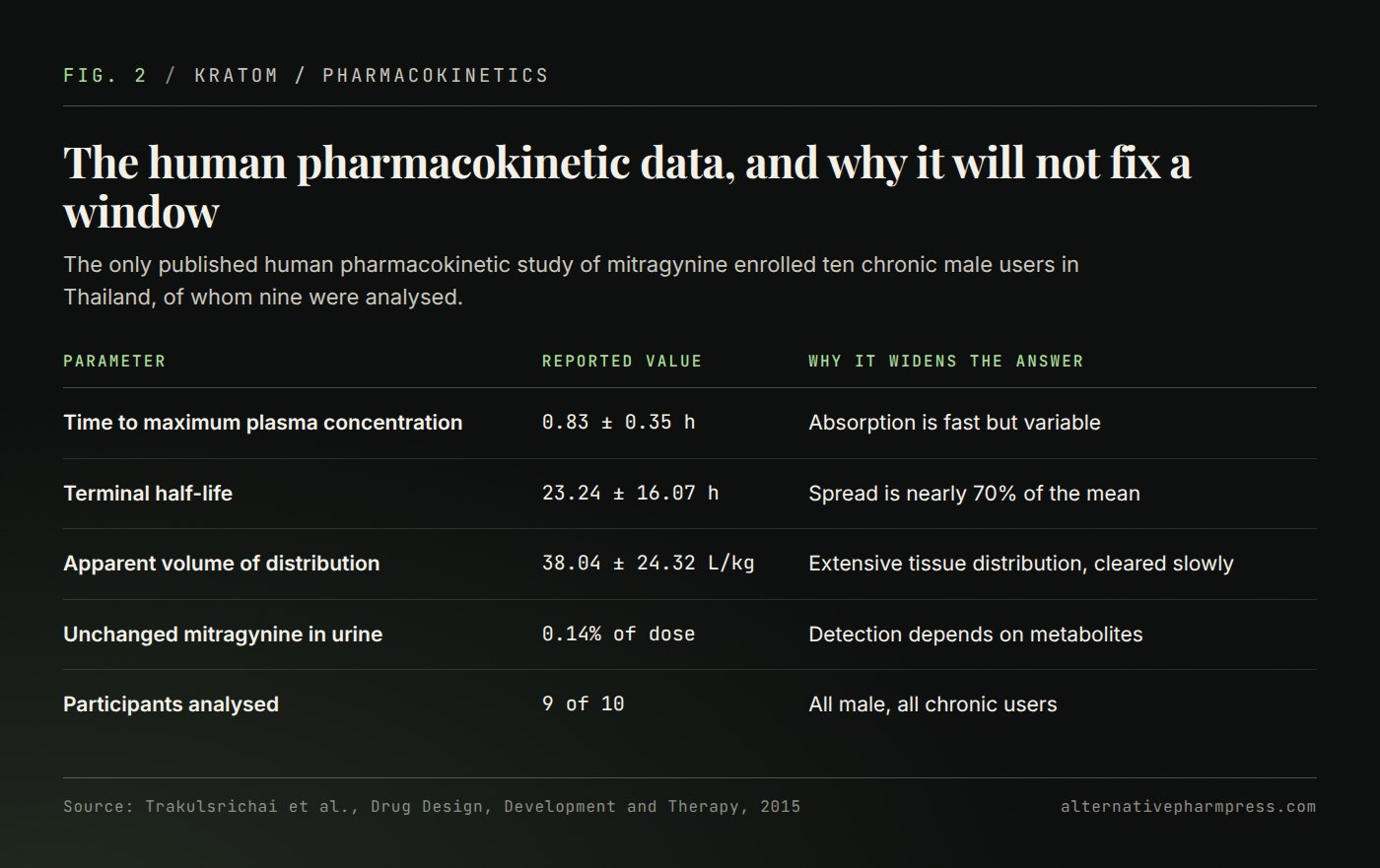
No study has followed people after a known dose and tested them until they turned negative, so no reliable detection window exists for any sample type. What exists are blood half-life studies and laboratory rules of thumb.
In the first human study, nine chronic male users in Thailand had a mitragynine terminal half-life of 23.24 ± 16.07 hours, and only 0.14% of the dose appeared unchanged in urine.10 In a 2024 controlled study of encapsulated leaf powder, the highest mean mitragynine half-life was 43.4 hours after one dose and 67.9 hours after 15 daily doses; for 7-OH it was 4.7 and 24.7 hours.11 That study was funded by a kratom company, and its authors consult for the industry.
A rough rule is that a drug is largely cleared after about five half-lives, which for mitragynine would be several days in a regular user. Detection also depends on dose, the lab’s cut-off and which metabolites are targeted, so this is an estimate, not a window.
Detection windows by sample type
| Sample | What sources report | Strength of evidence |
|---|---|---|
| Urine | Aegis: detectable for up to 5 days after use. APHL: 7-OH detectable for 1 to 9 days depending on use; no defined window for mitragynine7,8 | Laboratory guidance, not controlled studies |
| Blood | Detectable after intoxication; no defined window. Half-lives above suggest hours for 7-OH and days for mitragynine8,11 | Pharmacokinetic studies, small samples |
| Saliva | 48 hours or less7 | One laboratory’s guidance |
| Hair | Mitragynine 16 to 2,067 pg/mg in six Korean samples; 7-OH 0.34 to 15 pg/mg. A Swiss study found mitragynine but no 7-OH in 91 hair sections from a 3 g/day user12,13 | Method papers; no dose-time data |
Hair can record use over a longer period, but the Swiss and Korean results show that whether 7-OH is found depends heavily on the method’s sensitivity. For the 7-OH side of this question, see our detailed guide to how long 7-OH stays in your system.
Several things push detection longer or shorter: how much and how often someone uses, whether they take leaf or a concentrated extract, liver enzyme activity and interacting medicines, and the lab’s cut-off. Our guide to kratom and drug interactions covers the enzyme side.
Does 7-hydroxymitragynine show up on a drug test?
Only on a test designed to find it. 7-OH is not on standard panels.1 LC-MS/MS tests can measure it in urine and oral fluid.3,6
The bigger question is whether a kratom screen catches someone using a concentrated 7-OH tablet or shot. The mitragynine immunoassay reacts to 7-OH at only 0.14%, so a product that is mostly 7-OH may not trigger it on its own.4 Labcorp says its screen does not detect 7-OH directly but that commercial 7-OH products commonly contain mitragynine, which is usually enough for a positive, and that it rarely sees 7-OH without mitragynine.9 Aegis reports the opposite pattern in its own data: in an analysis of urine samples received from January 2025 to February 2026, it says 24% of positive samples were positive only for 7-OH or mitragynine pseudoindoxyl, use that a mitragynine-only test would have missed. Its overall kratom positivity rate, where testing was requested, was 1.8%.6
Clinicians reporting a case of dependence on a 7-OH sublingual film warned that standard lab testing can detect mitragynine but not 7-OH because of its shorter half-life, which can make 7-OH product use look like ordinary kratom use.18 For background on the two compounds, see mitragynine vs 7-hydroxymitragynine and how 7-OH products differ from traditional kratom.
Does mitragynine pseudoindoxyl show up on a drug test?
Not on a standard panel. Mitragynine pseudoindoxyl (MP) is a more potent opioid formed from 7-OH; in laboratory work, 7-OH converted into MP in human plasma far more than in animal plasma.20 Some labs now target it. Aegis includes MP in its urine test, and the Association of Public Health Laboratories lists it with mitragynine and 7-OH as a recommended analyte.6,8
MP is hard to measure. APHL notes that 7-OH and MP are isomers, so a test must separate them, and that 7-OH is unstable in whole blood because it converts to MP. In urine, 7-OH is stable for about 7 days refrigerated but loses more than half by 60 days, while MP is stable for over 30 days.8 A 2026 study of 38 commercial kratom products warned that relying on a single common mass transition can falsely identify 7-OH.24
Can kratom cause a false positive?
The evidence for false positives is thin. A 2020 conference abstract reported that kratom compounds appeared to cause false-positive results on one methadone-metabolite (EDDP) immunoassay. Of 48 qualifying urine samples, 24 contained mitragynine or 7-OH with no methadone or EDDP. Urine spiked with high concentrations of either compound gave indeterminate results, and the effect showed up after enzymatic hydrolysis.15 It involved one assay platform and has not been published as a full paper.
We found no published report of kratom alkaloids causing false positives on opiate or fentanyl immunoassays. Fentanyl screens do produce some false positives: in one emergency department study, rates were 1% and 3% for two FDA-approved assays, with no link to kratom reported.17 An unrelated research ELISA for mitragynine showed less than 0.01% cross-reactivity with codeine, morphine and methadone.25
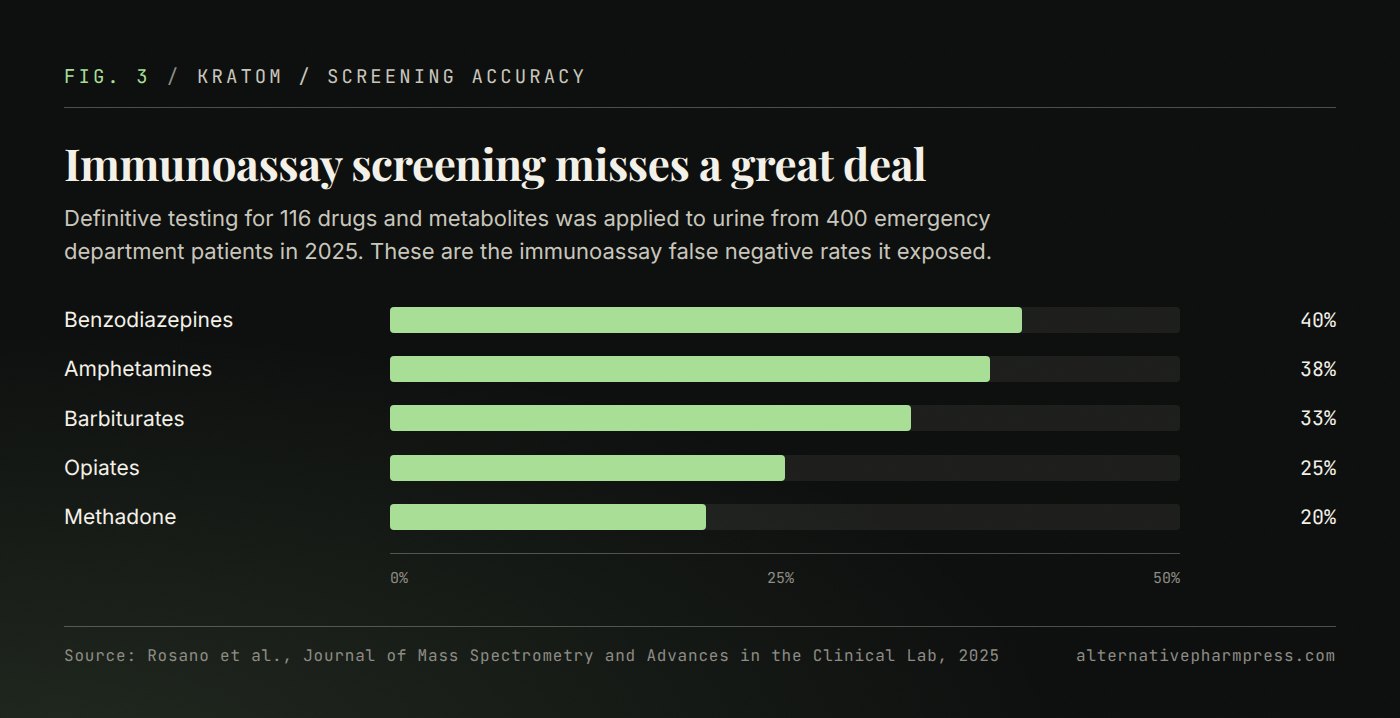
Two practical points follow. Any presumptive positive should be confirmed by mass spectrometry; a 2025 emergency department study found immunoassays missed 890 of 1,350 drug findings made by definitive testing.16 And a positive opioid result after kratom use may reflect something added to the product, as the O-desmethyltramadol case showed.2
Could a 7-OH product trigger an opiate screen?
It is not expected to, but no study has tested 7-OH products against opiate immunoassays directly. 7-OH shares mitragynine’s indole structure rather than the morphine skeleton those antibodies target. The bigger risk is the product, not the molecule: unregulated products have been found to contain undeclared synthetic opioids.2
What changes if 7-OH is federally scheduled?
On 14 October 2026 the DEA published a revised notice of intent to temporarily place 7-OH and mitragynine pseudoindoxyl in Schedule I above a threshold: more than 1 mg per gram or per millilitre, or a mitragynine-to-7-OH ratio below 100. The order cannot be published before 13 November 2026. Kratom leaf and mitragynine are not scheduled by it.26 Separately, mitragynine pseudoindoxyl and two synthetic 7-OH analogues (MGM-15 and MGM-16) have been temporarily in Schedule I since 26 August 2026.27 As of 24 October 2026, 7-OH itself is not federally scheduled. Our explainer on where 7-OH scheduling stands covers the threshold in detail.
For drug testing, scheduling would not automatically change workplace panels. The federal panel lists only drugs HHS has authorised, so 7-OH would need a separate HHS decision to be added.1 What scheduling is likely to change is demand: compliance programmes, courts, treatment services and private employers gain a reason to order kratom add-ons, and labs are already expanding their menus to include 7-OH and MP.6,8 State rules vary as well; see where kratom is legal in the US.
If you are worried about a test because you use 7-OH daily, stopping suddenly can bring withdrawal. Our guide to 7-OH withdrawal explains what case reports show, and a clinician can help plan a safer approach.
Frequently asked questions
Does kratom show up on a drug test?
Not on a standard 5- or 10-panel test or the federal workplace panel, which do not include kratom alkaloids.1 It does show up when a lab runs a kratom-specific test, either a mitragynine immunoassay or an LC-MS/MS method that can also detect 7-OH and mitragynine pseudoindoxyl. These are ordered deliberately, mostly in pain management, addiction treatment, forensic and criminal justice settings.4,6
Will kratom show up on a UA for probation or a job?
Only if the programme orders a kratom test. Federally regulated workplace tests cannot include it, because HHS sets that panel.1 Private employers, courts and probation services can add a kratom screen from commercial labs, and the main immunoassay is marketed for criminal justice use.4 If you are unsure, ask which panel will be used and declare any products you take.
Does 7-hydroxymitragynine show up on a drug test?
Not on standard panels. LC-MS/MS tests can measure it in urine and oral fluid.6 A mitragynine immunoassay barely reacts to 7-OH, at 0.14% cross-reactivity, so it may miss a product that contains little mitragynine.4 One lab reports that 24% of its positive urine samples showed only 7-OH or mitragynine pseudoindoxyl.6
Does mitragynine pseudoindoxyl show up on a drug test?
Only on a test that targets it. Some labs now include mitragynine pseudoindoxyl in kratom urine panels, and public health laboratory guidance lists it as a recommended analyte alongside mitragynine and 7-OH.6,8 It is an isomer of 7-OH, so the method must be able to separate the two. It has been temporarily in Schedule I since 26 August 2026.27
How long does kratom stay in your system?
There is no established window. Mitragynine’s half-life was about 23 hours in nine chronic users and up to 68 hours after repeated doses in another study.10,11 Laboratories quote urine detection of up to about 5 days, and 1 to 9 days for 7-OH, with saliva at 48 hours or less.7,8 Dose, frequency and the test’s cut-off all change the answer.
Can kratom cause a false positive for opiates or fentanyl?
It is not expected to. Opiate and fentanyl immunoassays target structures that kratom alkaloids do not share, and we found no published case of kratom causing either result. One conference abstract linked kratom compounds to false positives on a single methadone-metabolite (EDDP) screen.15 Any unexpected positive should be confirmed by mass spectrometry, which can also reveal adulterants.
Does kratom show up as an opiate on a drug test?
Usually not. Standard opiate immunoassays target morphine and codeine and don’t generally react to mitragynine. False positives have been reported rarely, and confirmatory lab testing can tell them apart.
Sources
- Substance Abuse and Mental Health Services Administration. Mandatory Guidelines for Federal Workplace Drug Testing Programs: Authorized Testing Panels. 91 FR 12308, FR Doc. 2026-04981. 13 March 2026. federalregister.gov
- Arndt T, Claussen U, Güssregen B, Schröfel S, Stürzer B, Werle A, et al. Kratom alkaloids and O-desmethyltramadol in urine of a “Krypton” herbal mixture consumer. Forensic Sci Int. 2011;208(1-3):47-52. DOI: 10.1016/j.forsciint.2010.10.025. PMID: 21112167. pubmed.ncbi.nlm.nih.gov
- Le D, Goggin MM, Janis GC. Analysis of mitragynine and metabolites in human urine for detecting the use of the psychoactive plant kratom. J Anal Toxicol. 2012;36(9):616-625. DOI: 10.1093/jat/bks073. PMID: 23024321. pubmed.ncbi.nlm.nih.gov
- Thermo Fisher Scientific. CEDIA Mitragynine Assay product specification (PS-FR-0380). March 2019. thermofisher.com
- Quest Diagnostics. Kratom has the potential for dependence and addiction (clinical testing guidance). January 2026. questdiagnostics.com
- Aegis Sciences Corporation. Kratom 7-hydroxymitragynine testing (urine and oral fluid; data on samples received 1 January 2025 to 15 February 2026). Accessed 24 October 2026. aegislabs.com
- Aegis Sciences Corporation. What Did My Patient Actually Take? An Overview of Kratom Alkaloids in Clinical Practice. 10 November 2025, updated 5 June 2026. aegislabs.com
- Association of Public Health Laboratories. Substance Awareness Bulletin: Kratom Alkaloids. June 2026. aphl.org
- Labcorp. Kratom and 7-hydroxymitragynine (7-OH): common provider questions. 4 June 2026. labcorp.com
- Trakulsrichai S, Sathirakul K, Auparakkitanon S, Krongvorakul J, Sueajai J, Noumjad N, et al. Pharmacokinetics of mitragynine in man. Drug Des Devel Ther. 2015;9:2421-2429. DOI: 10.2147/DDDT.S79658. PMID: 25995615. pubmed.ncbi.nlm.nih.gov
- Huestis MA, Brett MA, Bothmer J, Atallah R. Human Mitragynine and 7-Hydroxymitragynine Pharmacokinetics after Single and Multiple Daily Doses of Oral Encapsulated Dried Kratom Leaf Powder. Molecules. 2024;29(5):984. DOI: 10.3390/molecules29050984. PMID: 38474495. pubmed.ncbi.nlm.nih.gov
- Rhee J, Shin I, Kim J, Lee J, Cho B, Kim J, et al. LC-MS-MS method for mitragynine and 7-hydroxymitragynine in hair and its application in authentic hair samples of suspected kratom abusers. J Anal Toxicol. 2024;48(6):429-438. DOI: 10.1093/jat/bkae041. PMID: 38780234. pubmed.ncbi.nlm.nih.gov
- Meier U, Mercer-Chalmers-Bender K, Scheurer E, Dussy F. Development, validation, and application of an LC-MS/MS method for mitragynine and 7-hydroxymitragynine analysis in hair. Drug Test Anal. 2020;12(2):280-284. DOI: 10.1002/dta.2746. PMID: 31833662. pubmed.ncbi.nlm.nih.gov
- Axelsson MAB, Lövgren H, Kronstrand R, Green H, Bergström MA. Epidemiology of New Psychoactive Substances in Relation to Traditional Drugs of Abuse in Clinical Oral Fluid Samples. Basic Clin Pharmacol Toxicol. 2025;136(2):e14117. DOI: 10.1111/bcpt.14117. PMID: 39806572. pubmed.ncbi.nlm.nih.gov
- Pierre C, Gineste C, Bazydlo L. A Kratom Metabolite Causes False Positive Urine Drug Screening Results for Methadone (meeting abstract). Am J Clin Pathol. 2020;154(Suppl 1):S19-S20. DOI: 10.1093/ajcp/aqaa137.035. academic.oup.com
- Rosano TG, Islam SMT, Rumberger JM, Konetchy RM Jr, Wood M, Sorce JA, et al. Definitive urine drug testing in emergency medicine: Recreational and psychiatric drug findings. J Mass Spectrom Adv Clin Lab. 2025;37:16-27. DOI: 10.1016/j.jmsacl.2025.04.008. PMID: 40470103. pubmed.ncbi.nlm.nih.gov
- Mills CM, Dryja PC, Champion-Lyons E, Keppler C, Babic N. Performance of Fentanyl Immunoassays in an ED Patient Population. J Appl Lab Med. 2024;9(5):886-894. DOI: 10.1093/jalm/jfae022. PMID: 38517223. pubmed.ncbi.nlm.nih.gov
- Reif B, Adkins A, Boyer EW, Kanumuri SRR, Sharma A, Smith KE. Substance Use Disorder Following Consumption of a Novel Synthetic 7-Hydroxymitragynine Product. J Addict Med. 2025 (published online 5 November 2025). DOI: 10.1097/ADM.0000000000001603. PMID: 41189061. pubmed.ncbi.nlm.nih.gov
- Basiliere S, Kerrigan S. Identification of metabolites and potential biomarkers of kratom in urine. J Chromatogr B Analyt Technol Biomed Life Sci. 2020;1140:121971. DOI: 10.1016/j.jchromb.2020.121971. PMID: 32058315. pubmed.ncbi.nlm.nih.gov
- Kamble SH, León F, King TI, Berthold EC, Lopera-Londoño C, Siva Rama Raju K, et al. Metabolism of a Kratom Alkaloid Metabolite in Human Plasma Increases Its Opioid Potency and Efficacy. ACS Pharmacol Transl Sci. 2020;3(6):1063-1068. DOI: 10.1021/acsptsci.0c00075. PMID: 33344889. pubmed.ncbi.nlm.nih.gov
- Operation Supplement Safety (Department of Defense). Kratom and 7-OH: Significant Risks to Health. 7 October 2025. opss.org
- Stars and Stripes. Army bans kratom use, underscoring Pentagon’s prohibition of the drug. 1 July 2026. stripes.com
- Dyess Air Force Base. Reminder to Service Members: Kratom on DoD list of prohibited substances. Accessed 24 October 2026. dyess.af.mil
- Sheehan D, Li Y, Meckler E, Upton R, Zhang M. Avoiding False Identification of 7-Hydroxymitragynine in Kratom Products Using a Multicriteria LC-MS Confirmation. J Am Soc Mass Spectrom. 2026;37(5):1303-1312. DOI: 10.1021/jasms.6c00088. PMID: 41989479. pubmed.ncbi.nlm.nih.gov
- Lee MJ, Ramanathan S, Mansor SM, Tan SC. Development of an ELISA for detection of mitragynine and its metabolites in human urine. Anal Biochem. 2020;599:113733. DOI: 10.1016/j.ab.2020.113733. PMID: 32302607. pubmed.ncbi.nlm.nih.gov
- Drug Enforcement Administration. Schedules of Controlled Substances: Temporary Placement of 7-Hydroxymitragynine and Mitragynine Pseudoindoxyl Above a Specified Threshold in Schedule I. 91 FR 65370, FR Doc. 2026-20943, Docket DEA-1570. 14 October 2026. federalregister.gov
- Vicente LLP. DEA Places Three Kratom-Related Substances in Schedule I as 7-OH Scheduling Remains Pending. 9 September 2026. vicentellp.com
This article is for educational purposes only and is not medical or legal advice. Products discussed here are not intended to diagnose, treat, cure or prevent any disease. Laws vary by location and change often, so verify the rules that apply where you are. Always talk to a licensed healthcare provider before use, especially if you are under 21, pregnant or nursing, taking medication, or managing a health condition.