
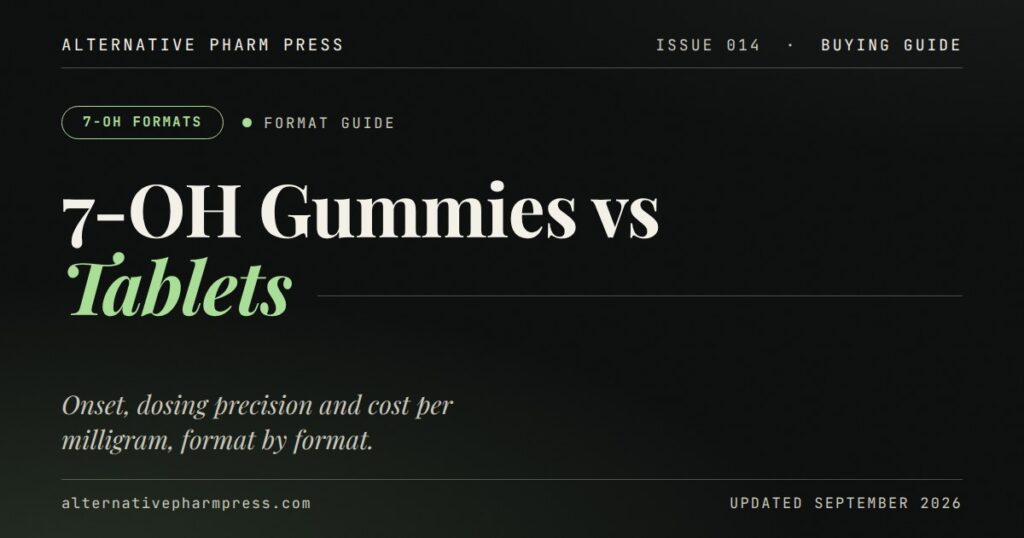
7-OH gummies and tablets contain the same opioid-acting alkaloid, 7-hydroxymitragynine, so neither format is safer. Tablets are easier to count but split unevenly. Gummies may be mixed unevenly and look like sweets, which raises the risk to children. No human study has measured onset for either, and most will exceed the DEA’s proposed 1 mg per gram limit.
An earlier version of this article recommended formats to new users on taste and cost. We have rewritten it. The FDA and the American College of Medical Toxicology (ACMT) both advise against using 7-OH,2,3 and we do not recommend a format to anyone starting out. This is harm-reduction information about dose accuracy, onset, child safety, dependence and the DEA’s 14 October 2026 notice.
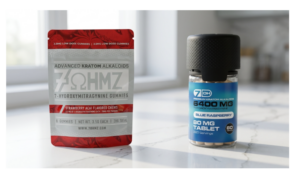
At a glance: 7-OH gummies vs tablets
| Property | 7-OH gummies | 7-OH tablets |
|---|---|---|
| Strength per unit | Varies widely; across 7-OH products DEA found 1 to 700 mg per serving1 | Same range |
| Label accuracy | 7-OH products have tested above label3 | Same concern |
| Even dose within a unit | Depends on mixing; untested for 7-OH | Better by design, but untested for 7-OH |
| Splitting | Cutting a gummy gives unknown amounts | Halves often unequal, especially unscored tablets5 |
| Onset and duration | No human data for 7-OH products | No human data for 7-OH products |
| Child-safety risk | Higher; looks and tastes like sweets2 | Lower, but still dangerous if swallowed |
| Dependence risk | Same as any 7-OH product3 | Same as any 7-OH product3 |
| Under the DEA threshold? | Most unlikely to be | Most unlikely to be |
What is in a 7-OH gummy versus a tablet
A 7-OH gummy is a gelatine or pectin sweet with 7-OH mixed in before it sets. A 7-OH tablet is a compressed pill, sometimes chewable. The alkaloid is the same in both.
Plain kratom leaf contains only trace amounts of 7-OH,1 so concentrated gummies and tablets deliver far more than the leaf does. The FDA has described 7-OH as an opioid that “can be more potent than morphine”.2 See mitragynine vs 7-hydroxymitragynine and 7-OH vs traditional kratom for the chemistry.
Dose-per-unit accuracy: can you trust the label?
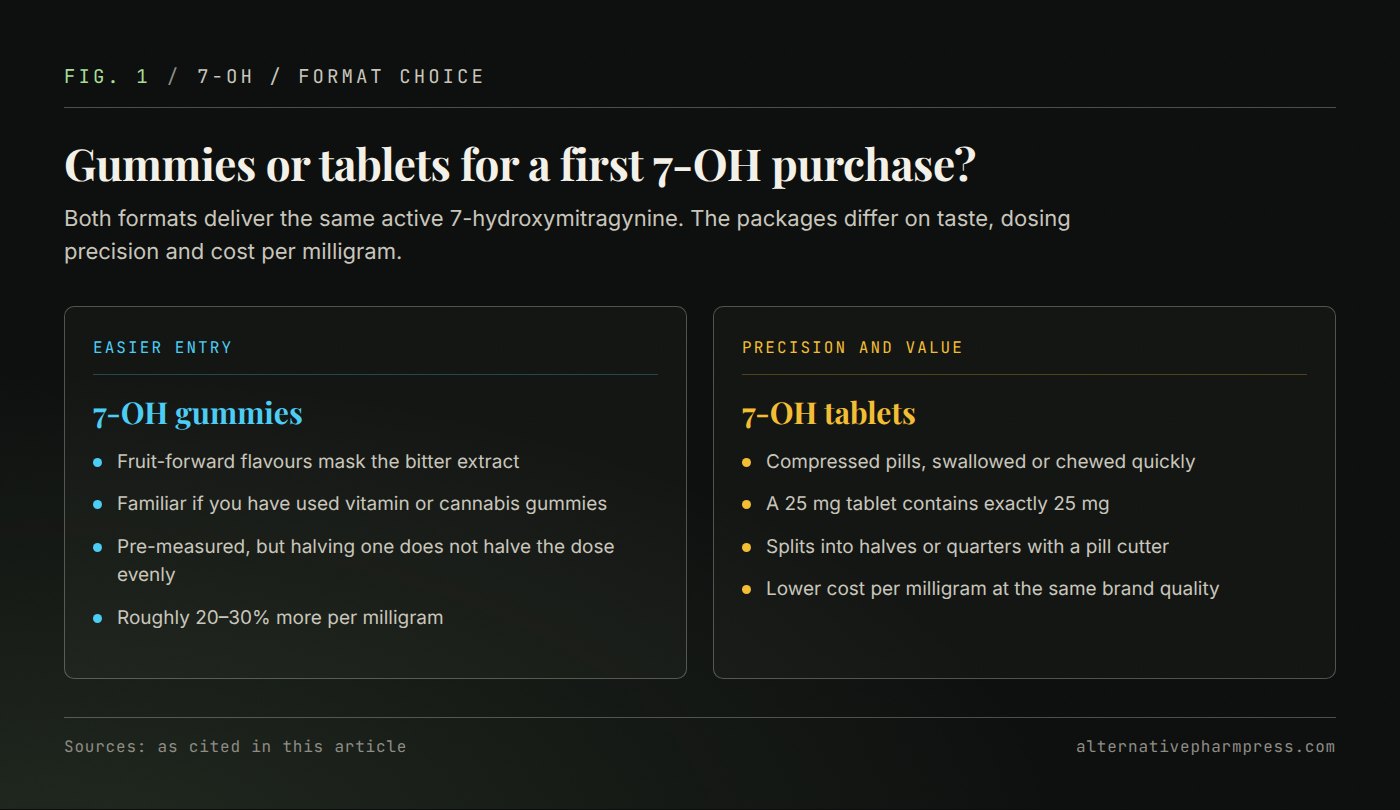
For 7-OH, the number on the pack is often unreliable. The ACMT notes that independent testing found 7-OH concentrations higher than the labelled content, and some products with profiles that suggested spiking with 7-OH.3 The FDA has warned that 7-OH products may be mislabelled as to their 7-OH content.2
Strength also varies enormously: the DEA reported 7-OH amounts from 1 mg to 700 mg per dose or serving across products it reviewed.1
Why gummies may vary more
We found no published test of 7-OH gummy uniformity. The closest evidence is from CBD gummies, made the same way: in a 2025 analysis of 56 products, 70% were more than 10% off label, and pieces from the same bottle varied by up to 27%.6 There is no reason to assume 7-OH gummies are mixed better, and a potent opioid leaves less room for error.
Tablets compressed from a well-blended powder tend to give more even units, but no independent data show how well 7-OH makers manage it. Our 7-OH tablets transparency ranking explains what batch testing should show, and red flags on a kratom COA applies to 7-OH reports too.
Splitting tablets vs cutting gummies
- Tablets. When nurses and members of the public split eight medicines, halves of five failed European Pharmacopoeia weight limits and about 10% of pieces were more than 25% off. Coated and unscored tablets split worst.5 A half tablet is not reliably half the dose.
- Gummies. Cutting a gummy divides its weight, not necessarily its 7-OH. If the alkaloid is unevenly distributed, two halves can differ, and gummies are hard to cut cleanly.
Neither format turns a high-strength unit into a reliable low dose.
Onset and duration: what the evidence does and does not show
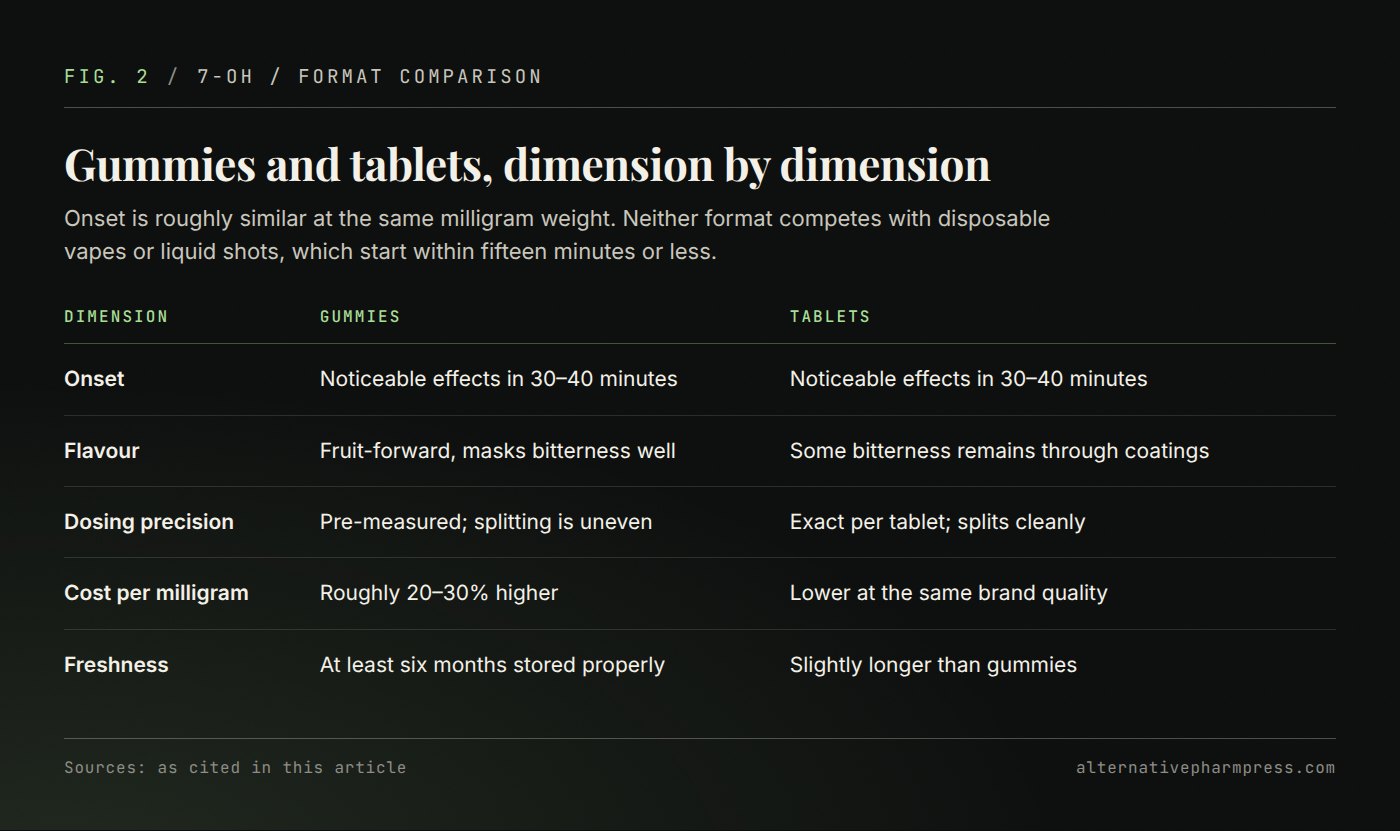
We found no human pharmacokinetic study of any 7-OH gummy or tablet, so seller onset times are not evidence-based. An earlier version of this article gave 30 to 40 minutes; we could not support that and have removed it.
The only controlled human data on 7-OH come from people taking kratom leaf, where 7-OH forms as a metabolite. In a 2024 dose-escalation trial of encapsulated leaf powder, 7-OH reached peak blood levels at a median of 1.2 to 2.0 hours. Its mean half-life was up to 4.7 hours after one dose and up to 24.7 hours after repeated daily dosing.4 Concentrated products, swallowed in far larger amounts, may behave differently.
In rats, only about 2.7% of swallowed 7-OH reached the bloodstream, but toxicologists note that high doses or absorption in the mouth could still produce significant exposure.3 Whether chewing changes absorption has not been measured.
The practical risk of an unknown onset is stacking: redosing because the first dose seems not to work, which with an opioid can lead to overdose. See our overview of 7-OH and the blood-brain barrier.
Child safety: why gummies carry the higher risk
When the FDA recommended scheduling 7-OH in July 2025, it singled out fruit-flavoured gummies as products that may appeal to children and teenagers, after warning seven companies selling 7-OH tablets, gummies, drink mixes and shots in June.2 The DEA also cites child-appealing packaging and sales without age limits.1
US poison centres logged a record 3,434 kratom-related reports in 2025, about 1,200% more than in 2015, though that analysis covered ages 12 and over and could not separate leaf from concentrates.8 In Georgia, the state poison centre reported a 400% rise in exposures among children aged five and under between 2024 and 2025, and pointed to kratom gummies and lollipops.7
If any 7-OH product is in a home with children:
- Keep it in child-resistant packaging, locked away.
- If a child may have swallowed some, call Poison Help on 1-800-222-1222. If the child is unresponsive, give naloxone if you have it and call 911.10
Dependence and tolerance apply to both formats
Format does not change the pharmacology. The ACMT links 7-OH to tolerance, dependence and opioid-like withdrawal, notes that buprenorphine and methadone have treated 7-OH dependence, and states that “no safe dose can be recommended”.3 The DEA notes preclinical evidence of tolerance, dependence and respiratory depression comparable to classic opioid painkillers.1
A sweet-like format may make regular use easier to underestimate. See our guides to 7-OH tolerance and 7-OH withdrawal symptoms and timeline.
The DEA’s October 2026 notice and the 1 mg per gram threshold
As of 24 October 2026, 7-OH is not federally scheduled. On 14 October 2026 the DEA published a revised notice of intent to place 7-OH and mitragynine pseudoindoxyl temporarily in Schedule I above a threshold. A product would be covered if it contains more than 1 mg of either substance, or both combined, per gram of a solid or per millilitre of a liquid. It would also be covered if its mitragynine-to-7-OH mass ratio is below 100. The order cannot be issued before 13 November 2026, takes effect when published, and has no comment period. The DEA states that products below the threshold are not deemed safe.1
Both formats are likely to exceed it. A 4 g gummy would need 4 mg of 7-OH or less to stay within 1 mg per gram, and most 7-OH gummies are sold at far higher doses. A small tablet labelled in tens of milligrams would be many times over. Products sold for their 7-OH will usually also fail the ratio test, which needs at least 100 times more mitragynine than 7-OH. These are worked examples, not product tests.
A separate DEA order placed mitragynine pseudoindoxyl, MGM-15 and MGM-16 in Schedule I from 26 August 2026 to 26 August 2028.9 See where DEA 7-OH scheduling stands and where kratom is banned in 2026.
For daily users, scheduling could cut supply suddenly. Talk to a doctor about tapering or treatment beforehand.
Frequently asked questions
Are 7-OH gummies stronger than tablets?
Not by format. Strength depends on the 7-OH in each unit, which ranges from about 1 mg to 700 mg per serving across products. A 30 mg gummy and a 30 mg tablet should match, but 7-OH products have tested above label, and gummies may vary between pieces.
Do 7-OH gummies or tablets work faster?
Nobody knows. No human study has measured onset for any 7-OH gummy or tablet. In people taking kratom leaf, 7-OH peaked at a median of about 1.2 to 2 hours, but concentrated products may behave differently. Because onset is uncertain, taking a second dose too soon can lead to taking far more than intended.
Is it safe to split a 7-OH tablet or gummy?
Splitting is imprecise. In a study of split medicines, halves of five of eight drugs failed weight limits, and about one piece in ten was more than 25% off, with unscored tablets worst. Cutting a gummy divides its weight, not necessarily its 7-OH. Neither gives a reliable small dose.
Are 7-OH gummies dangerous for children?
Yes. The FDA has warned that fruit-flavoured 7-OH gummies may appeal to children, and 7-OH is an opioid. Georgia’s poison centre reported a 400% rise in kratom exposures among children five and under between 2024 and 2025, linked partly to gummies. Store any product locked away and call Poison Help on 1-800-222-1222 after any exposure.
Will 7-OH gummies and tablets be illegal after the DEA order?
Most probably will be. The DEA’s 14 October 2026 notice would place products above 1 mg of 7-OH per gram, or with a mitragynine-to-7-OH ratio below 100, in Schedule I. The order cannot be issued before 13 November 2026. As of 24 October 2026, 7-OH is not yet federally scheduled, though some states already ban it.
Is 7-OH legal right now?
Federally, 7-OH was not yet scheduled as of 22 November 2026, but several states ban or restrict it, and the FDA has warned companies selling it. Check your state’s law and expect the federal position to change.
Sources
- Drug Enforcement Administration. Temporary placement of 7-hydroxymitragynine and mitragynine pseudoindoxyl in Schedule I (notice of intent). 91 FR 65370. 14 October 2026. federalregister.gov
- US Department of Health and Human Services. FDA takes steps to restrict 7-OH opioid products threatening American consumers. 29 July 2025. hhs.gov
- American College of Medical Toxicology. ACMT position statement: public health concerns associated with 7-hydroxymitragynine and other kratom compounds. August 2026. acmt.net
- Huestis MA, Brett MA, Bothmer J, et al. Human mitragynine and 7-hydroxymitragynine pharmacokinetics after single and multiple daily doses of oral encapsulated dried kratom leaf powder. Molecules. 2024;29(5):984. DOI: 10.3390/molecules29050984. PMID: 38474495. pubmed.ncbi.nlm.nih.gov
- Elliott I, Mayxay M, Yeuichaixong S, et al. The practice and clinical implications of tablet splitting in international health. Trop Med Int Health. 2014;19(7):754-760. DOI: 10.1111/tmi.12309. doi.org
- Johnson ED, Kilgore MW, Stafford M, et al. Cannabidiol gummy products: LC-MS/MS assessment of cannabinoid concentrations. Cannabis Cannabinoid Res. 2025;10(6):710-718. DOI: 10.1089/can.2024.0167. PMID: 40454463. pubmed.ncbi.nlm.nih.gov
- WSB-TV. Georgia Poison Center responding to surge in kratom-related calls. 31 March 2026. wsbtv.com
- Towers EB, Thomas YT, Holstege CP, et al. Increases in kratom-related reports to poison centers: National Poison Data System, United States, 2015–2025. MMWR Morb Mortal Wkly Rep. 2026;75(11):140-146. stacks.cdc.gov
- Vicente LLP. DEA places three kratom-related substances in Schedule I as 7-OH scheduling remains pending. 9 September 2026. vicentellp.com
- Cook Children’s. Texas kratom exposure spike prompts advice from Cook Children’s expert. 1 October 2025. checkupnewsroom.com
This article is for educational purposes only and is not medical or legal advice. Products discussed here are not intended to diagnose, treat, cure or prevent any disease. Laws vary by location and change often, so verify the rules that apply where you are. Always talk to a licensed healthcare provider before use, especially if you are under 21, pregnant or nursing, taking medication, or managing a health condition.