
Is 7-OH legal? Not federally scheduled yet, but close. As of 24 October 2026, a DEA order can take effect on or after 13 November 2026 placing 7-hydroxymitragynine above 1 mg per gram, or with a mitragynine ratio below 100, in Schedule I. By our count, 29 states and DC already ban or restrict 7-OH.1
That count covers three groups: states that ban all kratom, including 7-OH; states that allow plain leaf but ban or schedule concentrated 7-OH; and states whose Kratom Consumer Protection Acts cap how much 7-OH a product may contain. This page is about 7-OH tablets, shots, gummies and similar products. For plain kratom leaf, see our full guide to kratom laws by state.
Last updated 24 October 2026. Laws in this area change monthly; where we could not confirm a state’s rule we say so.
At a glance: is 7-OH legal in 2026?
| Question | Answer as of 24 October 2026 |
|---|---|
| Federally scheduled? | Not yet. Revised DEA notice published 14 October 2026; order possible on or after 13 November1 |
| Federal threshold | More than 1 mg/g (solids) or 1 mg/mL (liquids), or a mitragynine-to-7-OH mass ratio below 1001 |
| FDA position | Kratom and 7-OH are not lawful in foods or supplements; no approved product4 |
| States banning all kratom | 10 |
| Leaf legal, 7-OH banned or scheduled | 9 states plus DC |
| 7-OH capped by a KCPA | 10 states |
| Kratom leaf | Not covered by the federal order if below the threshold1 |
Federal status: the DEA’s 14 October 2026 notice
On 14 October 2026 the Drug Enforcement Administration published a revised notice of intent (FR Doc. 2026-20943, 91 FR 65370, Docket DEA-1570). It would temporarily place 7-OH and mitragynine pseudoindoxyl (MP) in Schedule I when either substance, or both combined:
- exceeds 1 mg per gram in a powder, capsule or other solid, or 1 mg per millilitre in a liquid; or
- is present at a level where the mass of mitragynine divided by the mass of 7-OH (or 7-OH plus MP) is less than 100.
The order cannot be published before 13 November 2026, takes effect on the day it is published, and lasts two years with a possible one-year extension. No comment period applies. The DEA says it intends to begin formal rulemaking for permanent control.1
The notice replaces a July 2026 proposal that used a 0.050% limit, which was withdrawn the same day. The threshold came from HHS, which said on 9 October that the ratio is designed to flag products “intentionally enhanced or concentrated” without scheduling natural kratom, in which 7-OH occurs only at trace levels.2 A separate DEA order has kept MP, MGM-15 and MGM-16 in Schedule I since 26 August 2026; the DEA plans to fold MP into the new threshold-based order.1,3
An illustration of how the ratio works, with invented numbers: a leaf powder with 15 mg of mitragynine and 0.05 mg of 7-OH per gram has a ratio of 300 and a concentration well under 1 mg/g, so it falls outside the order. A tablet with 15 mg of 7-OH and almost no mitragynine fails both tests. Our explainer on where 7-OH DEA scheduling stands works through more examples.
Two cautions from the DEA itself: products below the threshold should not be considered safe, and the federal action “does not preempt” stricter state law.1
7-OH banned states: the state-by-state table
The DEA’s notice lists 10 states that prohibit 7-OH consumption (Alabama, Arkansas, Connecticut, Indiana, Kansas, Louisiana, Massachusetts, Tennessee, Vermont and Wisconsin) and four that cap 7-OH as a share of alkaloids (Arizona, Colorado, South Carolina and Texas).1 We checked each against state sources and added states the DEA did not list. This table works as a text version of a 7-hydroxymitragynine legal states map.
| State | What the law does to 7-OH | Type |
|---|---|---|
| Alabama | Mitragynine and 7-OH in Schedule I since 20165 | Full kratom ban |
| Arkansas | Both in Schedule I by regulation since 20155 | Full kratom ban |
| Connecticut | Kratom and 7-OH in Schedule I, 20266 | Full kratom ban |
| Indiana | Both listed as synthetic drugs (Schedule I)5 | Full kratom ban |
| Kansas | Mitragynine and components including 7-OH in Schedule I from 1 July 20267 | Full kratom ban |
| Louisiana | Both in Schedule I from 1 August 20255 | Full kratom ban |
| Massachusetts | All kratom in Schedule I from 28 August 2026, up to one year8 | Full ban (emergency) |
| Tennessee | Any plant material or derivative containing mitragynine or 7-OH, from 1 July 20269 | Full kratom ban |
| Vermont | Both on the Regulated Drug Rule since 20165 | Full kratom ban |
| Wisconsin | Both in Schedule I since 20145 | Full kratom ban |
| Florida | 7-OH above 400 ppm in Schedule I since August 2025; related compounds added 2026; rule 2ER26-2 from 18 August 20265,10,11 | Emergency scheduling |
| Kentucky | 7-OH in Schedule I by regulation; 2% cap in the KCPA; all kratom sales banned from 1 July 202712,13 | Scheduling, then full sales ban |
| Ohio | 7-OH, MP, MGM-15 and other derivatives banned; extracts and blends banned; raw leaf legal14 | Pharmacy board rule |
| Virginia | HB 360 (2026) bans products containing 7-OH15 | Statutory ban |
| North Dakota | HB 1628 bans synthetic kratom including 7-OH, MP, MGM-15 and MGM-1616 | Statutory ban |
| Utah | Only pure leaf may be sold since 6 May 2026; extracts barred17 | Leaf-only rule |
| West Virginia | Chemically concentrated or synthetic products excluded from the legal “kratom product” definition since June 202618 | Statutory exclusion |
| California | Health department says kratom and 7-OH products are illegal to make or sell for consumption19 | Food and drug law |
| Missouri | Attorney general says high-potency 7-OH is illegal after the state adopted MGM-15’s Schedule I listing in September 202620 | Enforcement position (untested) |
| District of Columbia | 7-OH in Schedule I by regulation since 2016; mitragynine not addressed5 | Scheduling |
| Arizona | 7-OH no more than 2% of alkaloids; synthetics banned5 | KCPA cap |
| Colorado | No more than 2%; synthetic and semi-synthetic alkaloids banned5 | KCPA cap |
| Georgia | No more than 0.5 mg 7-OH per gram or 1 mg per serving5 | KCPA cap |
| Maryland | No more than 2%; synthetics banned5 | KCPA cap |
| Mississippi | No more than 1% of alkaloids and 0.5 mg per container5 | KCPA cap |
| Nebraska | Registered products need a lab report showing 7-OH below 2%5 | KCPA cap |
| Oklahoma | No more than 1% of total alkaloids5 | KCPA cap |
| Rhode Island | No more than 0.5 mg/g, 1 mg per serving or 1% of alkaloids21 | KCPA-type cap |
| South Dakota | No more than 2%; synthetics banned5 | KCPA cap |
| Texas | No more than 2% of alkaloids; enforced through lawsuits in 20265,22 | KCPA cap |
Three notes on the table. South Carolina is on the DEA’s cap list, but the state’s 2025 act as summarised by LAPPA bans synthetic alkaloids and requires labelling without a percentage cap, so we have not counted it; treat its cap as unconfirmed.5 Pennsylvania’s HB 2657, which would ban synthetic kratom compounds, passed the House on 5 October 2026 but is still in a Senate committee.23 And states not listed are not necessarily permissive: from the date of the federal order, products above the threshold will be Schedule I everywhere.
Where is 7-OH illegal even though kratom is legal?
This is the group buyers most often get wrong. In Florida, Kentucky (until its 2027 sales ban), Ohio, Virginia, North Dakota, Utah, West Virginia, California, Missouri and DC, plain leaf can be legal while 7-OH products are not.
Florida
Florida was first. An attorney general’s emergency rule effective 19 August 2025 made 7-OH above 400 parts per million (dry weight) Schedule I.5 A June 2026 rule added MP, 7-acetoxymitragynine, MGM-15, MGM-16 and two other compounds, with the 1 mg per gram and ratio-of-100 limits the DEA later adopted, and penalties of up to 30 years in prison.10 Rule 2ER26-2 superseded it on 18 August 2026.11 The legislature dropped a bill to make 7-OH’s scheduling permanent in March 2026.24
Ohio
The Board of Pharmacy’s emergency rule of 12 December 2025 became permanent on 19 May 2026. It bans 7-OH, MP, MGM-15 and 7-acetoxymitragynine along with extracts and tinctures; blended products have been illegal since 4 August 2026 after a court case. Natural leaf and plain powder remain legal.14
Virginia, North Dakota and Utah
Virginia’s HB 360, signed in May 2026, bans 7-OH products, sets the age at 21 and requires labels warning that kratom may cause dependence and opioid-like withdrawal.15 North Dakota’s HB 1628, signed on 4 September 2026, bans synthetic kratom and pauses all sales until licensing rules are adopted.16 Utah has allowed only pure leaf since 6 May 2026.17
Kentucky and Missouri
Kentucky’s health cabinet finalised a regulation listing 7-OH in Schedule I, and the legislature has since voted to ban all kratom sales from 1 July 2027.12,13 Missouri has no kratom statute, but in mid-October 2026 the attorney general widened a 7-OH investigation to nine more companies and ordered two to stop selling.20 Kansas City, Missouri, banned synthetic kratom products including 7-OH in February 2026.25
How 7-OH caps work in KCPA states
Most KCPA laws cap 7-OH as a share of the product’s alkaloid fraction, usually 2%, rather than in milligrams. That makes them hard to compare with the federal test, which uses milligrams per gram and a ratio to mitragynine. A product can pass a 2% state cap and still fail the federal ratio: if mitragynine makes up 66% of the alkaloids and 7-OH 1.5%, the state cap is met but the ratio is 44, below 100. That example is illustrative, not a real product.
Caps also depend on enforcement. Texas, for example, sued a retailer in 2026 after testing found 7-OH at 86% to 96% of total alkaloids.22 Our KCPA explainer covers each state’s rules, and our guide to reading a kratom lab report shows how to check 7-OH content per gram.
States where kratom leaf is banned
Ten states ban kratom itself, so 7-OH is illegal there too: Alabama, Arkansas, Connecticut, Indiana, Kansas, Louisiana, Massachusetts (temporarily), Tennessee, Vermont and Wisconsin.1,5 Rhode Island left this list on 1 April 2026 when its licensed market opened.21 Our pillar guide to where kratom is legal covers every state and DC, local bans and driving laws.
What happens after federal scheduling
Once the order is published, 7-OH and MP products above the threshold become Schedule I substances nationwide on that day. Schedule I substances can be handled lawfully only in federally approved research, and anyone handling them other than an end user must register with the DEA; unauthorised manufacture, distribution or possession is a federal crime.1,26
Several things will not change. Leaf and other products below the threshold stay federally unscheduled, though the FDA still considers kratom unlawful in foods and supplements.4 State bans stay in force, because the DEA’s action does not override stricter laws. Some states are ready to mirror the order: Missouri’s health department has said it would file an emergency rule if the DEA acts.27
The temporary order runs for two years, with a possible extra year, while the DEA pursues permanent scheduling through formal rulemaking.1 Temporary scheduling orders are not subject to judicial review.26 Our kratom regulation roundup tracks each step.
How to check a product before you buy
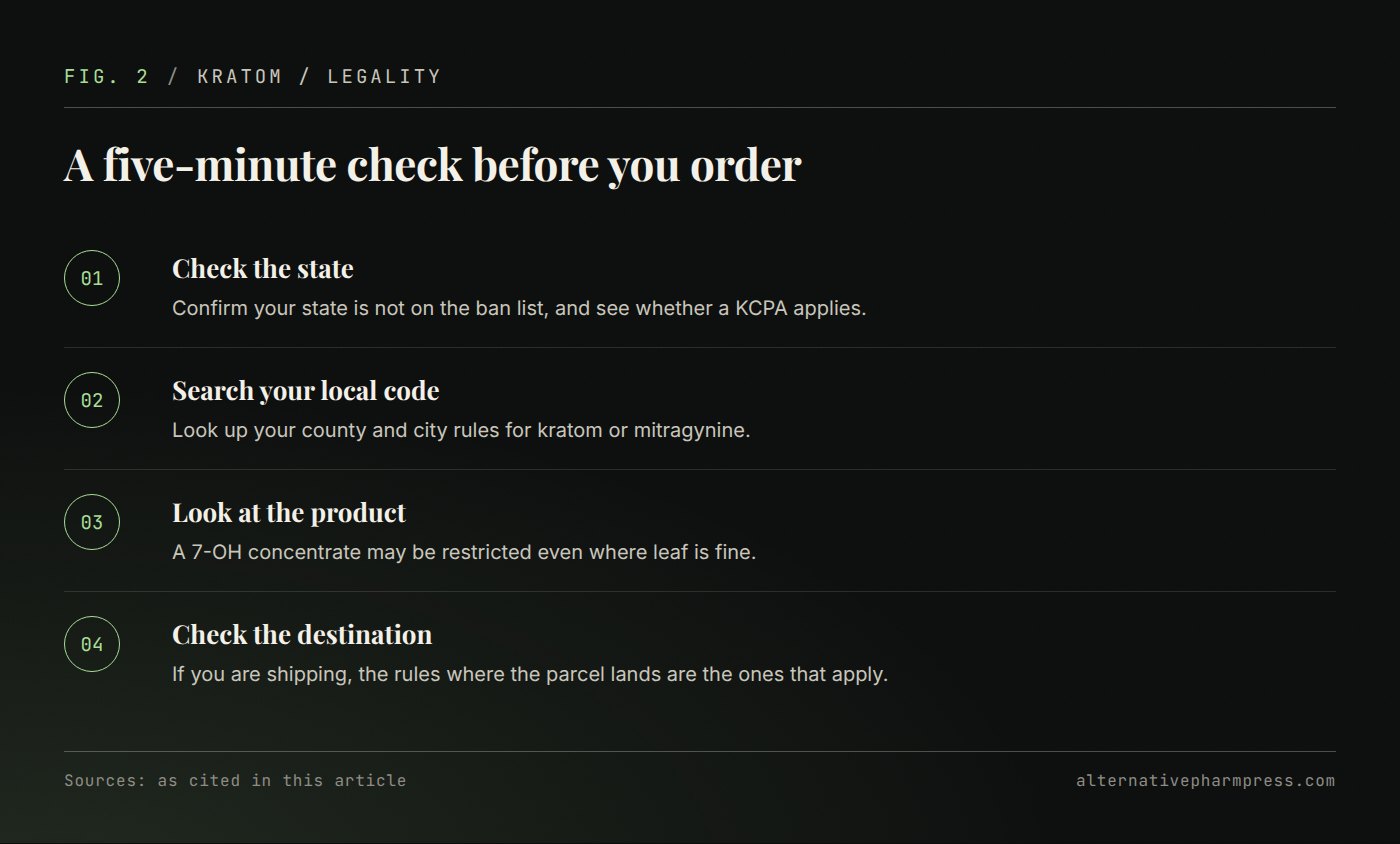
Check your state in the table above, then your county and city code, since local bans on 7-OH are spreading. Then check the product itself: ask for a batch certificate of analysis that reports both mitragynine and 7-OH in milligrams per gram, and work out the ratio. Our guide to red flags on a kratom COA lists what to look for, and our best kratom brands of 2026 guide covers leaf vendors that publish lab data.
Dependence, withdrawal and getting help
7-OH acts on the same mu-opioid receptor as morphine and is substantially more potent there than mitragynine, according to the FDA.4 Regular users can develop tolerance and dependence, and stopping suddenly, which may happen when shops clear their shelves, can cause opioid-like withdrawal; Virginia now requires a warning to that effect on kratom labels.15
If you use 7-OH daily, talk to a doctor before supply runs out rather than after. Our guide to 7-OH withdrawal covers symptoms and treatment options, and our article on how long 7-OH stays in your system covers detection times. The SAMHSA National Helpline, 1-800-662-4357, is free, confidential and open 24 hours a day, every day.28
Frequently asked questions
Is 7-OH legal?
Not for much longer at the federal level. As of 24 October 2026, 7-OH is not yet a federally controlled substance, but a DEA order can take effect on or after 13 November 2026 placing products above 1 mg per gram, or with a mitragynine ratio below 100, in Schedule I. By our count, 29 states and DC already ban or restrict it.1
What are the 7-OH banned states?
Ten states ban all kratom, including 7-OH: Alabama, Arkansas, Connecticut, Indiana, Kansas, Louisiana, Massachusetts, Tennessee, Vermont and Wisconsin. Florida, Kentucky, Ohio, Virginia, North Dakota, Utah, West Virginia, California and DC ban or schedule 7-OH products while leaf is treated differently, and Missouri’s attorney general treats high-potency 7-OH as illegal.1,5
Where is 7-OH illegal if kratom is legal?
In Florida, Ohio, Virginia, North Dakota, Utah and West Virginia, natural leaf can be sold to adults but concentrated or synthetic 7-OH cannot. DC schedules 7-OH but not mitragynine. Ten more states cap 7-OH under KCPA laws, usually at 2% of total alkaloids, far below the 86% to 96% Texas found in products it sued over.5,22
When does the federal 7-OH ban start?
The DEA’s revised notice says the temporary order cannot be published before 13 November 2026 and takes effect on the day it is published. It will last two years, with a possible one-year extension, while the DEA pursues permanent scheduling. As of 24 October 2026 the order had not been published.1
Will the 7-OH ban affect kratom leaf?
Not directly. The threshold is designed to exclude natural leaf, in which 7-OH occurs only in trace amounts, and mitragynine is not being scheduled. A leaf product enhanced with added 7-OH could fail the ratio test. Leaf is still banned under state law in 10 states.1,2
What should I do if I depend on 7-OH?
Talk to a doctor or addiction specialist now, before products disappear from shelves, because stopping suddenly can cause opioid-like withdrawal. Medical support can make tapering or switching safer. The SAMHSA National Helpline, 1-800-662-4357, offers free, confidential referrals 24 hours a day in English and Spanish.28
Is kratom legal in my state in 2026?
Kratom leaf isn’t federally scheduled, but several states ban it and many others regulate it with age limits and 7-OH caps. Cities and counties can add their own bans, so check both state and local rules.
Sources
- Drug Enforcement Administration. Schedules of Controlled Substances: Temporary Placement of 7-Hydroxymitragynine and Mitragynine Pseudoindoxyl Above a Specified Threshold in Schedule I (FR Doc. 2026-20943, 91 FR 65370, Docket DEA-1570). 14 October 2026. federalregister.gov
- US Department of Health and Human Services. HHS Recommends Science-Based Thresholds to Target Dangerous Enhanced Kratom Products. 9 October 2026. hhs.gov
- Vicente LLP. DEA Places Three Kratom-Related Substances in Schedule I as 7-OH Scheduling Remains Pending. 9 September 2026. vicentellp.com
- US Food and Drug Administration. FDA and Kratom. Updated 2 December 2025. fda.gov
- Legislative Analysis and Public Policy Association. Kratom: Summary of State Laws (laws in effect as of January 2026). 5 February 2026. legislativeanalysis.org
- Connecticut Department of Consumer Protection. Guidance for Businesses Regarding Controlled Substance Drug Schedule Updates. 4 March 2026. portal.ct.gov
- National Conference of State Legislatures. Lawmakers Weigh Guardrails, Bans on Kratom and 7-OH. 30 June 2026. ncsl.org
- Massachusetts Department of Public Health. Legal advisory: kratom (105 CMR 726.000). August 2026. mass.gov
- Metro Nashville Beer Permit Board. Metro Beer Permit Board Reminds Businesses of Tennessee Kratom Ban Effective July 1, 2026. 2026. nashville.gov
- The Capitolist. Florida moves to ban concentrated 7-OH products under emergency rule. 22 June 2026. thecapitolist.com
- Florida Department of Legal Affairs. Emergency Rule 2ER26-2: Addition of 7-Hydroxymitragynine (7-OH) and related substances to Schedule I. Effective 18 August 2026. flrules.org
- Kentucky Lantern. Omnibus bill would ban kratom sales, limit school levies and tax prediction markets. 1 April 2026. kentuckylantern.com
- Kentucky Revised Statutes § 217.2202, Kratom processors and retailers: prohibitions (effective 1 July 2027). apps.legislature.ky.gov
- Ohio Board of Pharmacy. Notice on kratom and 7-OH products under OAC 4729:9-1-01.1. Revised 5 October 2026. pharmacy.ohio.gov
- Virginia Mercury. Kratom product sales to be regulated in Virginia. 27 May 2026. virginiamercury.com
- Office of the Governor of North Dakota. Armstrong signs bill banning synthetic kratom, restricting natural kratom to 21 and older. 4 September 2026. nd.gov
- Utah Office of the Attorney General. New Kratom Law Now in Effect. 11 May 2026. ag.utah.gov
- West Virginia Legislature. Enrolled Committee Substitute for Senate Bill 985 (2026 Regular Session). Effective 12 June 2026. wvlegislature.gov
- California Department of Public Health. News release NR26-016 on kratom and 7-OH products. 1 May 2026. cdph.ca.gov
- KCTV5. Missouri AG expands 7-OH kratom investigation to 9 more companies. 15 October 2026. kctv5.com
- Rhode Island General Laws § 21-28.12-3. Kratom and kratom product limitations. Effective 1 April 2026. rilegislature.gov
- FOX 7 Austin. Texas sues Smokey’s Paradise over illegal kratom potency limits. 9 February 2026. fox7austin.com
- FastDemocracy. Pennsylvania HB 2657 (2025–2026): actions. Accessed October 2026. fastdemocracy.com
- WUSF. Synthetic opioid 7-OH has fuzzy future in Florida. 22 March 2026. wusf.org
- KCUR. Kansas City bans synthetic kratom and other gas station drugs. 13 February 2026. kcur.org
- Congressional Research Service. Temporary Control of 7-Hydroxymitragynine (7-OH) and Related Substances Under the Controlled Substances Act (LSB11457). 17 July 2026. everycrsreport.com
- Missouri Independent. Missouri AG bars St. Louis company from kratom sales as federal 7-OH ban looms. 7 August 2026. missouriindependent.com
- Substance Abuse and Mental Health Services Administration. SAMHSA’s National Helpline. Accessed October 2026. samhsa.gov
This article is for educational purposes only and is not medical or legal advice. Products discussed here are not intended to diagnose, treat, cure or prevent any disease. Laws vary by location and change often, so verify the rules that apply where you are. Always talk to a licensed healthcare provider before use, especially if you are under 21, pregnant or nursing, taking medication, or managing a health condition.